Blog

  • Surrealism Light Sculpture in Exhibitions Now

    Surrealism Light Sculpture in Exhibitions Now

    Surrealism light sculpture is a useful phrase for a cluster of exhibition choices visible in 2025 and 2026: dreamlike form, theatrical light, hybrid materials, and installations that ask viewers to read space as part of the artwork. The evidence does not prove one unified movement, and it would be too broad to say that every major exhibition has turned toward this mode. What the recent record does show is a meaningful overlap between surrealist imagery, sculptural lighting, and curatorial interest in atmosphere.

    That overlap matters to artists, galleries, and community arts organizers because light-based work is rarely just decorative in an exhibition setting. It can shape attention, produce shadows, suggest ritual, and change how people gather in a room. Surrealism, for its part, gives curators a language for dreams, hybrid bodies, myth, desire, and unstable perception. Put together, these approaches can move an exhibition away from a single object on a wall and toward an experience built from mood, memory, and material fact.

    What Surrealism Light Sculpture Signals In 2026

    Reading Surrealism Light Sculpture Through Evidence

    The term surrealism light sculpture should be used with care. A glowing sculpture is not automatically surrealist, and a surrealist exhibition does not necessarily depend on lighting technology. The connection becomes stronger when a work uses illumination to unsettle scale, suggest dream space, blur the line between utility and fantasy, or make familiar materials feel strange. That is why recent exhibition notes are best read as evidence of convergence, not as proof of a single art-market category.

    Several 2026 examples in the research record point in that direction. A major surrealism exhibition in Nashville, on view from May 22 to August 30, 2026, focused on the global reach of surrealism through paintings, film, photography, sculpture, and archival material. A New York exhibition of Leonora Carrington’s bronze sculptures ran from May 14 to July 25, 2026, centering mythological hybrid beings and including an AI-driven Tarot Reading Booth based on her deck. These examples show how surrealist presentation can now sit beside interactive formats and sculptural staging, though each show needs to be understood on its own terms.

    The Calendar Matters

    Dates are not a small detail in arts coverage. As of October 13, 2026, some exhibitions in the research record have already closed, while others have not yet opened. That distinction changes the responsible language. A past exhibition can be assessed retrospectively; a scheduled exhibition should be discussed as planned until it opens. For readers who use cultural writing to decide what to study, cite, or program locally, accurate timing protects both artists and audiences from confusion.

    It also keeps analysis grounded. A closed show can be discussed through its stated themes and documented presentation. A future show can be framed through the gallery’s announced details, without pretending that public reception or installation conditions are already known. That restraint is especially needed with light-based work, where the experience of scale, darkness, brightness, and proximity can differ sharply from a press description.

    Light As Object, Archive, And Social Memory

    Tom Lloyd’s Light Materials

    The strongest reminder that light sculpture has social and historical weight comes from Tom Lloyd. Tom Lloyd at Studio Museum in Harlem ran from November 15, 2025, to March 22, 2026, and surveyed the artist’s early light sculptures using materials such as Christmas tree bulbs and car tail-light lenses; the exhibition also placed his work in relation to Black visual culture and activism, according to the Tom Lloyd exhibition record. That history complicates any simple claim that light sculpture is mainly about spectacle.

    Lloyd’s materials matter because they connect illumination to everyday life. Christmas tree bulbs, tail-light lenses, and related components carry associations beyond the gallery: celebration, traffic, domestic ritual, street visibility, and manufactured color. In that context, light is not only an optical effect. It is a carrier of public and private memory. For community arts workers, this is a helpful lesson: the material source of a glowing object can shape how audiences understand its politics and emotional register.

    Alexandre De Betak’s Scheduled New York Exhibition

    A different case appears in Alexandre de Betak’s scheduled New York exhibition, TRUSS LIGHT SCULPTURES 01. Salon 94 Design states that the show is scheduled to open on November 5, 2026, and run through December 19, 2026; it is described as his first solo sculptural exhibition in New York and includes twelve works that combine industrial truss structures with lighting components, as noted by Salon 94 Design. Because the opening date had not arrived as of October 13, 2026, the prudent reading is prospective rather than retrospective.

    The announced premise is still significant. Truss structures usually belong to stages, concerts, fashion shows, and temporary production architecture. Presenting them as sculptural objects shifts attention from support system to artwork. That shift sits near the concerns of surrealism light sculpture because it can make backstage infrastructure appear uncanny: the equipment that usually frames performance becomes the figure under observation.

    Materials, Atmosphere, And Careful Claims
    Translucent sculptural lamps arranged on plinths with soft gallery shadows

    From Fixture To Spatial Encounter

    Research notes from 2026 design and art events point to sculptural lighting made with bio-plastics, beeswax, reconstituted leather, recycled wood dust, translucent stone, paper, glass, metal, and LEDs. The same notes identify weightlessness, transparency, layering, matte surfaces, and ethereal geometry as recurring design concerns. Those details suggest that many designers and artists are treating light as a spatial encounter rather than a fixture alone.

    The word “trend,” though, needs limits. Exhibition examples can show repeated interest, but they do not establish universal direction across all art institutions or all markets. A responsible account should separate three things: what a specific exhibition states, what several examples have in common, and what remains uncertain. That distinction keeps cultural criticism useful rather than promotional.

    • Look first at the stated dates, venue, artist, and materials.
    • Ask whether light is structural, symbolic, interactive, or mainly atmospheric.
    • Separate surrealist influence from general fantasy, theatricality, or design styling.
    • Avoid claiming a market-wide shift unless the evidence supports that scale.

    Why Communities Respond To Atmosphere

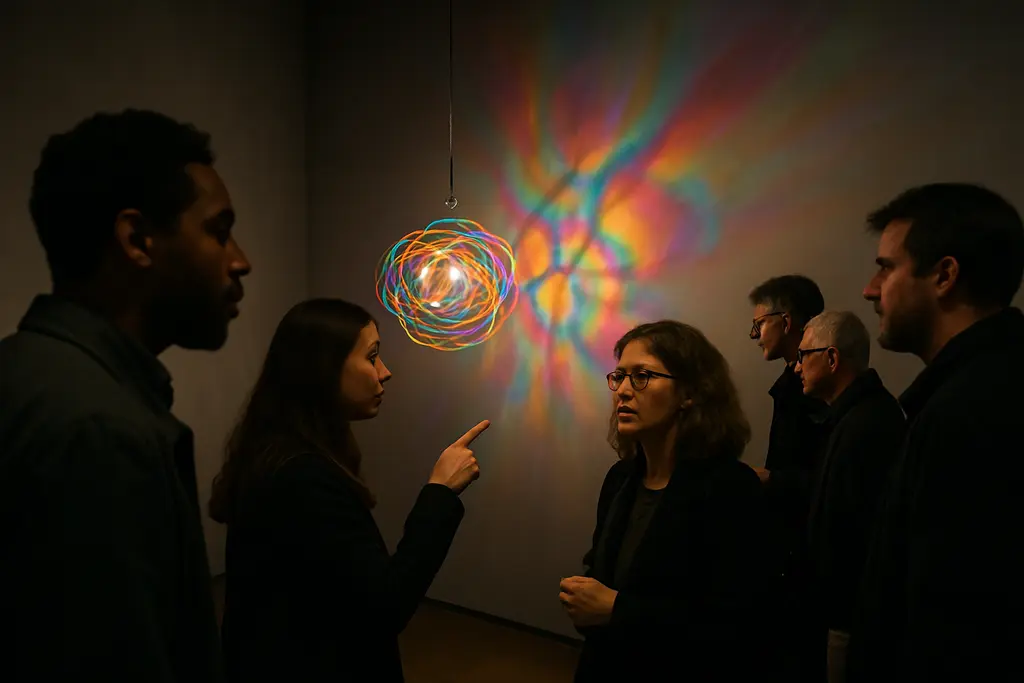
    Community response to light-based exhibitions often begins with the body. People slow down, adjust their distance, notice reflections, and become aware of other viewers moving through the same glow or shadow. That social dimension is one reason cultural organizers pay attention to light sculpture. It can create shared attention without requiring every visitor to arrive with the same art-historical background.

    Surrealist elements can intensify that shared attention. Hybrid forms, dream references, symbolic objects, and unexpected material pairings give visitors permission to speak from memory and association. This does not mean every interpretation is equally supported by the artwork, but it does mean the exhibition room can become a place where formal analysis and lived experience meet. For readers following connected cultural coverage through a related arts-and-culture network, the most useful conversations often start at a related arts-and-culture network site where community perspectives are highlighted.

    Surrealism Light Sculpture And Community Memory

    Surrealism light sculpture is most persuasive as an exhibition idea when it joins form with context. The formal side includes glow, shadow, scale, reflection, and unusual material combinations. The contextual side includes artist biography, cultural history, production systems, and the social life of objects. Tom Lloyd’s work shows how light materials can carry histories of Black visual culture and activism. De Betak’s scheduled exhibition suggests how theatrical infrastructure can be reframed as sculpture, pending the actual installed experience after November 5, 2026.

    For artists and organizers, the lesson is not to chase a label. It is to ask what light is doing in the room and whose memories, labor, or myths are being activated by that light. A strong exhibition can use illumination to make viewers feel suspended, unsettled, welcomed, or alert. A weaker one may rely on glow without giving the work enough conceptual or material grounding.

    The current evidence supports a careful claim: surrealist themes and sculptural lighting are meeting in notable exhibitions and design presentations during 2025 and 2026. The most thoughtful coverage should keep dates precise, credit artists accurately, and resist inflated language. That approach serves the communities who gather around art as much as it serves the artworks themselves.
  • Designing the Gilded Age: Met Highlights

    Designing the Gilded Age: Met Highlights

    As of October 12, 2026, Designing the Gilded Age is still ahead: The Met has scheduled the exhibition for October 22, 2026 through February 7, 2027 at The Met Fifth Avenue. For readers who care about art as a civic experience, the show offers more than a polished view of luxury design. It centers the drawings, studies, and workshop evidence that sit behind finished objects, giving visitors a clearer view of how artistic labor, studio systems, patronage, and public taste intersected around Louis C. Tiffany’s celebrated production.

    The exhibition is planned for Galleries 691–693 and will include nearly 120 works, including design drawings, working sketches, design watercolors, and select loans, according to The Met announcement. The museum says many of these works have rarely been displayed because of their fragility, and many have received recent conservation and scholarly study. That matters because drawings can shift the story from finished prestige objects toward process, collaboration, and decision-making inside a studio.

    Why Designing the Gilded Age Matters Now

    Designing The Gilded Age And The Working Drawing

    Decorative arts exhibitions often face a familiar tension: audiences admire the final object, while the preparatory materials that explain how it came into being remain in storage or are treated as secondary. This show appears to move those preparatory works to the center. Based on the museum’s description, the drawings are not simply illustrations of later glass, lighting, or interior work. They are evidence of artistic choice, revision, division of labor, and client-facing presentation.

    That focus is useful for community arts readers because it makes visible the labor structures behind beauty. A stained-glass window or lamp can be admired as a single object, but a studio object usually carries many hands within it. Drawings can show where a motif was tested, where scale mattered, where color and pattern were negotiated, and where the needs of a domestic, ecclesiastical, commercial, or public setting shaped the result.

    A Show Built Around Process

    The Met’s stated thematic organization covers domestic interiors, ecclesiastical settings, public and commercial commissions, and lighting design. That structure suggests an exhibition less concerned with a simple timeline and more concerned with how Tiffany Studios adapted design thinking across different social uses. A private interior does not ask the same things of an object as a church, hotel, public hall, or commercial site. In each setting, materials and motifs carry different expectations.

    For arts organizers, that framing is worth watching. It supports a broader conversation about how design circulates through shared spaces. Tiffany’s work has often been associated with elite interiors and collectors, but the research notes indicate that the exhibition will also address public and commercial commissions. That gives the show a wider civic lens, even while keeping its focus on the studio’s own materials and documented production.

    The Tiffany Studio Network On View

    Named Designers Beyond Louis C. Tiffany

    One of the strongest reported features is the attention to designers whose contributions have been underrecognized. The research notes identify Clara Driscoll, Agnes Northrop, Frederick Wilson, Jacob Holzer, and Julia Munson among the figures highlighted by the exhibition. That emphasis matters because Tiffany Studios was not only the expression of a single name. It was a working environment in which women designers and emigré designers contributed to the visual identity now associated with Tiffany.

    Care is needed here: the exhibition materials, not speculation, should guide how authorship is discussed. Still, the decision to foreground these figures can help visitors ask better questions. Who drew? Who translated designs into glass or metal? Who handled client expectations? Who shaped floral, figural, or architectural motifs? These questions do not reduce Louis C. Tiffany’s importance; they place him within a studio culture where credit, labor, and reputation were distributed unevenly.

    Media, Commissions, And Geography

    The works on view are reported to span roughly the 1890s through the 1920s, a period that allows the exhibition to follow Tiffany Studios across several decades and media. The research also notes designs connected with commissions in the United States, Canada, Mexico, Cuba, and Switzerland. That geographic range is significant because it shows the studio’s reach beyond a single New York story, while still requiring close attention to the particular commission contexts behind each work.

    For readers tracking the link between art and public life, that geographic spread raises useful interpretive questions. Did certain settings favor particular motifs? How did clients outside New York use Tiffany’s design language? What changed when work moved from domestic interiors to ecclesiastical or commercial projects? The exhibition may not answer every question fully, but the grouping described by The Met should create a stronger basis for asking them.

    The Window Reunion And Conservation Context

    A Rare Reunion Of Glass Elements

    A major loan will be the stained-glass window Woman in a Pergola with Wisteria from 1911, from the Chrysler Museum of Art. The research notes state that it will be shown with its original wisteria transom panels, which were recently rediscovered in a private Arizona home. The Met’s announcement says this marks the first time in at least 50 years that the window and transoms have been reunited.

    That kind of reunion is not merely a display event. It can affect how viewers understand scale, rhythm, and intended architectural setting. A panel separated from its related elements may still be beautiful, but the original ensemble can clarify how Tiffany Studios framed a scene, used repeated natural forms, and balanced vertical and horizontal components. For audiences, this can be a reminder that museum objects often arrive with interrupted histories.

    What Conservation Changes For Viewers

    The exhibition also draws attention to conservation and study. Many drawings described in the research have undergone recent conservation, which restored visual clarity and supported new scholarship. Because works on paper are sensitive to light and handling, their display tends to be limited. That scarcity can shape public memory: the objects most often seen are not always the objects most important for understanding process.

    Conservation, in this context, is not just repair. It is a form of access. When drawings can be stabilized, examined, and safely shown, audiences gain a fuller sense of decision-making within the studio. The cautious point is that conservation does not automatically settle every authorship question or interpretive debate. It does, however, create better conditions for evidence-based looking.

    Visitor Context At The Met Fifth Avenue

    Museum visitors moving through an American decorative arts gallery

    Dates, Galleries, And Admission

    According to visitor information reported by Metropolitan Museum coverage, the special exhibition is included with regular Met admission. The listed admission prices are US$30 for adults, US$22 for seniors 65 and older, US$17 for students, and free admission for children 12 and under. The same source notes that The Met is closed on Wednesdays. Because pricing and hours can change, visitors should verify details directly with the museum before making plans.

    • Exhibition dates: October 22, 2026 through February 7, 2027.
    • Location: The Met Fifth Avenue, Galleries 691–693.
    • Scope: nearly 120 works, including drawings, sketches, watercolors, and select loans.
    • Status on October 12, 2026: not yet open to the public.

    Permanent Displays That Add Context

    The temporary exhibition can be read alongside related permanent displays at the museum. The research notes identify the Worsham-Rockefeller Dressing Room in Gallery 742 of the American Wing, an original room from 4 West 54th Street dated 1881–82. They also identify Tiffany objects in Gallery 743, including a table lamp from about 1895–98, and the exotic loggia from Laurelton Hall, Tiffany’s Long Island estate, around 1905, in Gallery 701.

    These permanent displays are not described as part of the special exhibition, but they can deepen context for viewers who want to compare drawings, interiors, and completed objects. The distinction matters. A special exhibition can make a focused argument, while permanent galleries provide adjacent evidence. Holding those categories apart helps prevent overstatement while still encouraging a fuller museum visit. For readers who follow culture, public life, and arts coverage across our network, related civic arts writing can also be found at Kay Granger, a related site in the same network.

    Designing the Gilded Age For Community Arts Readers

    Designing the Gilded Age offers a promising case study in how museums can present decorative arts through labor, design practice, and attribution rather than spectacle alone. Its reported strengths are specific: a large group of drawings, a thematic structure tied to use, conservation-led access to fragile works, attention to underrecognized studio contributors, and the reunion of a major stained-glass window with its transoms.

    For community arts organizers, the exhibition’s value may lie in how it reframes creativity as collective work. The Tiffany name remains central, but the studio record points toward many forms of expertise: drawing, patterning, glass selection, metalwork, presentation, and installation. That is a useful model for talking about art beyond the single-genius frame, especially in local cultural settings where collaboration often sustains the work audiences eventually see.

    The strongest way to approach the show will be with attention to evidence. Look for what the drawings reveal, what labels attribute carefully, and where the museum signals uncertainty. If the exhibition succeeds on its own terms, it will not simply celebrate Gilded Age beauty. It will help viewers see how design ideas became objects, how studio labor shaped public taste, and why fragile paper records can change the way a community understands art history.

  • AI Copyright Lawsuit Stakes for Creators

    AI Copyright Lawsuit Stakes for Creators

    The AI Copyright Lawsuit debate moved from abstract worry to hard numbers during 2026. For artists, writers, musicians, costume makers, sellers, and community arts organizers, the issue is not only whether a model can generate a convincing image, lyric, melody, or design reference. The deeper question is who supplied the creative material, whether permission was given, and whether payment or credit can be traced back to the people whose work made the system useful.

    That concern deserves careful language. The reported cases do not create one settled rule for every artist or every tool. Some claims have settled, some lawsuits remain pending, and several arguments about training data, platform terms, and outputs still need court review. A cautious reading is still useful for creative communities because the legal filings and settlements show where pressure is building: documentation, licensing, compensation, and trust.

    Why The AI Copyright Lawsuit Wave Matters

    AI Copyright Lawsuit Signals For Artists

    The practical force of an AI Copyright Lawsuit is that it turns a private creative fear into a public record. On July 20, 2026, a U.S. judge granted final approval to a $1.5 billion settlement between Anthropic and a class of authors who accused the company of using books without permission to train Claude; Reuters described it as the largest known settlement in a U.S. copyright case to date Reuters report. A settlement is not the same as a final court ruling on every disputed legal theory, but the scale of the payment matters. It showed that creators’ objections to training data were not merely symbolic.

    For community arts groups, that distinction is worth repeating. A settlement can compensate a class, reduce business risk, and influence future licensing talks without telling every painter, poet, performer, or designer exactly how a future court will rule. Artists should not read one case as a universal answer. They can, however, treat it as evidence that recordkeeping and rights review are becoming more central to creative work.

    The Community Lens

    I often hear the same concern in local arts circles: people are not only asking whether AI tools are impressive. They are asking whether the tools were built in a way that respects living creative labor. That question runs through studio practice, music scenes, cosplay spaces, small-batch fashion, zines, and handmade markets. A maker who sells at a neighborhood fair may not use the same language as a record label, but the ethical worry can sound similar: was someone’s work taken into a system without consent?

    That is why creative communities should avoid both panic and complacency. Panic can lead to claims that are not supported by the record. Complacency can leave independent artists with little evidence if they later need to show what they made, where they posted it, or how it was licensed. The steadier response is cultural and practical: keep records, read platform terms, label collaborations clearly, and avoid presenting AI-assisted work as wholly handmade or wholly human-made if that is not true.

    What The 2026 Cases Have Already Put On Record

    Music Claims Put Training Data In Public View

    Music cases have given creators a particularly concrete view of the stakes. Sony Music Entertainment filed a lawsuit on July 21, 2026, against Udio, also known as Uncharted Labs, alleging that more than 30,000 recordings were scraped from YouTube for training and seeking up to $150,000 per infringed work Los Angeles Times coverage. Those are allegations in litigation, not findings of liability. Still, the filing illustrates why data provenance has become one of the central pressure points in disputes over generative tools.

    The research record as of October 11, 2026, also described separate music disputes involving lyrics, sheet music, and recorded works, with some parties settling and others continuing litigation. That mixed posture matters. It suggests that the industry is not moving through one single path. Some parties are negotiating licenses, some are pressing claims in court, and independent artists are seeking to test whether their own rights can be recognized in the same debate.

    Settlements Are Not The Same As Rules

    For creators, one of the easiest mistakes is to treat every headline as precedent. A large settlement may shape negotiations, but it does not necessarily answer how fair use, platform permissions, or output similarity will be judged in another case. A complaint can identify works and damages theories, but a complaint alone does not prove what happened. A licensing deal may bring payment, yet it can also raise a second question: who receives the money if the original performers, session musicians, songwriters, or visual contributors are not the same parties that control the catalog?

    That is why artists and cultural organizers should read the 2026 record as a set of signals rather than a closed rulebook. The strongest signal is that training data is no longer an invisible technical detail. Courts, labels, authors, artists, and unions are pressing for answers about what was used, where it came from, and who had authority to approve that use.

    How Creators Can Read The Signals Without Overclaiming

    A maker labels folders for drafts, licenses, receipts, and collaboration notes

    Documentation As Creative Care

    The most grounded step for independent creators is documentation. That does not mean turning every sketchbook, rehearsal, sample pack, costume fitting, or handmade prototype into a legal file. It means preserving dates, drafts, contracts, licenses, receipts, upload records, and collaboration notes where possible. Those records can support grant applications, gallery files, marketplace listings, band releases, and rights questions. They also help a community remember who contributed what.

    For artists who use AI tools in their own workflow, transparency can protect trust. If a poster, album visual, booth banner, costume concept, or product mockup used generative assistance, a clear internal note can prevent confusion later. Public disclosure norms vary by venue, platform, and audience, so a single rule would be too broad. Still, honest labeling is part of respect for buyers, collaborators, performers, and fellow makers.

    Licensing Questions For Makers And Performers

    Licensing is becoming more visible, but it is not always simple. A label, publisher, platform, performer, photographer, illustrator, choreographer, or craft collective may hold different interests in the same project. The reported disputes show why creators should be careful before assuming that an upload, a collaboration, or a distribution agreement gives every downstream user unlimited permission for model training.

    Costume and fantasy-fashion communities have long understood the complexities of inspiration and homage in creation. For those interested in this realm of creative culture, fairytale fashion projects serve as an insightful resource, highlighting that imaginative creation relies on a balance of reference and care. The same diligence should apply to AI-assisted work: ensure permissions are clear, and represent outputs transparently to avoid misleading others about authorship or affiliations.

    Music communities face a related problem. A rave flyer, sample-based track, DJ edit, or AI-assisted vocal idea may involve separate layers of authorship and permission. For a narrower music-law angle, NextClues has also examined the Suno Inc. case and the pressure it placed on AI music firms, labels, and artists. The shared lesson is not fear of new tools. It is respect for source material and clarity about rights.

    AI Copyright Lawsuit And Creator Practice

    The AI Copyright Lawsuit record on October 11, 2026, points toward a practical cultural ethic: document the work, credit collaborators, read licenses before relying on them, and avoid pretending that unresolved legal questions have already been fully answered. Artists should not have to become full-time legal analysts to make art. At the same time, creators who understand the basic shape of these disputes are better prepared to ask informed questions.

    For community organizers, the next responsible step is education rather than alarm. Workshops can teach artists how to preserve project records, discuss AI disclosure, and identify situations where professional advice may be needed. Panels can include musicians, visual artists, writers, sellers, and technologists without framing the debate as artists versus tools. The more useful frame is artists, audiences, and technology companies all being asked to account for the value of creative labor.

    The strongest creative communities I know are generous, but not careless. They share skills, remix references, celebrate influence, and protect one another from exploitation. The 2026 cases have not settled every question. They have made one point harder to ignore: creative work leaves traces, and those traces deserve respect when they are used to build new systems.

  • Collaborative Art at MOCA and REDCAT in Los Angeles

    Collaborative Art at MOCA and REDCAT in Los Angeles

    Collaborative art is a useful lens for reading the late-2026 programs at MOCA and REDCAT in Los Angeles, not because every project uses the same working method, but because both institutions are presenting exhibitions and events that depend on exchange across disciplines, archives, communities, and forms of knowledge. As of October 10, 2026, the key dates sit close together: REDCAT’s Flesh Witness is already on view, while MOCA’s Julian Charrière: Deep End is scheduled to open on November 15, 2026.

    The two programs are not interchangeable. MOCA’s announced exhibition centers an artist whose work, according to the museum, connects with marine scientists and coral restoration organizations. REDCAT’s exhibition, curated by GYOPO and Amy Kahng, addresses militarism in Asia and the Pacific through archival, memory-based, diasporic, Indigenous, and transpacific practices. A careful comparison shows how collaboration can function as method, subject, and ethical pressure rather than as a simple label.

    Why Collaborative Art Frames These Exhibitions

    Collaborative Art And Environmental Inquiry

    MOCA has announced Julian Charrière: Deep End as the inaugural Eric and Wendy Schmidt Environment and Art Prize exhibition, on view from November 15, 2026, through June 6, 2027, at MOCA Grand Avenue. The museum also identifies it as the French-Swiss artist’s first solo museum show in Los Angeles, a fact stated in MOCA’s exhibition announcement for Julian Charrière: Deep End.

    The research notes for the exhibition point to work with marine scientists and coral restoration organizations. That matters because scientific collaboration can change the role of the artist from solitary image-maker to investigator, editor, witness, and public translator. This does not mean that the exhibition should be reduced to science communication. It suggests that the artwork may be read through the friction between observation, environmental damage, and cultural imagination.

    In this setting, collaborative art does not simply mean several people making one object. It can also describe the chain of consent, expertise, field knowledge, and institutional support that allows an environmental artwork to exist. The cautious reading is to treat the museum’s stated partnerships as part of the work’s frame, while waiting for the exhibition itself to show how those relationships appear in space, image, sound, or material form.

    Archive, Memory, And Shared Witness

    At REDCAT, Flesh Witness runs from September 12 to December 13, 2026. REDCAT describes the group exhibition as curated by GYOPO and Amy Kahng, with artists addressing militarism in Asia and the Pacific through work grounded in archives, memory, and community-engaged methods. The venue’s listing for Flesh Witness places the exhibition within diasporic Asian Pacific Islander, Indigenous, and transpacific conversations.

    That framework shifts the meaning of collaboration toward responsibility. Archival and memory-based practices often involve more than gathering material; they can involve deciding how testimony, absence, family knowledge, and political injury are held in public. The research does not provide a full checklist of works or materials, so any claim about individual pieces would be premature. What can be said is that REDCAT’s framing treats shared memory and collective inquiry as central to the exhibition’s public meaning.

    Dates, Venues, And Program Relationships

    What Is Scheduled As Of October 10, 2026

    The calendar matters because several programs sit within a short period in Los Angeles. On October 10, 2026, REDCAT’s Flesh Witness was already open. MOCA’s Julian Charrière: Deep End had not yet opened and was scheduled for November 15, 2026. That distinction is necessary for temporal accuracy: one exhibition could be visited during that date window, while the other remained forthcoming.

    • September 12 to December 13, 2026: Flesh Witness at REDCAT.
    • October 17 to October 18, 2026: Democracy Sessions: Order and Its Others, presented by REDCAT in partnership with MOCA and Wild Up.
    • October 24 to October 25, 2026: As Ocean People: Symposium, Screenings, and Performance, tied to Flesh Witness and listed as free with RSVP in the research notes.
    • November 15, 2026, to June 6, 2027: Julian Charrière: Deep End at MOCA Grand Avenue.

    These dates show two kinds of institutional rhythm. REDCAT’s programming gathers exhibition, symposium, screenings, performance, music, and new work formats within a dense fall schedule. MOCA’s announced exhibition places environmental art inside a museum presentation with a longer run. The difference is not a hierarchy. It reflects how each institution can stage public attention: REDCAT through concentrated programs and live exchange, MOCA through extended exhibition time.

    Partnership Without Flattening Difference

    The research also identifies Democracy Sessions: Order and Its Others as a music and performance festival presented by REDCAT in partnership with MOCA and Wild Up, taking place on October 17 and October 18, 2026. That connection matters for readers tracking collaboration across institutions, yet it should not be used to merge all programs into one theme. A music-performance festival, a group exhibition on militarism, and an environmental museum exhibition each carry different stakes.

    For arts audiences, the productive question is not whether Los Angeles has a single institutional story. It is how these venues create adjacent spaces for artists, scholars, performers, and publics to test shared methods. Readers following related culture coverage across the same network can also find broader arts and creator-commerce context at Shimply, a related site in the same network.

    How To Read Collaboration Without Overstating It

    Audience members listening during an art symposium in a small theater

    Method, Subject, And Public Accountability

    Collaboration can be a visible method, as in a performance built through multiple bodies and voices. It can also be a subject, as in artworks that study the social relations behind archives, military histories, ecology, or displacement. In the MOCA and REDCAT examples, collaborative art appears to operate across both registers, though the exact balance will depend on the installed works and public programs.

    This distinction matters because arts writing can too quickly turn collaboration into praise. Working with others does not automatically make a project politically clear, ethically sound, or formally strong. The better critical question is more specific: who is invited into the process, what forms of knowledge are acknowledged, what remains unresolved, and how does the institution present those relationships to the public?

    For Deep End, the supported point is that the exhibition is connected to environmental inquiry and scientific partners. For Flesh Witness, the supported point is that the exhibition centers militarism in Asia and the Pacific through artists working with archives, memory, Indigenous knowledge, and community engagement. Those are strong frames, but they do not replace direct encounter with the works.

    Collaborative Art At MOCA And REDCAT

    The late-2026 programs at MOCA and REDCAT give Los Angeles audiences two carefully distinct views of collaborative art. One approaches environmental crisis through an artist’s museum exhibition shaped by scientific and restoration contexts. The other gathers artists and curators around memory, militarism, diaspora, and transpacific histories. Both suggest that shared practice is not a decorative add-on; it is part of how the work asks to be understood.

    The strongest reading, for now, is provisional. Flesh Witness was already on view on October 10, 2026, and Julian Charrière: Deep End was scheduled to open on November 15, 2026. Any fuller assessment should wait for the works, installations, and public programs themselves. What the announced facts already show is a serious institutional interest in art made through exchange: between artists and archives, artists and scientists, artists and communities, and museums and performance spaces.

  • Handmade Commerce Challenges In Community View

    Handmade Commerce Challenges In Community View

    Handmade commerce challenges are rarely only about sales. They touch studio time, material choices, local retail partnerships, fair pricing, and the fragile trust between makers and buyers. For community organizers, arts writers, and craft-market hosts, the question is not simply whether handmade goods can compete online. It is whether the systems around makers allow creative labor to be priced, presented, and understood without flattening the people behind it.

    The strongest available evidence points to pressure from several sides at once. In Spring 2026, Main Street America reported that 63% of surveyed small business owners named rising inventory, supply, or equipment costs as a major challenge, while 50% pointed to decreased customer spending. Among retailers in that survey, 48% named competition from Amazon and other online retailers as their third-greatest challenge, behind rising costs and lower customer spending, according to the Spring 2026 survey.

    Handmade Commerce Challenges In 2026 Context

    Why Handmade Commerce Challenges Feel Local

    Handmade sellers often sit at the point where cultural value and business math meet. A ceramicist, textile artist, jeweler, soap maker, or paper artist may sell through a local fair, a studio open house, a small retailer, an online marketplace, or some mix of those channels. Each setting changes the costs and expectations around the object. A booth fee is different from a wholesale margin. A direct conversation with a buyer is different from a product listing surrounded by mass-produced alternatives.

    That local character matters because handmade work is often part of community life. Markets bring foot traffic to neighborhoods. Gift shops can introduce visitors to regional materials or techniques. Workshops help people understand the time behind an object. Yet these cultural benefits do not remove the practical limits identified in the small-business data. If supplies cost more and shoppers spend less, the maker has fewer safe options: absorb the loss, raise prices, reduce production, simplify materials, or pause certain lines.

    Cost Pressure Is Not Aesthetic Failure

    One risk in public discussion is treating price increases as a weakness in the maker’s offer. That framing misses what the 2026 data suggests. Rising costs for inventory, supplies, or equipment were widely reported by small businesses, not only craft sellers. For handmade producers, those costs may include clay, fabric, findings, pigments, packaging, booth materials, display hardware, shipping supplies, and the tools needed to maintain quality. When those inputs rise, a higher shelf price may reflect continuity rather than expansion.

    This is where community-facing language can help. A market organizer does not need to expose a maker’s private finances. Still, programming, signage, and public education can remind buyers that handmade pricing includes materials, labor, skill, overhead, selling fees, and risk. That context respects artists without asking them to justify every dollar at the table.

    Market Access And The Scale Problem

    A Large Sector With Uneven Entry Points

    The scale of handmade and artisan goods can be easy to underestimate. A 2026 SEC filing for Handmade.com describes the handmade industry as a $900 billion market and names barriers including fragmentation, inefficiency, lack of market access, language, middle-men, and logistics in its offering memorandum. Because that source is a company filing, its framing should be read with care. Even so, the barriers it lists match many practical concerns heard around maker communities: reaching buyers, shipping reliably, communicating product value, and retaining enough margin after intermediaries take their share.

    Those pressures explain why handmade commerce challenges can look different depending on the seller’s stage. A part-time maker may need predictable local outlets and pricing confidence. A full-time studio may need wholesale accounts, batch planning, photography, customer service systems, and tax support. A cooperative or nonprofit shop may need enough foot traffic to serve artists without becoming inaccessible to the neighborhood it hopes to support.

    Trust Signals Need Careful Reading

    Market access also raises trust questions. Buyers want to know whether an item is genuinely handmade, whether product images represent the object, and whether the seller’s policies are fair. Makers want to know whether platforms, retailers, and event hosts will apply rules consistently. A related analysis of Handmade.com policies and maker trust is useful here because creator commerce depends not only on traffic, but on clear standards around originality, representation, and seller conduct.

    Community organizations can support trust without making claims they cannot verify. They can state how vendors are selected, whether resale is allowed, how complaints are handled, and what buyers should expect from custom work. Clear policy language does not make a marketplace perfect, but it gives artists and buyers a shared reference point.

    Community Strategy For Artist Support

    Small group watching an artist demonstrate a craft process at a community event

    Programming Can Reduce Misunderstanding

    Arts communities cannot control every cost, platform policy, or shift in consumer spending. They can influence how handmade work is interpreted. Demonstrations, artist talks, studio visits, and process photographs can show why two objects that look similar from a distance may differ sharply in time, skill, finish, and durability. This is especially useful when handmade work is placed near lower-priced goods that do not carry the same labor structure.

    Care is needed. Public programming should not pressure makers to perform unpaid education or reveal techniques they consider proprietary. Compensation, consent, and scheduling matter. A short paid demonstration may serve the community better than asking an artist to spend a full market day explaining process while also trying to sell.

    • Market hosts can publish vendor criteria in plain language.
    • Retail partners can identify handmade, small-batch, and resale goods without overstating claims.
    • Community groups can budget for paid artist talks rather than relying on exposure.
    • Buyers can be encouraged to ask respectful questions about care, materials, and production time.

    Pricing Conversations Should Protect Dignity

    Price is often the hardest public conversation. A customer may compare a handmade mug with a factory-made mug, or a hand-stitched accessory with a mass-market version. The comparison is understandable, but incomplete. Handmade commerce challenges include the labor of design, sourcing, failed tests, finishing, packing, bookkeeping, and customer communication. None of that labor is more visible simply because a seller is friendly at the booth.

    For cultural organizers, the answer is not to shame buyers. Many households face their own budget limits. A more useful approach is to create multiple points of participation: free talks, low-cost workshops where feasible, small goods alongside higher-priced work, and clear artist statements that explain process without turning the maker into a sales script. Related arts and culture coverage across the same network, including Robsonic, can help keep these conversations grounded in community rather than hype.

    Contextualizing Handmade Commerce Challenges

    The evidence available as of October 10, 2026 supports a cautious reading: handmade sellers are working within a difficult mix of cost pressure, buyer restraint, large-platform competition, and uneven access to markets. None of those forces erases public interest in handmade objects, but interest alone does not pay for materials, rent, labor, fees, or shipping.

    A respectful response starts with accuracy. Handmade commerce challenges should not be reduced to a simple story of makers needing better marketing or buyers needing more education. The research points to structural pressures shared by many small businesses, with added strain for artists whose value is bound to time-intensive work. Community institutions can help by presenting handmade goods with context, building fair participation rules, and treating creative labor as work rather than atmosphere.

    That approach keeps the focus where it belongs: on sustainable relationships among makers, buyers, shops, and cultural organizers. A community that understands the cost of handmade work is better prepared to support it without exaggeration, pity, or romantic myths.

  • AI Creator Commerce Strategies For 2027

    AI Creator Commerce Strategies For 2027

    AI creator commerce has shifted from an experimental talking point into a practical question for artists, makers, performers, educators, and community-centered sellers. The most useful evidence does not suggest that human creativity is being replaced. It suggests that creators are testing AI where it can reduce production friction, support audience growth, and help commerce sit closer to the creative work without erasing the artist’s judgment.

    That distinction matters for arts communities. A costume maker, print seller, music educator, gallery podcaster, or handmade-gift studio may not need a flashy automation stack. They may need clearer product descriptions, cleaner editing workflows, better scheduling, safer rights review, and more consistent ways to connect supporters with finished work. The stronger strategy is not “use AI everywhere.” It is to decide which parts of the business benefit from automation and which parts need visible human care.

    Why AI Creator Commerce Is Moving Into Workflows

    AI Creator Commerce Adoption Signals

    Adobe’s June 16, 2026 “Creators’ Toolkit Report,” based on a survey of more than 16,000 creators globally, found that 87% of creators using creative AI said it had accelerated growth of their business or audience, while 75% viewed AI as integrated or essential to their workflows, according to the Adobe report. Those findings are significant, but they should be read carefully. The statistic reflects creators already using creative AI, not every artist, seller, or cultural worker.

    For creator commerce, the value appears most plausible in repeatable support tasks: drafting captions, testing product-page language, sorting audience questions, preparing short-form edits, and summarizing campaign performance. These tasks can take time away from making, rehearsing, teaching, packing, or community programming. If AI reduces that administrative load, it may give small studios more room for work that cannot be automated responsibly: original design decisions, material choices, audience care, and cultural context.

    Where The Human Voice Still Carries Weight

    The cautious reading is that AI can assist the creator’s voice, but it should not impersonate community trust. A fan buying from a fiber artist, a cosplay pattern designer, or a local zine publisher is often responding to taste, process, and relationship. If an automated tool answers questions, recommends products, or drafts posts, the creator still has to decide whether the output sounds accurate and respectful.

    This is especially important in arts-adjacent commerce, where references can carry cultural meaning. A seller describing Indigenous-inspired patterns, sacred imagery, archival fashion references, rave visuals, or fan-made costume pieces must avoid vague claims and careless borrowing. AI may help organize language, but it cannot supply permission, provenance, or community consent.

    Strategies For Artists, Sellers, And Cultural Organizers

    Separate Creative Labor From Commerce Support

    A practical AI creator commerce plan begins by separating the work that defines the creator from the work that supports the shop. The first category includes original art direction, choreography, pattern drafting, music selection, styling, teaching, curation, and the choice of materials. The second category includes scheduling, formatting, basic customer-service triage, analytics summaries, and first-draft copy.

    Creators who make that separation can protect their identity while still gaining speed. For example, a handmade-gift seller might use AI to compare two versions of a product description for clarity, but still write the story behind the piece herself. A cosplay educator might use AI to outline a supply checklist, while personally verifying safety notes, measurements, and references. A community arts group might use AI to sort questions from event attendees, while a human organizer handles accessibility requests, artist concerns, and sensitive cultural issues.

    • Use AI for drafts, not final authority: Review factual claims, product details, dates, and prices before publishing.
    • Keep permissions visible: Track licensed assets, collaborator approvals, model releases, and music rights in a separate record.
    • Protect audience trust: If automation shapes recommendations or replies, consider clear disclosure where it affects the buyer relationship.
    • Measure time saved: A tool is useful only if it improves output quality, reduces strain, or strengthens sales without harming trust.

    Build Rights Review Into The Workflow

    Rights clearance should be treated as a standing part of creator commerce, not a last-minute worry. This is not legal advice, and no single article can decide whether a specific work, likeness, costume element, sound recording, or visual reference is cleared for sale. Still, creators can lower risk by keeping records of their own source material, licenses, collaborator agreements, and platform policies.

    AI tools can make this area harder if creators use them to imitate a living artist’s recognizable style, generate celebrity-like imagery, or create fan merchandise without permission. The safer strategic habit is to document what is original, what is licensed, what is public-domain after verification, and what should be avoided. For arts communities, this is also an ethical matter: credit, consent, and context help sustain the people whose work gives culture its depth.

    What The 2027 Market Projection Suggests

    Small studio desk with sales notes, laptop, and finished prints

    Growth Does Not Remove Pressure

    A securities filing cited in the research record projects that the creator economy will nearly double by 2027, according to an SEC filing. A projection is not a guarantee, but it does help explain why platforms, brands, and toolmakers are moving quickly around AI creator commerce. If more money flows through creator-led selling, the systems around discovery, attribution, recommendations, storefronts, and audience data become more contested.

    For small creators, growth can bring opportunity and strain at the same time. More commerce tools may lower barriers to selling prints, patterns, digital downloads, ticketed classes, styling guides, or limited merchandise. Yet the same tools can increase pressure to post more often, test more offers, respond faster, and package personality into sales channels. Artists who already balance studio labor with community presence may feel that tension sharply.

    Strategy Should Favor Stability Over Hype

    The best response is a measured strategy. A creator should ask whether an AI tool improves a specific business process, not whether it sounds advanced. Does it reduce missed messages? Does it clarify inventory planning? Does it make captions more accessible? Does it help compare which product photos explain the object best? Does it create a record that can be reviewed later?

    Community organizers can apply the same test. If a cultural market, gallery night, rave-adjacent vendor fair, or workshop series uses AI for promotion, the tool should support artist visibility rather than flatten it. Artist spotlights should still name materials, techniques, influences, and boundaries with care. For readers following public culture and civic life across this network, Kay Granger coverage offers related context on public-facing communication and community attention.

    AI Creator Commerce And Community Trust

    AI creator commerce will be judged not only by sales figures, but by how well it protects the relationship between makers and the people who support them. The available evidence from 2026 points to serious adoption among creators already using AI, and the 2027 projection points to continued commercial interest. Neither fact removes the need for human review, clear sourcing, rights care, and honest communication.

    For artists and cultural sellers, the durable strategy is modest but demanding: use AI where it helps the work reach people, reject it where it blurs authorship or consent, and keep the creator’s real practice at the center of the offer. Communities rarely gather around automation by itself. They gather around voice, skill, shared meaning, and trust.

  • Materiality in Art Across Two Solo Shows

    Materiality in Art Across Two Solo Shows

    Materiality in Art offers a useful way to read recent solo presentations by Sandra Vásquez de la Horra and Clotilde Jiménez because both artists make physical choices carry meaning. Their works ask viewers to look not only at figures, symbols, and stories, but also at paper, wax, charcoal, collage, folded structures, and the pressure of the hand. That attention matters in a gallery setting: surface and support are not passive containers. They help shape how memory, spirituality, family history, and embodiment become visible.

    The available exhibition records support a cautious comparison rather than a fixed ranking. Vásquez de la Horra’s recent solo shows emphasized drawing, paper, wax, and sculptural formats across several venues, while Jiménez’s recent and ongoing presentations foreground painting, collage, drawing, sculpture, and materials associated with domestic, familial, and cultural memory. Seen side by side, the two practices show how material decisions can act as evidence of care, friction, concealment, and repair.

    How Materiality in Art Shapes Recent Solo Shows

    Materiality in Art Through Paper, Wax, And Collage

    Recent exhibitions by Vásquez de la Horra make paper feel active rather than secondary. Her Denver Art Museum exhibition, The Awake Volcanoes, ran from April 7 to July 21, 2024, and is listed among her exhibitions on the artist’s official site exhibition archive. The research notes state that it presented nearly 190 works across drawings, paintings, and engravings, mapping a four-decade practice and marking her first solo exhibition in a U.S. museum. That scale matters because it placed repeated material choices in long view: graphite, watercolor, gouache, paper, and wax become a sustained vocabulary, not isolated effects.

    Here, Materiality in Art is tied to touch, preservation, and atmosphere. A review of Vásquez de la Horra’s work at ICA LA described works using beeswax-dipped paper, graphite, watercolor, gouache, and folded or three-dimensional paper structures CARLA review. The wax is especially significant because it changes both the look and the status of the sheet. It can deepen tone, soften edges, create a skin-like surface, and suggest an object that has been sealed, protected, or made ritual-like. The claim should stay close to what is visible and sourced: the material treatment does not prove one single meaning, but it strongly shapes how viewers encounter the images.

    Solo Shows As Material Case Studies

    Several recent Vásquez de la Horra exhibitions reinforce that point. The Murmur of the Cosmos at Akademie der Künste in Berlin ran from June 19 to August 25, 2024, and presented more than sixty drawings, photographs, and objects, according to the research notes. Those notes describe graphite, gouache, and pencil works followed by wax baths that gave surfaces a patina, with attention to large-format works. Soy Energía, shown at Haus der Kunst in Munich from November 14, 2025, to June 7, 2026, examined transnational and Indigenous perspectives through a retrospective view of more than forty years. Her São Paulo exhibition todo lo que vibra, at Gomide&Co from May 28 to July 18, 2026, brought together drawings from the previous five years and included works that extended drawing into folded, three-dimensional formats.

    Jiménez’s exhibition record offers a different route into material presence. Éramos silencios at Mariane Ibrahim in Chicago opened on September 16, 2026, and is scheduled through October 31, 2026, so it was ongoing on October 8, 2026. The research notes describe a focus on familial generational silence, identity, and memory, with painting, collage, drawing, and sculpture among the media. They also note an orange motif and the use of colored and translucent paper. Those details suggest an exhibition in which material layering is aligned with partial visibility: what is seen, what is muted, and what passes between generations.

    Sandra Vásquez de la Horra And The Weight Of Paper

    Wax As Surface And Threshold

    In Vásquez de la Horra’s practice, paper often appears to hold more than an image. Wax, folds, dense surfaces, and sculptural presentation give the sheet a bodily quality. That is not a decorative condition; it changes the viewer’s pace. A waxed drawing can ask for slower looking because light, opacity, and texture interfere with quick reading. The support becomes a threshold between image and object.

    The Denver, Berlin, Munich, and São Paulo exhibitions described in the research notes all point toward this expanded idea of drawing. A drawing can remain a drawing while also behaving like a relic, vessel, or folded structure. The São Paulo show is especially useful for this reading because it gathered works from the last five years and included formats that pushed drawing into three dimensions. Since the available notes do not provide a full checklist, it would be unwise to infer more than that. Still, the stated combination of body, nature, spirituality, and folded drawing gives enough basis to say that material form was part of the exhibition’s meaning.

    For educators, this is a strong teaching moment. Students often learn drawing as mark-making first, then paper choice later. Vásquez de la Horra’s recent exhibitions reverse that hierarchy. The paper, coating, fold, and surface treatment can be discussed as decisions with interpretive weight. A health-aware studio conversation might also include safe handling of wax, ventilation, posture during detailed hand work, and breaks for eyes and wrists. Those concerns do not reduce the art; they respect the labor behind it.

    Clotilde Jiménez And Collage As Memory

    Layering, Family Silence, And The Body

    Jiménez’s material language, as presented in the research notes, centers on painting, collage, drawing, and sculpture. His studio materials include charcoal, mixed-media collage, fabric, plastic, magazine cutouts, papel amate, wax-cast bronze, and ceramics. In Éramos silencios, the stated themes of familial generational silence, identity, and memory make collage especially resonant. Collage can hold fragments together without forcing them into a single smooth surface. That quality suits subject matter shaped by inheritance, silence, and partial recall.

    The exhibition The Contest, identified in the research notes as Jiménez’s first solo show with Mariane Ibrahim in Chicago, also foregrounded material presence through large-scale charcoal figures and collage using amate, wallpaper, and magazine clippings. The notes do not specify dates, so any time-based claim should remain limited. What can be said is that the use of charcoal and collage places drawing in conversation with found or culturally specific materials. Amate, described in the research as traditional bark paper, is not just a surface in that context; it carries material identity and cultural association that viewers should approach with care rather than flatten into texture alone.

    Orange, Translucency, And Partial Visibility

    The research notes for Éramos silencios mention an orange motif and colored or translucent paper. Without images or a full exhibition text in the approved sources, the safest reading is formal and thematic rather than definitive. Translucent paper can create overlap, filtering, and veiled visibility. In a show concerned with silence and memory, those properties may support a sense of information being present but not fully disclosed.

    That is where Jiménez’s material practice differs sharply from Vásquez de la Horra’s while still sharing a commitment to surface. Vásquez de la Horra often emphasizes sealed, waxed, folded, or patinated paper. Jiménez, based on the notes provided, builds through juxtaposition: charcoal, collage fragments, fabric, plastic, clippings, and sculptural media. One practice leans toward the charged sheet as object; the other toward assembled fragments that carry social and personal associations. Both resist the idea that an artwork’s support is neutral.

    What The Two Practices Ask Of Viewers

    Viewer standing quietly before mixed-media works in a gallery

    Slow Looking Without Style Imitation

    Comparing these artists can be productive, but it should not become a recipe for copying a living artist’s visual language. For students, makers, and sellers, the ethical lesson is to study principles rather than reproduce signature effects. Those principles might include how a surface slows perception, how fragments can hold memory, how sculpture can extend drawing, or how a material can signal care, pressure, or concealment. Any commercial use inspired by living artists should be approached with rights awareness and respect for authorship; this is a cultural and ethical caution, not legal advice.

    The comparison also reaches into costume, fashion, and handmade culture. Artists and designers who work with fabric, paper, masks, cosplay, or sculptural garments face related questions about surface and story. Readers interested in how material choices shape character, narrative, and embodied display might find Fairy Tale Fashion, a related arts-and-dress resource in the same network, to be of interest. The connection lies not in imitation, but in a shared focus on how materials convey meaning before verbal interpretation takes place.

    • Vásquez de la Horra: waxed paper, graphite, watercolor, gouache, folded formats, and sculptural drawing emphasize surface, seal, and objecthood.
    • Jiménez: charcoal, collage, fabric, plastic, papel amate, magazine cutouts, ceramics, and bronze point toward assembly, memory, and bodily presence.

    Materiality in Art As A Studio Question

    Teaching Materiality in Art With Care

    Materiality in Art becomes most useful when it changes the questions we ask. Instead of starting only with “What does this image show?” a viewer can ask: What does the surface do? What has been sealed, folded, layered, cut, cast, or obscured? How does the work carry evidence of pressure, time, and touch? In the solo shows discussed here, those questions are not secondary. They are central to how the works meet the viewer.

    For Sandra Vásquez de la Horra, the recent exhibition record points to paper as a charged medium that can be drawn on, dipped, folded, thickened, and treated as an object. For Clotilde Jiménez, the research points to collage and mixed media as ways to stage memory, identity, silence, and the body through fragments and layered surfaces. The comparison is strongest when it stays precise: two artists, different material vocabularies, and a shared insistence that meaning is built through physical decisions.

    That is the lasting teaching value of Materiality in Art in these solo shows. It invites careful looking without reducing either artist to technique. Materials are not mere tools here. They are active parts of the work’s thought, carrying touch, time, cultural association, and emotional pressure into the gallery space.

  • Creator Rights Funding at Converge 45 Portland

    Creator Rights Funding at Converge 45 Portland

    Creator Rights Funding is a useful lens for reading the 2026 Converge 45 Triennial in Portland because the event sits at the meeting point of public access, commissioned art, private fundraising, and artist compensation. The Triennial, titled Here, To You, Now and curated by Lumi Tan, opened across August 27-30, 2026, with programming continuing through fall 2026. As of October 8, 2026, it should be discussed as a program that had already opened, not as an event still waiting for its first public weekend.

    That timing matters because claims about cultural value can become too loose after an opening weekend. A fair review has to separate what is visible to visitors from what is publicly documented. Converge 45 has published meaningful information about the scale and access model of the Triennial. It has not, based on the research available for this review, published individual artist pay amounts or commission-by-commission budgets. Those two statements can sit together without contradiction.

    Why Creator Rights Funding Matters In Portland

    Artist Labor Beyond Exhibition Presence

    For an exhibition built around new commissions, artist labor is not limited to showing finished objects. It can include research, site visits, fabrication, installation, community dialogue, documentation, and time spent shaping work in relation to place. In the case of Converge 45, the public record states that the 2026 Triennial includes 28 featured artists, 17 new commissions, and 16 citywide venues, with core exhibitions described as free and accessible through the organization’s own public materials on the Converge 45 site. Those figures make the funding question concrete rather than abstract.

    The free-entry model has civic value. It lowers the threshold for visitors who might avoid a ticketed contemporary art program, and it can help distribute attention across multiple Portland sites rather than concentrating it in one institution. Yet free access is not free production. Someone still pays for artist fees, fabrication, shipping, installation, venue needs, public programs, insurance, communications, and staff time. That is why transparency around sources and uses of funds deserves careful attention.

    Creator Rights Funding Questions To Ask

    For Creator Rights Funding, the rights conversation here should be kept precise. This is not a legal judgment about copyright ownership, licensing terms, moral rights, or whether any specific work is protectable. The public evidence does not provide enough contract detail for that. A safer cultural question is how an organization describes its commitments to artists and whether public documents let the community understand the structure behind those commitments.

    Useful questions include whether commissioned artists are paid separately from production costs, whether travel or fabrication support is itemized, whether documentation rights are explained, and whether community collaborators are credited and compensated. The available public record answers some larger-scale questions about access and scale, but it does not answer those contract-level questions. That absence is not proof of poor practice. It is a limit on what outside reviewers can responsibly claim.

    What The 2026 Triennial Discloses

    Free Access And Commission Scale

    The strongest public case for Creator Rights Funding at Converge 45 starts with what the organization has chosen to disclose. The 2026 edition is not framed only as a presentation of existing art. It includes a significant number of new commissions, and the organization describes its exhibitions as free and accessible. In an arts funding climate where admission charges and donor dependence can shape who feels welcome, that access claim is significant, though it still needs to be read beside the unpublished details of artist pay.

    The scale also changes the stakes. A 16-venue program disperses art through the city and asks visitors to understand the Triennial as a set of relationships rather than a single room. That approach can make commissioning more responsive to place. It also makes budget clarity harder for the public to see because costs are spread across artists, venues, production sites, and partners.

    Public Grant Evidence

    There is at least one public grant reference tied to Converge 45 production. In 2026, the Oregon Arts Commission awarded $2,000 to an artist for production and presentation of a major installation in Converge 45 at the Center for Contemporary Art and Culture at Pacific Northwest College of Art, according to an Oregon Arts Commission release. That is a specific public funding point, but it should not be treated as a full account of the Triennial’s budget.

    One grant can support a portion of one artist’s project while leaving many other costs outside public view. It also does not establish what Converge 45 itself paid that artist, what other funders contributed, or how total production expenses were divided. For reviewers, Creator Rights Funding should mean reading each figure at its proper scale: a grant is evidence, not a full ledger.

    Where Public Evidence Stops

    Curator notes and exhibition plans on a table near art supplies

    Private Contracts And Public Claims

    The most careful reading is that Converge 45 publicly emphasizes artist compensation, community partnership, and free exhibitions, while the details of individual compensation appear to remain private. That is common in the arts, where contracts often include personal financial terms, production obligations, image permissions, and delivery schedules that are not released to the public. Common, though, does not mean beyond critique. Public-facing cultural organizations can still choose to publish pay ranges, fee policies, or aggregate artist-compensation totals without revealing every contract.

    This is where the language of transparency needs discipline. A public campaign can tell donors what values their gifts support, but it may not tell artists, visitors, or peer institutions what the pay floor is. A press page can collect media coverage, but that is not the same as budget reporting. A free exhibition can expand access, but it does not, by itself, prove fair compensation. Each claim needs its own evidence.

    • Supported by public material: the 2026 Triennial opened August 27-30, 2026, and includes 28 artists, 17 commissions, and 16 venues.
    • Supported by public material: Converge 45 describes its core exhibitions as free and accessible.
    • Partly supported: public funding can be traced in at least one Oregon Arts Commission grant.
    • Not publicly established from the reviewed record: individual artist fees, commission budgets, and contract terms.

    Community Trust And Cultural Review

    Arts criticism should not treat missing data as scandal by default. It should, however, name the gap clearly. For artists, the question is whether the labor of making new work is funded at a level that respects time, skill, and risk. For visitors, the question is whether free entry is sustained by a funding model that protects artists rather than shifting invisible costs onto them. For donors, the question is whether giving supports both access and fair working conditions.

    Those interested in similar discussions around creator and commerce topics on this network might find Shimply a useful reference point. This distinction is crucial: while Shimply offers related insights, analyses regarding Converge 45 should be strictly based on Converge 45 documents and publicly available records.

    Converge 45 Triennial Rights And Funding Record

    A Cautious Read On The 2026 Edition

    As of October 8, 2026, the 2026 Converge 45 Triennial can be described as an ambitious, citywide contemporary art program that had already opened and continued into fall. Its public materials support several concrete claims: free access, 28 featured artists, 17 new commissions, and 16 venues. The research notes also point to a fundraising campaign with a $100,000 goal, a first $25,000 match before October 15, 2026, and about $6,100 raised around late September. Because fundraising totals can change quickly, that figure should be treated as time-stamped rather than live.

    The useful Creator Rights Funding question is not whether Converge 45 has disclosed nothing. It has disclosed meaningful program information. The sharper question is whether future public reporting could connect the values of access, commission support, and artist compensation more directly to numbers. Aggregate artist-fee totals, production-support categories, or a plain-language pay policy would give the public a stronger basis for trust without requiring private contracts to be released.

    For now, the responsible critical position is balanced. Converge 45’s 2026 Triennial appears to have invested in new commissions and free public access, both of which matter to Portland’s cultural life. The exact financial terms behind that investment remain partly outside public view. A rights-aware review should praise what is evidenced, withhold what is not, and keep artist labor at the center of the funding conversation.

  • Cultural Reflections Through War at The Campus

    Cultural Reflections Through War at The Campus

    Cultural Reflections Through War offers a careful way to read the pairing of Matthew Monahan and Tuan Andrew Nguyen within the 2026 Annual Exhibition at The Campus. The phrase does not make their practices identical. It points instead to a shared pressure: how art can carry signs of damage, displacement, memory, and repair without turning war into spectacle.

    The exhibition opened on June 27, 2026 and is scheduled to run through November 1, 2026. As of October 7, 2026, it has already opened and remains on view. The Campus lists both Matthew Monahan and Tuan Andrew Nguyen among the participating artists, and its exhibition page names Monahan works including Body Electric (Dagger Dance) (2014), Body Electric (Divining Rod) (2014), Forager (2016), Frankenstorm (2019), and Not Here, Not Now (2025), as documented by The Campus exhibition listing.

    Cultural Reflections Through War in the 2026 Exhibition

    How Cultural Reflections Through War Frame Both Artists

    Placing Monahan and Nguyen in the same exhibition invites comparison, but it also calls for restraint. The available exhibition information confirms their participation and the presence of specific Monahan works; it does not, by itself, prove a single curatorial argument about the two artists. Still, the research record supports a measured reading: both artists have made work that treats bodies, objects, and materials as carriers of historical pressure.

    For Monahan, the pressure often appears through the figure. The research notes describe sculpture in the exhibition as presenting the figure as a kind of relic, or as survival under pressure. Metallic planes appear folded, crushed, and severe, suggesting witness rather than commemoration. That distinction matters. A monument often asks the viewer to accept a stable public meaning. A relic-like figure can behave differently: it may feel partial, wounded, displaced, or left behind after a force has passed through.

    Nguyen’s practice, as described in the research, is tied to war, displacement, colonial violence, the Vietnam War, and the afterlives of stories that have been left at the edge of official memory. His work often asks how objects remember. Instead of treating war material only as evidence of destruction, he has used remnants and salvaged matter to explore sound, repair, and forms of remembrance that are not limited to written history.

    Why The Exhibition Context Matters

    The Campus Annual Exhibition gives these practices a public setting where viewers may move between different approaches to history. Monahan’s listed works span 2014 to 2025, which means the exhibition is not presenting a single moment of production. Nguyen’s presence, viewed through the research on his broader body of work, brings another form of time into the room: the long afterlife of conflict, where violence continues through land, memory, and inherited silence.

    For community audiences, this matters because art about war can be difficult to receive. Some viewers arrive with direct family histories of military service, migration, loss, or displacement. Others encounter the subject through archives, classrooms, public memorials, or news images. A respectful exhibition reading should leave space for those differences. It should avoid easy claims that art heals all wounds, while still recognizing that artists can create forms where grief, memory, and survival are given shape.

    Matthew Monahan And The Damaged Figure

    Material Strain Instead Of Heroic Display

    Monahan’s work, as summarized in the research, often joins bodies with signs of damage: wounds, detachment, disfigurement, and conflict. That does not mean every work should be reduced to a literal image of war. Rather, the figure becomes a site where tension can be registered. The body is not smooth proof of victory. It may appear interrupted, altered, or unable to return to an intact state.

    This is where Cultural Reflections Through War becomes a useful critical lens. Monahan’s figures can be read as forms shaped by pressure rather than as declarations of triumph. The severe material language described in the research encourages viewers to think about what remains after impact. A folded or crushed surface can suggest force without illustrating a battlefield. A detached or injured body can evoke conflict without offering a direct historical scene.

    That indirectness is not avoidance. In many works of contemporary art, the refusal to narrate violence plainly can be an ethical choice. It may prevent the viewer from consuming trauma too quickly. It may also acknowledge that cultural memory is often broken, partial, and mediated by fragments. Monahan’s work appears to operate in that space between presence and ruin, between human form and damaged artifact.

    Relic, Witness, And Community Reception

    Describing a figure as a relic changes the relationship between object and viewer. A relic is not merely old. It is charged by survival. It asks what has been preserved, what has been lost, and who is responsible for care. In a community exhibition setting, that question can become social rather than only formal. Viewers are not just assessing surface, scale, or material. They are also encountering an object that may feel marked by histories of pressure.

    As a community organizer, I am drawn to this point because public exhibitions can create shared conditions for careful looking. Not every visitor will bring the same vocabulary to sculpture, but many people understand the emotional language of strain, endurance, and fracture. Monahan’s contribution, based on the available research, can be read through that shared recognition without making unsupported claims about a single intended meaning.

    Tuan Andrew Nguyen And War Remnants

    Objects That Hold Sound And Memory

    Nguyen’s work brings a different but related emphasis to Cultural Reflections Through War. His film The Unburied Sounds of a Troubled Horizon (2022), according to the research notes, is set in Quảng Trị province and explores the making of art and objects from bomb remnants. The same research states that the province remains heavily affected by unexploded ordnance. That context is central to understanding why material is not neutral in Nguyen’s practice.

    One especially clear example is Singing Bowls (2022). A review in Afterimage via University of California Press describes the work as made from evacuated artillery shells and functioning as both sculpture and musical instruments that sound when struck. The shift from weapon remnant to resonant object should not be overstated as a simple cure. It is more cautious, and more powerful, to say that the work opens a space where violence can be heard differently.

    Sound matters here because it is physical and communal. A struck bowl produces vibration. It occupies the air between people. In that sense, Nguyen’s work can turn the residue of war toward listening, not denial. The artillery shell does not vanish. Its prior function remains part of the object’s meaning. Yet the object’s use changes, creating room for meditation, remembrance, and shared attention.

    Memory Beyond Official Narratives

    The research on Nguyen also points to histories involving colonial violence, the Vietnam War, displacement, and forgotten stories, including those involving Vietnamese-Senegalese and Moroccan soldiers. These are not decorative references. They suggest a practice concerned with people and experiences that may sit outside dominant national accounts of war.

    For arts communities, that approach raises an ethical question: whose memory becomes visible, and through which materials? Nguyen’s use of salvaged war matter, arms, and artillery shells in other exhibitions described by the research indicates sustained attention to objects marked by conflict. Such objects are not treated as neutral supplies. They carry wear, erosion, and the accumulation of trauma. The artist’s act is not to erase that past, but to place it where listening and reflection become possible.

    Reading War, Memory, And Care Together

    Small group viewing sculpture together in a calm exhibition room

    Similar Pressures, Different Methods

    Monahan and Nguyen should not be collapsed into one argument. Monahan’s work, as represented in the available research, centers the damaged or pressured figure. Nguyen’s work often starts from historical remnants and the afterlife of war material. One approach leans toward the body as relic; the other often treats the object as a carrier of memory and sound.

    Still, both practices help explain why Cultural Reflections Through War feels relevant to the 2026 Annual Exhibition. Neither artist, based on the research provided, appears to frame conflict as glory. Instead, each turns attention toward what remains: fragments, wounds, artifacts, vibrations, stories, and forms of survival that resist easy closure.

    • Monahan’s listed works at The Campus support a reading centered on figure, pressure, and damaged form.
    • Nguyen’s documented use of artillery shells and war remnants supports a reading centered on memory, sound, and postwar material life.
    • Together, their practices offer viewers a way to think about cultural memory without reducing war to spectacle.

    Why This Matters For Community Arts Writing

    Community arts writing has a responsibility to avoid overstating what an exhibition proves. It should also resist flattening artists into a theme that is more convenient than accurate. In this case, the supported facts allow a focused interpretation, but not a closed one. The exhibition dates, artist participation, and listed works are clear. The broader critical reading depends on documented patterns in each artist’s practice and should remain open to what visitors encounter in person.

    That openness is part of cultural work. A gallery or exhibition can become a meeting point for people who carry different relations to war: inherited stories, migration histories, family silence, or no direct connection at all. Nearby cultural networks, including Robsonic, can facilitate ongoing conversations and provide wider context to arts coverage, ensuring these dialogues remain vibrant and diverse without replacing the direct experience of the work.

    Cultural Reflections Through War at The Campus

    Cultural Reflections Through War is not a slogan that solves the work of Matthew Monahan or Tuan Andrew Nguyen. It is a careful frame for seeing how two artists use figures, remnants, damage, and resonance to address the aftereffects of conflict. At The Campus, that frame is especially useful because the exhibition setting places different artistic languages in proximity, allowing viewers to compare without forcing sameness.

    The stronger reading is also the more cautious one. Monahan’s sculptures, based on the available research, invite attention to the body under pressure and the figure as witness. Nguyen’s documented works invite attention to war material altered into forms of sound, reflection, and remembrance. Between them, the exhibition offers a space where cultural memory is not settled. It is carried, struck, fractured, heard, and reconsidered in public.

  • Giorgio Griffa Survey and Progressive Abstraction

    Giorgio Griffa Survey and Progressive Abstraction

    The Giorgio Griffa survey at the Clark Art Institute gives North American museum audiences a concentrated view of a painter whose abstraction is built from restraint, repetition, and open-ended systems. Opened on June 13, 2026, and scheduled to run through October 12, 2026, Giorgio Griffa: Paths in the Forest is identified by Fondazione Giorgio Griffa as his first solo museum exhibition in the United States, with 22 mostly large-scale works spanning his career Fondazione Giorgio Griffa.

    That first-museum status matters, but it should not be overstated into a claim that Griffa is newly relevant or suddenly discovered. The supported point is narrower and more useful: this exhibition places decades of work in a North American institutional setting, using a survey format to test how his signs, raw supports, and recurring cycles read together across time. For those interested in a broader network of art-related discussions, Kay Granger provides additional perspectives, while the focus here remains on the exhibition record and the works described by the organizing source.

    Why The Giorgio Griffa Survey Matters Now

    Giorgio Griffa Survey As A First

    The Giorgio Griffa survey is significant because the phrase “first” applies to a specific institutional category: a solo museum exhibition in the United States. It does not mean Griffa had no prior visibility in the U.S., nor does the available research support broad claims about market momentum or audience reception. What can be said is that the Clark presentation gathers works from across his career and gives them a museum context in Williamstown, Massachusetts, where questions of scale, installation, and viewing distance can be examined closely.

    The show was curated by Robert Wiesenberger, Senior Curator of Contemporary Art at the Brooklyn Museum and a former curator of contemporary projects at the Clark. That background is relevant because the exhibition is not framed as a single-period display. It draws from thirteen cycles described as autonomous yet interconnected “ecosystems,” each shaped by different compositional rules or canons. The survey structure therefore fits Griffa’s practice: rather than arranging abstraction as a march from one resolved style to another, it allows repeated procedures to appear, return, and shift.

    Curatorial Stakes At The Clark

    The installation site also carries interpretive weight. The exhibition is presented in the Lunder Centre at Stone Hill, a building designed by Tadao Ando. The research notes emphasize broad windows and measured proportions as part of the encounter with Griffa’s works. That architectural fact should be treated cautiously: architecture can affect perception, but it does not explain the art by itself. In this case, the setting seems most useful as a way to observe how unstretched canvases, tacked at the top edge, occupy wall space without behaving like conventional framed paintings.

    Griffa’s paintings often resist the expectation that a canvas is a closed field. Raw fabrics remain visible. Marks stop before the support is filled. A work may appear paused rather than finished in the usual sense. The Clark display, by gathering works from different decades, makes that recurring openness available as a career-long concern rather than a passing formal device.

    Materials, Rules, And Progressive Abstraction

    Unstretched Canvas As Method

    The material constants are central to any fair reading of Griffa’s abstraction. His practice includes unstretched raw canvases made from materials such as linen, cotton, and hemp; water-based acrylics; visible fabric; and installation by tacking works to the wall only along the top edge. Those choices are not decorative quirks. They shift attention from illusionistic depth to the physical act of marking a surface, while leaving the support exposed as an active part of the work.

    The result is a form of progressive abstraction that advances by rule, interval, and interruption rather than spectacle. Lines, signs, rhythms, and sequences recur, but they do not usually close into a rigid system. The works often seem to ask how little is needed for a painting to hold time, gesture, and thought together. That question connects Griffa to wider debates in postwar and contemporary abstraction, yet the available research here supports only a focused claim: the Clark exhibition presents those procedures across thirteen cycles, making internal variation visible.

    Cycles Rather Than Periods

    Calling the cycles “ecosystems” is useful because it suggests relation without flattening difference. Each cycle appears to follow a set of compositional rules, or canons, but the cycles remain connected. This is one reason the survey format suits Griffa’s work. A chronological checklist alone could imply linear development; a cycle-based reading can show how an artist returns to earlier concerns under altered terms.

    There is also an ethical point for criticism here. Griffa’s practice should not be reduced to a prompt, a style tag, or a marketable look. His raw supports and rhythmic signs arise from decades of sustained work. Artists and creators who respond to such abstraction can study material decisions, pacing, and exhibition context without copying identifying traits for commercial imitation. That distinction matters especially in cultural spaces where visual influence can be mistaken for permission.

    Works That Reframe The Career

    From Rosa To Sessanta Frammenti

    Several named works help clarify the exhibition’s range. Rosa from 1968 is described in the research as never before publicly exhibited and as a turning point away from figuration. That status makes it a key object for understanding how Griffa’s later abstraction did not appear fully formed. It emerged through decisions about what to leave behind, what to retain, and how a painted surface might operate after figural reference receded.

    Sessanta Frammenti from 1980 offers a different kind of evidence. Composed of 60 painted canvases of varying size and shape, it is reconfigured in each installation. That format makes change part of the work’s public life. The piece does not simply travel from place to place as a fixed arrangement; its components can be reordered, making installation a meaningful part of reception. This is not randomness. Based on the exhibition description, it is better understood as a structured openness consistent with Griffa’s interest in rules, fragments, and time.

    Late Works And Continuing Canons

    The list of representative works extends from Obliquo in 1976 and Narciso in 1986 to Undici Segni in 1999, Canone Aureo 958 (Agnes Martin) in 2017, Kaddish in 2024, and On the Road in 2025. Without images or catalogue text beyond the supplied research, it would be unwise to assign detailed meanings to each piece. Still, the dates alone support one important observation: the exhibition does not frame Griffa’s abstraction as an early breakthrough followed by repetition. It includes late works close to the present date of the exhibition, indicating a continuing practice.

    The catalogue may deepen that reading. It is published by the Clark Art Institute and distributed by Yale University Press, with essays by Joanna Fiduccia, Matilde Guidelli-Guidi, Kate Nesin, and Robert Wiesenberger, plus studio and installation photography. A catalogue does not replace direct viewing, but it can document installation choices and critical arguments that are otherwise hard to recover after an exhibition closes.

    Comparing Abstraction Without Collapsing Difference

    Museum visitors comparing abstract works across adjoining gallery spaces

    Institutional Frames And Cultural Meaning

    Abstraction is never a single language. Griffa’s signs, fabrics, and cycles belong to one artistic path, while other exhibitions place abstraction in relation to identity, tradition, and modernism through different histories. For readers interested in how museum framing can alter the reading of nonfigurative work, NextClues’ coverage of the Geometries exhibition at Studio Museum Harlem offers a separate case with a distinct cultural basis.

    The comparison is useful only if difference is preserved. Griffa’s work should not be folded into a generic account of geometric or gestural abstraction. The Clark exhibition’s own emphasis falls on paths, forests, canons, rhythms, unfinished surfaces, and passage through unknown space. The “dark forest” metaphor in the research suggests movement through uncertainty, connection, and ecological thought. That metaphor should be read as curatorial framing unless expanded by the catalogue or artist statements; still, it aligns with works that avoid a closed endpoint.

    Audience Interpretation With Care

    Because no reception data is supplied, claims about public response should remain limited. It would be unsupported to say that audiences embraced the show, that critics reached consensus, or that the exhibition changed the market for Griffa’s work. A stronger analysis stays close to what is documented: dates, venue, curator, number of works, key titles, materials, cycles, and publication. Those facts are enough to explain why the exhibition deserves attention without inflating its immediate effect.

    This cautious approach does not make the work less compelling. It respects the artist by letting the recorded structure of the exhibition lead the interpretation. It also respects audiences by separating observation from promotion. The Giorgio Griffa survey can be valued as a rare North American museum encounter with a long-running practice precisely because the evidence is specific.

    Giorgio Griffa Survey In Context

    What The Exhibition Clarifies

    The Giorgio Griffa survey clarifies that progressive abstraction need not depend on novelty in the loud sense. It can proceed through repeated marks, exposed supports, and a disciplined refusal to close the image too neatly. Across 22 works and thirteen cycles, the Clark presentation shows how Griffa’s art treats painting as an open field of intervals, returns, and partial decisions.

    As of October 6, 2026, the exhibition is in the final days of its scheduled June 13 to October 12 run. The most defensible takeaway is not that the show settles Griffa’s place in North American art discourse. It is that Paths in the Forest gives that discourse a substantial museum object to study: a body of work where raw fabric, sparse signs, and structured change carry the weight of abstraction over time.