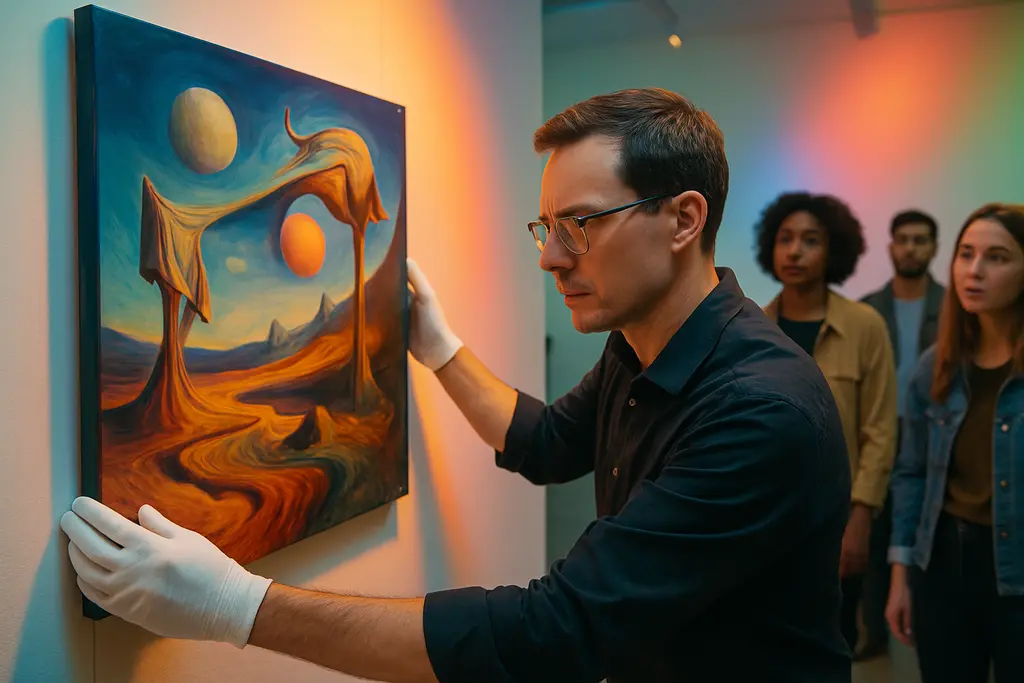
The GaHee Park exhibition Behind the Curtain opened at Yerba Buena Center for the Arts in San Francisco on August 7, 2026, and is scheduled to run through January 3, 2027. YBCA identifies it as Park’s first U.S. solo institutional museum exhibition, curated by Dorothy Dávila YBCA announcement. As of September 7, 2026, the exhibition is no longer an upcoming debut; it is an active presentation that can be discussed through its stated themes, its institutional framing, and its relation to fantasy and surrealist visual language.
Park was born in Seoul in 1985 and is based in Montreal. Her education, as listed by YBCA, includes a BFA from Tyler School of Art in Philadelphia in 2012 and an MFA from Hunter College in New York in 2015. Those biographical facts do not explain the paintings by themselves, yet they do place the exhibition within a transnational art education and studio context rather than a single regional category.
Why The GaHee Park Exhibition Matters Now
GaHee Park Exhibition As Institutional Threshold
The significance of this GaHee Park exhibition rests partly on format. A solo museum exhibition in the United States gives viewers a chance to encounter a body of work across time, rather than through isolated fair presentations, gallery images, or single reproductions. YBCA states that Behind the Curtain features paintings from roughly the last five years, around 2021 to 2026. That span is narrow enough to preserve a focused mood, but long enough to suggest changes in motif, pacing, and pictorial pressure.
The title Behind the Curtain is useful because it frames looking as a charged act. A curtain can imply theater, domestic privacy, concealment, or staged revelation. Park’s listed themes—sexuality, mortality, fantasy, identity, and alienation—fit that threshold. The viewer is invited to see, but the paintings appear to question the terms of that viewing.
What The Exhibition Claims, And What It Does Not
Evidence from the museum material supports a careful reading of Park’s work through surrealism and fantasy. It does not support broad claims about a new movement, a market trend, or a generational consensus. For that reason, the safer critical move is to look at how the motifs work inside this specific show.
YBCA describes a palette that includes muted grays and pinks, with motifs such as women in contemplative solitude, still lifes, cocktails, cats, insects, and reflections. These details suggest a domestic or intimate pictorial field, but not a simple one. Still life, portraiture, and interior space are familiar art-historical structures. Park’s use of reflections and solitary figures, as described by the institution, complicates who is looking and who is being looked at.
Surrealism, Fantasy, And The Question Of The Gaze
Fantasy Without Escapism
Fantasy in this context should not be reduced to escape. The GaHee Park exhibition positions fantasy beside mortality, alienation, sexuality, and identity. That grouping suggests a visual method for staging interior states that may not be available through realism alone. A cocktail, a cat, an insect, or a reflection can function as more than a prop when placed inside a psychologically charged scene.
Surrealist influence is often discussed through dream logic, unexpected combinations, and disturbances of ordinary scale or behavior. Based on the research available here, Park’s work appears to draw from that broad visual inheritance while remaining grounded in intimate scenes. The phrasing should stay cautious: the museum describes the work as using a surrealist lens, but it does not require us to assign Park to a fixed historical category.
Power Dynamics In Portraiture
YBCA notes that the works subvert the viewer’s gaze and often invert traditional power dynamics in portraiture. That is a substantial claim, and it is best understood through the exhibition’s recurring motifs. A contemplative figure may appear available to view, yet the painting can deny easy possession through reflection, pose, scale, mood, or surrounding objects.
This matters because portraiture has long involved questions of access, authority, and display. Who is represented? Who controls the scene? Who is permitted to look without being questioned? Park’s paintings, as framed by YBCA, appear to place those questions inside scenes that are at once intimate and unstable. The result is not simply surreal imagery, but a test of the viewer’s confidence.
Film, Fashion, And Cross-Medium Fantasy
The Open Window Film Series
The exhibition is accompanied by a related film series titled Through an Open Window, co-presented with filmmaker Michael Vass and YBCA. It began on August 15, 2026, and is scheduled for Saturdays at 2 p.m. through October 31, 2026. YBCA describes the program as 12 screenings and also describes its components as 11 features plus 3 shorts, including films connected with figures such as Alfred Hitchcock, Joan Jonas, and Maya Deren.
That film context matters because it gives viewers a parallel way to think about frames, windows, bodies, desire, and suspense. A painting exhibition does not become cinema because a film series sits beside it. Still, the pairing suggests that YBCA wants the audience to consider Park’s images in relation to moving-image traditions where looking, concealment, and psychological tension are formal tools.
Costume, Surface, And Community Imagination
For readers who follow fantasy fashion, costume culture, or handmade visual practice, Park’s work offers a useful reminder: fantasy aesthetics need not be loud to be potent. Muted colors, staged interiors, reflective surfaces, and small symbolic objects can carry as much imaginative force as ornate costume or theatrical spectacle. For adjacent reading across fantasy dress and art-inspired visual culture, you might find valuable insights at Fairytale Fashion, a site within the same network of interests.
This connection should be made with care. The available research does not say that Park is designing fashion or working in cosplay culture. The relation is interpretive, not biographical: viewers interested in how surface, self-presentation, fantasy, and identity meet across mediums may find the exhibition productive without collapsing painting into costume or costume into painting.
Dates, Access, And Verified Exhibition Details
Practical Information With Date Clarity
Because the exhibition opened before September 7, 2026, date language should be precise. Behind the Curtain opened on August 7, 2026, and runs through January 3, 2027. The related film series began on August 15, 2026, and is scheduled to continue through October 31, 2026. YBCA lists admission as $10 general admission, $5 for students and seniors, and free general admission on Wednesdays.
- Exhibition: Behind the Curtain at Yerba Buena Center for the Arts, San Francisco.
- Curator: Dorothy Dávila.
- Dates: August 7, 2026, through January 3, 2027.
- Related program: Through an Open Window, August 15 to October 31, 2026.
- Admission listed by YBCA: $10 general, $5 students and seniors, free general admission on Wednesdays.
Collections And San Francisco Context
YBCA lists Park’s work in the permanent collections of the Columbus Museum of Art in Ohio, Institute of Contemporary Art Miami in Florida, Pond Society in Shanghai, and Medianoche Foundation in Granada, Spain. Collection placement can signal institutional recognition, though it should not be treated as a full measure of an artist’s importance. It is one piece of evidence within a broader practice.
There is also a separate San Francisco art context around Park in late 2026. SF/Arts lists her first solo show with Jessica Silverman as scheduled to open on October 28, 2026 SF/Arts listing. Since that date is after September 7, 2026, it remains scheduled rather than past. The overlap suggests that San Francisco viewers have more than one institutional or gallery point of contact with Park’s work during the same period.
Behind The Curtain And GaHee Park Exhibition Context
A Careful Critical Frame
The most persuasive reading of the GaHee Park exhibition is not that it announces a single trend, but that it gathers a set of visual problems: how fantasy can carry unease, how portraiture can resist possession, and how familiar objects can become unstable. The stated motifs—women alone, still lifes, cocktails, cats, insects, and reflections—are ordinary enough to be recognizable. Their force appears to come from arrangement, mood, and the pressure of looking.
As a first U.S. solo institutional museum exhibition, Behind the Curtain gives Park’s recent paintings a public frame with enough space for comparison and close attention. The show’s value, based on the verified material available, lies in that concentrated encounter: surrealism as a lens, fantasy as a pressure point, and the gaze as a question rather than a settled position.