Category: Discover

  • Small Retailers in TikTok Creator Commerce

    Small Retailers in TikTok Creator Commerce

    Small Retailers are no longer peripheral to creator commerce on TikTok, at least according to the platform-specific economic and shop data now available for 2025 and January through July 2026. The clearest signal is not a single viral product or a broad claim about cultural taste. It is the measurable relationship between sellers, short-form video, affiliate creators, and customer discovery. For artists, handmade sellers, small boutiques, and community-rooted makers, that relationship deserves careful attention because it connects commerce with storytelling, trust, and presentation.

    That does not mean every shop can expect the same outcome, and the available research should be read with care. TikTok’s 2026 Economic Impact Report said TikTok-supported economic activity generated about $81 billion in U.S. GDP in 2025 and supported 410,000 jobs; it also reported that 93% of U.S. businesses using TikTok said they increased sales after promoting products or services on the platform TikTok economic report. Those figures describe a broad business base, not only cultural sellers. Still, they offer a useful frame for understanding why creator-led selling has become a practical concern for small operators rather than a side conversation.

    How Small Retailers Fit Creator Commerce Data

    What Small Retailers Can Read From The 2025 Figures

    Small Retailers should treat the 2025 numbers as evidence of scale, not as a guarantee of individual sales. The report data says more than half of small business owners said TikTok helped them reach customers they otherwise could not reach and significantly increased their sales. That is especially relevant to makers and independent cultural shops because discovery is often the limiting factor: a ceramicist, costume accessory seller, zine distributor, or independent fashion label may have a distinct product language but limited access to foot traffic or paid media budgets.

    From a community arts perspective, the phrase “reach customers they otherwise could not” is the most meaningful part of the research. Creator commerce can move a product story beyond a local market without stripping away the maker’s voice, if the seller presents process, materials, use, pricing, and availability with clarity. The evidence does not tell us which artistic categories benefited most, so it would be unsafe to claim that handmade goods or art objects outperformed other categories. What it does support is a narrower claim: small businesses using the platform reported meaningful commercial effects, and many tied those effects to customer reach.

    Why Caution Still Matters For Creative Sellers

    The rise of platform selling brings risks as well as openings. For creative sellers, product identity can be close to personal authorship, cultural heritage, costume reference, or fan practice. That makes rights-clearance and truthful marketing part of the business conversation, not a separate issue. A seller can celebrate influence, process, and community taste without implying permissions, copying a living artist’s recognizable style for commercial confusion, or using protected characters and likenesses without rights. For a related practical angle, NextClues has covered how TikTok Shop policies affect handmade sellers.

    There is also a local civic dimension. Community organizers often see small commercial activity and cultural life overlap at markets, fundraisers, school events, and neighborhood fairs. For those who are interested in more community-centric discussions related to public life and commerce, the website Kay Granger offers additional insights within this network. The key point for seller strategy is modest but useful: creator commerce can connect local work to wider audiences, yet the strongest claims should remain tied to verifiable data and transparent product presentation.

    Why Affiliate Creators Changed The Sales Equation

    January Through July 2026 Benchmarks

    Between January and July 2026, U.S. TikTok Shop generated an estimated $10.6 billion in revenue across 27 categories, according to MADA’s benchmark analysis; the same analysis said affiliate creators drove 74% of that revenue, while brands’ own accounts contributed 13% MADA benchmarks. For Small Retailers, that split is significant because it suggests the seller’s own channel may not be the only path to sales. Creator relationships, product demonstrations, and third-party storytelling can shape the purchase path.

    Affiliate-driven commerce is not the same as traditional advertising. A small retailer may be used to writing a product caption, photographing inventory, and waiting for buyers. Creator commerce asks a different question: who can explain the object in use, in context, and with enough specificity that a viewer understands why it matters? For art-adjacent products, this could mean a maker showing glaze variation, a costumer discussing fit and movement, or a gift seller explaining packaging and occasion. The data does not prove that every creator mention works. It shows that, during the measured period, affiliate creators accounted for a large share of U.S. TikTok Shop revenue.

    Community Trust And Product Interpretation

    Creator involvement can be especially powerful when the product requires interpretation. A print, handmade bag, rave accessory, cosplay component, or small-batch home object often carries value beyond function. The buyer may need to see scale, texture, styling, durability, or ethical sourcing cues before deciding. A creator can supply some of that context if the relationship is clear and the claims are accurate.

    That said, sellers should avoid treating creators as interchangeable distribution points. In arts and culture commerce, credibility often comes from alignment between object, community, and presenter. A costume maker may need reviewers who understand material limits. A music-event accessory seller may need creators who can speak responsibly about comfort and safety. A fine-art-adjacent shop may need careful language around prints, editions, and authorship. The data supports affiliate influence at a high level; it does not remove the need for seller judgment.

    What The Channel Mix Says About Presentation
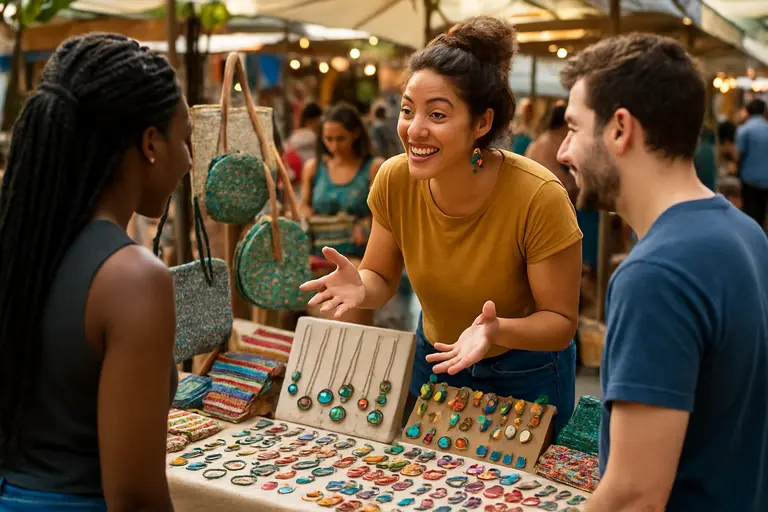
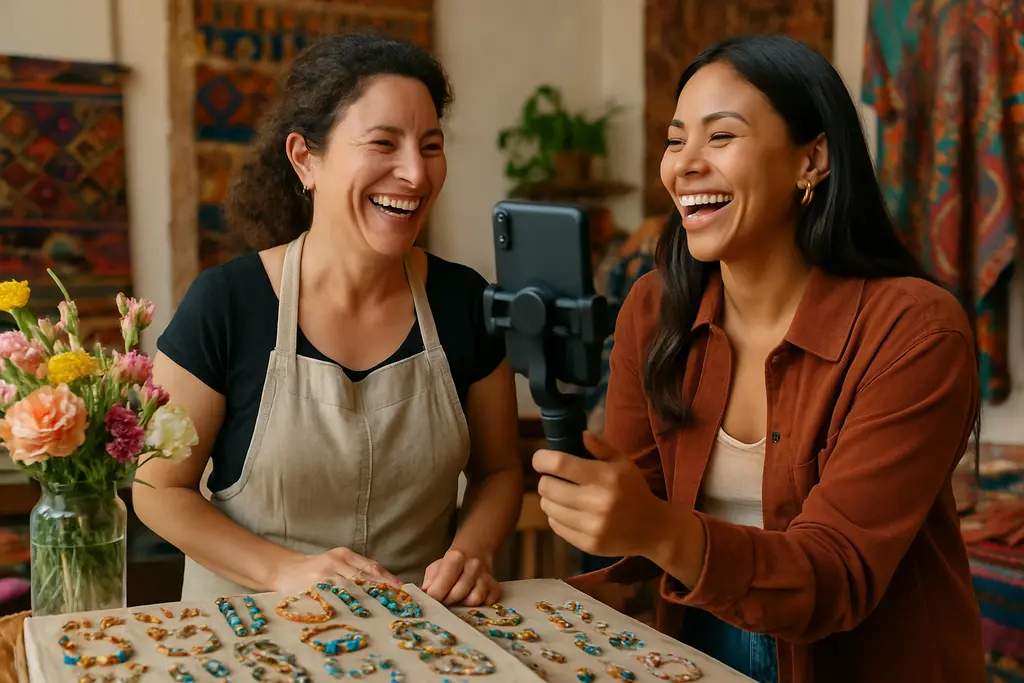
    Handmade accessories arranged near a phone set up for filming

    Short Video Led Revenue In The Measured Period

    MADA’s January through July 2026 analysis also reported that short video content accounted for 63.3% of U.S. TikTok Shop revenue, while LIVE commerce and product cards each contributed about 18%. Small Retailers can read that as a sign that concise product storytelling mattered during that period. A short video can show how a necklace catches light, how a handmade notebook opens flat, how a costume piece moves, or how a gift is packed. Those are not minor details in cultural commerce; they are often the difference between a product listing and a product people understand.

    LIVE commerce and product cards still represented meaningful shares in the same data. The practical reading is not that one format should replace every other format. Instead, presentation formats may serve different buyer needs. Short video can introduce the object. LIVE sessions can answer questions or show variation. Product cards can convert interest into a transaction after the viewer has enough context.

    • Short video may work best for process, styling, scale, and before-and-after use cases.
    • LIVE selling may fit limited drops, demonstrations, and question-led buying.
    • Product cards may be most useful when the buyer already understands the item.

    What The Data Does Not Prove

    The available research does not prove that TikTok Shop is the best channel for every independent retailer, nor does it establish category-level outcomes for every kind of art, fashion, gift, or event-related product. It also does not settle questions about margin, returns, production capacity, copyright permissions, or fulfillment strain. Those factors matter deeply for creators who make objects by hand or in small batches.

    A cautious seller should ask whether demand created through creator commerce can be fulfilled without lowering quality or overextending labor. The answer will vary by product type. A print-on-demand poster seller faces a different capacity question than a jeweler producing one-of-a-kind pieces. A vintage seller faces inventory limits. A costume maker may need longer production windows. The public data shows scale and channel contribution; the seller still has to assess operational fit.

    Small Retailers In TikTok Creator Commerce

    A Practical Reading For Cultural Sellers

    The evidence from 2025 and January through July 2026 points to a clear but limited interpretation: TikTok-linked commerce has become large enough that Small Retailers cannot dismiss it as a niche channel, yet the data should not be turned into a promise. For creative communities, the most constructive use of the research is to refine how products are explained, credited, demonstrated, and sold.

    That means centering accurate descriptions, clear sourcing, respectful cultural references, and honest expectations around shipping and availability. It also means choosing creator partners who can interpret the work responsibly rather than flattening it into a generic sales pitch. The best creator-commerce strategy for cultural sellers is not only about reach. It is about whether the person presenting the work can help a buyer understand the object without distorting its origin, purpose, or rights status.

    For community-minded retailers, this is where commerce and culture meet. A platform may widen access, but the seller’s choices still shape trust: how a product is named, how inspiration is discussed, how collaborators are credited, and how buyers are informed. The rise shown in the research is real at the platform level. The responsible opportunity is to build sales practices that protect both the maker’s work and the communities that give that work meaning.
  • Cultural Reflections Through War at The Campus

    Cultural Reflections Through War at The Campus

    Cultural Reflections Through War offers a careful way to read the pairing of Matthew Monahan and Tuan Andrew Nguyen within the 2026 Annual Exhibition at The Campus. The phrase does not make their practices identical. It points instead to a shared pressure: how art can carry signs of damage, displacement, memory, and repair without turning war into spectacle.

    The exhibition opened on June 27, 2026 and is scheduled to run through November 1, 2026. As of October 7, 2026, it has already opened and remains on view. The Campus lists both Matthew Monahan and Tuan Andrew Nguyen among the participating artists, and its exhibition page names Monahan works including Body Electric (Dagger Dance) (2014), Body Electric (Divining Rod) (2014), Forager (2016), Frankenstorm (2019), and Not Here, Not Now (2025), as documented by The Campus exhibition listing.

    Cultural Reflections Through War in the 2026 Exhibition

    How Cultural Reflections Through War Frame Both Artists

    Placing Monahan and Nguyen in the same exhibition invites comparison, but it also calls for restraint. The available exhibition information confirms their participation and the presence of specific Monahan works; it does not, by itself, prove a single curatorial argument about the two artists. Still, the research record supports a measured reading: both artists have made work that treats bodies, objects, and materials as carriers of historical pressure.

    For Monahan, the pressure often appears through the figure. The research notes describe sculpture in the exhibition as presenting the figure as a kind of relic, or as survival under pressure. Metallic planes appear folded, crushed, and severe, suggesting witness rather than commemoration. That distinction matters. A monument often asks the viewer to accept a stable public meaning. A relic-like figure can behave differently: it may feel partial, wounded, displaced, or left behind after a force has passed through.

    Nguyen’s practice, as described in the research, is tied to war, displacement, colonial violence, the Vietnam War, and the afterlives of stories that have been left at the edge of official memory. His work often asks how objects remember. Instead of treating war material only as evidence of destruction, he has used remnants and salvaged matter to explore sound, repair, and forms of remembrance that are not limited to written history.

    Why The Exhibition Context Matters

    The Campus Annual Exhibition gives these practices a public setting where viewers may move between different approaches to history. Monahan’s listed works span 2014 to 2025, which means the exhibition is not presenting a single moment of production. Nguyen’s presence, viewed through the research on his broader body of work, brings another form of time into the room: the long afterlife of conflict, where violence continues through land, memory, and inherited silence.

    For community audiences, this matters because art about war can be difficult to receive. Some viewers arrive with direct family histories of military service, migration, loss, or displacement. Others encounter the subject through archives, classrooms, public memorials, or news images. A respectful exhibition reading should leave space for those differences. It should avoid easy claims that art heals all wounds, while still recognizing that artists can create forms where grief, memory, and survival are given shape.

    Matthew Monahan And The Damaged Figure

    Material Strain Instead Of Heroic Display

    Monahan’s work, as summarized in the research, often joins bodies with signs of damage: wounds, detachment, disfigurement, and conflict. That does not mean every work should be reduced to a literal image of war. Rather, the figure becomes a site where tension can be registered. The body is not smooth proof of victory. It may appear interrupted, altered, or unable to return to an intact state.

    This is where Cultural Reflections Through War becomes a useful critical lens. Monahan’s figures can be read as forms shaped by pressure rather than as declarations of triumph. The severe material language described in the research encourages viewers to think about what remains after impact. A folded or crushed surface can suggest force without illustrating a battlefield. A detached or injured body can evoke conflict without offering a direct historical scene.

    That indirectness is not avoidance. In many works of contemporary art, the refusal to narrate violence plainly can be an ethical choice. It may prevent the viewer from consuming trauma too quickly. It may also acknowledge that cultural memory is often broken, partial, and mediated by fragments. Monahan’s work appears to operate in that space between presence and ruin, between human form and damaged artifact.

    Relic, Witness, And Community Reception

    Describing a figure as a relic changes the relationship between object and viewer. A relic is not merely old. It is charged by survival. It asks what has been preserved, what has been lost, and who is responsible for care. In a community exhibition setting, that question can become social rather than only formal. Viewers are not just assessing surface, scale, or material. They are also encountering an object that may feel marked by histories of pressure.

    As a community organizer, I am drawn to this point because public exhibitions can create shared conditions for careful looking. Not every visitor will bring the same vocabulary to sculpture, but many people understand the emotional language of strain, endurance, and fracture. Monahan’s contribution, based on the available research, can be read through that shared recognition without making unsupported claims about a single intended meaning.

    Tuan Andrew Nguyen And War Remnants

    Objects That Hold Sound And Memory

    Nguyen’s work brings a different but related emphasis to Cultural Reflections Through War. His film The Unburied Sounds of a Troubled Horizon (2022), according to the research notes, is set in Quảng Trị province and explores the making of art and objects from bomb remnants. The same research states that the province remains heavily affected by unexploded ordnance. That context is central to understanding why material is not neutral in Nguyen’s practice.

    One especially clear example is Singing Bowls (2022). A review in Afterimage via University of California Press describes the work as made from evacuated artillery shells and functioning as both sculpture and musical instruments that sound when struck. The shift from weapon remnant to resonant object should not be overstated as a simple cure. It is more cautious, and more powerful, to say that the work opens a space where violence can be heard differently.

    Sound matters here because it is physical and communal. A struck bowl produces vibration. It occupies the air between people. In that sense, Nguyen’s work can turn the residue of war toward listening, not denial. The artillery shell does not vanish. Its prior function remains part of the object’s meaning. Yet the object’s use changes, creating room for meditation, remembrance, and shared attention.

    Memory Beyond Official Narratives

    The research on Nguyen also points to histories involving colonial violence, the Vietnam War, displacement, and forgotten stories, including those involving Vietnamese-Senegalese and Moroccan soldiers. These are not decorative references. They suggest a practice concerned with people and experiences that may sit outside dominant national accounts of war.

    For arts communities, that approach raises an ethical question: whose memory becomes visible, and through which materials? Nguyen’s use of salvaged war matter, arms, and artillery shells in other exhibitions described by the research indicates sustained attention to objects marked by conflict. Such objects are not treated as neutral supplies. They carry wear, erosion, and the accumulation of trauma. The artist’s act is not to erase that past, but to place it where listening and reflection become possible.

    Reading War, Memory, And Care Together

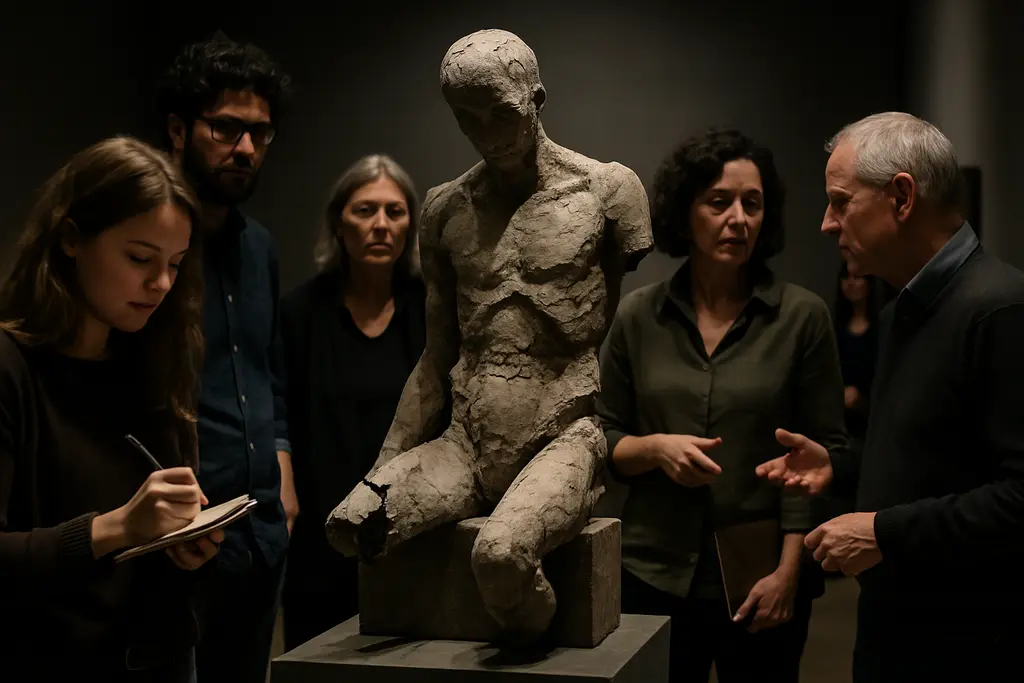
    Small group viewing sculpture together in a calm exhibition room

    Similar Pressures, Different Methods

    Monahan and Nguyen should not be collapsed into one argument. Monahan’s work, as represented in the available research, centers the damaged or pressured figure. Nguyen’s work often starts from historical remnants and the afterlife of war material. One approach leans toward the body as relic; the other often treats the object as a carrier of memory and sound.

    Still, both practices help explain why Cultural Reflections Through War feels relevant to the 2026 Annual Exhibition. Neither artist, based on the research provided, appears to frame conflict as glory. Instead, each turns attention toward what remains: fragments, wounds, artifacts, vibrations, stories, and forms of survival that resist easy closure.

    • Monahan’s listed works at The Campus support a reading centered on figure, pressure, and damaged form.
    • Nguyen’s documented use of artillery shells and war remnants supports a reading centered on memory, sound, and postwar material life.
    • Together, their practices offer viewers a way to think about cultural memory without reducing war to spectacle.

    Why This Matters For Community Arts Writing

    Community arts writing has a responsibility to avoid overstating what an exhibition proves. It should also resist flattening artists into a theme that is more convenient than accurate. In this case, the supported facts allow a focused interpretation, but not a closed one. The exhibition dates, artist participation, and listed works are clear. The broader critical reading depends on documented patterns in each artist’s practice and should remain open to what visitors encounter in person.

    That openness is part of cultural work. A gallery or exhibition can become a meeting point for people who carry different relations to war: inherited stories, migration histories, family silence, or no direct connection at all. Nearby cultural networks, including Robsonic, can facilitate ongoing conversations and provide wider context to arts coverage, ensuring these dialogues remain vibrant and diverse without replacing the direct experience of the work.

    Cultural Reflections Through War at The Campus

    Cultural Reflections Through War is not a slogan that solves the work of Matthew Monahan or Tuan Andrew Nguyen. It is a careful frame for seeing how two artists use figures, remnants, damage, and resonance to address the aftereffects of conflict. At The Campus, that frame is especially useful because the exhibition setting places different artistic languages in proximity, allowing viewers to compare without forcing sameness.

    The stronger reading is also the more cautious one. Monahan’s sculptures, based on the available research, invite attention to the body under pressure and the figure as witness. Nguyen’s documented works invite attention to war material altered into forms of sound, reflection, and remembrance. Between them, the exhibition offers a space where cultural memory is not settled. It is carried, struck, fractured, heard, and reconsidered in public.

  • Best Buy TikTok Shop Sets October Retail Test

    Best Buy TikTok Shop Sets October Retail Test

    The Best Buy TikTok Shop is scheduled to debut in late October 2026, after Best Buy announced on September 22, 2026, that it planned a TikTok Shop storefront with nearly 10,000 products curated for social discovery, according to the company’s corporate announcement. As of October 5, 2026, the launch had not yet occurred, so any assessment should be framed as a preview rather than a performance review.

    The announcement matters because it places a major electronics retailer inside a shopping format shaped by creator videos, in-app product pages, and a dedicated shop tab. For artists, costumers, home-studio musicians, photographers, streamers, and gift sellers, the relevant question is not only whether products appear in TikTok feeds. It is how a large retailer’s presence may affect the way tools, accessories, and household technology are presented through everyday creative stories.

    Why The Best Buy TikTok Shop Launch Matters

    Best Buy TikTok Shop And Social Discovery

    Best Buy said customers would be able to discover products through shoppable creator videos, the retailer’s TikTok shop page or tab, and in-app product pages. That structure differs from a conventional product search because the first encounter may come through a demonstration, styling choice, unboxing, studio setup, kitchen counter, dorm room, or work desk rather than a search bar.

    For cultural observers, this is where commerce and presentation meet. A pair of headphones may be framed as part of a bedroom production setup. A camera may appear within a maker’s documentation process. A small appliance may be shown through cooking, gifting, or home routines. None of that proves a broad change in shopper behavior by itself. It does suggest that the product page is no longer the only site where retail meaning is formed.

    An Electronics Assortment Built For Short Video

    The announced categories include headphones, cameras, small appliances, laptops, and accessories. Best Buy also named brands including Oura, Bose, Dyson, and Microsoft. Those details matter because the assortment is not described as a narrow novelty test. Nearly 10,000 products is a sizable selection for launch, though the practical effect will depend on which items are promoted, how availability is handled, and how product information appears inside TikTok’s purchase flow.

    There is a creative-commerce angle here. Many independent makers rely on consumer electronics to document work, edit images, stream process videos, print shipping labels, manage sales, or package commissions. The Best Buy TikTok Shop is not a craft marketplace, but it may place tools used by creative communities closer to the same short-video spaces where their work is shown and sold.

    What The Storefront Will Actually Offer

    Product Categories Named In The Announcement

    Based on the available announcement, the storefront is expected to focus on familiar Best Buy categories rather than handmade goods or original art objects. The named product areas point toward consumer technology, lifestyle devices, and home equipment. This distinction is useful for readers who follow maker culture: the storefront appears more likely to supply the tools around creative production than to sell the creative work itself.

    • Headphones may connect to music production, gaming, editing, commuting, and home listening.
    • Cameras may serve photographers, streamers, costume makers, and small sellers documenting products.
    • Small appliances may sit within food content, gifting, home care, and domestic design videos.
    • Laptops and accessories may support editing, listing management, drawing, design, and remote work.

    That list should not be read as a promise about which exact products will be available on the first day. It reflects categories Best Buy has named. The user experience, pricing visibility, stock levels, and creator participation will be clearer only after the late October 2026 storefront is live.

    Fulfillment And Returns As Trust Signals

    Operations may be just as important as discovery. A retail analysis reported that orders placed through the TikTok storefront would be fulfilled by Best Buy, with returns available in stores or by mail, according to eCommerce Placement. That detail matters because a social shopping experience can lose credibility if fulfillment, delivery expectations, or return options feel unclear.

    For buyers of electronics, return pathways can be central to confidence. Headphones may not fit as expected. Laptops require compatibility checks. Cameras and accessories can involve model-specific decisions. If the social interface encourages quick discovery, the support system behind the order still needs to match the caution shoppers often bring to higher-consideration purchases.

    Creator Commerce Context For Makers

    A creator films a tabletop product setup with lights, camera gear, and accessories

    Where Cultural Products Meet Retail Tools

    The most interesting cultural question is not whether a large retailer can post products on TikTok. It is how creator-led explanation changes the social life of ordinary devices. In costume culture, fantasy fashion, handmade gifting, and small-studio production, tools often become part of the story: the ring light behind a makeup test, the camera used to document embroidery, the headphones worn during editing, or the laptop that manages a weekend shop update.

    A neighboring cultural lens such as fairy-tale fashion research helps show why tools should not be separated too sharply from aesthetics. Fashion and costume communities often treat process, materials, staging, and documentation as part of the finished cultural expression. Retailers entering creator-driven channels may benefit from recognizing that context without flattening creators into product demonstrators.

    For the Best Buy TikTok Shop, that means the most credible content will likely be content that respects practical use. A creator showing how a camera supports product photography offers a different kind of value than a generic sales pitch. The same applies to audio gear, laptop accessories, or home appliances. The evidence available before launch does not show which creator partners, if any, will define the storefront’s tone. That remains a point to watch after launch.

    Limits Of The Evidence

    The available facts support a clear preview: late October 2026 timing, a large announced product count, named product categories, in-app discovery, and Best Buy-linked fulfillment. They do not yet support claims about sales performance, customer adoption, creator earnings, or competitive effects. Any statement that the launch will reshape electronics retail would be premature on October 5, 2026.

    A cautious reading also separates platform possibility from community impact. TikTok’s format may help some products become easier to understand through use-based video. It may also increase pressure on creators to blend recommendation, entertainment, and commerce. For artists and small sellers, that pressure is familiar: visibility can help, but it can also reward constant posting and quick conversion over slower forms of craft explanation.

    Best Buy TikTok Shop In Late October 2026

    Questions To Track After Launch

    Once the storefront opens in late October 2026, the most useful analysis will come from observing concrete details. Are product pages clear enough for electronics decisions? Do creator videos disclose commercial relationships where required by platform rules and applicable advertising standards? Are returns easy to understand inside the purchase path? Does the assortment remain close to the announced categories, or does it shift after launch?

    The Best Buy TikTok Shop should be read as a practical test of retail presentation inside a social app. Its cultural meaning will depend less on the fact of arrival than on how products are explained, who is invited to explain them, and whether the experience respects shoppers who need reliable information before buying technology. For creative communities, the launch is worth watching because it places the tools of making, documenting, listening, cooking, editing, and selling within the same video spaces where community stories already circulate.

  • Information Design at MoMA’s Full Disclosure

    Information Design at MoMA’s Full Disclosure

    Information design has often been treated as a practical tool: a chart that clarifies a statistic, a map that directs movement, or a diagram that condenses a larger system. MoMA’s Full Disclosure: The Edge of Information Design, which opened on September 27, 2026, gives that practice a more focused museum setting. The exhibition is scheduled to remain on view through June 13, 2027, and MoMA identifies it as the museum’s first exhibition devoted entirely to this field.

    The timing matters because the show does not frame charts, maps, interfaces, and data portraits as neutral containers. It presents them as designed objects with choices embedded in them: what to measure, what to omit, who is represented, and how trust is built or weakened. That emphasis makes the exhibition useful not only for designers, but also for artists, educators, journalists, and community historians who work with public evidence.

    Why Information Design Now Has A MoMA Stage

    Information Design As A Collection Category

    MoMA’s press materials describe Full Disclosure as a presentation of 30 works, spanning both digital and analog forms, with six pieces newly acquired for the museum’s collection. The exhibition is organized by Paola Antonelli, Senior Curator in the Department of Architecture and Design and Director of Research and Development, with Jules Bernstein, Curatorial Assistant, and Forrest Pelsue, the 2025–26 Marron Research Consortium Fellow. These details, taken together, show the museum treating the field as part of design history rather than as a technical footnote. The exhibition details are outlined in MoMA press materials.

    That framing is significant, but it should be read with care. A museum exhibition does not prove a universal cultural shift by itself. It does, however, mark an institutional decision about what belongs in a design collection. By placing works of evidence, mapping, climate communication, and historical analysis together, MoMA presents information design as a practice shaped by aesthetics, research, and public responsibility.

    What The Dates And Location Signal

    The exhibition’s location also carries meaning. MoMA states that Full Disclosure is installed in its street-level gallery, which is free and accessible to the public. That setting aligns with the subject matter: many of the works address issues that depend on public legibility, from environmental change to migration, poverty, and state power. A free gallery does not remove every barrier to access, but it does place the material closer to the public-facing edge of the museum.

    The exhibition opened on September 27, 2026, so it should be discussed as an active presentation rather than an upcoming one. Its scheduled closing date, June 13, 2027, gives the museum a long window for visitors, educators, and critics to assess how the installation handles a subject that can easily become opaque. The strongest measure of the show may be whether viewers leave with sharper questions about evidence, not simply with admiration for polished diagrams.

    What Full Disclosure Places On View

    Digital And Analog Forms

    The 30 works named in the research materials indicate a broad range of formats and time periods. Chow and Lin’s The Poverty Line (Tomatoes) (Myanmar), 2010–2020 approaches economic conditions through image and comparison. Forensic Architecture, Forensic Oceanography. Seizure of the Iuventa from 2019 points toward investigative work, where design helps assemble and present evidence. Ed Hawkins’s Warming Stripes, 1850–2025, begun in 2018 and described as ongoing, condenses climate records into a form that is visually direct. Ben Fry’s isometricblocks, from 2002–05, adds an earlier digital design reference point.

    These examples suggest that Full Disclosure is not organized around one visual style. Its common thread is a design problem: how information can be structured so that viewers can perceive a pattern, test a claim, or understand a relationship. That is a different task from illustration alone. It asks form to carry evidence, and it asks audiences to recognize the difference between persuasion and verification.

    Artistic Context Without Flattening The Work

    There is a risk, in any exhibition about data, of reducing works to their subject matter. A climate graphic can become only “about climate.” A poverty study can become only “about poverty.” A forensic project can become only “about evidence.” The more careful reading is to examine how each work uses scale, sequence, color, repetition, absence, and comparison. Those formal choices are part of the meaning, not decoration added after the facts.

    That point connects the exhibition to broader creative communities. Costume makers, textile artists, set designers, and independent sellers also work with systems of visual meaning: patterns, measurements, cultural references, and audience recognition. Related writing on costume and fashion culture research offers one adjacent path for thinking about how design choices communicate identity and context. The connection is not that every medium handles data in the same way. It is that form often determines what a community can see, remember, and debate.

    Reading The Works Across Time And Medium

    Historical Continuity And New Tools

    The research notes describe data visualization as a practice with centuries of precedent, while the exhibition focuses on 20th- and 21st-century developments. That pairing matters. It prevents the show from treating recent software as the origin of visual evidence. At the same time, the inclusion of digital works acknowledges that algorithms, machine learning, artificial intelligence, and animated networks have changed the forms available to designers.

    Care is needed here, because technology alone does not guarantee clarity. A dynamic interface can reveal relationships that a static chart cannot easily show, but movement can also distract or imply certainty where the underlying data is partial. A printed image may appear simpler, yet it can still carry strong analytical force. The exhibition’s mix of analog and digital forms allows those differences to sit beside one another without forcing a single hierarchy.

    Data Portraits And Community Memory

    The ethical charge of data becomes clearer through MoMA Magazine’s discussion of W. E. B. Du Bois’s data portraits, which returned attention to historical methods of visualizing Black life, migration, and social conditions. The MoMA Magazine essay connects the subject to representation, visibility, and the responsibilities of design. That context is valuable because it shows that data is never only numerical. It can also be social memory, political record, and cultural argument.

    For community stories, this is a central issue. Who gathers the data? Who is missing from it? Who has the authority to interpret it? Which visual form makes a pattern legible without stripping people of context? Full Disclosure appears to position these questions within design practice rather than outside it. That is a productive stance, especially for viewers who approach museum objects as evidence of choices made under social pressure.

    The Ethics Behind Information Design

    Close view of layered charts and maps arranged for interpretation

    The exhibition’s title, Full Disclosure, suggests openness, but the research points to a more demanding idea. Disclosure is not only the act of presenting information. It is also the work of showing how that information was sourced, organized, filtered, and made persuasive. A chart can look authoritative while concealing uncertainty. A map can appear complete while leaving out communities, borders, routes, or histories. A timeline can create order while narrowing causality.

    This is where information design becomes ethically charged. Designers make decisions that affect trust: categories, colors, scales, labels, animation speed, comparison points, and captions. Those decisions can help viewers ask better questions, or they can lead viewers toward a predetermined reading. The research notes also point to concerns around bias, transparency, and institutional distrust. Those concerns are not abstract. They shape how audiences respond to public data, especially when the subject involves harm, displacement, climate, or state action.

    A cautious reading of the show should resist two extremes. One extreme treats designed data as objective truth because it looks ordered. The other rejects visual evidence as manipulation because it is designed. The more useful approach sits between them: ask what the work claims, what materials support that claim, what remains uncertain, and how the design invites or limits interpretation.

    Information Design At MoMA’s Full Disclosure

    Full Disclosure: The Edge of Information Design gives MoMA a focused platform for works that make systems visible, but it also asks viewers to examine visibility itself. The exhibition’s 30 works, its free street-level placement, and its scheduled run from September 27, 2026, to June 13, 2027, give the subject a public setting with enough time for close reading.

    Its value may rest less in declaring a rise than in showing why the field now demands sustained cultural criticism. The exhibition gathers objects that sit between art, design, research, journalism, and public memory. For audiences willing to look slowly, the key question is not whether data can be beautiful. It is whether beauty, structure, and evidence can meet without obscuring the people and conditions being represented.

  • Rockwell Museum Exhibitions Reframe America

    Rockwell Museum Exhibitions Reframe America

    Rockwell Museum Exhibitions in fall 2026 placed American art under a civic lens: who gets represented, how public hardship shapes art, and how a museum can ask visitors to test their own curatorial instincts. As of September 28, 2026, the museum’s fall program was already underway, with two main exhibitions and one participatory installation running into January 2027.

    The strongest thread across the program is not a single style or period. It is a question of framing. The Rockwell Museum in Corning, New York, used its 50th anniversary year and the United States’ 250-year national milestone to reconsider the museum’s collection through labor, memory, identity, place, and public life. That is a large interpretive task, so the most useful way to read the season is exhibition by exhibition, then through the community-facing choices that link them.

    Rockwell Museum Exhibitions And The 2026 Frame

    How Rockwell Museum Exhibitions Use Dates And Space

    The museum’s fall exhibitions overlapped by design. Rockwell Reframed: Director’s Choice opened on August 29, 2026, and was scheduled to run through January 4, 2027 in the Special Projects Gallery on Floor 2. Art at Work: Reframing Artists of the WPA opened on September 5, 2026, and was scheduled to run through January 19, 2027 in the Spotlight Gallery on Floor 1M. A related hands-on installation, Reframe/Re-Arrange, also opened on September 5, 2026, with a closing date of January 3, 2027.

    Those dates matter because, on September 28, 2026, none of these projects had closed. They were not previews or speculative announcements. They were active exhibitions with distinct gallery locations and connected interpretive aims, according to the museum’s fall exhibition announcement.

    The Anniversary Context

    The museum tied the season to two anniversaries: The Rockwell Museum’s founding in 1976, marking 50 years, and the United States’ 250-year national milestone. That framing helps explain why the program does not treat American art as a fixed inheritance. Instead, it asks how historical artworks, modern works, and contemporary works can be placed in conversation without smoothing away questions of inequity, labor, exclusion, and belonging.

    This is where the museum’s collection depth matters. The Rockwell Museum reports nearly 3,000 objects, with strengths in historic and contemporary Native American art, 19th-century views of place, traditional bronze sculpture, and a growing body of modern and contemporary works. The fall program used that collection profile not as background decoration, but as an interpretive structure.

    Art At Work And The WPA Question

    Labor, Community, And Public Art

    Art at Work: Reframing Artists of the WPA revisited artists connected to the Works Progress Administration era of the New Deal, from the 1930s into the early 1940s. The museum’s stated themes included labor, community, resilience, and social change. That makes the exhibition especially resonant in a community setting because WPA-era art was tied to public patronage and to questions about what artists contribute during periods of economic hardship.

    The listed artists included Thomas Hart Benton, Philip Evergood, William Gropper, Yasuo Kuniyoshi, Elizabeth Olds, Reginald Marsh, and Dox Thrash, among others. The grouping is not a neutral roll call. These artists worked across different subjects, methods, and social commitments, yet the museum’s framing drew attention to how art can register work, class pressure, public identity, and community life.

    For readers who want a related focus on this specific exhibition, our companion piece on WPA artists at The Rockwell Museum considers how public patronage and community themes shape the show’s interpretive charge.

    Why Reframing Matters Here

    The word “reframing” can sound fashionable when it is used loosely. In this case, the museum gave it a concrete function: placing WPA-era artists within a present-day discussion about resilience and social change. That does not mean collapsing the 1930s into 2026. It means asking how art made under one set of public pressures can help viewers think about public responsibility in another period.

    For a community organizer, that is one of the most valuable aspects of the exhibition. It treats artists as participants in civic life, not as figures detached from the conditions around them. The show’s caution is also important: it does not require every artist to say the same thing, and it does not reduce the WPA period to a single lesson.

    Rockwell Reframed And Collection Choice

    Director’s Choice As An Argument

    Rockwell Reframed: Director’s Choice was curated by Executive Director Erin M. Coe and included a personal selection of 25 works by historic and contemporary artists. The museum organized the exhibition into eight thematic groupings, including memory, identity, and sense of place. That structure signals that the director’s selections were not only about individual masterworks. They were about relationships among works.

    The artists named in the museum’s materials included Romare Bearden, Jacob Lawrence, Arthur Dove, John Marin, Betye Saar, Whitfield Lovell, Jaune Quick-to-See Smith, John Steuart Curry, and Samuel Levi Jones. Such a roster can support several readings: American modernism, collage and assemblage, social memory, regional identity, and the pressure that history places on images.

    Recent Acquisitions In The Reframed Selection

    The exhibition also introduced recent acquisitions. Eastman Johnson’s Study from Life: Down East was identified as the museum’s first historic genre painting added to the collection. Grafton Tyler Brown’s Grand Canyon and Falls from Hayden Point, Yellowstone was presented as an expansion of the museum’s 19th-century American holdings tied to place and national imagery.

    These additions deserve careful language. They do not, by themselves, redefine the whole museum. The supported claim is narrower and more useful: the acquisitions broaden areas already connected to the institution’s collecting interests. They also give the director’s exhibition a live institutional function, showing how a museum can use acquisitions to shift what future visitors are able to compare.

    Visitor Participation And Community Interpretation

    Visitors arranging artwork reproductions at an interactive museum station

    Reframe/Re-Arrange As A Curatorial Exercise

    Reframe/Re-Arrange invited visitors to create their own gallery arrangements using reproductions of works from the permanent collection and loans from Art Bridges Foundation. It also included a community response wall. That is a meaningful choice because it makes interpretation visible. Visitors are not merely asked whether they like a work; they are asked to think like arrangers, editors, and meaning-makers.

    This kind of participation can be especially productive for students and community groups. It shows that curating is not only about placing beautiful objects in a room. It involves sequence, emphasis, comparison, absence, and audience. The museum’s inclusion of a response wall also creates a public record of how viewers process the themes, though the research available here does not provide visitor comments or measurable response data.

    Programs Already Held And Public Context

    The museum paired the exhibitions with programming, including a Director’s Tour on September 19, 2026. Because that date had passed by September 28, 2026, it should be understood retrospectively as part of the season’s public engagement rather than as an event still to come.

    The broader civic angle also reaches beyond museum walls. Arts coverage often sits beside public-life coverage because both ask who is represented and how communities tell shared stories. Readers who follow that wider civic conversation may also recognize related network coverage at a related site in the same network, though the art analysis here rests on The Rockwell Museum’s own published exhibition materials.

    Rockwell Museum Exhibitions And Community Meaning

    Rockwell Museum Exhibitions in fall 2026 are best understood as a coordinated act of institutional self-study. Art at Work looks back to federally supported artists and the social pressures of the New Deal period. Rockwell Reframed uses a director’s selection to test connections among memory, identity, place, and collection growth. Reframe/Re-Arrange hands part of the interpretive process to visitors.

    For Corning and for museum audiences beyond the city, the value lies in that shared structure. These projects do not ask viewers to accept one clean story of American art. They ask viewers to compare frames: public labor, private memory, institutional collecting, community response, and national anniversary narratives. That approach is cautious, but it is not cold. It honors artists by taking their contexts seriously, and it respects communities by treating interpretation as something people can practice together.

  • Durable Fashion Shapes Fall 2026 Design Values

    Durable Fashion Shapes Fall 2026 Design Values

    Durable fashion has become one of the clearer cultural signals in fall 2026 design, not as a slogan alone but as a measurable concern tied to construction, material choice, repair, and trust. The strongest evidence does not suggest that every brand has solved longevity. It does suggest that shoppers are asking harder questions about why a garment costs what it does, how it is made, and whether it can survive repeated wear.

    For a cultural observer, the shift is most interesting where it meets community practice. Tailors, menders, costume makers, denim repairers, knitters, and independent sellers have long treated clothing as something to maintain rather than discard. Fall 2026 fashion is not inventing those habits. It is giving them wider commercial visibility, with a need for care in how brands borrow the language of craft.

    Why Durable Fashion Is Gaining Cultural Weight

    Consumer Evidence Is Stronger Than A Mood

    The case for durability is not built only on runway language. Cotton Incorporated’s Global Durability Survey 2026 reported responses from 9,151 consumers across major markets. In that survey, 82% said they expected cotton items to last longer than polyester, rayon, or other man-made fibres, while 76% named quality of construction as a top factor in clothing longevity and 69% named fibre content Cotton Incorporated survey. Those figures give designers and retailers a concrete reason to treat endurance as part of value, not an afterthought.

    Still, these numbers should be read carefully. A consumer expectation is not the same as a laboratory test of every garment. Cotton, wool, synthetics, and blends can all perform differently depending on weave, knit, finish, seam strength, washing, and use. The useful point is that shoppers appear to connect natural fibres and careful construction with longer life. That perception can shape buying choices, even when the technical reality varies by item.

    Repair Changes The Meaning Of Value

    Repair has also moved closer to the center of mainstream fashion retail. Associated Press reported on August 10, 2026, that brands including Uniqlo and Zara had added in-store repairs and sewing workshops, responding to Gen Z interest in extending garment life AP repair report. The cultural signal is modest but meaningful: a repaired garment can carry use, memory, and personal adjustment rather than simply representing damage.

    For communities built around sewing, cosplay, thrift alteration, and handmade gifting, this is familiar ground. Mending is not just a service; it can be a visible form of authorship. A patched cuff, replaced lining, or reinforced pocket can reveal how clothing lives with its wearer. In that sense, durability is both practical and expressive.

    Craft, Materials, And The Fall 2026 Silhouette

    Durable Fashion Starts With Construction

    For durable fashion, the fall 2026 conversation has returned attention to details that are easy to admire but harder to evaluate at speed: seams, linings, closures, hem allowances, buttons, pockets, and the hand of the fabric. These elements do not always photograph as dramatically as shape or color, yet they often decide whether a piece feels trustworthy after several wears.

    The supported research points to a wider interest in tactile textures, reworked classics, tailoring, patchwork, buttons, ribbons, and other worked details during the fall-winter 2026 season. That does not mean ornament automatically equals longevity. A decorative ribbon can fray; a patch can be purely surface-level; a heavy button can stress weak cloth. The stronger design argument comes when craft detail and structure support each other.

    Outerwear, denim, knitwear, and shirts are useful examples because their weaknesses become visible through use. A coat needs stress points that hold. Denim needs seams and fabric weight appropriate to its cut. A sweater needs yarn and construction suited to repeated wear. These are not abstract standards. They are the everyday tests a garment faces on public transit, at work, at a night event, or in a studio.

    The Hand-Worked Signal Is Not Always Proof

    The renewed appeal of craft should be handled with respect for the people who sustain it. Hand-worked details can reference regional techniques, family sewing knowledge, theatre costume practice, fantasy fashion, or repair cultures. They should not be treated as generic decoration detached from makers. Those interested in exploring the intersection of fantasy themes and fashion can visit Fairy Tale Fashion for cultural insights where craft and fantasy meet.

    There is also a marketing risk. A garment can look artisanal while being poorly made, just as a plain garment can be built with care. Good criticism should avoid treating visible stitching, patchwork, or hand-finished surfaces as automatic evidence of ethical production or long wear. The better question is narrower: does the design choice improve use, repair, comfort, or emotional attachment?

    What This Means For Independent Makers And Sellers

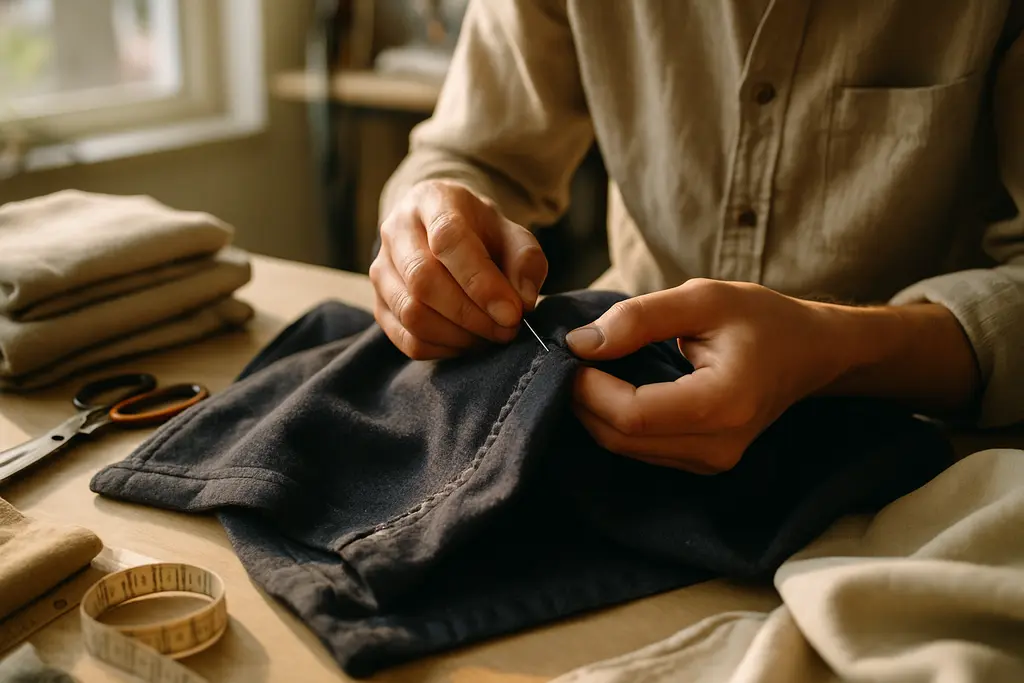
    Independent maker sewing a reinforced pocket onto dark fabric

    What Durable Fashion Means For Makers

    For independent makers, the rise of durability language creates opportunity but also pressure. A small label or solo seller may not have access to formal testing, yet they can still communicate process clearly. Fibre content, care instructions, reinforcement choices, made-to-order timing, and repair options all help buyers understand what they are paying for.

    Claims need restraint. A seller should not promise that a garment will last a decade unless there is a sound basis for that claim. It is safer to describe construction choices: French seams, reinforced stress points, replaceable buttons, pre-washed cloth, repair kits, or spare yarn. Specifics build trust without overstating evidence.

    Price, Time, And Community Trust

    The cultural value of craft is often tied to time. A hand-finished edge, custom fitting, or visible mend may not suit the lowest possible price. That can create tension in creator commerce, especially when buyers compare handmade work with mass-produced items. Clear explanation helps: materials, labour, fit adjustments, and aftercare can be part of the story without turning the maker into a marketing prop.

    This shift also connects with broader fall 2026 style reading, including tailoring, colour choices, and creator-commerce signals discussed in fall 2026 fashion trends. Durability does not cancel seasonal taste. It changes the questions attached to it: will the piece be worn often, repaired if needed, and kept after the trend cycle moves on?

    Rights and likeness issues require similar caution. Costume-inspired sellers and fantasy-fashion makers should avoid implying authorization for protected characters, logos, or celebrity likenesses unless they have appropriate rights. The safer creative route is original design language, transparent materials, and community-rooted craft rather than commercial imitation.

    Durable Fashion And Fall 2026 Design Culture

    Durable fashion in fall 2026 is best understood as a convergence of evidence, taste, and frustration. Consumers report that construction and fibre content matter. Retail repair programs have gained public attention. Designers and makers are using craft signals to suggest endurance, though those signals deserve careful reading.

    The most credible future for this design direction is not anti-fashion. It is fashion with memory built in: garments that can be worn, altered, repaired, and judged by more than novelty. For artists, makers, and communities who have long valued the hand, the seam, and the mended edge, the current attention may feel overdue. The task now is to keep the conversation honest, specific, and respectful of the labour behind the clothes.

  • WPA artists Reframed at The Rockwell Museum

    WPA artists Reframed at The Rockwell Museum

    As of September 21, 2026, The Rockwell Museum’s fall Spotlight Exhibition, Art at Work: Reframing Artists of the WPA, places WPA artists within a civic and social frame rather than treating New Deal art as a closed chapter. The exhibition opened on September 5, 2026, and is on view through January 19, 2027; the museum states that it brings together 28 prints and paintings from its collection and significant loans, including work by Thomas Hart Benton, Philip Evergood, Yasuo Kuniyoshi, Reginald Marsh, Elizabeth Olds, Dox Thrash, and others The Rockwell Museum exhibition page.

    The timing gives the show added weight. The Rockwell Museum connects the exhibition with the 250th anniversary of the nation in 2026 and the museum’s 50th anniversary, under the theme “Rockwell Reframed.” That framing invites a careful question: how should viewers read art made under public employment programs during the Great Depression without flattening the artists into symbols of a single federal project?

    Why WPA artists Matter At The Rockwell Museum

    WPA artists In A Public Collection

    The Federal Art Project, part of the WPA, operated from 1935 to 1943 and hired thousands of visual artists to make work reflecting everyday life in America during the Great Depression. The Rockwell Museum’s choice to focus on prints and paintings matters because these mediums often travel between public, institutional, and personal settings. A print can speak to distribution and affordability; a painting can invite slower attention to gesture, composition, and local detail.

    The selected WPA artists include figures with established art-historical reputations and others whose work may be less familiar to general museum audiences. That mix is valuable, but it also asks for care. Fame can create an uneven reading of group exhibitions: a known name may pull attention away from artists whose work carried different social or formal stakes. The exhibition’s title, with its emphasis on reframing, suggests a refusal to let the best-known participants define the whole story.

    Anniversary Framing Without Nostalgia

    Anniversary exhibitions can drift toward celebration alone. Here, the subject makes that difficult. The works emerged from economic hardship, public labor policy, and debates about who has access to cultural production. The WPA was not only an art story; it was also a labor story. That is why the exhibition’s themes, as described by the museum, help organize the material around the dignity of labor, regional place and community life, and government patronage.

    Those themes keep the show from becoming a period room for Depression-era images. They also invite viewers to ask how a museum collection can hold works made under conditions of crisis. The question is not whether the past offers a simple model for the present. It does not. The more useful question is how public support shaped what artists were able to make, who received recognition, and which communities entered the visual record.

    How The Exhibition Frames Work And Community

    Labor As Subject And Structure

    The dignity of labor is one of the exhibition’s central sections. That phrase can be read in two directions. It names labor as a subject in art: people at work, tools, bodies, production, fatigue, and skill. It also points to the labor of artists themselves. Under the Federal Art Project, artists were workers within a public program. Their work was not treated solely as private inspiration or market activity.

    This distinction remains useful for cultural analysis. If art is seen only as a luxury object, then public investment can appear secondary or decorative. If art is seen as skilled labor that records public life, the argument changes. The Rockwell Museum’s exhibition appears to sit in that second frame, showing art as both image-making and civic work.

    Community Life Beyond A Single National Image

    The museum’s section on regional place and community life also deserves attention. The research provided by the museum names community life as a theme, which suggests that the exhibition is not presenting one fixed picture of America. Works by artists such as Benton, Kuniyoshi, Marsh, Olds, and Thrash can carry different relationships to region, class, race, migration, and urban or rural experience. The available exhibition notes do not give enough detail to assign specific arguments to each artwork, so a careful reading should avoid claims beyond what the museum has stated.

    Even with that caution, the thematic structure is revealing. Public art programs can document shared conditions while still showing difference. Community life is not a single mood or style. It can appear through streets, farms, interiors, workplaces, and gathering spaces. A viewer moving through this exhibition may encounter the New Deal period not as one national story, but as a set of lived settings mediated by individual artists.

    Public Patronage Without Simplifying The Record

    Archival-style mural study shown beside framed artworks

    Government Support As An Artistic Condition

    The third theme, government patronage, is especially relevant because it names the support system directly. The exhibition includes a major loan: William Gropper’s 1938 mural study for the Department of the Interior building in Washington, D.C. A mural study is a useful object for this conversation because it points to art before public installation. It can reveal planning, adaptation, and the relationship between an artist’s hand and a public commission.

    Government support did not create one uniform style. The research notes point to aesthetic range within the WPA, including representational and abstract approaches, although this exhibition’s public description emphasizes the works and themes rather than a full stylistic survey. That restraint is helpful. WPA art is often reduced to recognizable social-realist imagery, yet the program included artists working across different visual languages.

    Equity Questions In The Historical Record

    Modern discussion of New Deal art often returns to access: who was hired, who was seen, and who entered institutional memory. An editors’ note in Notes in the History of Art states that WPA hires included artists from working-class backgrounds, that 41% were female in 1935, and that the program helped catalyze later community art center movements Notes in the History of Art editors’ note. Those details do not mean the program solved inequity. They do show why the WPA remains a reference point in debates about cultural labor and institutional gatekeeping.

    The Rockwell Museum’s reframing arrives at a moment when museums are often asked to account for collection histories and public responsibility. Based on the research available, the exhibition seems to use the WPA not as a decorative anniversary subject, but as a way to examine how artists and institutions represent resilience during economic stress. That does not require romanticizing the 1930s. It requires seeing public art as evidence of choices: funding choices, curatorial choices, and choices about which forms of community memory are preserved.

    WPA artists And Their Relevance Today

    WPA artists As Civic Memory

    WPA artists remain relevant because their work sits at the crossing point of culture, labor, and public life. The Rockwell Museum’s exhibition shows how art can register economic hardship without reducing communities to hardship alone. The three-part structure described by the museum gives viewers a clear path: first labor, then community, then patronage. That sequence matters. It moves from people and work to place and belonging, then to the systems that made the art possible.

    The most useful contemporary lesson is not that the Federal Art Project can be repeated in identical form. The historical conditions were specific. The stronger lesson is that art made with public support can carry social awareness while still allowing formal difference, regional specificity, and individual agency. This point is especially relevant for museums, schools, community arts organizations, and public funders considering how creative labor is valued during periods of strain.

    For those interested in exploring related arts coverage, Shimply provides insights within the same network. This connection is particularly meaningful as the Rockwell Museum exhibition encourages us to see art as part of a larger system encompassing makers, audiences, and cultural institutions.

    What makes Art at Work: Reframing Artists of the WPA timely on September 21, 2026, is its refusal to separate aesthetics from conditions of making. The works on view through January 19, 2027, belong to a past federal program, but the questions they raise remain active: Who gets supported? Whose labor is visible? Which communities are recorded with dignity? The exhibition cannot answer those questions for every present debate, yet it gives viewers a grounded place to start.

  • GaHee Park Exhibition And Surreal Fantasy

    GaHee Park Exhibition And Surreal Fantasy

    The GaHee Park exhibition Behind the Curtain opened at Yerba Buena Center for the Arts in San Francisco on August 7, 2026, and is scheduled to run through January 3, 2027. YBCA identifies it as Park’s first U.S. solo institutional museum exhibition, curated by Dorothy Dávila YBCA announcement. As of September 7, 2026, the exhibition is no longer an upcoming debut; it is an active presentation that can be discussed through its stated themes, its institutional framing, and its relation to fantasy and surrealist visual language.

    Park was born in Seoul in 1985 and is based in Montreal. Her education, as listed by YBCA, includes a BFA from Tyler School of Art in Philadelphia in 2012 and an MFA from Hunter College in New York in 2015. Those biographical facts do not explain the paintings by themselves, yet they do place the exhibition within a transnational art education and studio context rather than a single regional category.

    Why The GaHee Park Exhibition Matters Now

    GaHee Park Exhibition As Institutional Threshold

    The significance of this GaHee Park exhibition rests partly on format. A solo museum exhibition in the United States gives viewers a chance to encounter a body of work across time, rather than through isolated fair presentations, gallery images, or single reproductions. YBCA states that Behind the Curtain features paintings from roughly the last five years, around 2021 to 2026. That span is narrow enough to preserve a focused mood, but long enough to suggest changes in motif, pacing, and pictorial pressure.

    The title Behind the Curtain is useful because it frames looking as a charged act. A curtain can imply theater, domestic privacy, concealment, or staged revelation. Park’s listed themes—sexuality, mortality, fantasy, identity, and alienation—fit that threshold. The viewer is invited to see, but the paintings appear to question the terms of that viewing.

    What The Exhibition Claims, And What It Does Not

    Evidence from the museum material supports a careful reading of Park’s work through surrealism and fantasy. It does not support broad claims about a new movement, a market trend, or a generational consensus. For that reason, the safer critical move is to look at how the motifs work inside this specific show.

    YBCA describes a palette that includes muted grays and pinks, with motifs such as women in contemplative solitude, still lifes, cocktails, cats, insects, and reflections. These details suggest a domestic or intimate pictorial field, but not a simple one. Still life, portraiture, and interior space are familiar art-historical structures. Park’s use of reflections and solitary figures, as described by the institution, complicates who is looking and who is being looked at.

    Surrealism, Fantasy, And The Question Of The Gaze

    Fantasy Without Escapism

    Fantasy in this context should not be reduced to escape. The GaHee Park exhibition positions fantasy beside mortality, alienation, sexuality, and identity. That grouping suggests a visual method for staging interior states that may not be available through realism alone. A cocktail, a cat, an insect, or a reflection can function as more than a prop when placed inside a psychologically charged scene.

    Surrealist influence is often discussed through dream logic, unexpected combinations, and disturbances of ordinary scale or behavior. Based on the research available here, Park’s work appears to draw from that broad visual inheritance while remaining grounded in intimate scenes. The phrasing should stay cautious: the museum describes the work as using a surrealist lens, but it does not require us to assign Park to a fixed historical category.

    Power Dynamics In Portraiture

    YBCA notes that the works subvert the viewer’s gaze and often invert traditional power dynamics in portraiture. That is a substantial claim, and it is best understood through the exhibition’s recurring motifs. A contemplative figure may appear available to view, yet the painting can deny easy possession through reflection, pose, scale, mood, or surrounding objects.

    This matters because portraiture has long involved questions of access, authority, and display. Who is represented? Who controls the scene? Who is permitted to look without being questioned? Park’s paintings, as framed by YBCA, appear to place those questions inside scenes that are at once intimate and unstable. The result is not simply surreal imagery, but a test of the viewer’s confidence.

    Film, Fashion, And Cross-Medium Fantasy

    The Open Window Film Series

    The exhibition is accompanied by a related film series titled Through an Open Window, co-presented with filmmaker Michael Vass and YBCA. It began on August 15, 2026, and is scheduled for Saturdays at 2 p.m. through October 31, 2026. YBCA describes the program as 12 screenings and also describes its components as 11 features plus 3 shorts, including films connected with figures such as Alfred Hitchcock, Joan Jonas, and Maya Deren.

    That film context matters because it gives viewers a parallel way to think about frames, windows, bodies, desire, and suspense. A painting exhibition does not become cinema because a film series sits beside it. Still, the pairing suggests that YBCA wants the audience to consider Park’s images in relation to moving-image traditions where looking, concealment, and psychological tension are formal tools.

    Costume, Surface, And Community Imagination

    For readers who follow fantasy fashion, costume culture, or handmade visual practice, Park’s work offers a useful reminder: fantasy aesthetics need not be loud to be potent. Muted colors, staged interiors, reflective surfaces, and small symbolic objects can carry as much imaginative force as ornate costume or theatrical spectacle. For adjacent reading across fantasy dress and art-inspired visual culture, you might find valuable insights at Fairytale Fashion, a site within the same network of interests.

    This connection should be made with care. The available research does not say that Park is designing fashion or working in cosplay culture. The relation is interpretive, not biographical: viewers interested in how surface, self-presentation, fantasy, and identity meet across mediums may find the exhibition productive without collapsing painting into costume or costume into painting.

    Dates, Access, And Verified Exhibition Details

    Gallery entrance area with visitors checking exhibition information

    Practical Information With Date Clarity

    Because the exhibition opened before September 7, 2026, date language should be precise. Behind the Curtain opened on August 7, 2026, and runs through January 3, 2027. The related film series began on August 15, 2026, and is scheduled to continue through October 31, 2026. YBCA lists admission as $10 general admission, $5 for students and seniors, and free general admission on Wednesdays.

    • Exhibition: Behind the Curtain at Yerba Buena Center for the Arts, San Francisco.
    • Curator: Dorothy Dávila.
    • Dates: August 7, 2026, through January 3, 2027.
    • Related program: Through an Open Window, August 15 to October 31, 2026.
    • Admission listed by YBCA: $10 general, $5 students and seniors, free general admission on Wednesdays.

    Collections And San Francisco Context

    YBCA lists Park’s work in the permanent collections of the Columbus Museum of Art in Ohio, Institute of Contemporary Art Miami in Florida, Pond Society in Shanghai, and Medianoche Foundation in Granada, Spain. Collection placement can signal institutional recognition, though it should not be treated as a full measure of an artist’s importance. It is one piece of evidence within a broader practice.

    There is also a separate San Francisco art context around Park in late 2026. SF/Arts lists her first solo show with Jessica Silverman as scheduled to open on October 28, 2026 SF/Arts listing. Since that date is after September 7, 2026, it remains scheduled rather than past. The overlap suggests that San Francisco viewers have more than one institutional or gallery point of contact with Park’s work during the same period.

    Behind The Curtain And GaHee Park Exhibition Context

    A Careful Critical Frame

    The most persuasive reading of the GaHee Park exhibition is not that it announces a single trend, but that it gathers a set of visual problems: how fantasy can carry unease, how portraiture can resist possession, and how familiar objects can become unstable. The stated motifs—women alone, still lifes, cocktails, cats, insects, and reflections—are ordinary enough to be recognizable. Their force appears to come from arrangement, mood, and the pressure of looking.

    As a first U.S. solo institutional museum exhibition, Behind the Curtain gives Park’s recent paintings a public frame with enough space for comparison and close attention. The show’s value, based on the verified material available, lies in that concentrated encounter: surrealism as a lens, fantasy as a pressure point, and the gaze as a question rather than a settled position.

  • No-Man’s-Land Exhibition At Knoxville Museum

    No-Man’s-Land Exhibition At Knoxville Museum

    The No-Man’s-Land Exhibition at the Knoxville Museum of Art runs from August 13, 2026 through November 8, 2026, and remains open as of September 3, 2026, according to the museum’s Knoxville Museum of Art listing. The museum listed the opening reception for Thursday, August 13, 2026, beginning at 5:30 PM, with a members’ and artists’ hour from 5:30 to 6:30 PM.

    The exhibition gathers work by ten artists: Seba Calfuqueo, Ada Friedman, Guillermo Galindo, Eddie Owens Martin, Harrison Mayes, Erin Jane Nelson, Sarah M. Rodriguez, Suzanne Treister, Saya Woolfalk, and Joseph Elmer Yoakum. Its organizing idea is not a single border line, but a set of threshold spaces between bodies, spiritual traditions, cultures, countries, private property, public ground, and imagined planets. That breadth calls for care. Rather than treating borders as simple metaphors, the exhibition appears to ask how people make meaning in places where ownership, identity, belief, and movement do not settle neatly.

    What The No-Man’s-Land Exhibition Asks Of Viewers

    How The No-Man’s-Land Exhibition Uses Border Thinking

    The No-Man’s-Land Exhibition is centered, in part, on Harrison Mayes, a Kentucky coal miner turned evangelist who was born in Tennessee in 1898 and died in Middlesboro, Kentucky, in 1986. For more than 60 years, Mayes installed concrete beacons inscribed with spiritual messages in ambiguous strips of land between state and private property. Those sites, described as “no-man’s-lands,” give the show a grounded point of departure. The title is not only poetic; it is tied to a specific practice of placing hand-built markers where authority and access could be unclear.

    That focus is useful because it keeps the exhibition from becoming too abstract. A boundary can be political, legal, spiritual, bodily, ecological, or cosmic, but Mayes’ concrete beacons remind viewers that boundaries are also lived through materials and placement. A sign set in a contested strip of ground carries a different pressure than a sign inside a gallery. By bringing such ideas into the museum, the exhibition can frame the border as both a physical fact and an imaginative condition.

    Spiritual Messages And Public Ground

    Mayes’ work also raises questions about how personal conviction enters public space. The available research does not claim how passersby responded to his beacons, so that should remain uncertain. What can be said is that the practice combined religious language, durable concrete, and roadside or in-between locations. That combination matters because it places art-adjacent activity outside conventional art systems while still asking viewers to read form, message, and site together. In that sense, the show’s attention to Mayes opens a wider discussion about who gets to mark space and how those marks are later interpreted inside a museum.

    Artists And Materials In Border Spaces

    Found Objects, Sound, And Migration Memory

    Guillermo Galindo’s work, as described in the exhibition materials, uses found objects from the U.S.–Mexico border, including shoes, clothing, and fragments of fencing. He changes these remnants into sculptural instruments activated through sound. This practice should be approached with respect for the people and histories implied by the materials. The objects are not neutral studio supplies; they are tied to movement, exposure, loss, and memory along a heavily charged border. Sound, in this context, can make absence perceptible without pretending to resolve the conditions that produced it.

    The full artist list shows how broad the exhibition’s border concept is:

    • Seba Calfuqueo
    • Ada Friedman
    • Guillermo Galindo
    • Eddie Owens Martin, also known as St. EOM
    • Harrison Mayes
    • Erin Jane Nelson
    • Sarah M. Rodriguez
    • Suzanne Treister
    • Saya Woolfalk
    • Joseph Elmer Yoakum

    Speculative Bodies And Invented Worlds

    Saya Woolfalk’s contributions are described as reimagining beings who can alter genetic makeup and merge with plants. Her installations combine video, sculpture, textiles, and speculative environments, treating change as an ongoing state rather than a single before-and-after event. That position connects bodily boundaries to ecological imagination. It also shifts the exhibition away from border thinking as only a matter of national lines. A border can also be the unstable edge between human and plant, body and costume, biology and myth, or self and collective identity.

    Joseph Elmer Yoakum adds another register. Born in 1890 and deceased in 1972, Yoakum began producing art later in life and made more than 2,000 works over his final decade. His psycho-geographies, grounded in memory, imagination, and places ranging from Tennessee to Antarctica, suggest that geography can be internal as well as mapped. The available research does not provide individual object titles for this presentation, so close interpretation should wait for direct viewing or fuller documentation. Still, the inclusion of Yoakum supports the exhibition’s interest in places that are remembered, invented, crossed, or reconfigured.

    Access, Place, And The Museum Setting

    Museum exterior near a public park with visitors approaching the entrance

    Dates, Hours, And Local Access

    The Knoxville Museum of Art is located at 1050 World’s Fair Park Drive, Knoxville, TN 37916. The research notes list regular gallery hours as Tuesday through Saturday from 10 AM to 5 PM and Sunday from 1 to 5 PM. A local events listing states that exhibition admission and parking are free for Knox County residents, a practical detail that can affect who is able to spend time with the work rather than only know about it through images or announcements Find Knoxville.

    Access is not a secondary issue for a show about boundaries. If an exhibition studies cultural, spiritual, political, and bodily thresholds, then the conditions of entry matter. Free admission and parking for Knox County residents do not answer every access question, and the research does not specify every visitor circumstance. Even so, that policy is relevant because it reduces one barrier for nearby audiences. Readers can explore further creative-community perspectives at Robsonic, a related site in the same network.

    Support And Institutional Framing

    The exhibition is supported by McCarty, Holsaple, McCarty Architects, Inc.; Vicki S. Kinser and John Jarnagin; Debbie and Jimmy Jones; and Susan French. Sponsorship information is often easy to skip, yet it belongs in the record because exhibitions depend on institutional, financial, and community support. This does not define the meaning of the artworks, but it helps identify the setting in which audiences encounter them.

    Ada Friedman’s biography adds a university-linked thread to the presentation. The museum materials state that Friedman received the Grant Wood Fellowship and holds a Visiting Professorship in Painting and Drawing at the University of Iowa for 2025–26. They also note a prior role as Visiting Artist in Painting and Drawing at the University of Tennessee, Knoxville, in 2021–22. Such details are not proof of how a work should be read, but they place one artist within teaching, regional exchange, and institutional art education.

    No-Man’s-Land Exhibition At KMA

    A Cautious Reading Of Cultural Boundaries

    For Knoxville audiences, the No-Man’s-Land Exhibition offers a concentrated study of cultural boundaries without reducing them to one meaning. The available facts point to an exhibition that joins roadside spiritual markers, border-found sculptural instruments, speculative plant-human beings, imagined geographies, and other artistic approaches to threshold spaces. That range is significant, but caution is still needed. The research provided does not include critical reviews, visitor feedback, installation photographs, or object-by-object labels, so any broader judgment about reception would be premature.

    What can be said with confidence is that the show places materially different practices in relation to borderlands: concrete beacons, found objects, sound, textiles, sculpture, video, drawing, and imagined environments. Its strength, based on the documented theme, lies in treating boundaries as things people build, cross, inherit, imagine, and contest. The museum setting gives these works a shared frame, while the artists’ varied practices resist a single answer. That tension is the most useful reason to read the exhibition closely: it asks viewers to consider where a boundary begins, who names it, and what creative acts become possible at its edge.

  • Before the Spotlight: Origin Stories of Today’s Indie Icons

    Before the Spotlight: Origin Stories of Today’s Indie Icons

    We love a great artist origin story. There’s something powerful about those first steps. These stories show us raw passion and a strong belief in a unique sound.

    Take Flogging Molly, for example. Some doubted their energetic sound would succeed. But they believed in themselves. They built a career on a small indie label, with a loyal community.

    Ani DiFranco also made a groundbreaking move. She founded her own label, Righteous Babe Records. It was more than a business choice. It was a statement of artistic and financial freedom.

    We’re thankful for these stories. They show us that lasting innovation often begins from the bottom. It’s driven by authenticity and support. Let’s celebrate the spirit behind these amazing music career beginnings!

    Case Study 1: From Bedroom Recordings to Festival Headliner

    What started as a simple gesture in a bedroom turned into a career that inspired millions. We love sharing indie success stories that show how music can change lives. Mandy Harvey’s journey is a great example of this.

    Mandy faced a big challenge when she lost her hearing. For a singer, this could have ended her career. But she found a new way to connect with music. She recorded a heartfelt cover of “Come Home” for her husband in her bedroom.

    This raw, emotional recording became her foundation. It led her to the national spotlight on ‘America’s Got Talent’. From there, her career took off, with her becoming a festival headliner. This shows that even the most humble beginnings can lead to great success.

    This story fills us with excitement! It shows that raw talent and a true story can touch people more than perfect music. Mandy’s journey from a bedroom to a festival stage is a true indie success story. It proves that heart and vision are what truly drive success.

    Aspect The Bedroom Beginning The Festival Headliner Reality
    Environment A personal, quiet home space focused on emotional expression. Vast, public arenas and festival grounds with massive crowds.
    Technical Setup Basic recording equipment for a single, heartfelt take. Full professional production teams and state-of-the-art sound systems.
    Primary Audience One person (her husband) and herself. Thousands of fans and national television viewers.
    Mindset & Goal Personal connection and rediscovery of a lost passion. Sharing a message of hope and inspiration on a global scale.

    Mandy’s path shows a common thread in modern music. Many bedroom producers become festival headliners. The technology changes, but the core truth remains. Authentic expression in a personal space has incredible power.

    Her story is a reminder for all emerging artists. Your current creative space, no matter how modest, is valid. Your personal story is your greatest asset. The spotlight often finds those who create from a place of genuine truth, not fame. We are grateful for these inspiring indie success stories. They show us what’s possible when talent meets unwavering perseverance.

    Case Study 2: The College Radio Station That Changed Everything

    Bill Frisell’s journey to fame started in Denver’s Teller Elementary and Gove Junior High. These schools had great music programs. They gave him a community and a way to work together.

    We celebrate these local spots. Schools, community centers, and college radio stations are key. They help new talent grow before the world notices.

    College radio stations are special. They run on passion and coffee. Getting airplay there is a big deal. It’s like getting validation from friends and hearing your music on the radio.

    These places do more than teach music. They build a team spirit. Playing with friends or meeting new musicians helps artists grow. They learn to listen, adapt, and create something bigger.

    We’re thankful for these places. They work hard for the art and the people making it. By supporting local music and listening to indie radio, we help the next big thing.

    Case Study 3: Open Mic Nights and Early Fan Discovery

    In today’s digital world, nothing beats the power of an open mic night. These live settings are where talent meets an eager audience. Here, musician backgrounds are shaped, not alone, but together.

    The magic is in the moment. A laugh, a sigh, or the silence after a note creates a bond. This connection is real and human, unlike online followers. It’s the foundation of a lasting career.

    A cozy open mic night setting in an intimate cafe, with warm, soft lighting that creates a welcoming atmosphere. In the foreground, a diverse group of musicians is performing on a small stage, wearing casual yet stylish clothing. They exude passion and energy, engaging with a captivated audience. In the middle ground, small round tables are occupied by attentive listeners, some holding drinks and others jotting down notes or clapping softly. The background features rustic decor, string lights, and a chalkboard menu, enhancing the artistic vibe of the venue. The scene captures an inspiring moment of creativity and community, showcasing the early stages of indie musicians connecting with their fans in a nurturing environment. The image should be shot with a slightly blurred foreground for depth, and natural, warm tones to evoke a sense of comfort and discovery.

    Josh Barrett’s story shows this path well. Before joining The Wailers, he sang in his church choir and learned from neighbors. These places were his first stage and critics, all in a supportive setting.

    This early foundation was key. It gave him skills and confidence. He formed Judah Tribe, with fans who saw him grow. They supported him, not just because of marketing.

    Many artists follow this path. Open mic nights and local spots are more than gigs. They’re incubators for authenticity. Feedback is quick, relationships are deep, and growth is real.

    We’re thankful for these early chapters in artists’ lives. They show that a musician background built on live experiences is priceless. It’s the heart of finding fans and a lasting music career!

    The Role of Day Jobs in Artistic Development

    Before fame, many musicians worked regular jobs to fund their dreams. We see this as a sign of great dedication. It shows how passion and practicality can build lasting careers in music.

    Take percussionist Bill Summers, for example. Before joining Flo, he worked at a racetrack. He saved every penny, aiming for one goal. His savings helped him move to California and study music at UC Berkeley. This practical step didn’t slow him down; it propelled his career forward.

    Bill’s story teaches us a valuable lesson. Day jobs do more than just pay the bills. They offer life lessons that enrich an artist’s work and character. These lessons are invaluable:

    • Patience: Success in art doesn’t come quickly. Day jobs teach the importance of steady effort.
    • Resourcefulness: Making art on a tight budget sparks creativity. It turns limits into opportunities.
    • Deep Work Ethic: Handling multiple tasks builds stamina and discipline. Passion alone can’t always provide this.
    • Real-World Experience: Interacting with diverse people adds depth to art. It enriches songwriting and performances.

    We’re thankful for these stories of starting small. They show that the journey to success is unique. The day job chapter is a key part of this journey. It’s built on hard work, hope, and a deep love for the craft. Embracing this phase can lay a strong foundation for future success.

    Early Recordings: Demo Quality vs Professional Polish

    Before mixing boards and mastering suites, there’s the simple act of capturing a song. This moment is special! It’s where magic often happens, without the filter of overproduction. The contrast between a demo’s raw charm and a polished track is key for artists.

    Think of Jason Mraz writing “I’m Yours.” He just picked up his guitar and let the melody flow. That raw, spontaneous feeling connected with millions. It shows a demo’s value is in its authentic emotional capture, not just sound quality. These early career struggles are actually periods of pure innovation.

    A dimly lit, cluttered recording studio with vintage recording equipment scattered around. In the foreground, a young musician, dressed in modest casual clothing, appears focused and slightly frustrated as they adjust the dials on an old mixing console. Their body language conveys determination amidst struggle. In the middle ground, various instruments, like an acoustic guitar and a microphone stand, hint at the creative chaos of early demo recordings. The background features shelves filled with vinyl records and soundproofing materials that add to the authentic studio vibe. Soft, warm lighting casts a nostalgic glow, creating an atmosphere that reflects both ambition and the raw essence of the indie music scene.

    Limited equipment and technical know-how can seem like barriers. Yet, they often force incredible creativity. Artists learn to make the most of what they have. This creates a unique sound that polished records can sometimes miss.

    The key is to see the challenge as creative freedom, not a limitation. Learning to navigate these early career struggles builds a resilient, resourceful artistic mind.

    Fans often have a special fondness for these early, unvarnished recordings. They feel like a secret glimpse into the artist’s soul. This connection is priceless. It shows that perfection isn’t the goal—connection is.

    The energy in a rough take can be more compelling than a flawless, but sterile, studio version. For emerging artists, this phase is golden. Embrace the imperfections. Capture ideas freely without the pressure of a “final product.”

    If you’re wondering about process, exploring when to record a demo before finishing your song can offer great guidance. The demos you make today are the treasured artifacts of tomorrow. They document your growth and purest expressions. So, record freely, create boldly, and cherish the journey during these early career struggles.

    Social Media Before the Fame: Authentic vs Calculated Growth

    Before algorithms ruled, artists shared their true selves online. This early digital footprint shows a key choice. It’s between genuine growth and strategic moves. For artists facing early career struggles, this choice shapes their first impression.

    Faceman, Steve Schnepel’s musical alter ego, is a great example. His iconic mask came from his dad’s nickname, “rubber face.” This personal touch built a real community, not a fake image.

    Authentic growth is rooted in personal stories and passion. Calculated growth focuses on numbers and trends. True connections are more powerful than any strategy.

    • Authentic Growth: Based on personal stories or unique views. It feels like talking to a friend. The community is small but loyal. Content is heartfelt, even if it’s not always there.
    • Calculated Growth: Based on data and what others do. It feels like a deal. The goal is to get followers fast. Content is planned out carefully.

    When an artist’s true self becomes their brand, magic happens. This bond helps through tough times. For those in early career struggles, this bond is key. It gives the strength to keep going when progress is slow.

    A dedicated group of fans who connect with your true voice is priceless. This isn’t just advice; it’s a lasting model. It makes building an online presence a journey of discovery.

    So, think about this as you share your work: does it show me? Your answer will guide you through the noise. Building something real takes time, but it’s worth it.

    Breakthrough Moments: The Songs That Changed Everything

    We celebrate those defining tracks that serve as a launchpad, catapulting talented musicians into the public eye. These songs become synonymous with an artist’s name, creating a career launchpad that reshapes their future. For an indie artist, this moment is a whirlwind of excitement and profound change.

    Consider Hanson’s iconic single, “MMMBop.” This track wasn’t just a hit; it was a cultural phenomenon that defined the band’s early career. Taylor Hanson later reflected with immense pride on creating something that connected with millions globally. It was a testament to how a single melody could open doors to a worldwide audience.

    Similar to Hanson, the Flobots experienced a seismic shift with “Handlebars.” While it became known as a national one-hit wonder, its true power was in establishing the band’s enduring platform in their home state of Colorado. The song provided a permanent foothold and recognition that fueled their subsequent creative journey.

    A breakout song is a double-edged sword in the best possible way. The sudden surge of fame can be overwhelming. Yet, this very moment provides an unshakeable foundation. It transforms an artist from a hidden gem into a recognized name, granting them the visibility to build a lasting career.

    The positive impacts of such a breakthrough hit are transformative:

    • Instant Recognition: The artist’s name becomes known to a massive new audience almost overnight.
    • Creative Validation: It confirms that their artistic vision resonates on a large scale, boosting confidence.
    • Industry Opportunities: Doors open for better production deals, festival slots, and collaborations.
    • Fan Community Growth: It catalyzes the formation of a dedicated, supportive fanbase.

    We share these stories with gratitude for the magic of music. A defining track is more than a chart position; it’s a life-altering opportunity that rewards years of patience and craft. For every emerging artist, it represents the beautiful moment when years of work culminate in a song that changes everything.

    Mentor Relationships: Established Artists Helping Newcomers

    Mentorship in music is more than just learning chords. It’s about gaining a philosophy that shapes a career. The most lasting musician backgrounds often come from guidance by those who came before. This cycle of giving back is key to artistic growth.

    We are thankful for the established artists and community leaders who share their wisdom. Their help goes beyond simple advice. It creates a legacy of support that sparks innovation across generations.

    The band Flobots’ story is a powerful example. Their mentor, the late historian Vincent Harding, didn’t teach them guitar. Instead, he challenged their purpose. Harding helped them use their music for social commentary, shaping their identity and mission.

    For jazz legends, their backgrounds are filled with influences. Guitarist Bill Frisell’s sound was shaped in New York, where he learned from Paul Chambers and Charles Mingus. These giants gave him a wealth of ideas, technique, and approach to make his own.

    These mentorships offer more than just technical tips. They provide philosophical grounding. A mentor helps navigate the industry and clarifies artistic values. This support is key for building resilience and authenticity.

    This knowledge and ethos transfer is essential. It prepares new artists to contribute to the cultural conversation. A caring mentor turns raw talent into a sustainable, innovative, and meaningful career.

    Looking at successful musician backgrounds, mentorship is often a key factor. It shows the power of community and the lasting effect of sharing knowledge to guide others.

    Lessons for Current Emerging Artists: Patience and Persistence

    Artist origin stories show us a key truth. A music career is a long journey, not a quick race. Success comes from being patient and persistent.

    Dressy Bessy’s Tammy Ealom kept writing songs for eight years before releasing new music. DeVotchKa worked for seven years to create an album that met their high standards. Taj Mahal has been making music for over 60 years.

    These stories teach us that quiet times are important. They are periods of growth. Your unique path and timing are your strengths.

    We urge every new artist to believe in this journey. Stay connected with your community. Let your true passion guide you. Your story is unfolding with every note and challenge.

    Let these stories of perseverance motivate you. Build your legacy step by step, with patience and persistence.