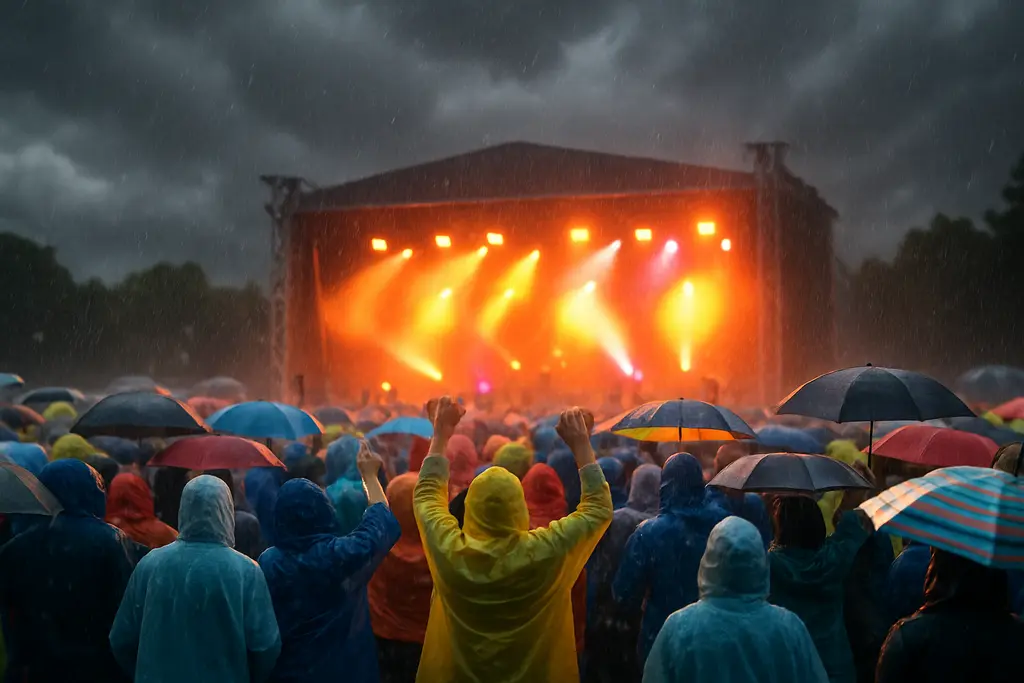
Festival weather disruptions shaped several major U.S. music events in 2026, not as background inconvenience but as a defining condition for artists, crews, audiences, and host communities. As of October 5, 2026, the clearest review is retrospective: events scheduled earlier in the year have either concluded, been cut short, or been canceled. The artistic question is not only what performances were lost. It is also how outdoor music culture, local planning, and audience trust respond when weather turns the site itself into the central concern.
That framing matters because festivals are cultural gatherings before they are simple entertainment products. A canceled day can mean lost chances for emerging artists, interrupted travel plans for fans, and revenue gaps for nearby workers. At the same time, severe weather decisions are safety decisions. A review that respects music communities has to hold both truths: disappointment is real, and weather-related shutdowns can be necessary when wind, flooding, lightning, or site damage makes a crowd environment unsafe.
How Festival Weather Disruptions Changed 2026 Reviews
Festival Weather Disruptions As Cultural Criticism
Festival weather disruptions complicate the usual language of music criticism. A reviewer cannot fairly judge a festival only by the bill, stage design, or crowd energy when the event was reshaped by emergency delays, evacuations, or damaged grounds. The 2026 examples show that a review now has to ask practical questions: Were schedule changes communicated clearly? Did the site have workable exit paths? Did the festival protect crews and performers as well as ticket buyers? Those questions sit beside artistic ones.
Oceans Calling Festival in Ocean City, Maryland, was scheduled for September 25–27, 2026, but the event was canceled before the weekend after a rare September nor’easter brought heavy rain, high winds, beach erosion, flooding, and unsafe conditions. Organizers cited tides, floods, and high winds, and the festival had sold out with a reported capacity of about 55,000 per day, according to The Washington Post. That scale makes the cancellation more than a local schedule change; it affected a large temporary public space built around coastal infrastructure.
Coastal Sites Faced Distinct Pressures
Coastal festivals face risks that inland festivals may not experience in the same way. In the research record for September 2026, Ocean Way Festival in Santa Monica was canceled on September 11, 2026, after Hurricane Marie’s surf and storm runoff eroded beach areas planned for the inaugural event. The venue was deemed unsafe for both build-in and audience capacity. In the New York City area, Global Citizen and All Things Go were also canceled during the same September 25–27 weekend affected by the nor’easter system cited in relation to Oceans Calling.
The shared issue is not simply rain. Coastal erosion, storm runoff, flood potential, and wind exposure can change what a festival site can safely hold. For community organizers, that is an arts planning issue as much as a weather issue. Temporary stages, vendor areas, public art installations, fashion activations, and accessibility routes all depend on ground conditions. A beautiful waterfront site can create a powerful setting, but the same openness that gives the event its atmosphere can leave it exposed.
Bonnaroo, Delays, And Site Recovery
Manchester’s 2026 Schedule Was Interrupted
Bonnaroo Music & Arts Festival in Manchester, Tennessee, took place June 11–14, 2026, but the event was again affected by weather. Sunday had a three-hour delay and canceled sets due to thunderstorms, as reported by IQ Magazine. Research notes also indicate that organizers announced on August 21, 2026, that there would be no Bonnaroo in 2027 so the site could recover.
That detail is significant because recovery is usually less visible than cancellation. Audiences often experience the immediate result: a delayed gate, a missed set, an evacuation message, or a shortened day. Site recovery involves a different time scale. Roads, drainage, grass, camping areas, and load-in routes shape whether the next festival can operate with acceptable risk. The research notes say Bonnaroo had invested in new roadways, grass, and drainage before 2026, yet weather still disrupted the schedule and led to evacuations.
Attendance Does Not Erase Vulnerability
Large attendance can signal strong audience loyalty, but it does not make an outdoor event less vulnerable. The research notes estimate Bonnaroo 2026 attendance at around 45,000 people despite weather issues. A crowd of that size makes weather response more urgent, not less. Evacuation, sheltering, transportation, medical access, and staff coordination all become harder when tens of thousands of people are dispersed across a farm site.
For reviewers, this suggests a shift in what deserves attention. A festival’s cultural value may still come from community rituals, genre mixing, stagecraft, and shared memory. Yet its credibility also depends on whether the event can care for the people who make those moments possible: stagehands, food vendors, touring musicians, disabled attendees, campers, security staff, and local residents.
Communication, Evacuations, And Audience Trust
September Storms Tested Several Cities
During the September 18–21, 2026 weekend, severe thunderstorms and lightning affected several major U.S. festivals in the Midwest and Southeast. Research notes identify Riot Fest in Chicago, Shaky Knees in Atlanta, and Louder Than Life in Louisville among the events that adjusted set times, evacuated, or halted performances. Riot Fest cut its second day short, while Shaky Knees evacuated on Saturday evening.
At Shaky Knees, research notes state that 60 mph wind gusts forced evacuation of Piedmont Park on Saturday night. Attendee frustration centered on communication, including an evacuation text followed about two hours later by a reopening notice when only one headliner remained. Without overstating from a single case, that example shows why communication is part of the audience experience. Safety instructions have to be fast, clear, and consistent enough for people to act on them under stress.
Creative Communities Need Clear Signals
Festival weather disruptions also affect the creative workers surrounding the music. Costume designers, merch sellers, photographers, stylists, installation artists, and independent makers often plan around festival weekends. A sudden shutdown can leave handmade inventory, travel expenses, and collaboration plans in limbo. For a closer look at how fashion intersects with event culture, a related site offers insight within the same network.
Those communities need clear signals before, during, and after an event. Before gates open, audiences need to know bag policies, shelter expectations, refund procedures, and where official updates will appear. During a storm threat, they need fewer mixed messages and more direct instructions. After a cancellation, they need honest timelines for refunds, rescheduled appearances where applicable, and artist updates. None of that restores a missed performance, but it can preserve trust.
What 2026 Shows About Outdoor Music Risk
The 2026 record does not support a careless claim that every festival is now unsafe, and it should not be read that way. Many outdoor events still proceed without major disruption. The supported evidence does show that severe weather affected a notable group of major festivals across different regions: coastal Maryland, Santa Monica, Manchester, Chicago, Atlanta, Louisville, and the New York City area all appear in the research notes. The causes varied, including thunderstorms, lightning, high winds, flooding, beach erosion, storm runoff, and a nor’easter.
That range matters because it resists a single solution. Lightning protocols are not the same as erosion planning. A campground drainage problem is not identical to a city park evacuation. A beach festival’s build-in risk differs from a multi-stage inland site. Treating these as one generic “bad weather” problem can flatten the practical differences that event producers, municipalities, artists, and audiences have to address.
For arts reviewers, the fairest standard is to evaluate both preparation and response. Preparation includes site selection, drainage, load-in planning, shelter options, and communication channels. Response includes whether delays are timely, whether evacuations are orderly, whether staff have consistent information, and whether post-event explanations match what attendees experienced. These are cultural judgments because they shape whether a festival feels like a shared civic gathering or a fragile commercial container.
Festival Weather Disruptions And U.S. Music Culture
Festival weather disruptions are now part of how 2026’s U.S. music festival year will be remembered. Oceans Calling was canceled before its September 25–27 weekend. Bonnaroo concluded after thunderstorm delays and canceled sets on June 14, 2026. Shaky Knees, Riot Fest, Louder Than Life, Ocean Way, Global Citizen, and All Things Go were each affected in the research record by storms, wind, erosion, evacuation, or cancellation.
The cultural impact is measured in more than lost stage time. It appears in artists who lose a major audience moment, fans who travel for a weekend that changes in hours, crews who work under dangerous conditions, and host communities that absorb both celebration and disruption. A careful review should not turn those experiences into spectacle. It should ask what was known, what was communicated, and what can be learned without pretending that weather can be fully controlled.
For communities that love live music, the goal is not to retreat from outdoor gathering. It is to treat weather resilience as part of the art of producing public culture. The best festivals are remembered for sound, style, movement, and belonging. In 2026, they were also judged by how they responded when the sky, ground, and shoreline changed the terms of the show.