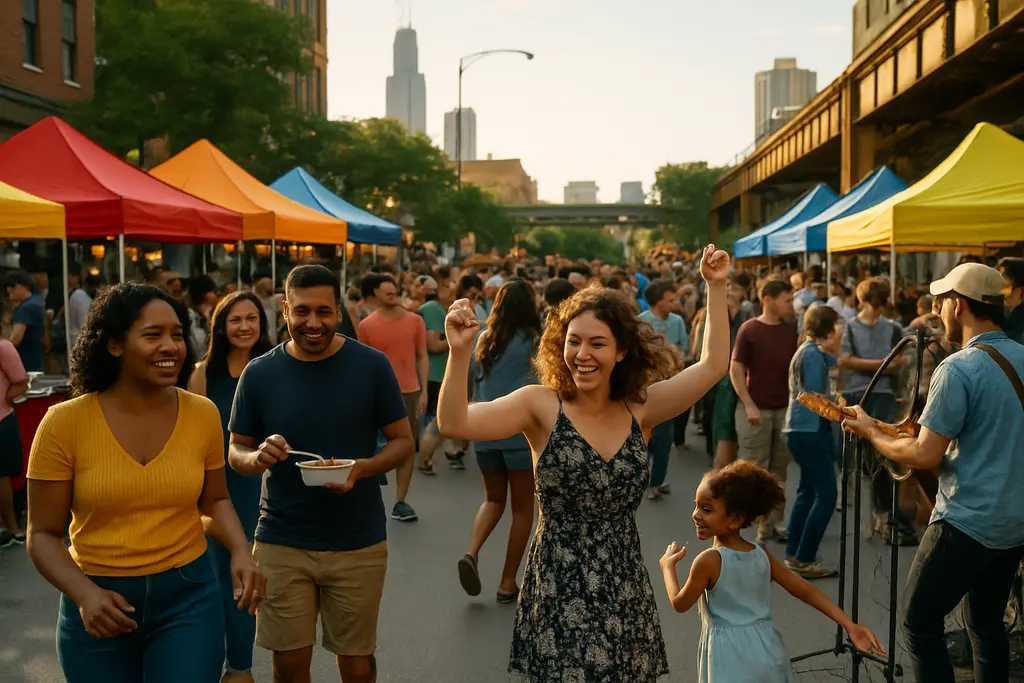
PravdaFest Chicago returned on Saturday, September 12, 2026, at FitzGerald’s Nightclub in Berwyn, Illinois, after being billed as a day-and-evening gathering built around Pravda Records’ roster and guests. The official festival page listed 16 bands across three stages, placing the event within the kind of label-centered, venue-rooted programming that can reveal how an independent music community remembers itself in public PravdaFest details.
Because the event had already taken place by October 5, 2026, the more useful frame is not a preview. It is a measured look at what the return signaled: continuity for a long-running Chicago independent label, a practical use of a multi-stage club setting, and a public gathering where catalog history and present-day performance met in one room, patio, and stage schedule.
What PravdaFest Chicago Marked In 2026
PravdaFest Chicago And The Label Story
Pravda Records has been described by its own materials as Chicago’s longest continuously operating independent rock label, founded in 1984 by Kenn Goodman. That claim matters less as a slogan than as a structural fact about duration. Independent labels often serve as archives, release channels, social networks, and informal conveners at the same time. A festival tied to such a label can carry the feeling of a reunion, but it can also show how older releases, current bands, and audience memory remain connected.
Axios reported that the label has released more than 200 records by more than 70 artists, a scale that gives context to why a label festival can fill a full day rather than a short showcase Axios Chicago report. The 2026 event’s confirmed names included Jon Langford, The Effigies, The Handcuffs, the Josh Caterer Trio, and Nicholas Tremulis & the Prodigals. That group of artists suggests a program concerned with continuity across scenes rather than a single narrow sound.
Why A Return Carries Cultural Weight
The word “return” can be overused in music writing, but here it has a specific basis. PravdaFest had earlier marked the label’s 38th anniversary in 2022 with a two-day festival at Sketchbook Brewing in Skokie, Illinois. The label later celebrated its 40th anniversary with a 2024 PravdaFest at FitzGerald’s, featuring 17 bands across three stages. The 2026 date did not appear in isolation; it followed a recent pattern of anniversary and community gatherings tied to the label’s catalog and friendships.
The strongest reading of PravdaFest Chicago is that it functioned as a living index of a label’s relationships. Not every listener at a multi-act event arrives with the same reference points. Some may come for one older act, others for a current favorite, and others because FitzGerald’s has earned trust as a gathering place. That mix is part of the cultural value: a festival can let separate listening histories share space without forcing them into one story.
A Label Anniversary Framed By A Venue
FitzGerald’s As A Practical Setting
FitzGerald’s Nightclub in Berwyn was more than an address for the September 12, 2026 event. The official listing’s three-stage structure indicates a format designed for movement, overlap, and pacing. In venue terms, three stages can create a marathon feel without asking every artist to carry the same kind of audience pressure. It lets a festival shift between headline recognition, catalog depth, and shorter discovery sets.
There is a community reason this matters. Independent music events succeed or fail not only through booking but through flow: whether people can move between performances, pause between sets, meet friends, and still feel oriented. The research notes do not provide attendance figures or set times, so any claim about crowd size would be unsupported. What can be said is narrower and firmer: the listed design used multiple stages over a day-and-evening span, giving the label room to present a broad roster in one venue environment.
The Berwyn Factor
Berwyn’s presence in the festival listing is also worth treating with care. It would be easy to fold the event into a simplified “Chicago music” label and ignore the suburban venue context. Yet the official materials identify FitzGerald’s in Berwyn, Illinois, and that matters for how audiences encounter the event. A venue just outside the city line can still be part of the region’s live-music ecology, especially for listeners who follow artists rather than municipal boundaries.
For readers tracking community arts programming across the region, the relationship between venues, routes, and local identity also appears in coverage of Chicago Exhibition Week, where cultural participation is shaped by how people move between spaces. Music festivals and visual-arts weeks are different forms, but both depend on access, timing, and trust in host sites.
Why The Roster Format Mattered
A Label Festival Is Not Just A Lineup
A commercial festival lineup often reads as a stack of market signals: billing order, genre lane, draw, and scarcity. A label festival can work differently. The September 12, 2026 PravdaFest listing tied performers to the history of Pravda Records itself. That does not make the event better by default, but it changes how one might read the program. The roster becomes part of an institutional memory, not only a set of unrelated appearances.
PravdaFest Chicago, viewed this way, was less about isolating one act as the event’s single meaning and more about showing how a label’s long-term practice can gather different audiences. The confirmed performers named in reporting span artists with distinct histories and followings. Without inventing genre claims beyond the supplied research, it is fair to say the 2026 bill drew on acts associated with the Pravda circle and placed them in a shared festival frame.
Respecting Artists Without Flattening Them
Community festivals sometimes risk turning artists into symbols of a scene rather than treating them as working performers with separate bodies of work. A cautious reading avoids that. Jon Langford, The Effigies, The Handcuffs, the Josh Caterer Trio, and Nicholas Tremulis & the Prodigals should not be collapsed into one aesthetic just because they appeared in the same reported context. The label connection is meaningful, but it is not a substitute for listening to each act on its own terms.
- The supported facts show a 16-band event across three stages on September 12, 2026.
- The available sources support the label’s founding year, long operation, and broad release history.
- The reporting identifies several confirmed performers, but it does not justify claims about attendance, sales, or audience demographics.
That boundary is useful. Evidence-based music coverage should not inflate an event into a movement without data. What can be honored is the work of gathering: a label, artists, venue staff, and listeners sharing a day structured around independent music history.
Community Context Beyond One Stage
Independent Infrastructure And Audience Trust
The return of a label-centered festival highlights a form of infrastructure that can be easy to miss. Independent labels preserve catalogs, maintain relationships with artists, and give audiences a recognizable point of entry. Venues provide the physical setting where those relationships become public. Neither side can replace the other. When they meet in a format such as PravdaFest, the result is not simply entertainment; it is a visible act of cultural maintenance.
This is where the community category becomes more than a tag. A festival built from a label’s own roster and guests can help audiences understand independent music as a set of relationships rather than a queue of content. That distinction matters in local culture writing because it keeps attention on people, spaces, and histories without pretending every event has the same scale or impact.
Culture Coverage With Appropriate Limits
For adjacent arts and creator coverage within the same network, community culture often depends on small-scale participation as much as headline recognition. This context aligns with other platforms such as Shimply, which highlights the importance of such community-based initiatives. Still, caution is needed. The research supplied for this piece does not establish economic impact, travel draw, or long-term outcomes from the 2026 festival. Those questions would require attendance data, venue reporting, artist interviews, or local business evidence.
What the available record does show is a carefully bounded claim: Pravda Records used FitzGerald’s to gather 16 bands and guests on three stages on September 12, 2026, extending a recent pattern that included the 2022 38th-anniversary event and the 2024 40th-anniversary event. That is enough to discuss continuity, but not enough to declare a broad regional shift.
PravdaFest Chicago As Community Memory
PravdaFest Chicago stands out because it placed label history in a live setting after more than four decades of Pravda Records activity. The event’s value, based on the supported record, lies in how it connected a long-running independent label, a Berwyn venue, and a roster tied to that label’s extended circle. It was not necessary to overstate the case for the gathering to matter.
For PravdaFest Chicago, the clearest community lesson is that music culture is often sustained through repeat contact: artists returning to shared spaces, audiences trusting familiar hosts, and labels treating their catalogs as active relationships rather than closed files. On September 12, 2026, that idea took the form of a three-stage festival at FitzGerald’s. The lasting interpretation should remain grounded in what is known, while leaving room for artists and attendees to define what the day meant to them.