
Fashion Nostalgia is not operating as a simple costume exercise in the Fall/Winter 2026 coverage reviewed here. In the Women & Home article published around mid-August 2026, the emphasis was on autumn and winter dressing that still values elegant, expensive-looking pieces even as “quiet luxury” had cooled as a dominant phrase. That framing matters because it treats memory as a practical wardrobe tool rather than a demand to repeat a past decade exactly. For readers who care about culture, craft, and community style, the review question is not only “what is back?” It is also “why does this return feel usable now?”
The answer appears to sit between comfort and editing. Across the reported signals, several eras were being reworked through fabric, proportion, and color: velvet jackets, capes, plum and maroon tones, peplums, military jackets, flapper-adjacent details, ’70s bohemian references, and ’90s minimalism. Some of those references are dramatic; others are quiet enough to live inside an ordinary coat, a knit, or a boot. A cautious reading suggests that Fall/Winter 2026 nostalgia was less about one decade winning the season and more about many recognizable codes being softened for adult wardrobes.
Fashion Nostalgia And The 2026 Wardrobe Review
Women & Home’s Ageless Styling Frame
Women & Home’s Fall/Winter 2026 trend article positioned the season around nine autumn and winter trends, with a clear focus on ageless, elegant, and flattering dressing; the article also noted that quiet luxury had cooled while timeless, expensive-looking aesthetics still had a place in autumn wardrobes Women & Home’s trend report. That distinction is useful. It avoids treating mature style as trend-resistant while also resisting the idea that every revival must be loud or youth-coded.
Fashion Nostalgia often becomes most convincing when it allows different age groups to interpret the same reference differently. A cape may read as theatrical on one wearer, practical on another, and ceremonial in a community arts setting. A scarf cardigan can feel like heritage knitwear without needing to announce a specific decade. In that sense, the Women & Home framing is review-worthy because it gives readers a way to assess wearability, not just novelty.
How Fashion Nostalgia Shows Up In Fabric
Fabric is one of the clearest places where memory enters the season. Vogue reported on February 9, 2026, that velvet jackets had a 35% year-on-year rise in in-store arrivals during FW25 compared with FW24, while embroidered velvet jackets grew by 58% in the same comparison; its forecast expected these fabric signals to continue into FW26 Vogue’s FW26 forecast. Those numbers do not prove universal consumer adoption, but they do show that retailers had already increased exposure to the category before Fall/Winter 2026.
Velvet carries strong cultural associations: eveningwear, theater curtains, historic dress, formal jackets, and handmade embellishment. For artists and local organizers, that matters because the material can shift an outfit toward performance even when the cut is familiar. An embroidered velvet jacket at a gallery opening, winter fundraiser, or small music event may function as clothing and as a visual cue that the wearer is participating in a shared occasion.
Decades Returning Without A Single Era Taking Over
2016, The 1920s, The 1970s, And The 1990s
The research points to several memory lanes at once. Women & Home separately covered 2016 nostalgia in early 2026, framing that year as a renewed touchstone, especially among women in their 40s through 60s. Who What Wear’s August-to-September 2026 trend summary emphasized runway references to the Roaring ’20s, including flapper hemlines, T-bar shoes, and beaded fringe, alongside ’70s bohemia and ’90s minimalism. Elle Singapore’s September 8, 2026 report noted the return of the peplum after a decade, plus military jackets, stronger ’80s influence, and fuller animal prints.
This mix makes Fashion Nostalgia feel plural. A 2016 reference may involve social-media-era accessories and mid-2010s silhouettes; a 1920s cue may arrive through fringe or beading; a 1970s cue can appear through bohemian softness; a 1990s cue may be expressed through reduced shapes and cleaner lines. These are not interchangeable histories, and respectful style criticism should not flatten them. Each era carried different economic, social, and visual conditions. The 2026 version selects fragments, not full context.
For readers interested in how 2016 references returned with caution rather than simple repetition, NextClues has also reviewed 2016 fashion trends through a cultural lens. That approach fits this topic because nostalgia is strongest when it is identified carefully: the revival of a choker, bomber, or lo-fi image style does not automatically revive the entire mood of the year it references.
Color As A Memory Device
Color also carried a nostalgic charge. Vogue’s February 2026 forecast reported that mentions of capes in fall 2025 arrivals rose 217% year-on-year, while plum apparel increased 175% year-on-year and maroon apparel almost doubled. The same forecast noted expected growth from FW25 to FW26 in the visibility of carmine red in the United States and darker purple-red hues in Europe. These shades connect easily to winter formality, heritage coats, theatrical dressing, and festive gatherings, but the available research does not justify calling them universal wardrobe staples.
T-Fashion’s October 7, 2026 runway data added another grounded signal: black appeared in 54.1% of FW26 runway looks, chocolate brown in 22.5%, with tailored pants increasing from about 19.1% to 22.3% of looks and poplin from 8.4% to 10.1%. Because that data concerns runway looks, it should not be read as direct proof of what every shopper bought. It does, however, help explain why the season’s nostalgic language leaned toward dark tailoring, deep neutrals, and polished separates.
What The Review Suggests For Communities And Creators
Style As Shared Memory, Not Imitation
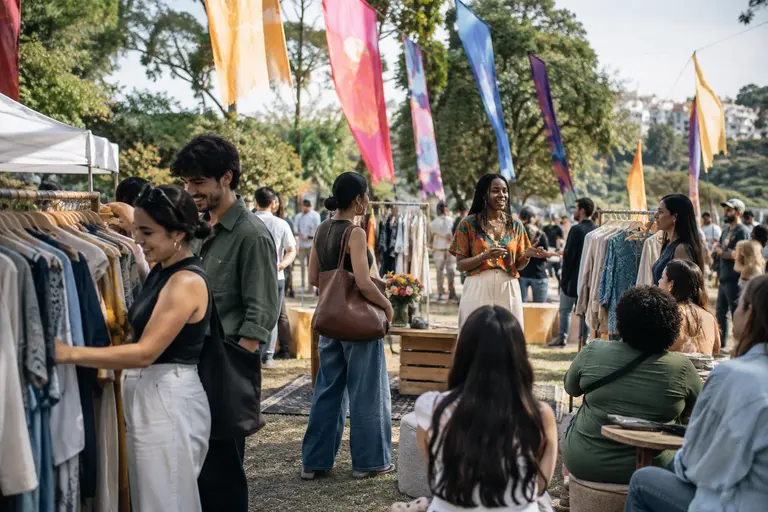
For community organizers, stylists, small sellers, and arts programmers, the most useful part of Fall/Winter 2026 is the way familiar silhouettes can support intergenerational participation. A printed midi dress with knee-high boots, covered by Women & Home in late September 2026, can speak to classic autumn dressing without requiring a wearer to belong to a specific fashion subculture. Scarf jumpers and scarf cardigans, covered by Women & Home on October 26, 2026, also show how utilitarian and heritage knit ideas can be adapted for flattering cold-weather dressing.
That does not mean every maker or seller should chase every revival. Fashion Nostalgia can be persuasive, but creator-commerce choices still need restraint. A handmade accessory can reference a period color, a fabric mood, or a silhouette without copying protected characters, celebrity likenesses, or a living designer’s identifiable work in a misleading way. This is not legal advice; it is a cautious cultural practice that respects artists, estates, labels, and buyers. For readers comparing creator-commerce and style coverage across this network, related cultural material can also be explored at Shimply.
- Use era references as research prompts, not as shortcuts.
- Describe materials and shapes clearly: velvet, cape, peplum, midi length, tailored trouser, scarf knit.
- Avoid implying official licensing, endorsement, or direct designer connection unless it can be verified.
- Credit cultural sources carefully when styling for exhibitions, markets, or themed gatherings.
Fashion Nostalgia In Women & Home’s Fall/Winter 2026 Trends
A Practical Verdict On The Season
As a review, the Women & Home-led reading of Fall/Winter 2026 is strongest when it treats trend as an editing process. The season’s nostalgia does not ask one reader to become a flapper, another to become a 1970s bohemian figure, and another to reenact 2016. Instead, it offers a set of controlled references: velvet for tactility, capes for shape, plum and maroon for depth, midi dresses and knee-high boots for continuity, scarf knits for warmth, and tailoring for structure.
The weaker risk is overgeneralization. Because many of the cited signals come from runway analysis, arrivals data, and fashion media reporting, they show visibility and editorial momentum more clearly than confirmed personal adoption. That distinction is worth preserving. Fashion Nostalgia in Fall/Winter 2026 looks credible as a cultural and styling signal, but it should be read as a set of supported cues rather than a single rulebook. For arts communities, that is enough: the season gives people shared references, room for interpretation, and a respectful way to dress memory for real gatherings.