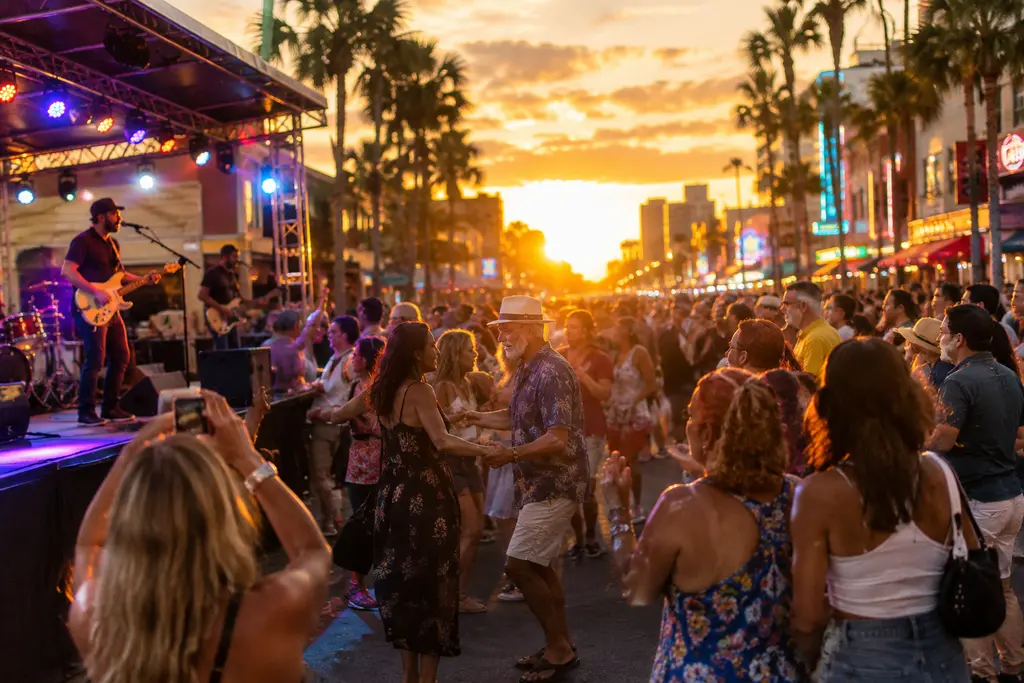
Live On Sunset is scheduled for Saturday, November 14, 2026, from 4:00 PM to 11:00 PM on Sunset Boulevard between Doheny Drive and San Vicente Boulevard in West Hollywood. As of November 3, 2026, the official event information lists admission as free, registration as required, and registration as at capacity with a waitlist available on the official event page. That combination gives the concert an unusual civic character: open in price, limited in capacity, and located on one of Southern California’s most symbolically loaded music corridors.
The event deserves attention not only as a concert booking, but as a public-space decision. A street stage on Sunset Boulevard changes how audiences encounter the Strip. Instead of entering a single club, theater, or hotel ballroom, attendees are being gathered along the corridor itself. That matters because the Sunset Strip’s music identity has often been built through a patchwork of private venues, nightlife memory, and city branding. A city-produced outdoor event reframes that memory as a shared civic experience, even while the registration cap reminds us that public culture still depends on logistics, security planning, access rules, and neighborhood impacts.
What Live On Sunset Puts On The Strip
Live On Sunset Access And Capacity
The strongest evidence available from official sources is practical: date, place, cost, registration status, and lineup. The concert is free, but free admission does not mean unrestricted entry. Because Live On Sunset is listed as at capacity, the waitlist becomes more than an administrative detail. It is a signal that demand has already exceeded the initial registration pool before the event date. For a civic concert, that raises a familiar arts-access question: how can a city celebrate public culture while keeping the event safe, legible, and usable for the people who secured access and for residents living near the closure zone?
The research notes describe a broader closure period from Friday, November 13 at noon through Sunday, November 15 at noon, with the concert itself set for November 14. That is a significant intervention for a one-night program. It means the event’s footprint extends beyond performance hours and into setup, street management, business access, residential routines, and teardown. For event culture, these details are not secondary. They shape who feels included, who feels inconvenienced, and whether a festival-style program is remembered as a civic gathering or as a disruption with a stage attached.
One Stage, Many Meanings
The reported plan includes one main stage, food and beverage vendors, outdoor activations, and fan engagement across the corridor. A single-stage format can concentrate attention in useful ways. It avoids the fragmented scheduling of multi-stage festivals, where audiences may treat music as background while moving from one attraction to another. Here, the symbolic premise is narrower: Sunset Boulevard as a shared listening site for one evening. That does not automatically make the event more artistically serious, but it does place performance at the center of the public design.
Access, Closures, And Crowd Flow
Free Does Not Mean Frictionless
Free concerts are often discussed as if price is the only barrier. In practice, registration timing, transportation, street closures, bag rules, weather policy, accessibility services, and waitlist communication can all shape the audience. The research notes state that the event is rain or shine, that large bags over 12 inches by 6 inches by 12 inches are prohibited, that outside food and beverage are barred, that umbrellas are not allowed, and that pets are excluded except service animals. ADA accommodations are also listed. Those policies are common in large outdoor event settings, but they still require clear communication because they affect families, disabled attendees, older concertgoers, workers arriving from shifts, and visitors unfamiliar with West Hollywood’s street grid.
Street closures also change the cultural feel of a place. Closing Sunset Boulevard between key points, with adjacent blocks affected, temporarily removes the corridor from ordinary vehicle use and assigns it a ceremonial function. That can be powerful. It can also expose the tension between entertainment branding and everyday city life. A cautious reading is best: the closure may help create a focused event zone, but its success depends on execution that the public will only be able to judge after November 14, 2026.
- Scheduled concert hours: November 14, 2026, 4:00 PM to 11:00 PM.
- Location: Sunset Boulevard between Doheny Drive and San Vicente Boulevard.
- Admission: free, with required registration listed as at capacity as of November 3, 2026.
- Broader closure window in the research notes: November 13 at noon through November 15 at noon.
For readers seeking further understanding on how different cultural sites manage events, Shimply provides insightful parallels within the same network. In this case, the most responsible framing is not hype; it is a careful separation of confirmed event details from claims that can only be assessed after the concert takes place.
Lineup As Cultural Framing
From Headliner To Corridor Identity
Visit West Hollywood identifies Sheryl Crow as the headline act and describes her as a nine-time Grammy winner and Rock & Roll Hall of Fame inductee, with Local Natives, Empress Of, Grace Bowers, Doug Locke, and Mia Moretti also on the bill Visit West Hollywood listing. That booking strategy reads as broad rather than narrowly genre-bound. Crow brings an established rock and pop-country profile; Local Natives connect the bill to Southern California indie rock; Empress Of brings electronic pop and bilingual artistic identity; Grace Bowers represents younger guitar-driven performance; Doug Locke and Mia Moretti expand the frame across performance and DJ culture.
This mix matters because the Sunset Strip’s musical memory has often been reduced to a few dominant eras and images. A lineup with multiple generations and adjacent styles can resist a simple nostalgia package. It suggests that the city is not merely staging a reenactment of a past club scene. Instead, it is presenting a one-night program that uses a heritage corridor while acknowledging that music culture now moves through festivals, DJ sets, digital discovery, guitar performance, and civic placemaking at the same time.
Respecting Artists Without Inflating Claims
It would be easy to overstate what one concert can do. A single municipal event cannot, by itself, revive a music district, solve venue economics, or settle debates about nightlife, housing, policing, parking, and public spending. Those outcomes require longer evidence. What can be said, based on the confirmed lineup and location, is narrower and more defensible: the event places recognized artists and local cultural infrastructure in direct conversation with the Strip’s public image.
That distinction is important for cultural criticism. Artists should not be treated as decorative proof of a city’s ambitions. They are working performers entering a civic production with its own budget, access limits, and political meaning. The best reading keeps both sides visible: the artistry on stage and the municipal choice to build a public event around that artistry.
Heritage Without Nostalgia
The Strip As A Working Symbol
The research notes connect the 2026 event to earlier Sunset Strip music festivals that ran from 2008 to 2014. That comparison is useful, but it should be handled with care. Continuity in location does not always mean continuity in purpose, scale, funding, or cultural effect. A festival associated with clubs and a city-produced street concert may share geography while operating under different public expectations.
Heritage can become a shorthand that flattens local culture into marketable memory. West Hollywood’s challenge is to avoid treating the Strip as a museum piece. The more interesting possibility is to use the corridor as a living site where residents, businesses, visitors, and artists negotiate what public music can mean in a dense city. The one-stage format and free registration model are part of that negotiation. So are the closures, parking suspensions, security policies, and waitlist.
From a curatorial standpoint, the event’s value will be measured through more than applause. Useful questions after November 14 will include whether crowd movement felt safe, whether local businesses benefited or were boxed out, whether accessibility commitments were visible in practice, whether sound and sightlines served audiences beyond the front rows, and whether the program expanded the Strip’s story rather than simply repeating its most familiar mythology.
Live On Sunset And The Strip’s Public Memory
A Concert Before It Becomes A Claim
Live On Sunset is best understood, before it happens, as a high-profile experiment in civic music programming. The confirmed facts are strong enough to justify attention: a free but capacity-limited concert, a Sheryl Crow-led lineup, a major Sunset Boulevard closure, and a production window that reaches beyond the evening of performance. The larger claims — revitalization, renewal, cultural reset — should remain provisional until the event can be evaluated through attendance experience, neighborhood response, and post-event public reporting.
The value of Live On Sunset may lie in that tension. It is both a celebration and a test. It asks whether a city can honor music heritage without freezing it in nostalgia, whether a famous corridor can serve a present-day public rather than only its own legend, and whether free access can be made meaningful when demand exceeds capacity. On November 14, 2026, West Hollywood will place those questions on Sunset Boulevard. The review that follows should be measured by evidence, not by memory alone.