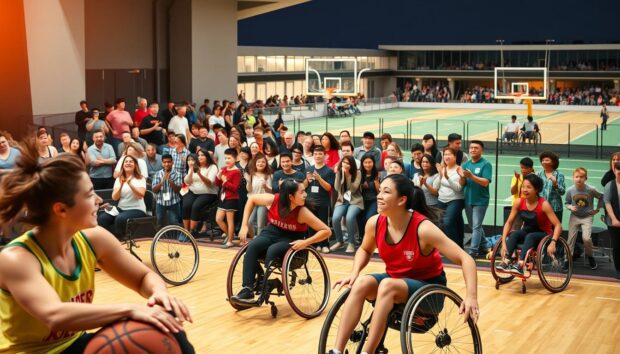
Imagine a buzzer-beater three-pointer as a power wheelchair moves like LeBron. It’s not a Marvel scene, but a Tuesday night at your local rec center. Groups like Move United and the Special Olympics are more than hosting games. They’re breaking down barriers with adaptive programs.
Remember when “participation trophies” were mocked? We’ve been scoring wrong. Now, over 5 million athletes with disabilities compete globally. This shows that youth sports leagues are for everyone, not just future stars.
Wheelchair basketball is no longer just for a few. It’s halftime fun at college games, with fans and TikTok moments. It’s not about diversity checks. It’s about coaches who ask “how?” and athletes changing the game.
It’s time for less inspiration porn and more “hold my Gatorade” spirit. The fieldhouse doors are open. But does your league’s playbook need an update?
What Does Accessibility in Sports Mean?
Let’s clear up a myth: sports accessibility is more than just wheelchair ramps. It’s about creating experiences where everyone can participate fully. Imagine your cousin with cerebral palsy playing basketball and trash-talking your jump shot.
Move United gets it right with their programs for warfighters. They turn “I used to…” into “Watch me now.” Their goal is to make adaptive sports as popular as brunch with avocado toast. Special Olympics goes even further, creating unified teams where everyone plays together.
For true sports accessibility, we need three key things:
- Adaptive equipment that’s as cool as your AirPods (like wheelchair blades that glide on ice)
- Rule modifications that welcome everyone, not just the usual players
- Culturally competent staff who understand both sports talk and kindness
| Aspect | Traditional Sports | Inclusive Programs |
|---|---|---|
| Equipment | Standard issue | Customizable adaptive tech |
| Scoring | Fixed rules | Flexible achievement metrics |
| Coaching | Performance-focused | Trauma-informed approach |
USA Cheer’s adaptive squads show what’s possible. They perform wheelchair spins that would impress Beyoncé. The key is to see accommodations as enhancements, not compromises. When we do, every court becomes a place for amazing athletic feats.
So, when we talk about “accessible sports,” think beyond just ramps. Picture arenas where prosthetic legs click during warmups, where sign language interpreters call plays. Victory is about breaking barriers, not just scoring points. That’s the real goal, and it’s way more thrilling than another Super Bowl ad.
Local Examples of Accessible Events & Facilities
Think your city’s sports scene can’t rival the Paralympics? Think again. Cities now have adaptive arenas and rec centers hosting events that are as exciting as a Marvel movie. Let’s look at two examples where parking lots are becoming podiums.
Hardwood Heroics: Wheelchair Basketball Unleashed
The Kansas City Chiefs are more than football now. They have an adaptive sports division with wheelchair basketball showdowns. Players show off moves that would impress NBA stars. These events feature:
- Custom sports chairs with NASCAR-worthy suspension
- Mixed-ability teams (yes, able-bodied players welcome)
- Post-game skills clinics taught by Paralympic athletes
Chicago’s Adaptive Sports Complex now has “Try-it Tuesdays”. It’s like an open gym meets American Ninja Warrior, but for wheelchair sports. Last month, their game drew more fans than the Bulls’ preseason game. That’s no coincidence.
Track Meets Where Prosthetics Become Jetpacks
Move United’s adaptive track programs turn standard tracks into innovation labs. At their Denver facility, runners with prosthetics reach speeds that make Usain Bolt’s records seem slow. Key features include:
- 3D-printed running blades adjusted in real time
- Visually impaired sprinters guided by laser beam systems
- Hybrid relays pairing wheelchair racers with amputee sprinters
These meets are more than competitions. They’re places where engineers and athletes work together to create new gear. A 14-year-old from Phoenix recently broke the junior 100m record with a carbon fiber foot she helped design. That’s beating participation trophies.
Your local YMCA might be hosting groundbreaking athletics, just like the Olympics. Look for wheelchair basketball leagues or adaptive track clinics. Or, call your parks department to find out when they’re hosting their next “Every Body Wins” event. Remember, bring popcorn. These events are more exciting than March Madness.
Inclusive Leagues and Programs
Imagine Little League without the toxic parent sideline commentary. Picture bowling nights where gutter balls spark more cheers than strikes. Welcome to sports re-engineered for human connection over competition – where the real MVP is the person who remembered everyone’s snack preferences.

Youth Sports Leagues Reimagined
The Special Olympics Unified Sports program isn’t just ditching participation trophies – it’s torching the entire elitism playbook. They pair neurotypical athletes with those who have intellectual disabilities before the first whistle blows. The result? Teenagers now trade TikTok clips of opponents helping each other up after slides into home plate.
CheerAbilities takes this further, transforming pyramid formations into accessibility laboratories. Their adaptive stunting protocols make Cirque du Soleil look like amateur hour. Move United’s education programs teach coaches to spot hidden talents – like how a wrestler’s wheelchair transfer speed might predict their takedown reflexes.
Adult Recreation Leagues
Beer-league softball’s glow-up proves inclusivity isn’t just for kids. Modern adult recreation leagues now feature:
- Blind soccer matches with echolocation training clinics
- Powerchair hockey teams sponsored by local microbreweries
- Sign language interpreters doubling as base coaches
| League Type | Traditional Focus | Inclusive Upgrade | Social Impact |
|---|---|---|---|
| Youth Baseball | Batting averages | Conflict resolution drills | 57% fewer bullying reports |
| Adult Softball | Championship brackets | Adaptive equipment loans | 82% return players |
| Cheerleading | Competition scores | Mobility aid choreography | Tripled volunteer signups |
These programs aren’t just changing games – they’re rewriting the social contract of sports. The real victory? Watching former college athletes realize their wheelchair-bound teammate’s trash talk game puts theirs to shame.
How to Find and Register for Accessible Events
Finding upcoming local sports events shouldn’t be hard. I’ve spent hours on confusing websites, only to find they were wrong. For example, I once thought there was an adaptive archery workshop, but it was actually an architecture lecture.
Move United’s member map is like a sports dating app. Just swipe right on your area to see options. You can filter by sport, skill level, and location.
- Sport type (from wheelchair rugby to blind soccer)
- Skill level (newbie-friendly to Paralympic prep)
- Transportation-friendly locations
The Special Olympics calendar is always full of events. Bookmark their “Just Announced” page for new opportunities.
| Platform | Best For | Registration Hack | Hidden Gems |
|---|---|---|---|
| Move United | Year-round programming | Early-bird discounts | Veteran-led clinics |
| Special Olympics | Seasonal competitions | Team registration deals | Youth mentor programs |
| Local Community Boards | Pop-up events | Direct coach contact | Equipment loan days |
Off-the-Grid Event Hunting
Google Maps can miss adaptive sports. Try these tips:
- Follow rehab centers’ social media – they often host “return to play” nights
- Check library bulletin boards (yes, physically – it’s like analog SEO)
- Join regional Facebook groups using search terms like “adaptive [sport] + [state]”
Registration tip: Always call before you click. I’ve found scholarships through quick phone calls. It’s saved me from eating ramen to afford sports.
Spotlight: Athlete Stories
Let’s look beyond the usual stories of overcoming. The real tales are about outplaying what people expect. They show the strategic mind of a chess master and the humor of a Netflix star. These athletes are changing the game of special needs sports and ignoring old clichés.
From Physical Therapy to Podiums
Keely Icardi’s story started with a hospital release. A car accident left her paralyzed at 19. She moved from cheerleading to wheelchair rugby, finding it more fun.
Her training is a mix of Serena Williams’ focus and Jackass stunts. Last year, she worked 900 hours in adaptive sports and finished her engineering degree. Now, she’s aiming for the Paris 2024 Paralympics.
Military Veterans Finding New Arenas
Matthew Scholten went from Army Ranger to wheelchair football quarterback. His journey is like a Marvel story. “Combat taught me to think on my feet,” he says. “Now, I plan plays that confuse opponents.”
His team uses a unique playbook. It combines military tactics with sports strategy. They’ve won three national championships. “We don’t wear capes,” Scholten laughs, “but our wheelchairs leave tracks.”
Ways Families & Friends Can Support
Cheering at adaptive sports is more than just face paint and foam fingers. It’s about understanding how to support athletes in meaningful ways. It’s like learning a new language, where “rah-rah” means something specific.
Being supportive without being annoying is key. It’s about knowing when to cheer and when to keep quiet. Let’s explore how to be helpful without being that annoying relative at a wheelchair rugby game.
The Sideline Playbook: 3 Game-Changing Moves
- ASL Chants 101: Learn five basic signs like “Defense,” “Push,” and “Yes!” to support deaf athletes. Practice with your cat first. If they seem confused, you’re on the right track.
- Hydration Heroics: Be the MVP of water breaks. Learn which athletes need special straws or bottles. It’s like knowing their coffee order.
- Cringe-Free Cheers: Instead of saying “You got this!”, give specific feedback like “That pivot was 🔥!” Athletes love specific comments, not generic ones.
Many supporters make a big mistake: they think accessibility only means ramps. True inclusion means adapting to the sport’s needs. Timing bathroom breaks during wheelchair basketball is like solving a puzzle.
USA Cheer shows that 68% of athletes face more barriers from mismatched enthusiasm than from physical ones. Your goal is to be the useful kind of loud. Use your energy to learn about equipment and accessibility in sports. Check out how to improve accessibility in sports for more info.
The Support Hierarchy (Ranked by Actual Usefulness)
- 1. Transportation ninja (knows every accessible parking spot)
- 2. Rulebook translator (explains wheelchair rugby penalties to confused aunts)
- 3. Quiet zone architect (creates sensory-safe spaces for neurodivergent fans)
The best supporters are like RPG healers. They anticipate needs before they become obvious. Now, go cheer smarter, not louder. Your foam finger is optional, but your awareness is essential.
Best Practices for Event Organizers
Organizing an accessible sports event is not hard. But, it’s not easy either. We need to learn from groups that really get it right. Move United and Special Olympics offer great guides to avoid big mistakes.
First, make sure your accessible facilities are truly accessible. The ADA is not just a suggestion. It’s the law. But, doing the minimum is not enough. We should aim to make athletes feel like they belong, not like they’re getting charity.
Three Non-Negotiables for Inclusive Events:
- Recruit volunteers like you’re casting Ocean’s 11 – prioritize situational awareness over savior complexes
- Test facilities with actual humans, not just checklists (pro tip: borrow a wheelchair and navigate your own venue)
- Budget for adaptive equipment – that $500 ramp beats a $50k lawsuit
It’s embarrassing when someone tries to help a Paralympian in a wrong way. Special Olympics teaches staff to ask how they can help. This shows respect, not pity.
Accessibility ≠ Afterthought
- Embed disability consultants in planning committees (pay them)
- Audit venues 6 months pre-event – construction delays are the Kraken of inclusion
- Publish detailed accessibility specs online – because “surprise stairs” belong in horror movies
The best events make adaptations seem invisible. When the only drama is the scoreboard, you’ve succeeded. Now, let’s make sure our facilities are not embarrassing.
Overcoming Barriers to Participation
Why does adaptive sports equipment cost more than a Peloton bike? It’s not just about insurance. It’s about systemic inertia. We face not just physical barriers but also the mindset of those who see $3,000 wheelchairs as “optional upgrades.”
- Gearflation: Adaptive equipment costs 400% more than standard gear
- Transportation traps: 65% of possible athletes live beyond public transit routes
- Insurance labyrinths: Most policies call sports wheelchairs “recreational luxuries”
Meet the game changers. Move United’s gear libraries are like Netflix for adaptive gear. For $50/month, you get access to $15k worth of gear. Cities like Denver offer 50% off rideshare to adaptive sports events.
| Barrier | Old System | New Solution |
|---|---|---|
| Equipment Costs | $8,000 basketball wheelchair | Libraries cut costs by 94% |
| Transportation | 2-hour bus commutes | Subsidized Lyft partnerships |
| Insurance | “Not medically necessary” | Advocacy legal teams |
Communities in food deserts are leading the way. Detroit’s wheelchair rugby team turns old grocery stores into courts. Phoenix coaches trade gear fixes for Spanish lessons. Adaptive sports events are breaking down barriers, not waiting for permission.
The biggest challenge is changing old ways of thinking. When a Texas little league banned adaptive gloves, parents held protest pickleball tournaments at the commissioner’s house. They made it clear: inclusion is a must.
Advocacy and Community Action

Let’s talk real change in adaptive sports. It’s not just about posting #InclusionMatters on Instagram. The Special Olympics’ “Revolution Is Inclusion” campaign showed us how. It didn’t just trend on social media. It got 1.2 million athletes involved through community action and modern storytelling.
Want to make a real difference? Here’s how to go from just posting to actually making a change:
- Flip the charity 5K script: When you run for charity, ask where the money goes. Does it fund ramps at courts or just buy T-shirts?
- Play policy bingo: Move United’s lobbyists know how to turn sports funding into wins. They show how accessible facilities create jobs, appealing to politicians.
- Crash the committee: City councils have subcommittees that need your input. Bring adaptive athletes’ needs to them, talking about cost savings and tourism.
Why just post about change when you can make policy? In Portland, activists used charity sports events to push for a wheelchair-accessible skatepark. After months of effort, the city council agreed.
For every viral video of a para-athlete, there are many inaccessible fields. We have the plans and examples. Now, we need a strong pitch to make inclusion a must for leaders.
Resources for Adaptive Sports in Your Area
Finding accessible sports events is easier than you think. The world of adaptive sports is like a book where you choose your path. Start with Move United’s member directory, a tool that helps you find sports near you.
It lists over 200 programs by sport and location. You can find wheelchair rugby in Phoenix or sled hockey in Maine.
Local chapters of groups like Blaze Sports America and the Challenged Athletes Foundation offer more than just events. They have equipment exchanges, volunteer networks, and mentorship programs. Join Facebook groups like “Adaptive Gear Swap & Talk” for deals on sports gear.
For hands-on advice, check out this list of adaptive sports. It shows programs from Alaska to Miami. Even Colorado offers “try-it days” for free.
Using these tools together can lead to amazing discoveries. Look for Special Olympics events and park district calendars. Also, bookmark the National Center on Health, Physical Activity and Disability’s webinars. Accessible sports events are out there, waiting to be found.