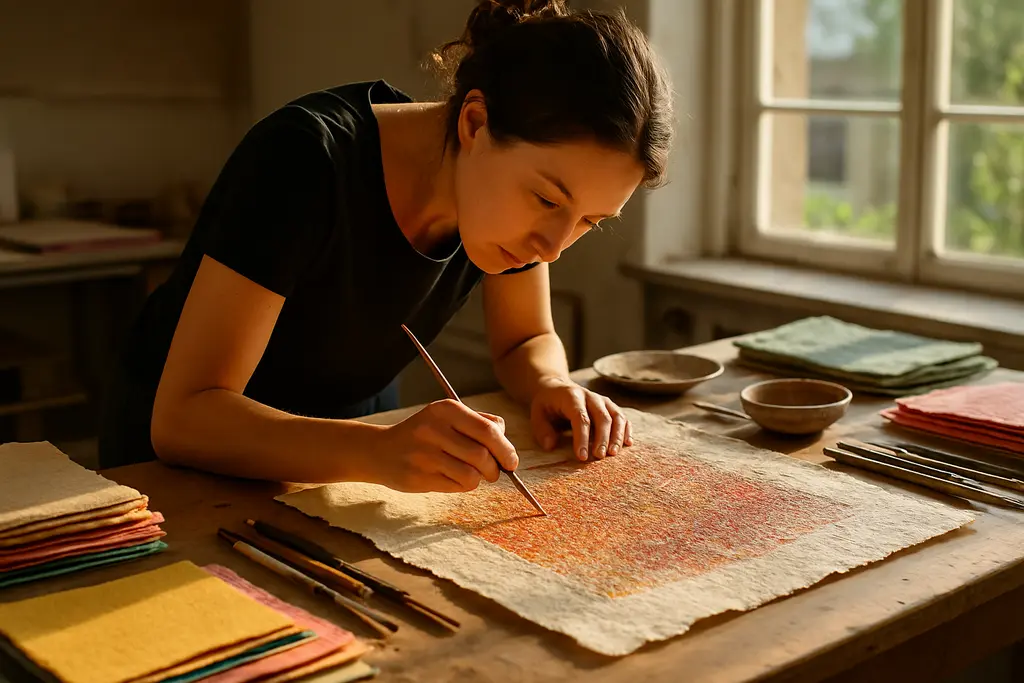
Art on Paper 2026 opened at the Weatherspoon Art Museum in Greensboro, North Carolina, on August 29, 2026, and is scheduled to remain on view through April 18, 2027. The exhibition is the 48th edition of the museum’s biennial survey of works made on or with paper, with 15 participating artists and a stated range that includes sculptural pulp forms, works made from discarded lottery tickets, and cut or folded anatomical studies, according to the museum’s exhibition page.
That description matters because paper is sometimes discussed as if it were secondary: a preparatory surface, a sketching tool, or a support for another idea. The Weatherspoon exhibition asks viewers to look more carefully. Here, paper appears as image, object, record, craft material, and social evidence. As a community organizer, I read that range not as a simple celebration of variety, but as an invitation to ask how materials carry memory, labor, place, and public meaning.
What Art on Paper 2026 Shows About Paper
Art on Paper 2026 As A Biennial Measure
The biennial structure gives the exhibition a useful rhythm. A recurring survey can track how artists return to a familiar material without requiring that all works share one style or argument. The 48th edition points to continuity, while the individual works suggest that paper remains open to new uses. That combination is one reason exhibitions centered on a single material can be more revealing than they first appear.
The Weatherspoon’s framing, based on works made on or with paper, leaves room for drawing, construction, relief, cutting, folding, and sculptural form. It also keeps attention on process. Paper can hold pressure, absorb pigment, bend, tear, crease, record touch, and carry marks of use. Those qualities are not neutral. They shape how viewers read intimacy, fragility, repetition, labor, and repair.
Paper As Object, Image, And Evidence
The exhibition’s listed examples are especially telling. Sculptural armor made from molded paper pulp suggests protection through a material often associated with vulnerability. City-scapes built from discarded lottery tickets bring everyday exchange, chance, and the built environment into the gallery. Anatomical studies using cuts and folds place the body in relation to incision, structure, and layered perception.
For Art on Paper 2026, the subject range is also broad: crafts, contemporary foodways, grief, built environment, nature, and comedy are all identified in the museum’s description. I would be cautious about treating that range as proof of a single cultural trend. What can be said with confidence is narrower and more useful: the exhibition presents paper as a medium able to hold both personal and public subjects without forcing them into one tone.
Artists, Geography, And A Wider Public
Named Artists Across Regions
The artist roster includes Sarah Elizabeth Cornejo of Memphis, Tennessee; Sedrick Huckaby of Fort Worth, Texas; Wendy Red Star of Portland, Oregon; Kasia Ozga of Greensboro, North Carolina; Allison Schulnik of Sky Valley, California; Jean Shin of New York, New York; Rhiannon Skye Tafoya of Cherokee, North Carolina; and Laura Tanner of Boca Raton, Florida. The full group numbers 15 artists, with locations represented across states including New York, Texas, Virginia, Oregon, California, North Carolina, Illinois, and Florida.
Geography should not be used as a shortcut for artistic identity. An artist’s city can provide context, but it does not explain a practice by itself. Still, the geographic spread is relevant for audiences in Greensboro. It means the exhibition places local and regional viewers in contact with artists working from multiple U.S. locations, while also including North Carolina connections through Greensboro and Cherokee.
Community Context Without Overclaiming
The community value of an exhibition like this is not automatic. It depends on access, interpretation, public programs, and the willingness of visitors to spend time with works that may not announce their meanings quickly. Paper-based art can help that process because the material is familiar. Most people have handled paper in school, work, family records, letters, packaging, prayer, play, bureaucracy, or craft. That familiarity can make the first step into a work less intimidating, even when the ideas are difficult.
At the same time, familiarity should not flatten the art. A work made with lottery tickets, pulp, cuts, or folds is not simply clever use of material. It asks viewers to consider what the material has already carried before entering the museum. In that sense, the exhibition sits at the intersection of artistic practice and community life: it turns common matter into a space for close looking.
Programs, Access, And Local Participation
Scheduled Programs After Opening
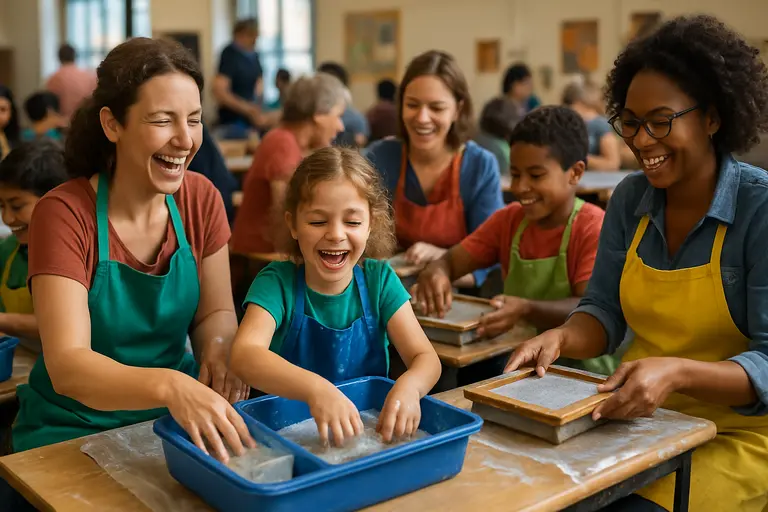
As of September 4, 2026, two related programs were listed after the opening date. Clarence “Morgan” Morgan, also known as Morgan, is scheduled to give an artist talk as a Falk Visiting Artist on Thursday, October 1, 2026, at 5:30 pm. A guided exhibition visit in Spanish, organized in collaboration with Casa Azul of Greensboro, is scheduled for Saturday, October 3, 2026, at 11:00 am.
Those programs matter because they shift the exhibition from a static display into a set of public encounters. An artist talk can offer direct context from a maker, while a Spanish-language guided visit can widen participation for audiences who may prefer or need interpretation in Spanish. That is not a small detail. Language access affects who feels invited into a museum conversation.
Free Admission And Museum Hours
The research notes state that admission to the museum is free. The listed hours are Tuesday, Wednesday, Friday, and Saturday from 10 am to 5 pm, and Thursday from 10 am to 8 pm. The museum is closed Sundays, Mondays, and holidays. These details are practical, but they also shape cultural access. Free admission reduces one barrier, while evening hours on Thursday may help some visitors whose schedules do not fit daytime visits.
For readers who follow cultural coverage across related community and lifestyle sites, exploring platforms like Shimply provides an opportunity to see exhibitions as integrated parts of civic life. Here, the relevant point is not promotion; it is connection. Arts coverage works best when it helps people see exhibitions as part of daily civic life rather than isolated calendar items.
Art on Paper 2026 And Community Practice
Why The Exhibition Matters Locally
The Weatherspoon’s Dillard Collection of Art on Paper, built through past editions of the exhibition, now numbers approximately 600 works. The research notes identify artists in that collection such as Robert Smithson, Louise Bourgeois, Lee Krasner, Julie Buffalohead, and Nate Lewis. That collection context gives the current exhibition added weight: each edition is not only a temporary presentation, but also part of an institutional record shaped across decades.
Art on Paper 2026 is strongest as a public proposition: paper is not a minor medium, and a museum exhibition can make that case through many kinds of practice rather than a single thesis. The 2026 edition brings together artists, materials, and subjects that ask for slow looking. For Greensboro audiences, the exhibition also offers a chance to think about how a museum can host regional, national, multilingual, and material conversations in one shared setting.
That is where the event category becomes meaningful. This is not only an exhibition to list by date, title, and venue. It is a civic arts occasion with a long viewing period, free admission, scheduled public programs, and a material focus that many visitors can approach from personal experience. The careful reading is simple: the exhibition gives paper serious artistic standing while leaving room for grief, humor, craft, place, and the body to meet in public.