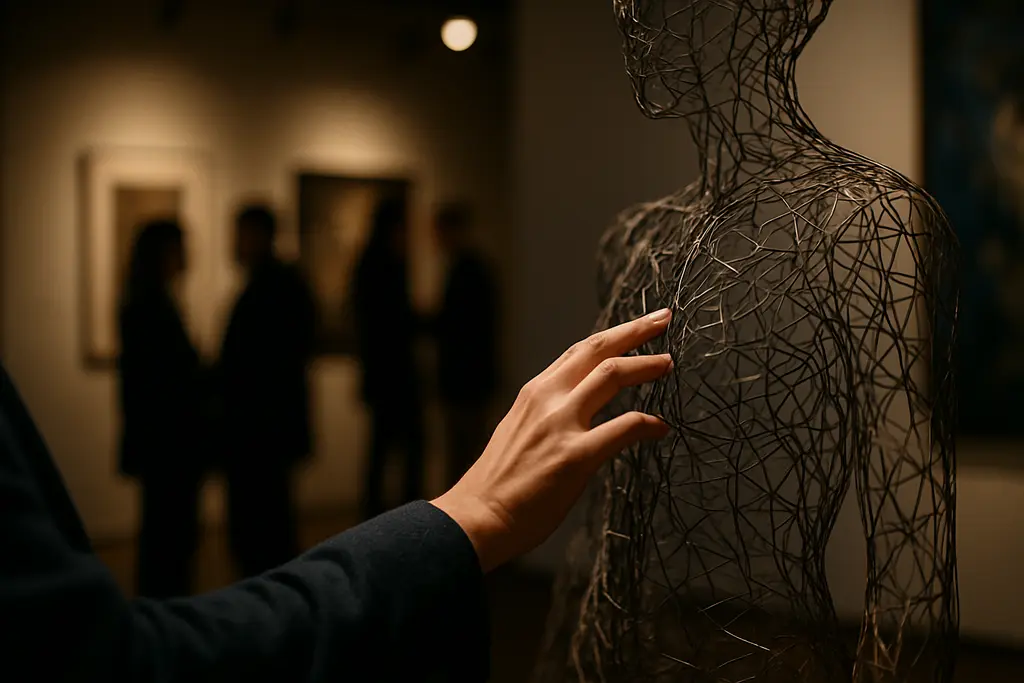
The No-Man’s-Land Exhibition at the Knoxville Museum of Art asks a question that feels both local and expansive: what happens in spaces that do not fit one settled category? According to the museum, the temporary exhibition opened with a reception on Thursday, August 13, 2026, at 5:30 PM and is scheduled to remain on view through November 8, 2026. That timing matters because, as of September 8, 2026, the show is not a memory or a future promise; it is an active cultural project in Knoxville.
The exhibition is grounded in borderlands, thresholds, spiritual passage, speculative bodies, and uncertain jurisdictions. Its point of entry is Harrison Mayes, a Kentucky coal miner turned evangelist, born in 1898 and deceased in 1986, who placed concrete markers described as beacons in ambiguous strips between state and private lands. KMA describes those spaces as no-man’s lands, areas often without clear jurisdiction, on its official exhibition page. The show’s value is not only in the unusual story of Mayes, but in the way that story becomes a structure for reading borders between cultures, bodies, countries, spiritual traditions, and even planets.
Dates, Sources, And The Museum Frame
What The Exhibition Record Supports
The museum identifies ten artists in the show: Seba Calfuqueo, Ada Friedman, Guillermo Galindo, Eddie Owens Martin, also known as St. EOM, Harrison Mayes, Erin Jane Nelson, Sarah M. Rodriguez, Suzanne Treister, Saya Woolfalk, and Joseph Elmer Yoakum. That list is unusually wide in subject matter, but the exhibition record gives a clear curatorial thread. These artists are not presented as if they share one background or one medium. They are brought together through questions about passage, limits, spiritual signs, imagined geographies, ecological change, and the pressure of human systems on bodies and places.
For a cultural reader, the most useful caution is to avoid reducing the show to one regional identity or one political message. The material available from the museum supports a reading centered on liminality rather than a simple statement about Appalachia, migration, gender, ecology, or spirituality alone. Each of those themes appears, but the exhibition’s structure depends on the friction between them.
Why Temporary Status Matters
Temporary exhibitions create a specific form of civic attention. They gather artists, archives, objects, and interpretive language for a limited period, then leave behind memory, documentation, and public conversation. Because this exhibition runs only from August 13 to November 8, 2026, the public record around it may remain relatively compact. For that reason, claims about reception, attendance, or influence should be made carefully unless supported by museum data or reliable reporting.
For readers comparing coverage within the same arts cluster, the related NextClues note on the No-Man’s-Land Exhibition at Knoxville Museum offers a nearby reference point. Furthermore, those aware of broader cultural coverage may find Kay Granger intriguing as part of a connected site within the network. This emphasizes the exhibition’s themes and records.
No-Man’s-Land Exhibition And The Meaning Of Threshold
No-Man’s-Land Exhibition As A Threshold Study
The No-Man’s-Land Exhibition uses thresholds as both subject and method. A threshold can be geographic, as in border territory. It can be bodily, as in gender, transformation, aging, or adaptation. It can be spiritual, as in markers meant to guide or warn. It can also be speculative, as in works that imagine other forms of being. The term is useful because it does not force the show into a single category. Instead, it helps explain why artists working with concrete beacons, sculptural instruments, maps, textiles, natural forms, video, and installation can share one curatorial space.
Mayes is central because his concrete markers were placed in spaces with uncertain legal and social status. The exhibition’s interpretation of those markers does not need to romanticize ambiguity. Ambiguous territory can be dangerous, contested, or neglected. Yet such spaces can also expose how categories are made. Who decides where public land ends, where private land begins, and which bodies are treated as belonging? The exhibition appears to take those questions seriously by placing Mayes beside artists whose work addresses migration, Indigenous worldviews, colonial legacies, ecological relations, and imagined futures.
Borderlands Without A Single Border
The show’s borderlands are not limited to one national line. Guillermo Galindo’s contribution, as described by the museum, involves sculptural instruments made from objects recovered along the U.S.–Mexico border, including shoes, clothing, water bottles, and fencing fragments. Through sound and performance, those materials evoke passage, migration, memory, and spiritual transition. The objects themselves carry signs of movement and risk, but the exhibition framing asks viewers to consider how sound can change discarded or displaced material into witness.
Seba Calfuqueo’s work brings a different threshold into view. Born in Santiago, Chile, in 1993, Calfuqueo identifies as trans and Mapuche. The museum describes work using performance, installation, ceramics, and video to address the collision between Indigenous worldviews and Western colonial legacies, with connections to feminism, environmental rights, and gender studies. Here, the border is not only a line on a map. It is the pressure between knowledge systems, body politics, and land relations.
Artists, Bodies, Memory, And Material Evidence
Speculative Bodies And Ecological Change
Saya Woolfalk’s Empathics series imagines beings who can genetically merge with plants. In the context of this exhibition, that speculative premise is not escapist decoration. It stages a body that refuses to remain separate from its environment. Sculpture, textiles, video, and installation become ways to think about transformation as ritual and speculative science. The museum’s description supports a reading of Woolfalk’s work as a bridge between bodily change and ecological imagination, though it would be too strong to claim one fixed meaning for the series in this setting.
Sarah M. Rodriguez’s work offers another material route into adaptation and survival. The museum describes sculptures made through casting techniques that use natural materials such as seed pods, branches, shells, and bones, with organic matter burned out to create aluminum forms. That process leaves a tension between origin and result. A branch or shell may begin as evidence of organic growth, but the final object belongs to a human-made material system. The work can be read as a negotiation between natural form and human intervention, a theme that fits the exhibition’s interest in categories under strain.
- Mayes frames uncertain jurisdiction through concrete beacons and spiritual marking.
- Galindo turns recovered border objects into sculptural instruments tied to passage and memory.
- Calfuqueo addresses Indigenous, colonial, environmental, feminist, and gendered thresholds.
- Woolfalk imagines plant-human merging through speculative bodies.
- Rodriguez uses casting to shift organic materials into aluminum traces.
Memory, Geography, And Imagined Place
Joseph Elmer Yoakum adds a geography of memory and imagination. The museum states that Yoakum produced more than 2,000 works in his later years after a spiritual awakening. His drawings use what the museum calls psycho-geography, joining memory, imagination, and observation. Place names in his work span Tennessee, Mexico, Sweden, Antarctica, and other locations, while often departing from realistic geography. That departure is not a failure of mapping. Within the exhibition’s logic, it becomes a way to ask whose maps count and what kinds of memory formal geography leaves out.
The No-Man’s-Land Exhibition gains strength from this range of materials without collapsing them into sameness. Concrete, cast aluminum, recovered border objects, textiles, video, ceramics, installation, and drawing do different kinds of cultural work. Some hold residue. Some stage possible futures. Some mark spiritual urgency. Some make unstable identities visible without turning artists into symbols. That distinction matters in community arts writing, because respect begins with allowing each artist’s practice to retain its own terms.
Appalachian Imaginary And Community Reading
How The KMA Frame Expands Regional Thinking
The exhibition also connects to a wider KMA initiative described by director Steven Matijcio and curator Conley through the phrase Appalachian Imaginary. Inside of Knoxville reported in 2025 that this concept involves rethinking what Appalachia is and could be through folklore, boundary crossing, spiritual expression, and challenges to conventional representations, in its interview on the Appalachian Imaginary. That context helps explain why a Knoxville exhibition might place a Kentucky evangelist alongside artists working across Chilean, Mapuche, U.S.–Mexico border, speculative ecological, and imagined geographic references.
This is not a claim that Appalachia contains all these experiences in any simple sense. A more cautious reading is that KMA is using Appalachian cultural questions as an opening rather than a boundary. Folklore, spiritual markers, self-taught or visionary practices, and contested land histories can connect to global conversations without erasing their differences. The risk in such framing is always overextension; the opportunity is a more open account of how regional museums can host art that unsettles fixed definitions of place.
Community Life Beyond The Gallery Wall
Community response to an exhibition like this cannot be assumed without documented evidence. Still, the supported themes suggest why the show may matter for public conversation in Knoxville. It gives viewers a shared vocabulary for discussing borders that are not always visible: between public and private land, inherited and chosen identity, human and nonhuman life, memory and map, spiritual sign and civic territory. Those are not abstract concerns for communities. They shape how people understand belonging, stewardship, migration, belief, and care.
As a community organizer, I find the strongest public value in exhibitions that do not demand instant agreement. The No-Man’s-Land Exhibition appears to invite slower looking. A visitor can begin with Mayes’s concrete beacons, move toward Galindo’s border materials, then encounter Calfuqueo’s engagement with colonial legacies, Woolfalk’s speculative plant-human beings, Rodriguez’s cast natural forms, and Yoakum’s imagined geographies. The result is not one answer, but a set of carefully staged cultural questions.
No-Man’s-Land Exhibition As Community Inquiry
What This Exhibition Lets Knoxville Ask
The No-Man’s-Land Exhibition is most persuasive when read as an inquiry into how cultures mark the uncertain. Its artists work with borders that are legal, spiritual, ecological, bodily, and imaginative. The show’s evidence comes from objects and practices rather than slogans: markers in ambiguous territory, border remnants turned into instruments, bodies imagined beyond fixed biological categories, organic forms translated into metal, and maps shaped by memory rather than standard measurement.
For Knoxville, that inquiry sits inside a museum context committed, at least through the Appalachian Imaginary frame, to reconsidering regional identity without treating region as a closed container. The show asks whether the spaces between categories can be read not as empty zones, but as charged sites of memory, risk, creativity, and responsibility. That is a careful and useful question for any arts community willing to think beyond simple labels.