The return of OBJECTS: USA is not only an exhibition revival; it is a test of how American craft is read after more than five decades of debate about material, function, authorship, and cultural value. The San Francisco presentation opened at the Museum of Craft and Design on September 5, 2026, and is scheduled to run through January 17, 2027. That timing matters. As of September 28, 2026, the show is no longer a preview or promise. It is now a live case study in how a 1969 craft statement can be reassembled for an audience shaped by studio craft, design culture, museum collecting, and maker economies.
For community organizers and arts readers, the exhibition offers a useful question: what happens when craft is framed not as a secondary category beside painting and sculpture, but as a central form of cultural thinking? The answer cannot be reduced to nostalgia. The research notes describe a smaller 2026 presentation of more than 70 works, pairing artists associated with the original exhibition with contemporary makers. That curatorial choice invites comparison without pretending that 1969 and 2026 share the same artistic conditions.
Why OBJECTS: USA Still Matters
The 1969 OBJECTS: USA Benchmark
OBJECTS: USA opened on October 3, 1969, at the Smithsonian National Collection of Fine Arts, now the Smithsonian American Art Museum, in Washington, D.C. Smithsonian architectural history. The original exhibition was organized by art dealer Lee Nordness and curator Paul J. Smith, with sponsorship from SC Johnson & Son. According to Smithsonian Magazine, it included more than 500 works by 308 artists, with materials including clay, fiber, glass, wood, enamel, metal, and mosaic Smithsonian Magazine account.
Those numbers alone explain part of the exhibition’s force. A show of that scale did not present craft as a minor decorative side note. It gave artists working with vessels, furniture, jewelry, fiber, and object-making a museum-scale platform. By that measure, OBJECTS: USA gave craft a public seriousness that still shapes how museums and audiences talk about handmade and materially inventive work.
Material Respect Over Category Policing
The strongest historical claim supported by the research is that the exhibition blurred the line between fine art and craft. That does not mean every object became interchangeable with painting or sculpture. It means the show asked viewers to judge utility, surface, structure, skill, and concept together. A chair, vessel, necklace, or woven object could carry aesthetic force without needing to disown use, touch, or domestic association.
This point is central to contemporary craft criticism. Craft objects are often read through labor and material knowledge before they are read through market category. That can be a strength, but it can also lead to under-reading the conceptual work in a piece. The 1969 exhibition challenged that habit by treating material practice as an art language, not merely a production method.
The 2026 San Francisco Presentation
How The New Selection Changes The Scale
The 2026 OBJECTS: USA presentation at the Museum of Craft and Design is far smaller than the original. The research notes describe more than 70 works, compared with the 1969 exhibition’s more than 500. That reduction changes the viewing experience. A broad national survey can imply abundance and scope; a smaller selection can sharpen comparison. It may allow the exhibition to operate less as an encyclopedic statement and more as a concentrated argument about continuity, contrast, and inheritance.
The artist group described in the research notes brings together figures connected to the earlier show, including Wendell Castle, George Nakashima, Art Smith, and Marguerite Wildenhain, with contemporary makers such as the Haas Brothers, Roberto Lugo, Tanya Aguiñiga, Nicole Cherubini, Jolie Ngo, Amber Cowan, Jay Sae Jung Oh, and Joyce Lin. The value of that pairing lies in the gap between them. The older works can show how studio craft gained public recognition in the late 1960s. The newer works can suggest how material practice now intersects with identity, design, found materials, digital-era fabrication habits, and expanded ideas of function.
Materials As Evidence, Not Ornament
The research notes identify fiber, terracotta, glass, wood, stoneware, mixed media, and found-object assemblage among the materials in the San Francisco exhibition. That range should not be treated as a checklist of attractive surfaces. In craft, material is often evidence. It shows training, bodily knowledge, regional practice, resource choices, and the artist’s relationship to durability, fragility, repair, and use.
For viewers, this calls for slower looking. A ceramic surface can register firing decisions and hand pressure. A wood form can hold design history and a maker’s response to grain. Found-object assemblage can carry social meaning through previous use. Fiber can connect domestic labor, sculpture, fashion, and architecture. None of these readings requires inflated claims. They ask for attention to what the object is doing materially and culturally.
Craft, Community, And Cultural Memory
Why Community Context Changes The Reading
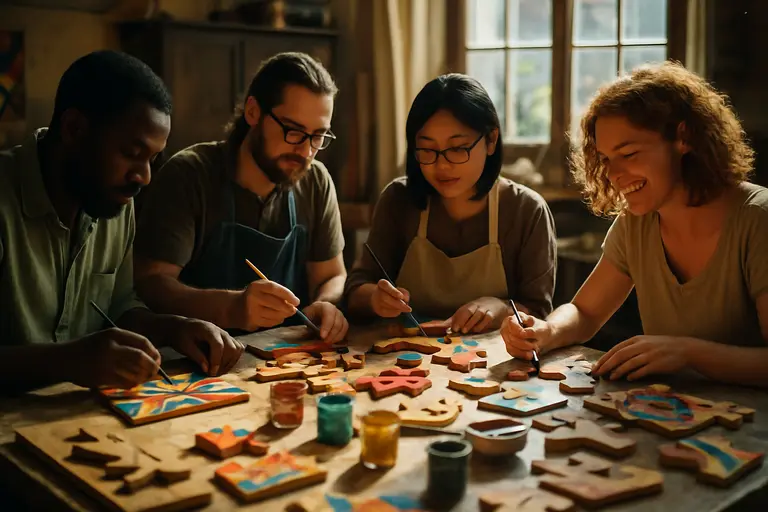
Craft exhibitions often speak to communities beyond the museum: teachers, studio artists, guilds, designers, collectors, family makers, and visitors who understand making through lived practice. That breadth can make craft unusually public. A person who has thrown clay, repaired furniture, stitched cloth, or assembled objects at home may bring a physical understanding to the gallery. The exhibition’s connection to Handwork: Celebrating American Craft 2026, described in the research notes as a year-long Craft in America initiative, places the San Francisco show inside a larger national conversation about traditional and emerging craft practices.
That context matters because craft is frequently sustained by networks: workshops, community studios, schools, apprenticeship patterns, local markets, and museum programs. A show like this can validate those networks without romanticizing them. It can also raise harder questions. Which makers are preserved in museum memory? Which forms of labor are celebrated? Which communities gain institutional visibility, and which remain outside the frame?
Reading Craft Across Arts Coverage
In seeking to connect broader cultural perspectives, readers who follow exhibitions as part of wider cultural life might find Robsonic arts writing beneficial. This analysis can complement discussions on American place and identity, like those in exhibitions such as Andrew Edlin’s American place show, which engage with how objects and images convey social meaning.
The caution is to avoid making the 2026 exhibition stand for all American craft. The research supports a more modest reading: this is a selected contemporary response to a historically influential exhibition. It is meaningful because of its lineage, its material range, and its artist pairings, not because it can settle every question about craft’s place in museums.
What OBJECTS: USA Means For Craft Communities
A Living Argument About Value
What makes OBJECTS: USA useful in 2026 is not simply that it returned. Its value lies in how it keeps an argument active. Craft has long been asked to justify itself against fine art categories, commercial design, domestic use, and decorative reputation. The exhibition’s history gives contemporary viewers a way to see those pressures rather than accept them as natural.
For artists, the show can be read as an acknowledgment that material intelligence is intellectual work. For museums, it is a reminder that collecting and exhibiting craft means more than displaying beautiful things. It requires attention to process, community, function, and the social meanings carried by materials. For audiences, it offers a practical way to look: start with the object, then ask how its material, use, form, and cultural setting shape one another.
As a community organizer, I find that craft exhibitions often build unusually generous conversations because people enter them through both knowledge and memory. Some visitors know the named artists. Others know the feeling of making, mending, shaping, or handling materials. The San Francisco presentation benefits from that shared ground. It asks viewers to respect the object not as a lesser art form, but as a site where skill, imagination, and community life meet in physical form.