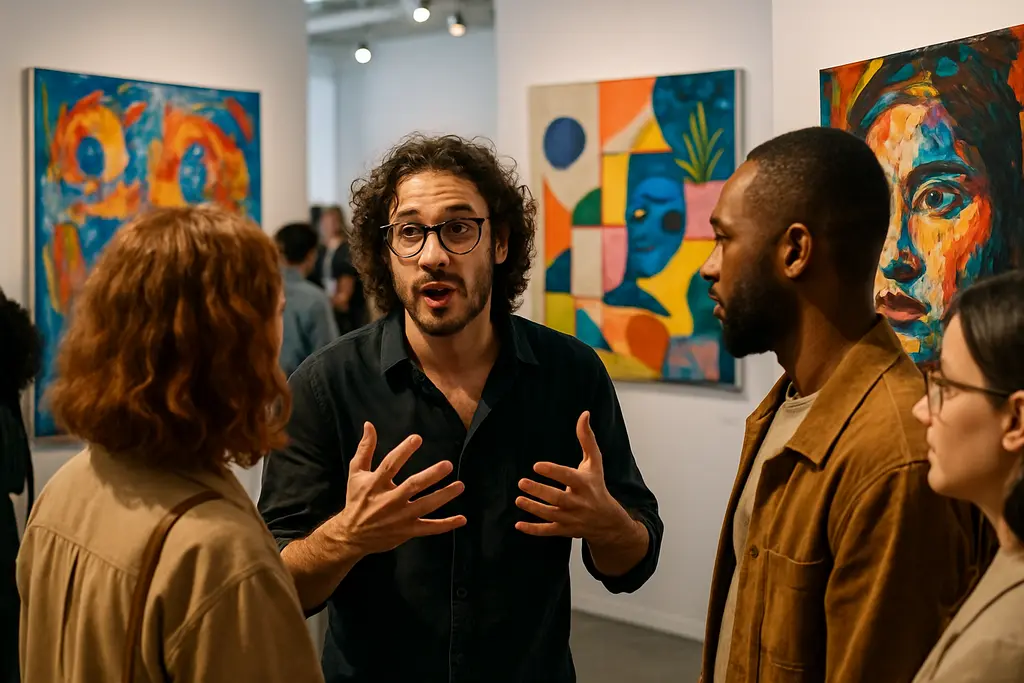
The Converge 45 Triennial opened in Portland on August 27–30, 2026, with receptions, performances, screenings, and talks, according to the research materials for Here, To You, Now. By October 20, 2026, the opening weekend had passed, so the clearest reading is retrospective: a citywide art event that used campuses, galleries, media spaces, and community venues to place contemporary practice in public circulation.
Several claims can be made with caution. The program materials identify Lumi Tan as curator, name 28 participating artists, and describe 17 new commissions across 16 venues. Those numbers suggest scale, but they do not by themselves prove audience reach, market effect, or long-term civic impact. The more useful question is what kinds of encounters the triennial made possible: free access, cross-campus participation, new work, and projects attentive to place, material, sound, sovereignty, and collective gathering.
Converge 45 Triennial Highlights After Opening Weekend
Converge 45 Triennial Dates And Access
The Converge 45 Triennial opened with a concentrated August 27–30, 2026 weekend, while programming was described as continuing through the fall. Portland State University’s event listing states that admission is free to all Converge 45 events, a point that matters because cost can quietly determine who feels able to enter cultural spaces: Portland State University listing.
Free admission should not be treated as a full equity analysis. It lowers one barrier, but it does not answer questions about transportation, schedule access, childcare, disability access, language access, or artist compensation. Still, for an event spread across Portland institutions, no-cost entry gives the public a clearer invitation to compare works across sites rather than treating a single gallery as the whole event.
A Citywide Format With Measurable Boundaries
Across the Converge 45 Triennial, the research notes name 16 venues and 28 artists, with 17 commissions made for the 2026 edition. That combination matters in two ways. First, commissions can support work that responds to the exhibition’s particular location and moment. Second, a distributed format can create uneven viewing conditions: a film screening, a sound work, a workshop, and a gallery installation ask different things from audiences.
For reviewers and visitors, that makes comparison difficult but productive. A single ranking of “best works” would flatten the event’s structure. A better approach is to ask how each site shaped attention. A campus gallery might frame work through teaching and research; a community media venue might foreground access to production tools; a performance or screening might create a temporary audience that cannot be repeated in the same way after the event ends.
Campus Sites As Public Gathering Points
Portland State’s Gallery Cluster
Portland State University’s Art Building Gallery, within the Jordan Schnitzer School of Art + Art History + Design, was listed in the research notes as presenting works by Tannaz Farsi, Marcus Fischer, Patricia Vázquez Gómez, Jacqueline Kiyomi Gork, Rob Rhee, and Vo Vo. In a campus context, such grouping can invite slow comparison between media, methods, and questions of public address.
The campus setting is not neutral. It brings students, faculty, staff, neighbors, and art audiences into the same building, though not always at the same time or with the same expectations. For an art triennial, that mix is valuable because it resists the idea that contemporary art belongs only to specialized viewers. It also asks institutions to host public culture with care, especially when works engage community memory, ecological pressure, migration, or contested histories.
PCC’s Sound And Materials Programs
Portland Community College’s August 2026 news post reported that PCC participated through its Cascade and Sylvania campuses, including Marcus Fischer’s debut of We Are the Confluence of Two Rivers, a site-specific sound performance at PCC Sylvania’s rock garden, and Meech Boakye’s “Black Pool Party” bioplastics workshop at PCC’s Paragon gallery: PCC coverage.
Those two examples show the range of experience contained inside the broader event. Fischer’s project, as described in the research, was tied to a specific outdoor campus site through sound. Boakye’s workshop centered material process, with participants creating compostable biomaterial using agar derived from seaweed. One asks audiences to listen to place; the other asks them to handle process. Both shift attention away from art as a distant object and toward participation, duration, and physical setting.
Artistic Context And Community Expression
Le Guin’s Phrase As A Curatorial Frame
The research notes state that the title Here, To You, Now derives from Ursula K. Le Guin’s 1985 novel Always Coming Home, with an emphasis on impermanence, spontaneous dialogue, and community-making. That framing is apt for a triennial that does not sit in one building. It suggests that meaning arrives through address: here, to you, now, rather than sealed away as a fixed cultural monument.
Still, literary inspiration should be handled carefully. A title can guide interpretation, but it should not be used to impose one reading on every participating artist. The stronger critical move is to treat the phrase as an invitation to notice how works speak to immediate conditions: land, sound, material, gathering, and the civic use of art spaces.
Land, Sovereignty, And Site Awareness
The research notes identify Gerald Clarke of Anza, California, as a participating artist whose Between the Lines includes sculpture, prints, mural, and video addressing land acknowledgment and Indigenous sovereignty. That description points to one of the event’s more serious responsibilities: not treating place as a backdrop. In an exhibition distributed across Portland, questions of land and sovereignty cannot be ornamental; they sit at the center of how public culture names where it stands.
This is where festivals and triennials require a slower form of attention. Celebration alone is not enough. Respectful viewing asks what claims a work makes, who is being addressed, and what forms of knowledge the institution is prepared to host without reducing them to atmosphere. For readers interested in creator support and access questions around the event, our related analysis of creator rights funding examines public information about free admission, commissions, grants, and gaps in pay data.
Material Culture Beyond The Gallery
Why Fashion And Handmade Audiences May Care
Although the event is framed as contemporary art rather than a fashion festival, several of its concerns overlap with costume culture, handmade practice, and material experimentation. A bioplastics workshop, site-responsive sound, murals, video, sculpture, and printmaking all raise questions familiar to makers: what materials carry, what processes reveal, and how public presentation changes meaning.
For those intrigued by the fusion of clothing, fantasy, craft, and cultural context, a related site in our network, Fairytale Fashion, provides an enlightening perspective. This connection highlights that while triennial art is distinct from costume design, both domains value attention to surface, craftsmanship, symbolism, and ethical cultural borrowing.
Careful Reading Instead Of Trend Claims
It would be easy to overstate the event as proof of a broad art trend. The available research does not support that. What it does support is narrower and more reliable: Portland hosted a 2026 edition with free admission, multiple campuses and venues, new commissions, and works described across sound, biomaterials, sculpture, prints, mural, video, screenings, talks, workshops, and performances.
That is enough to show an event built around varied forms of creative expression, but not enough to claim permanent change in Portland’s arts economy or national exhibition practice. Evidence-based cultural writing should leave room for uncertainty, especially when audience data, artist payment details, and long-term institutional outcomes are not fully available in the provided materials.
What Converge 45 Triennial Shows About Portland
The Converge 45 Triennial is best read as a distributed public art event that asked viewers to move across institutions and across forms. Its strongest documented features were access, scale, campus participation, and the range of media represented. The opening weekend on August 27–30, 2026, has already passed, so the event now invites assessment rather than advance promotion.
What remains most persuasive is not a single headline claim but a set of grounded observations. Free entry widened the invitation. Campus sites brought art into educational settings. PCC’s listed projects foregrounded sound, place, and material making. The curatorial frame drew from Le Guin without requiring one fixed interpretation. Works addressing land acknowledgment and Indigenous sovereignty signaled that place-based art must account for history and power. Taken together, the Converge 45 Triennial offered Portland a layered model of cultural gathering: temporary, public, and worth reading with care.