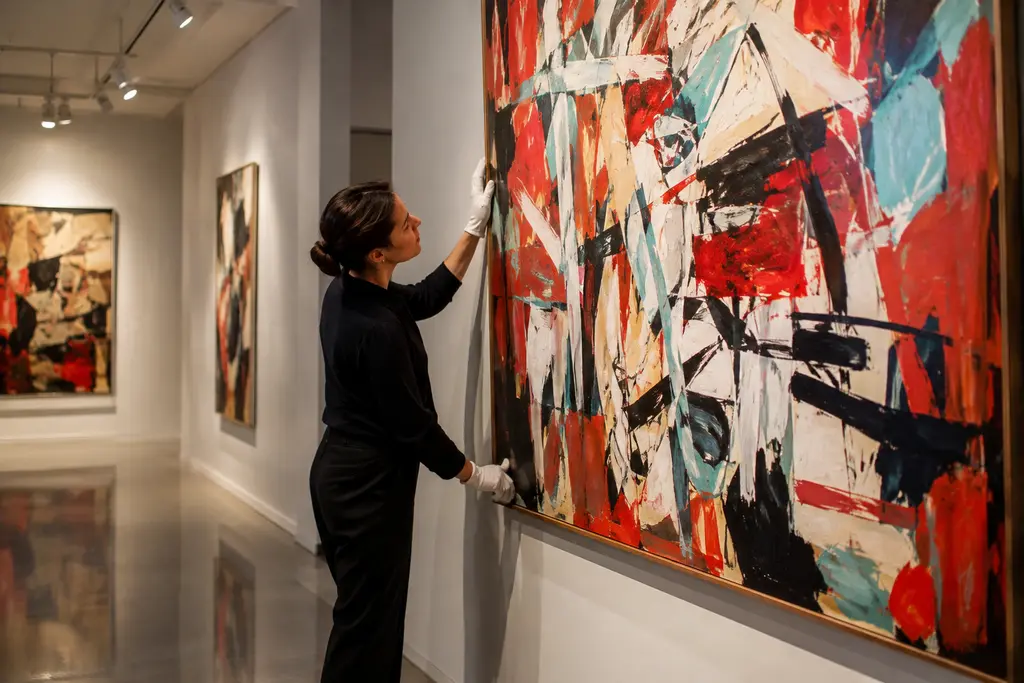
The Krasner Pollock Met exhibition opened to the public on October 4, 2026, and is scheduled to remain on view through January 31, 2027, in Gallery 899, the Tisch Galleries, at The Met Fifth Avenue, according to The Met exhibition page. Its title, Past Continuous, comes from Lee Krasner’s 1976 mixed-media painting, which incorporated collaged fragments of earlier drawings. That title is not decorative; it gives the show a framework for thinking about recurrence, revision, memory, and artistic contact.
The exhibition’s significance rests partly on scale and partly on structure. It gathers more than 120 works, including paintings, works on paper, and ephemera, with rarely seen material and loans from private collections. It also marks the first major New York exhibition at The Met in more than 20 years dedicated to either Krasner or Jackson Pollock. Rather than treating one artist as the context for the other, the show presents their careers in parallel: before they met, through their marriage from 1945 onward, and after Pollock’s death in 1956.
What The Krasner Pollock Met Frames
Why The Krasner Pollock Met Chronology Matters
The chronological structure is one of the show’s central interpretive tools. It asks viewers to consider timing before reputation. Krasner and Pollock are not shown only as a famous artistic couple, nor is the material reduced to biography. The layout places early formation, mutual exchange, and later development into a sequence that makes comparison possible without forcing sameness.
That matters because the artists’ public reputations have not always been balanced. Pollock’s name has often carried wider recognition, while Krasner’s career has required repeated reassessment in museum and scholarly settings. The curatorial frame described in the research notes, led by David Breslin and Brinda Kumar, emphasizes both Krasner’s standing as an artist and her role in supporting Pollock’s legacy after his death. The stronger reading of the show is not that influence moved in one direction, but that proximity, argument, ambition, and memory shaped two distinct bodies of work.
A Parallel Method, Not A Marriage Plot
A parallel display can be risky if it turns artistic practice into domestic anecdote. Here, the more useful question is how each artist worked through scale, gesture, fragmentation, and return. Pollock’s Autumn Rhythm: Number 30 from 1950 is among the featured works. The painting measures 8 feet 10 inches by 17 feet 4 inches and entered The Met’s collection in 1957 through the George A. Hearn Fund. Its presence gives the exhibition a major institutional anchor, but it does not end the argument.
Krasner’s later production receives focused attention, including large-scale abstract canvases and collage-based work such as Rising Green from 1972. That placement is important because Krasner’s post-1956 work cannot be treated as an epilogue to Pollock. It belongs to a continuing practice. The subtitle Past Continuous is especially apt here: earlier marks, drawings, and decisions return as active material rather than as archive alone.
Collection Imbalance And Exhibition Balance
What The Numbers Suggest
As of October 8, 2026, The Met held 125 works by Pollock and 9 by Krasner. In this exhibition, 10 Pollocks and 4 Krasners from the museum’s holdings are on view in Gallery 899. Those numbers do not explain the full exhibition, since the show includes loans from many sources, but they do signal a familiar institutional imbalance. Museums can shape public memory not only through the art they display, but through what they have collected over time.
The exhibition’s loans help offset that imbalance. The show includes works from more than 80 institutions globally and places Krasner and Pollock in relation to art historical precedents and contemporaries, including Matisse, de Kooning, and Picasso, as reported by The Guardian. That wider field is useful because it resists the idea that either artist developed in isolation. The display situates their innovations within broader mid-20th-century modernism, where exchange, rivalry, absorption, and rejection all mattered.
- The exhibition opened on October 4, 2026, and is scheduled through January 31, 2027.
- It is installed in Gallery 899, the Tisch Galleries, at The Met Fifth Avenue.
- It includes more than 120 works across paintings, works on paper, and ephemera.
- The structure follows both artists before they met, during their marriage, and after Pollock’s death in 1956.
Why Institutional Context Changes The Reading
The Met’s modern and contemporary galleries, galleries 900–925, are closed while being rebuilt as part of the Oscar L. Tang and Agnes Hsu-Tang Wing. That wing is scheduled to open in 2030 and is planned to offer around 69,500 square feet of exhibition space. The location of this show in Gallery 899 therefore carries extra weight. During a period of rebuilding, a concentrated exhibition can become a temporary argument about how modern art should be displayed and interpreted.
A related NextClues essay on the Krasner Pollock dialogue also weighs the problem of influence and the visibility of Krasner’s post-1956 production. The shared concern is not whether one artist should replace the other in public attention. The sharper issue is whether a museum can show contact without hierarchy.
Influence, Recurrence, And Modern Art

How The Exhibition Recasts Influence
The Krasner Pollock Met also raises a broader question for modern art criticism: how should influence be described when two artists lived closely, worked intensely, and changed across time? Influence is often narrated as a line from one artist to another. This exhibition suggests a less simple pattern. Shared conditions may lead to different solutions. A painter may absorb pressure from a peer without imitating that peer. A later work may reactivate earlier material without repeating it.
Krasner’s collage practice is central to that issue. The 1976 painting that gives the exhibition its subtitle used collaged earlier drawings, making the past physically present in a new work. That is not only a personal strategy; it is also a model for reading the exhibition. The show asks viewers to see prior work as something artists revise, cut, preserve, and challenge.
Pollock’s inclusion, especially through a major painting such as Autumn Rhythm: Number 30, allows the exhibition to acknowledge his institutional stature. Krasner’s inclusion, especially through later canvases and collage-based works, tests whether institutional attention can catch up to a longer career arc. The result is not a simple correction. It is a more demanding comparison, one that depends on sustained looking.
Where Visual Culture Enters The Conversation
Although the exhibition centers on painting, drawing, and ephemera, its questions reach beyond the museum wall. Modern art continues to affect how artists, educators, designers, and makers think about gesture, surface, scale, and memory. Readers interested in the overlap between art history, dress, and fantasy-inflected visual culture may also find related coverage at Fairy Tale Fashion, particularly where exhibition thinking meets costume and image-making.
Care is needed here. It would be misleading to claim that the exhibition has already changed contemporary practice in a measurable way as of October 26, 2026. What can be said is narrower and better supported: the show gives viewers a major institutional case study in how two modern artists can be presented as separate, linked, and historically situated at the same time.
Krasner Pollock Met And Modern Art
The Krasner Pollock Met is most persuasive as a study in relation rather than ranking. Its parallel chronology, its attention to Krasner’s later work, and its placement of both artists among wider mid-20th-century references make it a significant exhibition for readers interested in modern art’s public narratives. It does not erase biography, but it refuses to let biography do all the interpretive work.
For emerging artists and students, the show offers a useful lesson: artistic identity is often built through return, revision, and contact with others. For critics and museum audiences, it offers a different task: to look at influence without flattening difference. On the evidence available, Krasner and Pollock: Past Continuous is not only about two major artists. It is about how museums decide which continuities become visible.