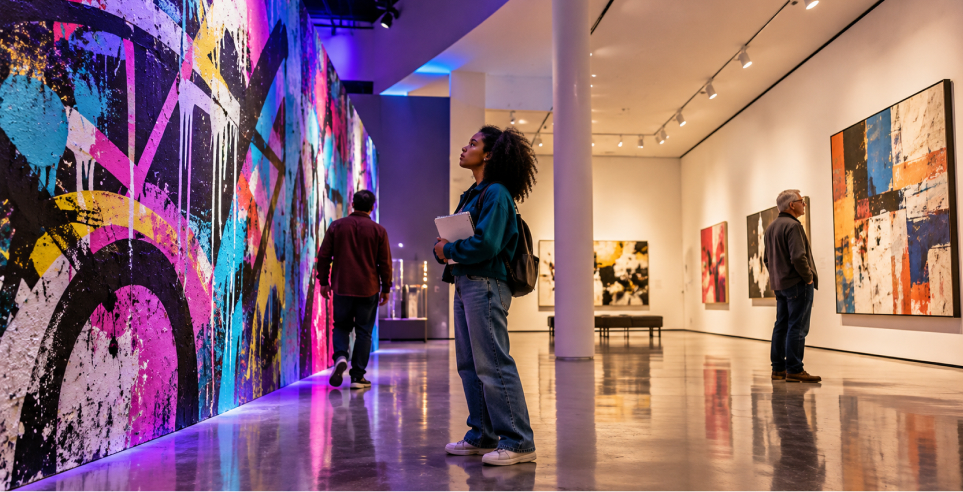
Street art has traditionally challenged the boundaries of the conventional art world. From painted subway cars and neighborhood walls to politically charged stencils and expressive graffiti lettering, the movement developed largely outside established museums and commercial galleries. Now, the Mobile Museum of Art in Alabama is bringing that creative history into a formal exhibition setting.
The arrival of internationally recognized artists such as Banksy and Jean-Michel Basquiat in Mobile reflects Alabama’s expanding cultural landscape, where major exhibitions, community festivals, and public events are attracting attention beyond the state’s borders. As Alabama’s entertainment industry develops, discussions about tourism, economic opportunities, and regulatory policy continue across different sectors. Readers following these broader developments can explore Alabama sports betting legal updates for information about the state’s evolving gambling legislation, a separate policy issue from the artistic programming and cultural investment represented by the GATEWAY exhibition.
The exhibition, GATEWAY: From Graffiti to Gallery, brings together internationally recognized artists associated with street art, graffiti, and contemporary visual culture, including Banksy, Jean-Michel Basquiat, Keith Haring, KAWS, and Kenny Scharf.
For Mobile, the exhibition represents an opportunity to introduce audiences to artistic movements that transformed public spaces into platforms for cultural expression. It also raises a larger question: What happens when art originally associated with streets, subways, and unconventional venues becomes part of a museum experience?
The exhibition’s public programming gained additional attention on October 24, 2026, when the museum hosted a free GATEWAY Family Day featuring activities intended to make contemporary art accessible to visitors of different ages.
The event highlights a growing emphasis on connecting museum exhibitions with community participation rather than treating internationally recognized artworks as objects reserved for specialists.
For Alabama’s cultural community, GATEWAY offers an opportunity to examine the relationship between urban art, artistic identity, public expression, and the changing role of regional museums.
What Is GATEWAY: From Graffiti to Gallery?
GATEWAY opened to the public on September 1, 2026, at the Mobile Museum of Art, located at 4850 Museum Drive in Mobile, Alabama. The exhibition is scheduled to remain on view through September 1, 2027, giving residents and visitors an entire year to explore its artistic themes.
The museum is the exclusive venue for the exhibition, which was developed in collaboration with the Masterworks Foundation and Level & Co. Gallery. Its collection includes 28 significant works by five influential artists whose careers demonstrate how graffiti and street art evolved into internationally recognized forms of contemporary expression.
Rather than presenting a complete chronological history of graffiti, GATEWAY examines five interconnected artistic approaches. The exhibition explores how artists adapted techniques associated with public spaces into paintings, installations, graphic imagery, and other works that could circulate within galleries and collections.
The official Alabama tourism listing for GATEWAY describes an exhibition connecting the immediacy of street-level artistic expression with the broader development of contemporary art.
That distinction is important. Graffiti and street art are not identical, and the artists represented in GATEWAY followed different creative paths. Some developed their visual languages through New York’s street culture, while others adapted public imagery, commercial graphics, and political commentary into distinctive contemporary practices.
By placing their works together, the museum encourages visitors to identify both the shared influences and the differences between them.
Five Artists Who Changed the Relationship Between Streets and Galleries
The exhibition’s strongest attraction is its combination of artists whose work helped redefine the boundaries between public art, fine art, and popular culture.
| Artist | Artistic Approach | Significance to GATEWAY |
|---|---|---|
| Jean-Michel Basquiat | Expressive painting, text, symbols, and cultural references | Connects New York street culture with contemporary painting |
| Keith Haring | Bold outlines, energetic figures, and accessible visual symbols | Demonstrates how public art can communicate across audiences |
| Kenny Scharf | Pop surrealism, vivid colors, and imaginative characters | Connects street culture, popular imagery, and large-scale painting |
| KAWS | Repeated characters, graphic forms, and commercial imagery | Explores the relationship between art, branding, and mass culture |
| Banksy | Stenciled imagery, satire, and political commentary | Challenges conventions surrounding public space and artistic authority |
Jean-Michel Basquiat and the Language of Urban Expression
Jean-Michel Basquiat emerged from New York’s downtown cultural scene during the late 1970s and early 1980s. His paintings combine expressive marks, written language, symbols, historical references, and images that invite multiple interpretations.
Basquiat’s association with the SAMO graffiti project helped establish his connection to the city’s street culture before his paintings gained international recognition.
His work is particularly relevant to GATEWAY because it demonstrates that the movement from public expression to museum exhibition was not simply a change in location. It also involved questions about artistic identity, race, cultural authority, and who determines which creative practices receive institutional recognition.
Keith Haring and Art Designed for Public Audiences
Keith Haring developed a visual language that could be understood quickly in public spaces. His energetic figures, thick outlines, and repeated symbols became recognizable through drawings in New York subway stations and later through paintings, murals, and other projects.
Haring’s work often addressed social issues, including public health, discrimination, and community responsibility.
His inclusion illustrates how visual simplicity can coexist with serious cultural commentary.
The exhibition features works that reflect the immediacy of Haring’s approach, including unconventional painted surfaces associated with his practice.
Kenny Scharf and the Influence of Pop Surrealism
Kenny Scharf brings a different atmosphere to the exhibition.
His work combines colorful characters, popular culture, science-fiction influences, and surreal visual environments. The resulting imagery can appear playful while also commenting on consumer culture and modern life.
GATEWAY includes an immersive presentation of Scharf’s Evolution Revolution series, demonstrating how scale and repetition can transform a gallery environment.
Scharf’s connection to Mobile is also notable. Local reporting has highlighted the personal and regional relationships that helped bring the exhibition to southwest Alabama.
KAWS and the Expansion of Street Art Into Global Visual Culture
KAWS, whose real name is Brian Donnelly, represents a later generation of artists who moved between street interventions, graphic design, painting, sculpture, and commercial collaborations.
His recurring characters and recognizable visual motifs demonstrate how artistic imagery can circulate across galleries, consumer products, and digital culture.
GATEWAY features presentations of KAWS’ CHUM paintings, emphasizing the importance of repetition, character design, and scale.
His work raises questions about the relationship between artistic accessibility and commercialization.
Banksy and the Power of Political Imagery
Banksy is internationally recognized for stencil-based works that use satire, irony, and recognizable imagery to address political and social issues.
His public artworks frequently depend on their original surroundings for meaning, making their presentation inside museums particularly interesting.
GATEWAY includes works associated with Banksy’s distinctive visual approach, including Girl with Balloon and a piece paying tribute to Basquiat.
As described in Mobile Bay Magazine’s exhibition coverage, the presentation brings together the different visual languages of these five artists within a single museum setting.
The result is an exhibition that asks visitors to consider how artistic meaning changes when work associated with public spaces enters an institutional environment.
GATEWAY Family Day Brings Street Art to Alabama Families
The October 24 GATEWAY Family Day demonstrated how the Mobile Museum of Art is using the exhibition to encourage direct participation in artistic activities.
Held from 11 a.m. to 3 p.m., the free event combined gallery access with creative workshops, live demonstrations, poetry, and community activities.
The program included mural demonstrations, collaborative graffiti-inspired artwork, printmaking activities influenced by Keith Haring, guided exhibition tours, and spoken-word performances by regional artists associated with PowerLines Poetry.
Food trucks and family-friendly activities also helped create an environment intended to welcome visitors who might not regularly attend museum exhibitions.
Museum executive director Jon Carfagno emphasized the importance of connecting the exhibition’s artistic themes with community programming, while curator of art education Kaitlyn Amanor highlighted opportunities for families to explore art together.
The October 22 report from FOX10 News detailed the planned activities and the organizations supporting the event.
Although the event has passed, its significance extends beyond a single afternoon.
Street art is particularly well suited to participatory education because many of its visual techniques are immediately recognizable. Bold lettering, repeated symbols, stencils, and colorful characters provide accessible starting points for discussing more complicated ideas about artistic ownership and public expression.
Children can respond to the imagery before learning its historical context, while older visitors can examine questions about politics, cultural identity, and the relationship between artists and their communities.
The museum’s decision to combine a major exhibition with hands-on activities therefore supports a broader educational objective: encouraging visitors to see contemporary art as something they can engage with rather than simply observe.
Why Mobile Is an Important Location for This Exhibition
Mobile may not have the international art-market reputation of New York or Los Angeles, but the city has a substantial cultural history and an established community of artists, museums, and public arts organizations.
Its location along the Alabama Gulf Coast also places it within reach of visitors from Mississippi, the Florida Panhandle, and other parts of the Southeast.
Hosting GATEWAY exclusively in Mobile creates an opportunity for regional audiences to experience major works without traveling to larger metropolitan art centers.
The exhibition also demonstrates the value of partnerships between regional institutions and organizations that hold significant collections.
The Masterworks Foundation’s involvement helped make the presentation possible, while support from Level & Co. Gallery and exhibition sponsors contributed to its development.
Local reporting has identified connections between Masterworks leadership and the Mobile area as an important part of the exhibition’s origin.
This background illustrates how personal relationships, institutional collaboration, and regional cultural investment can influence where major exhibitions are presented.
However, it would be premature to claim that GATEWAY has already generated a measurable increase in tourism spending or museum attendance without published figures.
Its potential economic influence is nevertheless worth examining.
A year-long exhibition featuring internationally recognized artists may encourage repeat visits, educational trips, and travel from surrounding communities. Those visits can also create opportunities for nearby restaurants, accommodations, and other local businesses.
The broader cultural value is equally significant. Exhibitions of this scale can help regional museums strengthen their reputations, attract partnerships, and introduce audiences to artistic movements that are sometimes underrepresented in local programming.
How Museums Are Changing the Meaning of Street Art
One of GATEWAY’s central themes is the tension between street art’s public origins and its growing institutional recognition.
A mural or stencil created in a public setting can communicate directly with people who encounter it during everyday life. Its meaning may depend on the surrounding neighborhood, political environment, or physical surface.
When similar imagery enters a museum, the viewing experience changes.
The artwork becomes part of a curated presentation. Visitors encounter explanatory materials, institutional interpretation, and an environment designed for sustained observation.
That transition can preserve works and expand educational access, but it also raises questions about context.
Does a politically charged stencil carry the same meaning inside a gallery? Can a work rooted in unauthorized public expression retain its original character when displayed within an established institution?
There are no simple answers.
Basquiat, Haring, Scharf, KAWS, and Banksy each developed different relationships with public space, commercial culture, and institutional recognition.
GATEWAY’s value lies partly in allowing visitors to compare those approaches rather than treating all five artists as representatives of one uniform movement.
The exhibition also reflects a wider development in contemporary art: museums increasingly recognize that influential visual culture does not emerge exclusively from traditional academic or gallery settings.
Advertising, music, fashion, graffiti, and neighborhood artistic communities have all contributed to the development of contemporary artistic practices.
By examining these connections, museums can provide a more complete account of how visual culture changes over time.
Visiting the GATEWAY Exhibition at the Mobile Museum of Art
GATEWAY remains open through September 1, 2027, providing an extended opportunity for Alabama residents and out-of-state visitors to explore the exhibition.
GATEWAY Visitor Information
Through Sep 1, 2027
| Venue | Mobile Museum of Art |
| Address | 4850 Museum Drive, Mobile, AL 36608 |
| Regular hours | Tuesday–Saturday, 10 a.m.–5 p.m. |
| Adult admission | $12 |
| Senior admission | $10 |
| Student admission | $8 |
| Children under 6 | Free |
| Mobile County residents | Free on Thursdays |
Published visitor information; check the museum for current admission policies and schedule changes.
The museum is located in Municipal Park, also commonly known as Langan Park, making it accessible to visitors exploring Mobile’s wider cultural attractions.
Additional educational programming is scheduled throughout the exhibition’s run.
Monthly GATEWAY gallery talks offer visitors opportunities to explore the artists’ work and the exhibition’s historical themes in greater depth.
Upcoming talks are listed for November 5 and December 3, 2026, with additional dates extending into 2027. Published admission is $5 for museum members and $10 for nonmembers.
Visitors can consult the GATEWAY gallery talk schedule for upcoming sessions and registration information.
The year-long schedule also provides opportunities for schools, arts organizations, and community groups to incorporate the exhibition into educational activities.
What GATEWAY Could Mean for Alabama’s Cultural Future
GATEWAY arrives at a time when regional museums are increasingly expected to serve multiple roles.
They must preserve and interpret art while also providing educational experiences, encouraging community participation, and attracting audiences with different cultural interests.
The Mobile Museum of Art’s presentation addresses those responsibilities through a combination of internationally recognized artworks and locally accessible programming.
The exhibition’s exclusive Mobile location is particularly important because it challenges the assumption that major contemporary art presentations must be concentrated in America’s largest cities.
For younger artists, GATEWAY offers an opportunity to study creative careers that developed through unconventional paths.
For educators, it provides material for discussing visual communication, cultural history, and public expression.
For visitors, it offers a chance to compare artists whose imagery has influenced painting, fashion, advertising, and popular culture.
The most meaningful measure of the exhibition’s success will not necessarily be the number of famous names displayed on its walls. Its longer-term influence may depend on whether it encourages repeat museum visits, new artistic participation, and stronger connections between Mobile’s cultural institutions and surrounding communities.
With GATEWAY scheduled to remain open until September 2027, the museum has time to develop those relationships through tours, educational programs, and public events.
The exhibition ultimately demonstrates that Alabama’s museums can participate in important international artistic conversations while maintaining a distinctly regional commitment to public access and community engagement.