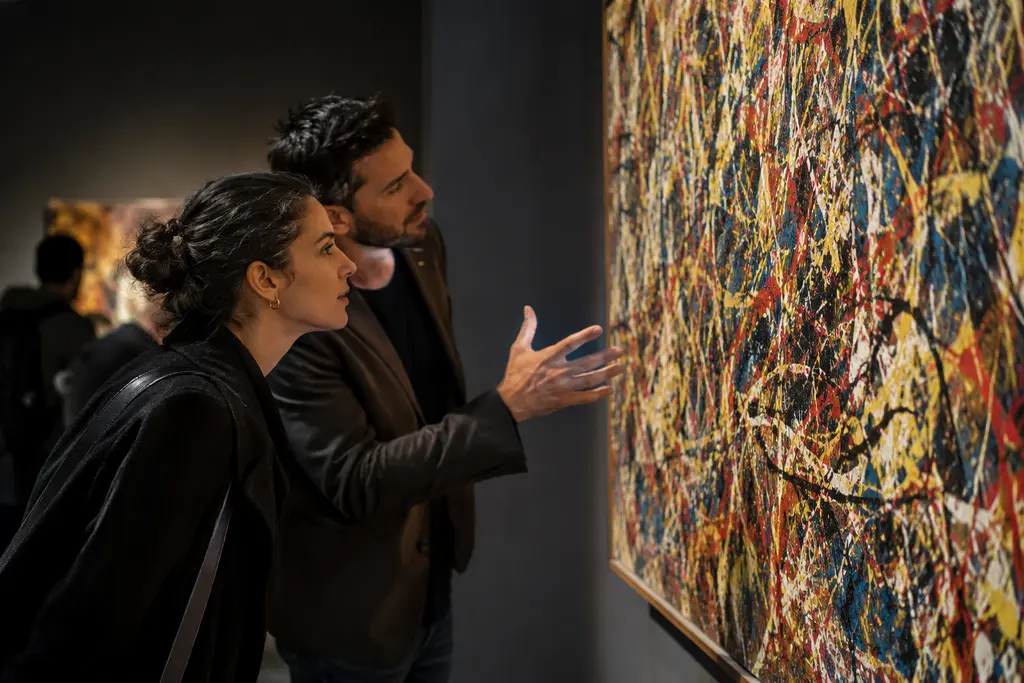
The Past Continuous Exhibition at The Met asks viewers to consider Lee Krasner and Jackson Pollock as two artists whose work developed through contact, tension, shared space, and difference. Opened on October 4, 2026, and scheduled to remain on view through January 31, 2027, the exhibition is installed in Gallery 899, the Tisch Galleries, at The Met Fifth Avenue, with more than 120 works drawn from The Met’s collection and loans according to The Met.
That framing matters because paired exhibitions can easily reduce one artist to the biography of another. The available facts point to a more careful structure: the show covers both careers, includes works from different phases, and closes attention on Krasner’s work after Pollock’s death in 1956. For community arts readers, the exhibition offers a useful case study in how museums can use proximity without flattening artistic identity.
What The Past Continuous Exhibition Shows Side By Side
Why The Past Continuous Exhibition Matters For Attribution
The central interpretive challenge is not whether Krasner and Pollock influenced one another. They lived and worked in relation to each other after meeting as emerging artists and marrying in 1945. The more careful question is how to describe that relation without making influence a one-way street. The show’s title, “Past Continuous,” suggests movement rather than a sealed historical episode: practices continued, shifted, and were re-read through time.
Pollock’s reputation has long been tied to large-scale abstraction and the drip-painting period associated with the late 1940s and early 1950s. The exhibition includes Autumn Rhythm: Number 30, 1950, a major painting measuring 8 ft. 10¼ in. by 17 ft. 4 in. That scale can dominate a room, but scale alone should not dictate interpretation. Krasner’s presence in the exhibition, including work from before and after 1956, gives viewers another route through mid-century abstraction: one based on revision, collage, gesture, structure, and self-critique.
Shared Lives Without A Single Story
Biographical context can help visitors understand chronology, yet it can also become a trap. Krasner and Pollock were married, and their domestic and studio lives intersected, but a respectful reading starts from the artwork. The exhibition’s value lies in showing parallel development rather than treating Krasner as a witness to Pollock’s career. That distinction is not a small matter. It affects wall text, catalogue writing, gallery order, and how audiences talk about the work after leaving the museum.
For local arts organizers and educators, this offers a model for public programming. A discussion group might compare how two artists respond to similar materials, pressures, or movements without requiring a winner. A classroom visit might ask students to identify formal decisions before reading biography. A community tour might pause on what is visible: scale, color, edge, layering, density, revision, and rhythm.
How The Exhibition Structure Guides Public Reading
A Gallery Setting During A Museum Transition
The exhibition’s placement in Gallery 899 matters because The Met’s modern and contemporary art spaces are in a period of change. The research notes state that most galleries numbered 900–926 are closed in preparation for the Tang Wing, scheduled for 2030. That creates a concentrated setting for Krasner and Pollock rather than a casual encounter within broader modern galleries. The result may sharpen the pair’s visibility, though it also means viewers encounter them through a focused curatorial frame.
A focused installation can be productive when it slows looking. It can also narrow context if visitors do not know what is temporarily absent elsewhere. The practical reading is simple: this is not just a display of two famous names. It is a structured presentation during a larger museum reconfiguration, and that institutional setting affects how visitors encounter the art.
The Catalogue As A Second Space For Interpretation
The accompanying catalogue, Krasner and Pollock: Past Continuous, was published on October 13, 2026, by Yale University Press. Its listed authors are David Breslin and Brinda Kumar, and the publisher describes a volume with essays, contemporary artist reflections, and more than 100 artworks on the Yale University Press page. For readers who cannot spend long periods in the gallery, the book functions as a second interpretive space rather than a souvenir alone.
Catalogues also matter because exhibitions end, while scholarship and images keep circulating. A carefully used catalogue can help community groups prepare talks, frame questions, and avoid repeating simplified accounts. It can also reveal what the gallery experience cannot fully hold: production history, reproduction details, essay arguments, and contemporary responses.
- Use the catalogue to compare chronology with visual evidence, not to replace direct looking.
- Ask how each artist’s work changes across time rather than reading one moment as the whole career.
- Keep biographical claims separate from formal observations unless a source supports the connection.
Community Arts Lessons From Krasner And Pollock

Respectful Interpretation Starts With Evidence
The Past Continuous Exhibition also has value beyond specialist art history. It shows how community arts writing can be passionate without becoming careless. Claims about influence, originality, and gendered reception should be tied to visible works or credible sources. That is especially true for Krasner, whose career has often been discussed in relation to Pollock. A better public conversation gives her work its own descriptive language.
That practice is useful across cultural coverage. Readers comparing arts features across related sites such as Shimply may notice that the strongest community writing does not rely on praise alone. It names what can be seen, states what is sourced, and leaves room for uncertainty where the record is incomplete.
There is also a rights-conscious lesson for artists, sellers, and educators. Discussing an exhibition does not require copying an artist’s style for commercial imitation or making unsupported claims about permissions. Community programming can focus on historical context, materials, gesture, abstraction, and museum interpretation while remaining cautious about reproductions, merchandise, and likeness-based projects.
How Local Groups Can Discuss The Show
A local reading group could use the exhibition as a prompt for broader questions: How do institutions display artistic couples? When does biography clarify, and when does it obscure? What happens when a museum places a less fairly recognized artist in direct relation to a more famous one? These are not abstract questions. They shape which artists appear in public memory and how young artists learn to see themselves within art history.
A related NextClues essay on parallel modernism at The Met considers a similar issue: how a side-by-side chronology can challenge inherited assumptions. That approach is strongest when it resists easy correction narratives. Krasner should not be valued only because Pollock is famous, and Pollock should not be reduced to a foil. The harder and more rewarding task is to see the pressure, difference, and independence in both bodies of work.
What The Past Continuous Exhibition Clarifies
The Past Continuous Exhibition clarifies that museum pairing is never neutral. To place Krasner and Pollock together is to make an argument about time, relation, and artistic memory. Based on the exhibition details available from The Met and the catalogue information from Yale University Press, the show gives viewers a concentrated opportunity to test that argument against more than 120 works and a publication that extends the conversation beyond the gallery.
For community audiences, the most useful takeaway is a method: look first, source claims carefully, and avoid inherited shortcuts. Krasner’s career deserves sustained attention, including her post-1956 work. Pollock’s work remains significant, but significance is not the same as singularity. Read together with care, the two artists offer a sharper account of modern abstraction than either myth or biography can provide on its own.