Live Nation’s artist-first merchandise policy, mainly carried through its On the Road Again program, changed a specific part of the live-event economy: merch income at participating club-size venues. As of September 14, 2026, the clearest supported record shows a policy with measurable benefits for developing artists, but also a limited reach across the full touring circuit. That distinction matters for artists, audiences, venues, and local communities that depend on live rooms as cultural infrastructure.
Merchandise is not only a souvenir table. For many artists, it is a practical revenue source that can help cover fuel, lodging, crew, production, and time away from other work. For audiences, buying a shirt, record, poster, or handmade item can feel like a direct way to support the performer they just heard. The policy therefore affected live events not by changing the music on stage, but by changing what happens around the room: the checkout line, the artist-fan exchange, and the post-show economics.
What The artist-first merchandise policy Changed
artist-first merchandise policy At Club Scale
Live Nation launched On the Road Again in 2023 in partnership with Willie Nelson. The company said the program waived merchandise-selling fees at participating Live Nation club venues, allowing artists to keep 100% of their merch profits at those shows, and also provided $1,500 per show for gas and travel costs to both headliners and support acts. By March 12, 2024, Live Nation said the program had supported more than 4,000 developing artists and had distributed “tens of millions of dollars” in added support through merch profit retention and travel stipends, according to its On the Road Again update.
Those details define the policy’s strongest case. It did not ask artists to wait for a royalty cycle, a later settlement, or a sponsorship deal. At qualifying shows, the change was attached to a familiar point of sale: the merch table. That made the benefit legible to artists and tour managers because the waived fee applied to money generated in the room on the night of the performance.
Travel Support And The Cost Of Showing Up
The $1,500 travel payment is part of the same live-event effect. Touring at club level can involve tight routing, long drives, and uncertain nightly sales. A fixed payment for gas and travel does not solve every expense, and the available source does not show every artist’s cost structure. Still, it addressed a known pressure point: reaching the next city can be one of the barriers that decides whether a developing act can continue a run of dates.
The artist-first merchandise policy did not remove all financial risk from touring. It did, however, shifted a defined portion of the risk away from the artist at participating club shows. That is a meaningful change for a support act selling modest quantities of merchandise, where a percentage cut and seller fees could reduce the margin on each item.
Why Merch Policy Matters Inside The Room
The Merch Table As A Community Exchange
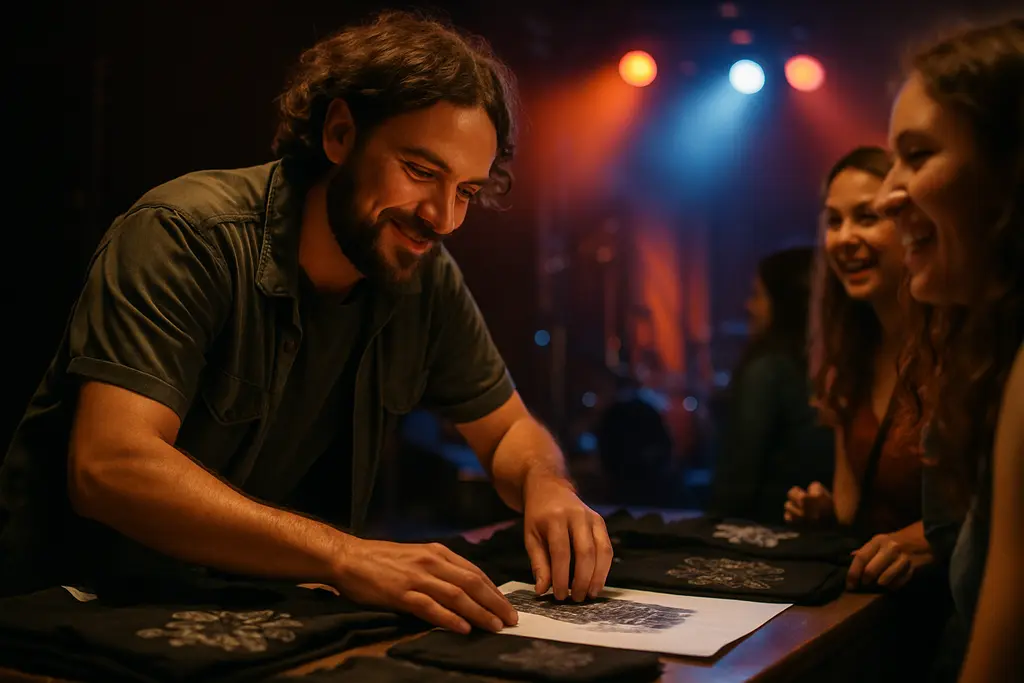
A live event is often remembered through the performance, but the social life of the room extends before and after the set. The merch table is where a fan may ask about a song, buy a record directly from a touring musician, or discover a local opener’s work. When a venue policy allows the artist to retain a larger share of sales, that exchange carries clearer economic meaning.
For audiences, the artist-first merchandise policy can reduce uncertainty about where their merch spending goes at a qualifying show. That does not mean every dollar at every Live Nation-affiliated event follows the same rule. The research supports a narrower statement: at participating club-size venues in the program, merchandise-selling fees were waived so artists kept 100% of merch profits from those sales.
Trust, Transparency, And The Post-Show Line
Community trust in live music is built from many small signals. Clear ticketing, respectful staff, fair treatment of local crews, safe rooms, accessible information, and artist compensation all shape how a venue is perceived. Merch policy sits within that larger set of signals. A room that reduces friction at the merch table may be read by artists as more hospitable, especially if the policy is communicated before settlement.
Audience perception is more difficult to measure from the available research. The cited materials do not prove that fans bought more merchandise because of the policy, nor do they prove that the policy changed attendance. A cautious reading is better: the program created conditions in which merch purchases at certain club shows could have a more direct financial link to the artist, and that can strengthen the ethical clarity of the fan’s choice to buy.
The Limits Of Coverage Across Live Events
Not Every Venue Was Covered
The main limitation is scope. The strongest documented benefits applied to participating club-size venues, not necessarily to theaters, arenas, festivals, or every date on a tour. Pitchfork’s reporting on the dispute between artists and venues over merch profits noted that venue merch cuts had become a serious issue for musicians and that policy fixes were not evenly applied across all rooms, as discussed in its report on artist merch cuts.
This matters because touring is rarely confined to one venue type. A developing band may play a Live Nation club on one night, an independent room the next, a festival slot later in the month, and a theater support date after that. If only some shows remove merch cuts, the artist’s budget still has to account for mixed terms across the route.
Why The Old Debate Did Not Disappear
Before programs like On the Road Again, reported merch cuts in many U.S. contexts were often described in the 20% to 30% range, with some accounts including seller fees. The research notes also point to examples outside the United States, including Australian documents showing 10% to 20% of gross sales in certain contexts. These figures help explain why the issue drew attention: a percentage taken from gross merch sales can matter sharply when production costs, card fees, tax handling, shipping to the tour, and unsold stock are considered.
Because the policy’s reach was limited, it did not end the broader argument over who should benefit from the labor and risk behind merch. Venues may point to staffing, space, payment systems, and building costs. Artists may point to design costs, manufacturing, transport, and the fact that the goods are tied to their creative identity. Both sides are discussing real pressures, but the policy showed that a zero-cut model could be implemented in at least one defined club program.
Practical Implications For Artists, Venues, And Audiences
What Changed In Tour Planning
For a tour manager, a waived merch cut at a qualifying show can make settlement easier to forecast. It does not guarantee a profitable night, since sales depend on attendance, pricing, demand, inventory, and the artist’s costs. It can, however, remove one variable from the calculation. That is especially relevant for developing artists who may depend on several modest revenue streams rather than one large guarantee.
For venues, the program raised a strategic question: whether goodwill with artists and audiences can outweigh income previously collected through merch percentages. The available research does not prove how each venue balanced that tradeoff. It does show that Live Nation was willing to frame club-level artist support as a public policy choice tied to touring sustainability.
- Artists: qualifying shows offered a clearer path to retaining merch profit and receiving travel support.
- Audiences: merch purchases at covered club shows could more directly support the performer.
- Venues: the policy placed pressure on rooms to explain or reconsider merch percentages.
- Local scenes: artist-friendly terms can help touring acts remain willing to play smaller rooms, though venue-by-venue proof is limited.
Community Value Beyond The Sale
Community-focused coverage should avoid treating every policy announcement as proof of a solved problem. Live music depends on relationships among artists, promoters, venue workers, local audiences, and neighboring businesses. Related cultural networks such as Robsonic underscore the same concern: performance spaces are not only commercial sites, but places where local identity, touring exchange, and creative work meet.
A cautious reading of the artist-first merchandise policy is that it made one part of that exchange fairer at participating club shows. It did not create a universal standard across every live event. It did give artists and advocates a concrete example to reference when asking how merch revenue should be shared.
Live Nation artist-first merchandise policy
The impact of Live Nation’s program is best understood as specific rather than total. It helped thousands of developing artists by March 12, 2024, according to Live Nation’s own statement, and it placed 100% merch-profit retention at participating club shows into the center of the public conversation. It also left open the harder question of what happens outside those rooms.
For communities that care about live music, the policy’s value lies in its clarity. If a fan buys merch at a covered club show, the supported claim is that the artist keeps the merch profit without the venue merchandise-selling fee. If an artist builds a tour budget, a covered date may carry better terms than a non-covered date. If a venue wants to be seen as artist-supportive, merch policy is now part of that public measure.
That is a real shift, but not a complete settlement of the issue. The next responsible conversation is not whether one company announcement fixed touring economics. It is how artists, venues, promoters, and audiences can identify which policies apply on which dates, and how those policies affect the people doing the creative work on stage.