
Assembly Art Fair arrived in Seattle with a stated emphasis on curated gallery presentations rather than standard booth arrangements. The inaugural event took place July 22 to 26, 2026, at West Canal Yards, described by the fair as a newly adapted historic fisheries building with expansive exhibition spaces on waterfront property near downtown Seattle, according to the official fair site. That setting matters because art fairs are never only about objects on walls; they also shape how viewers move, pause, compare, and speak with the people presenting the work.
For Seattle, the fair sits within a wider conversation about how regional galleries can meet collectors, curators, artists, and public audiences without flattening local identity into a sales floor. The available reporting supports a careful reading: this was a gallery-led, invitational event with a defined Western U.S. focus, not a general open call or a citywide survey. That narrower structure gave the fair a clear frame, while also leaving open questions about access, representation, and how future editions might broaden participation.
Assembly Art Fair And The Gallery-Led Format
What Assembly Art Fair Changes About Pace
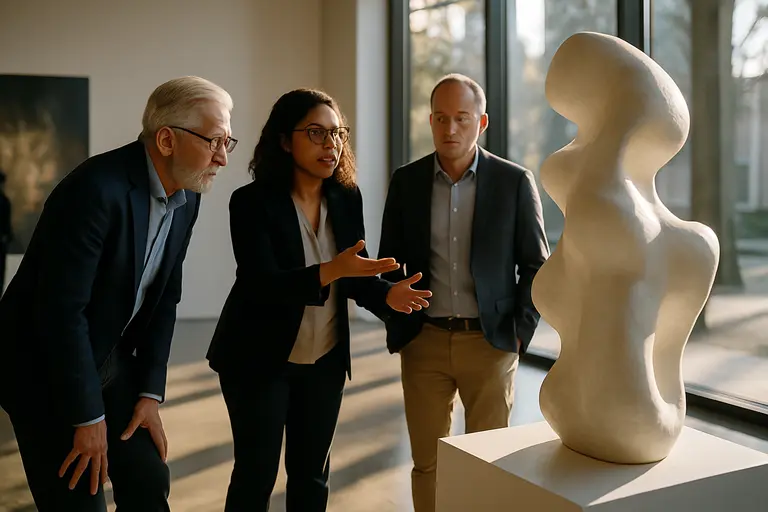
The Assembly Art Fair format is best understood as a shift in viewing conditions. Traditional fairs often rely on compact booths that encourage quick scanning and frequent comparison. Assembly’s stated model emphasized curated exhibitions, giving each participating gallery more room to shape a distinct encounter. This does not guarantee deeper engagement by itself, but it can create better conditions for slower looking when the installation, lighting, and staff conversations are handled with care.
Artnet reported that the fair featured 18 leading galleries from the Western U.S., including Traver Gallery, Greg Kucera Gallery, and PDX CONTEMPORARY ART, in a gallery-led invitational structure, as noted in its coverage of Assembly. That roster indicates a regional emphasis rather than a nationally diffuse fair identity. In cultural terms, such a choice can help viewers understand how galleries from nearby art centers speak to one another, even when their programs differ in medium, scale, and market position.
Curatorial Space Versus Commercial Compression
A curated fair presentation asks different questions from a standard booth. Instead of simply asking how many works can be shown, a gallery has to ask what relationship the works have to one another. Does a presentation build around one artist, several artists, or a material conversation? Does it reward extended looking, or does it depend on quick visual impact? These questions are familiar to museum and gallery visitors, but they carry different pressure inside a fair, where sales, introductions, press attention, and institutional interest can happen in the same room.
At Assembly Art Fair, the emphasis on intimate art encounters should be treated as an organizing aim, not as proof that every visitor had the same experience. Fairs remain uneven by nature. A collector with appointments may encounter the event differently from a student, artist, or neighborhood visitor. Still, a curated format can reduce some of the visual noise that often makes art fairs difficult, especially for audiences trying to understand why a gallery has placed certain works together.
West Canal Yards As A Cultural Setting
A Waterfront Site With Industrial Memory
West Canal Yards gave the fair a physical identity tied to Seattle’s working waterfront. The research describes the site as a historic fisheries building adapted for exhibition use, with seven acres of waterfront property and access by car, transit, and boat. Those details are not decorative. They affect how an art event feels, who can reach it, and how the city’s industrial past is placed beside contemporary cultural activity.
Adaptive reuse can be compelling for art presentation, but it also deserves caution in how we describe it. A historic industrial building can offer scale and atmosphere, yet those qualities do not automatically produce public benefit. The more grounded question is whether the venue supports clear movement, adequate time with the work, and respectful conditions for artists and visitors. Based on the fair’s stated focus on expansive exhibition spaces, West Canal Yards appears to have been chosen as part of the curatorial proposition, not merely as a container.
How Place Shapes Community Reading
Community arts coverage often turns too quickly to celebration. A more useful approach asks how a site shapes cultural meaning. Seattle’s waterfront carries associations with labor, trade, food systems, transport, and development. Presenting contemporary art inside that context can open productive tension: art is seen not in isolation, but in relation to the city’s material life. That does not mean every artwork directly addresses those histories. It means the audience’s experience is formed partly by the building and the route to reach it.
For galleries, a site like West Canal Yards can also shift the social rhythm of a fair. Visitors may spend longer in a destination venue than they would in a convention setting, though that depends on programming, transport, weather, and visitor goals. The available information does not support broad claims about attendance or public response, so the safer observation is formal: the venue choice aligned with the fair’s preference for curated, spatially distinct presentations.
Galleries, Collectors, And Curatorial Contact
Regional Galleries In Shared Conversation
The presence of galleries from the Western U.S. places Seattle in conversation with nearby cultural markets rather than isolating it as a local-only event. That regional scale is significant. It allows audiences to compare gallery programs across cities while still keeping the focus tighter than a large international fair. For artists, this kind of gathering can create visibility among curators and collectors, though the degree of benefit varies and should not be assumed without later evidence.
The named participants in the research point to galleries with established public profiles, but the fair’s invitational structure also raises fair questions. Who gets invited? Which media receive attention? How are emerging spaces considered? These are not criticisms by themselves. They are the normal questions that help an art community evaluate whether a new fair strengthens existing networks, repeats existing exclusions, or does some combination of both.
Why Curatorial Perspective Matters
Curatorial perspective is not limited to museums. Galleries make interpretive decisions whenever they select, group, and present work. In a fair setting, those choices are highly compressed. A strong presentation can help a visitor understand an artist’s material language or a gallery’s point of view in minutes. A weaker one can reduce artworks to inventory. The distinction matters for community trust because artists are not interchangeable content providers; their practices deserve context, time, and accurate representation.
Those interested in regional cultural dynamics can find additional insights by exploring related content on Kay Granger’s platform. This source can enhance understanding of how art fairs integrate broader social and economic frameworks, beyond just artistic merit.
What Assembly Art Fair Signals For Seattle
The most persuasive reading of Assembly Art Fair is not that Seattle suddenly has a single answer to the art-fair model. The stronger point is more measured: the event tested a gallery-led format that favored curated presentations, a regional gallery network, and a venue with a distinct Seattle setting. Those choices give critics, artists, collectors, and visitors something concrete to assess.
Future judgment should rest on evidence: which artists were supported, how audiences experienced the site, whether galleries found the format sustainable, and whether the fair created lasting curatorial relationships. For now, the documented facts support a cautious but meaningful claim. Seattle’s art community gained a new fair format in 2026, one that asked galleries to present with intention and asked visitors to look beyond the quick booth-to-booth rhythm common to many art fairs.
That is where the community story sits. Not in spectacle, and not in unsupported claims about a market shift, but in the practical meeting of place, presentation, and regional artistic labor. If the fair continues, its value will be measured less by novelty than by how responsibly it serves artists, galleries, and publics who bring Seattle’s art conversations into view.