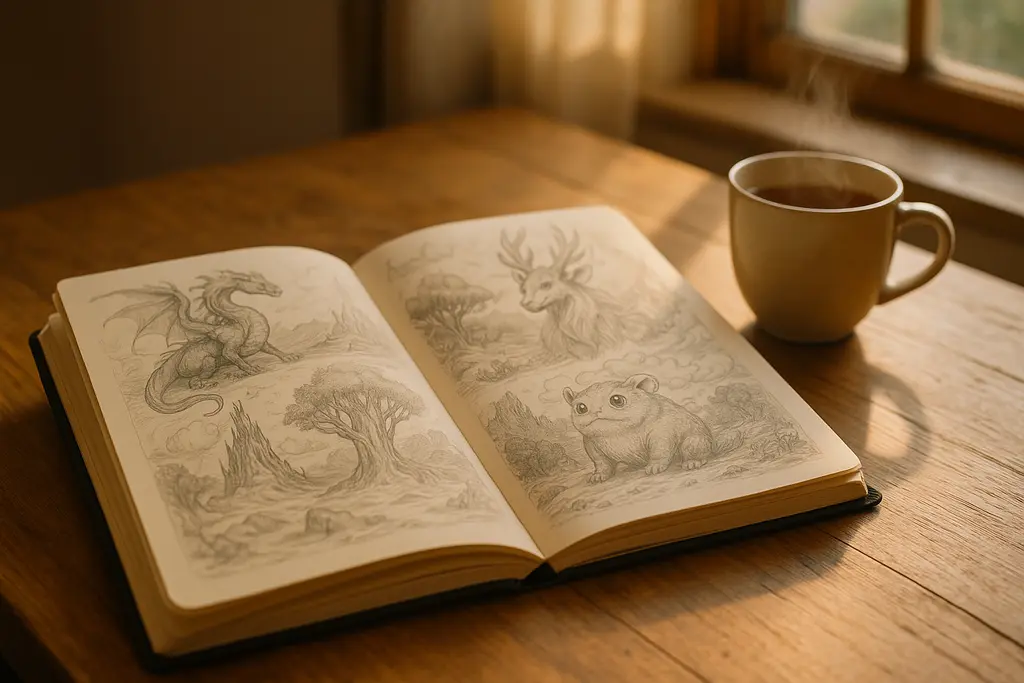
Leonora Carrington Sketchbooks offer one of the clearest routes into the artist’s thinking because they place image-making close to uncertainty, repetition, and private symbolic testing. Carrington, a British-Mexican artist and writer who lived from 1917 to 2011, is often discussed through finished paintings and fiction, yet the drawings connected with her Santander period ask for a slower kind of looking. They do not simply confirm a familiar account of Surrealism. They show how a woman artist shaped Surrealist language under pressure from war, confinement, mythology, psychology, and occult symbolism.
For students of visual art, the value of the sketchbook is not that it reveals a single key to Carrington’s work. Sketches rarely behave like footnotes. They are closer to evidence of process: provisional marks, recurring creatures, bodily transformations, and scenes that resist easy explanation. That makes them especially useful in a learning context, where the goal should be interpretation built from visible details and supported context rather than a fixed myth of the artist as an isolated visionary.
Why Leonora Carrington Sketchbooks Matter
Leonora Carrington Sketchbooks As Working Evidence
The phrase Leonora Carrington Sketchbooks can sound archival, as if the drawings mainly serve scholars who want to date an idea or trace a motif. Their importance is broader. A sketchbook can expose how an artist tests structure before public presentation. In Carrington’s case, that process is bound to a Surrealist vocabulary of hybrid beings, altered interiors, symbolic animals, and ritualized encounters. The drawings make visible an imagination that is not decorative fantasy but an inquiry into power, identity, and psychic disturbance.
This matters because Carrington’s contribution to Surrealism is often reduced to biography: her relationship with Max Ernst, her flight from Europe, or her later life in Mexico. Those elements are part of the record, but they should not crowd out the work itself. The drawings encourage viewers to start with form and image. What kinds of bodies appear? How do animals and humans cross into each other? Which spaces feel domestic, theatrical, medical, or mythic? Those questions keep interpretation grounded in the page.
From Private Mark To Art-Historical Claim
A cautious reading begins with what can be seen, then tests that observation against documented context. If a drawing contains an anthropomorphic figure, a viewer can describe the figure before assigning meaning. If a composition suggests ritual or transformation, that can be noted without claiming that one symbol has only one meaning. Carrington’s use of esoteric material, mythology, and psychological imagery supports a wide interpretive field, but responsible criticism should separate visible evidence from speculation.
Santander Drawings And The Symptomatic Surreal
Early 1940s Pressure And The Drawn Image
The Freud Museum London’s 2026 exhibition The Symptomatic Surreal was described as the first institutional exhibition dedicated to Carrington’s drawings from the Santander sketchbooks. The museum connects those works to the early 1940s, a period marked by personal and political upheaval, including Carrington’s internment in a Spanish sanatorium. That context does not make the drawings simple illustrations of trauma, but it does make the conditions of their production impossible to ignore.
The Santander material is significant because it sits at the meeting point of lived experience and Surrealist method. Surrealism had long been interested in dreams, automatism, and psychic fracture, but Carrington’s drawings complicate any detached fascination with the unconscious. Her images are not clinical case studies. They are acts of image-making by an artist negotiating fear, dislocation, and symbolic self-definition.
Psychology, Myth, And Occult Reference
The research around the exhibition points to themes including mythology, psychology, and the occult. In Carrington’s work, those categories often overlap. A creature may feel like a mythic familiar, a psychological double, or an alchemical figure without settling into only one reading. This is one reason her sketchbooks remain instructive: they teach viewers to tolerate ambiguity while still making disciplined observations.
For learners, that balance is essential. A drawing can invite symbolic interpretation without permitting any claim a viewer wants to make. The stronger approach is comparative. Track repeated figures, note changes in posture and setting, and ask whether a motif reappears in painting or writing. If a claim cannot be supported by the work or by reliable scholarship, it should remain a possibility rather than a conclusion.
Feminizing Surrealism Without Flattening It
Autonomy Against A Predominantly Male Movement
Carrington is frequently discussed as an artist who brought a female perspective to a Surrealist movement often dominated by men. The New Yorker framed this legacy through the idea that she “feminized Surrealism,” emphasizing how her work challenged inherited roles and centered women’s autonomy in art New Yorker profile. That phrasing is useful if handled with care. It should not imply that all women artists share one perspective, nor that Carrington’s work can be reduced to gender alone.
What the idea does clarify is the pressure Carrington placed on Surrealist imagery. In much male Surrealist work, women were often positioned as muses, fantasies, or symbolic vehicles. Carrington’s figures do not sit easily in that structure. They act, mutate, withhold, gather knowledge, and inhabit strange systems of relation. Her images suggest autonomy not by making power simple, but by refusing passive placement.
Animals, Women, And Self-Fashioning
Students should pay attention to Carrington’s hybrid beings without treating them as mere eccentric decoration. Animal-human figures can stage questions about transformation, protection, instinct, and social constraint. They can also unsettle stable identity. In this sense, Leonora Carrington Sketchbooks help readers see Surrealism not only as dream imagery but as a field where gendered assumptions could be challenged through form.
This reading also speaks to costume culture, fantasy fashion, and handmade creator communities that draw inspiration from historical art. Carrington’s symbolic universe may inspire study of texture, silhouette, and creaturely form, but creators should distinguish homage, education, and original interpretation from copying specific protected works or presenting derivative imagery as licensed. For readers interested in comparing art education resources, Shimply is part of the same network, providing further insights into creative communities.
How Students Can Read The Drawings Responsibly
From Visual Motif To Supported Claim
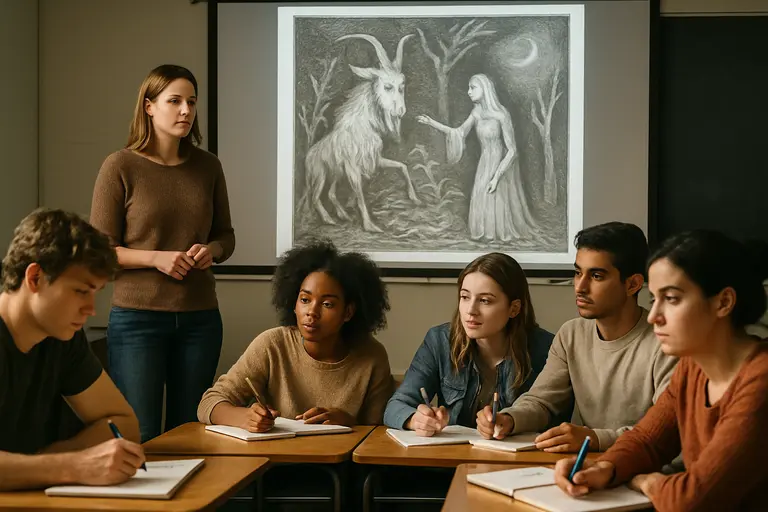
For students, Leonora Carrington Sketchbooks are best approached as a set of questions rather than a puzzle with one answer. The first task is close looking. Before naming a symbol, describe the line, scale, gesture, and setting. A thin figure in an enclosed room communicates differently from a crowded scene of animated beings. A creature looking outward asks for a different response than one absorbed in action.
- Begin with visible form: figure, setting, movement, and relation between bodies.
- Record repeated motifs before assigning symbolic meaning.
- Use exhibition material and reputable criticism to test claims.
- Keep biography in view, but do not let it replace analysis of the drawing.
This method is especially useful for emerging artists studying Surrealism. Carrington’s drawings show that influence is not imitation. The lesson is not to copy her creatures or borrow the atmosphere of her work as a surface style. The more serious lesson is structural: build a symbolic language through repeated inquiry, private testing, and attention to the relation between form and lived experience.
What The Sketchbook Can And Cannot Prove
A sketchbook can show that an artist returned to certain images. It can suggest patterns of thought. It can document a moment when private drawing and public art were connected. It cannot, on its own, prove every psychological or spiritual interpretation proposed by a later viewer. That limit is not a weakness. It is what makes the material intellectually valuable. The page asks for restraint.
Carrington’s Sketchbooks And Surrealist Study
A Careful Path For Further Learning
Studying Leonora Carrington Sketchbooks gives art learners a disciplined way to understand influence. Carrington’s work matters to Surrealism because it does more than add a woman artist to an existing canon. It tests the movement’s assumptions about the body, dreams, transformation, and power. Her Santander drawings, especially in the context presented by the Freud Museum, make that testing visible at a charged historical moment.
The strongest reading of Carrington begins with respect for uncertainty. Her sketchbooks do not hand over a simple story about suffering, liberation, mysticism, or gender. They hold those elements in tension. That is why they remain valuable for art history classrooms, studio research, and critical writing. They teach that influence can be quiet, strange, and resistant to easy summary, and that the page where an artist thinks may be as revealing as the finished work on the wall.