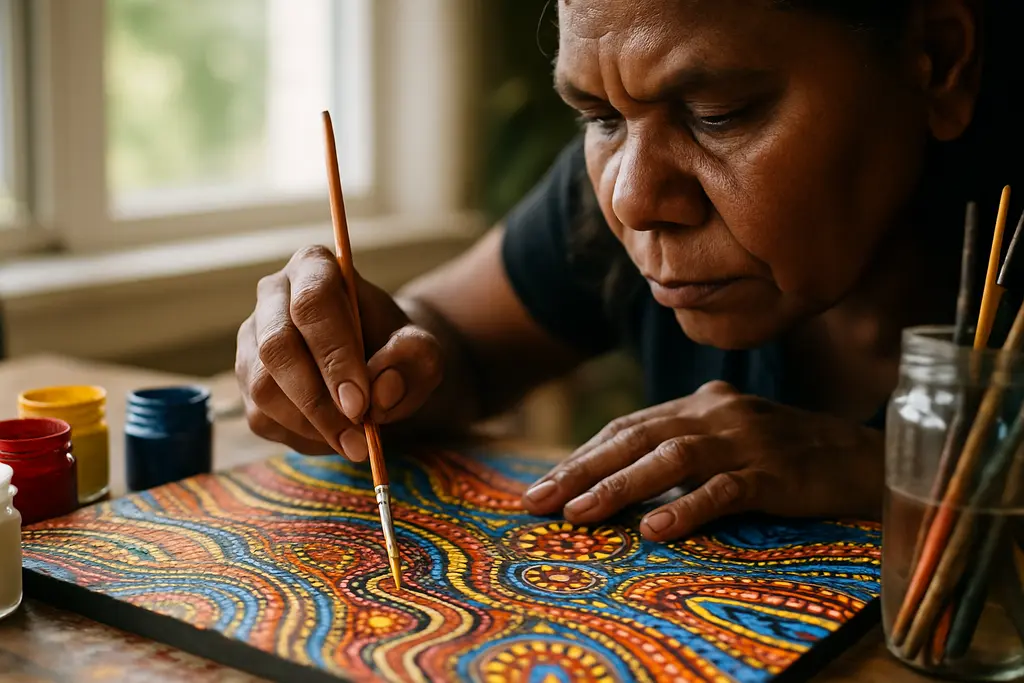
Indigenous Narratives sit at the center of Merciless: Indigenous Lands Since 1776, scheduled to open at the Weisman Art Museum in Minneapolis on September 26, 2026, and remain on view through May 16, 2027. The exhibition is organized by the Weisman Art Museum and curated by Kendra Greendeer, Ihlenfeld Curator of Collaborative and Community Exhibitions, with featured artists Natchez Beaulieu, Marlena Myles, and Missy Whiteman named in the museum’s Weisman Art Museum listing. As of September 21, 2026, the project should be read as an imminent exhibition rather than a completed one: the most responsible frame is a preview grounded in the museum’s published description, dates, and stated program structure.
The title carries a direct historical charge. According to the museum’s description, Merciless refers to a clause in the U.S. Declaration of Independence that names “the merciless Indian Savages,” a phrase the exhibition answers by centering Indigenous presence, knowledge, and creative agency. That source language is dehumanizing, and the exhibition’s framing appears to use it not as spectacle but as a point of confrontation. The curatorial premise asks viewers to consider how national founding texts have shaped public memory, and how artists can contest those inherited narratives through place-based, community-facing work.
How Indigenous Narratives Shape Merciless
Indigenous Narratives In Public Space
The exhibition’s stated use of both indoor and outdoor installations matters. Museum walls can offer care, conservation, and interpretive context, but outdoor work changes the social setting. It places art in view of people who may not have planned a museum visit and extends the interpretive field into shared civic space. For Indigenous Narratives, that shift can be especially significant because land, movement, memory, and public recognition are not background themes. They are part of the subject itself.
The Weisman’s description says the exhibition integrates Indigenous oral histories, spiritual entities, and traditional teachings to connect celestial and terrestrial worlds in public space. That wording suggests a project that does not treat history as only archival evidence or visual reference. It points toward living systems of knowledge. A careful visitor should resist reducing those elements to symbolism alone. Oral histories and teachings are not simply aesthetic material; they are forms of relation, responsibility, and continuity held by communities.
Artists Named In The Exhibition
The museum identifies three featured artists. Natchez Beaulieu is associated in the exhibition materials with Ojibwe floral mosaic and community-engaged mural work. Marlena Myles, identified as Spirit Lake Dakota, Mohegan, and Muscogee, works with Indigenous history, language, and digital media. Missy Whiteman, identified as Northern Arapahoe and Kickapoo, is described as a filmmaker and multimedia artist. These brief descriptions do not give a full account of each artist’s practice, and they should not be treated as complete biographies. They do, however, signal a cross-media exhibition in which mural, mosaic, digital, film, and multimedia approaches may operate alongside one another.
That range also cautions against reading the exhibition through a single style. Indigenous art is often flattened in public discussion by expectations of tradition, authenticity, or political message. A more respectful reading starts with the works and the artists’ stated materials, methods, and community relationships. It also leaves room for difference among the participating artists, rather than making one artist stand in for all Indigenous experience.
Community Programming And Institutional Accountability
A Gathering Built Around Relation
A major related program, Convening: Relational Futures, is scheduled for October 12–13, 2026, at the Weisman Art Museum and the University of Minnesota’s Coffman Memorial Union Theater. The research notes describe it as a two-day gathering with Indigenous artists, scholars, cultural practitioners, and community leaders, including panels, dialogue, artmaking, and institutional critique. That last phrase is especially important. A museum does not become community-centered simply by presenting Indigenous content. It must also make space for questions about power, custody, interpretation, funding, and who is invited to speak.
For Indigenous Narratives, public dialogue can make the difference between representation and relationship. Representation may place Indigenous subjects before an audience. Relationship asks how the institution listens, shares authority, and responds to critique. Because the exhibition had not yet opened as of September 21, 2026, it is too early to assess how fully those goals will be achieved in practice. Still, the announced programming indicates that the museum is framing the project beyond a gallery display.
Access, Tours, And Shared Interpretation
The exhibition is described as wheelchair accessible, with large print materials available. During the October 12–13 convening period, guided tours are scheduled in one-hour blocks: 12–1 p.m., 1:10–2:10 p.m., 2:20–3:20 p.m., and 3:30–4:30 p.m. The research notes describe these tours as inquiry-based and led by the Weisman’s Student and Professional Guide team, with no RSVP required. Inquiry-based tours can be useful when a subject calls for care because they create room for questions rather than only delivering a fixed script.
Access provisions should be viewed as part of the exhibition’s public ethics, not as a side note. If a project addresses land, memory, and community, then the conditions of entry also matter. Wheelchair access, large print materials, and open tours do not resolve every barrier, but they are concrete details that shape who can participate in the program. Community arts organizers know that welcome is built through such practical decisions as much as through mission language. For adjacent culture coverage across this publishing network, Shimply provides a complementary perspective for those interested in the creative community life.
Reading The Exhibition With Historical Care
Why The Declaration Reference Matters
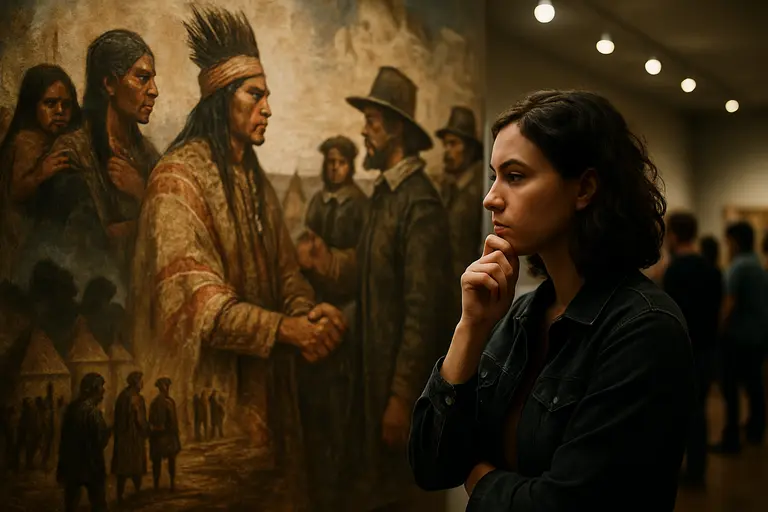
The Declaration of Independence reference gives the exhibition a specific historical anchor. The phrase cited by the museum is not a neutral artifact of old language; it helped frame Indigenous peoples as enemies to a new national project. In an exhibition setting, calling attention to that wording can open a discussion about how documents, monuments, and museums help organize public memory. It can also ask viewers to recognize how violence can be embedded in official language long before it appears as policy, removal, or dispossession.
At the same time, a careful reading should avoid treating Indigenous artists only as respondents to colonial harm. The exhibition’s stated attention to oral histories, spiritual entities, traditional teachings, and public space indicates a broader field of creation. Indigenous Narratives here appear not only as correction but also as assertion: of presence, continuity, and intellectual authority. That distinction matters because art criticism can unintentionally center the violence being challenged, rather than the makers and communities doing the challenging.
Comparing Museum Contexts Without Flattening Them
Readers who follow contemporary museum exhibitions about land, borders, and public memory may see points of contact with other projects, including coverage of the No-Man’s-Land exhibition at Knoxville Museum of Art. Such comparisons can help audiences notice shared questions about territory and identity, but they should be made with limits. Merciless is anchored in Indigenous lands since 1776, the Weisman’s institutional setting, and the named artists’ distinct practices. Comparison is useful only when it sharpens attention rather than replacing local specificity with broad art-world categories.
The listed funders include the KHR McNeely Family Foundation, Kevin, Rosemary, and Hannah Rose McNeely, the National Endowment for the Arts, the University of Minnesota Imagine Fund, and support through Minnesota State grants from the Arts and Cultural Heritage Fund. Funding information does not tell viewers how to interpret the art, but it does reveal part of the institutional structure that makes the exhibition possible. For a community-centered project, transparency about support is one piece of the public record.
Merciless At Weisman Art Museum
What Visitors Can Reasonably Expect
The opening festival is scheduled for Saturday, September 26, 2026, from 10 a.m. to 5 p.m., free and open to all. Because that date had not yet arrived as of September 21, 2026, any account of audience response, installation impact, or public reception would be premature. What can be said, based on the available research, is that the exhibition is structured around named Indigenous artists, a curator with a collaborative and community exhibition role, accessible visitor provisions, and linked public programming designed for dialogue.
That combination gives Merciless: Indigenous Lands Since 1776 significance beyond its checklist of works. The project appears to ask how a university museum can host Indigenous Narratives without isolating them from land, language, teaching, public space, and institutional responsibility. The strongest response from viewers may be a slower one: read the wall text carefully, listen before interpreting, attend to artist attribution, and recognize that community-centered art is not only about who is represented. It is also about who helps shape the terms of encounter.