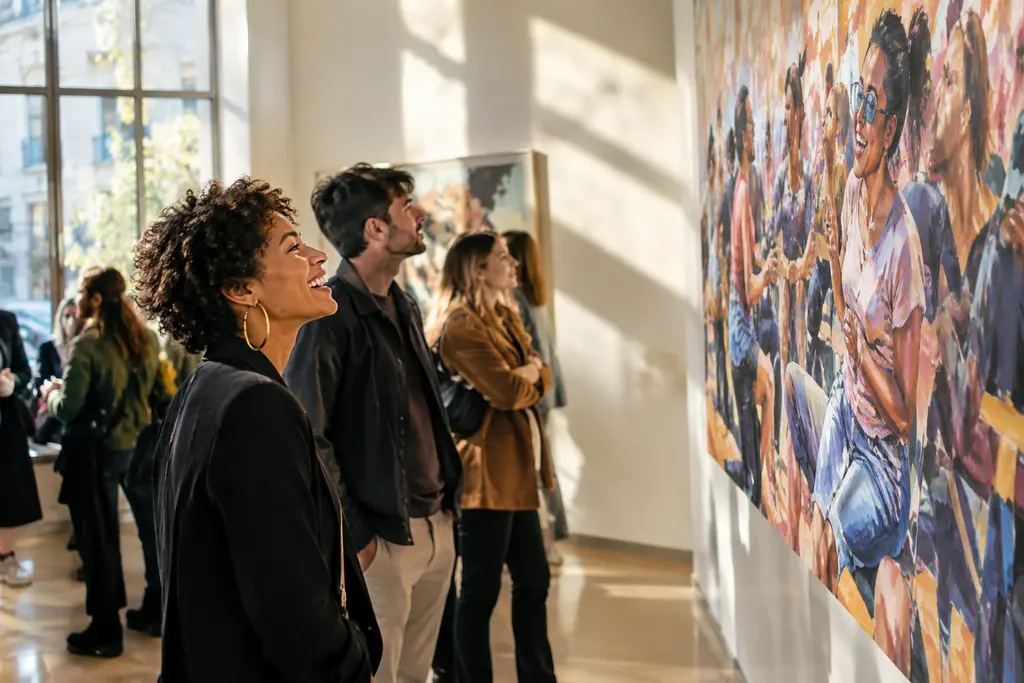
New York exhibitions on view on October 27, 2026, include two posthumous presentations that ask viewers to slow down around biography, iconography, and institutional framing. Celeste Dupuy-Spencer: Burning in the Eyes of the Maker is at Jeffrey Deitch in New York through October 31, 2026, while Michael Richards: Free F’All is on view at the Brooklyn Museum through June 6, 2027. Both exhibitions concern artists whose deaths shape, but should not flatten, how their work is received.
The pairing is not a claim that the two artists made the same kind of work. Dupuy-Spencer’s recent paintings, as described in exhibition materials, move through religious and mythological imagery. Richards’ central sculptural work draws on flight, martyrdom, Black military history, and spiritual reference. The shared issue is curatorial: how museums and galleries present art after an artist’s death without reducing the work to tragedy.
New York Exhibitions And Posthumous Context
Why New York Exhibitions Require Date Precision
Because both presentations were already underway by October 27, 2026, they should be discussed as ongoing exhibitions rather than future events. Jeffrey Deitch lists Celeste Dupuy-Spencer: Burning in the Eyes of the Maker in New York from September 12 to October 31, 2026, according to the gallery’s New York exhibitions page. That schedule places the show in its final days as of the date of this review.
Date precision matters in arts coverage because it affects how readers interpret access, urgency, and public record. Calling a nearly finished exhibition “upcoming” would mislead readers. A more accurate account treats the Dupuy-Spencer show as a current New York presentation with a limited remaining run, while the Richards exhibition remains open for a much longer period at the Brooklyn Museum.
Posthumous Presentation Is Not A Single Category
Posthumous exhibitions can serve different functions. Some gather late works. Some restore attention to under-seen practices. Some place a single object into a public memorial frame. The available research indicates that Dupuy-Spencer died in Los Angeles on April 10, 2026, and that Richards died on September 11, 2001, while working in his studio in the World Trade Center’s North Tower. Those circumstances are not interchangeable, and responsible criticism should avoid treating them as equivalent.
What they do share is the need for restraint. Biography can guide interpretation, but it cannot replace the visual, material, and cultural work carried by the art itself. In both cases, viewers are asked to consider how image, body, belief, and public memory interact without assuming that the artist’s death supplies a complete explanation.
Celeste Dupuy-Spencer At Jeffrey Deitch
Burning In The Eyes Of The Maker
Burning in the Eyes of the Maker presents an overview of Celeste Dupuy-Spencer’s paintings from the past four years, including works that use religious and mythological imagery. The exhibition was first shown in Los Angeles in April and May 2026 before its New York presentation, according to Arting’s exhibition entry. Among New York exhibitions now open, this one is marked by the closeness between the dates of the work, the artist’s death, and the gallery’s public presentation.
The research record also states that Dupuy-Spencer was born in New York City on December 22, 1979, and died at age 46 in Los Angeles on April 10, 2026. It identifies her work as being held by major institutions including the Whitney Museum of American Art, the Los Angeles County Museum of Art, the Hammer Museum, the San Francisco Museum of Modern Art, and the Hirshhorn Museum and Sculpture Garden. Those holdings indicate significant institutional attention, though they should not be used as a shortcut for assessing individual works.
How The Paintings Ask To Be Read
Religious and mythological imagery carries risks for casual interpretation. Such imagery can invite quick labeling: sacred, symbolic, visionary, ironic, personal, political. The more careful question is how those references operate within the paintings. Do they build drama, structure moral conflict, stage transformation, or place human figures under spiritual pressure? The available research supports the presence of these image sources, but it does not provide enough detail to assign a single interpretive key to the full exhibition.
That uncertainty is useful rather than limiting. It leaves room for close looking. Dupuy-Spencer’s show appears to sit at the intersection of recent studio production and retrospective attention, but the four-year span is not the same as a career survey. The exhibition’s force, based on the supplied facts, rests in its concentration: a recent body of work presented after the artist’s death, with imagery that reaches beyond ordinary realism into belief, myth, and heightened perception.
Michael Richards At Brooklyn Museum
Free F’All In The Rubin Pavilion
Michael Richards: Free F’All opened at the Brooklyn Museum on September 11, 2026, and is scheduled to remain on view until June 6, 2027. The research notes identify the work’s location as the Martha A. and Robert S. Rubin Pavilion on the museum’s first floor. They also state that viewing the work is included with general admission, with a suggested donation of $20 and free admission for visitors under 19.
The central sculpture, Free F’All, is described in the research as a large figure of a pilot, cast from a mold of Richards’ own body in 1997. The figure wears flight gear and is impaled with dozens of nails. That physical description is stark, but it is not merely sensational. The body, the pilot’s uniform, and the puncturing force of the nails create a field of associations around vulnerability, sacrifice, aspiration, and violence.
Flight, Martyrdom, And Public Memory
The supplied research states that Free F’All commemorates the Tuskegee Airmen, the first Black military pilots in United States history. It also identifies references to Kongolese nkisi nkondi figures and the martyrdom of Saint Sebastian. Those references create a demanding visual structure. The sculpture does not appear to use flight only as a symbol of freedom; it places flight beside wounding, history, and spiritual charge.
Richards was born on August 2, 1963, and was raised in Brooklyn and Kingston. His death on September 11, 2001, has often shaped public attention to his work, but the sculpture predates that day. That chronology matters. Free F’All was made in 1997, which means its imagery should not be read only through later events. The later history changes the conditions of reception, not the date of creation.
How To Read These New York Exhibitions Together

Shared Questions, Different Artistic Stakes
These New York exhibitions invite comparison because both are posthumous, but comparison should not collapse difference. Dupuy-Spencer’s presentation is framed around recent paintings from the final years of her life. Richards’ presentation centers on a major sculptural work made nearly three decades before its 2026 Brooklyn Museum display. One asks how to encounter a recent body of painting after sudden loss; the other asks how a work’s public meaning shifts across time, memory, and historical trauma.
For cultural readers tracking exhibitions across the same arts network, Robsonic is a related site in the same network, offering additional insights into creative communities and public events. That broader context is useful here because both exhibitions concern more than gallery attendance. They touch on how institutions create spaces for grief, study, and sustained attention without turning artists into symbols alone.
- For Dupuy-Spencer, the key questions concern late paintings, religious and mythological imagery, and the ethics of viewing recent work after an artist’s death.
- For Richards, the key questions concern bodily casting, aviation imagery, Black military history, martyrdom, and the changing reception of a 1997 sculpture.
Reading Against Simplification
The strongest approach is to resist a single emotional instruction. Viewers do not need to decide whether these shows are primarily memorial, historical, spiritual, political, or formal. They may be several of those things at once, depending on the object and the room. What criticism can do responsibly is keep the verified facts in place while leaving room for the artwork’s unresolved pressure.
Celeste Dupuy-Spencer And Michael Richards In New York
What The Two Presentations Clarify
The Dupuy-Spencer exhibition at Jeffrey Deitch and the Richards exhibition at the Brooklyn Museum clarify how New York institutions are presenting artists whose work now meets the public through the frame of loss. The dates, sites, and object histories are specific: Dupuy-Spencer’s show runs September 12 to October 31, 2026, and Richards’ presentation runs September 11, 2026, to June 6, 2027. Those facts provide the starting point, not the full meaning.
What remains is the viewer’s responsibility to look carefully. Dupuy-Spencer’s recent paintings, with their religious and mythological references, and Richards’ Free F’All, with its pilot body, nails, and layered iconography, both resist quick summary. They ask for time, care, and attention to context. Among New York exhibitions on view in late October 2026, they stand as serious encounters with art, memory, and the public life of images after death.