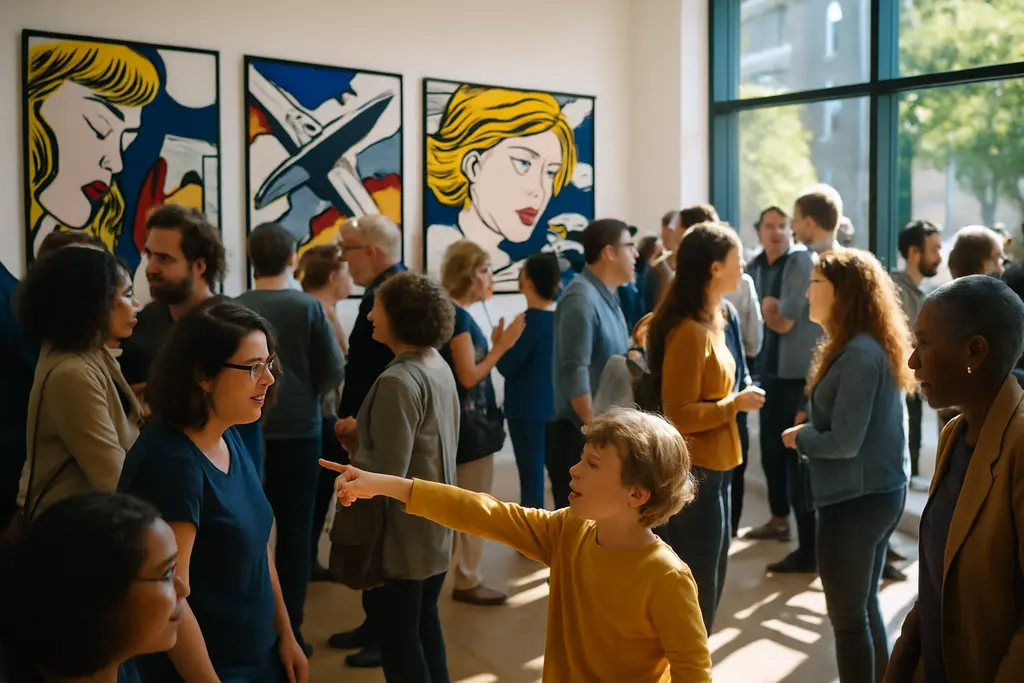
The Roy Lichtenstein Exhibition Roy Lichtenstein: Like New is scheduled to open to the public at the Whitney Museum of American Art on October 11, 2026, after member preview days from October 8–10, 2026. As of October 6, 2026, it remains an upcoming exhibition, not a completed retrospective. The Whitney states that the show runs through May 10, 2027, and presents Lichtenstein’s work through questions of copying, enlargement, translation, re-circulation, perception, duplication, simulation, and unstable images before digital reproduction Whitney exhibition details.
That framing is useful because Lichtenstein’s art has long sat near a fault line in twentieth-century visual culture: the line between borrowing and invention, between mass-media source material and museum-scale painting, between the comic panel and the carefully constructed art object. A cautious reading should avoid reducing that debate to praise or dismissal. The exhibition’s own announced premise suggests a more exact question: what happens when an artist repeatedly tests how images change as they move across formats, scales, and contexts?
Roy Lichtenstein Exhibition And The Question Of Originality
Why The Roy Lichtenstein Exhibition Starts With Copying
The central tension of the show is not simply whether Lichtenstein copied images. The Whitney’s stated theme points to a broader inquiry: how images are copied, enlarged, translated, re-circulated, and altered through perception and display. That emphasis matters. It places copying within a chain of visual operations rather than treating it as a single act with a single meaning.
For viewers, the distinction can change the tone of the gallery experience. A comic-derived image enlarged into a painted field does not function in the same way as its printed source. A brushstroke rendered as a sign of painting is not the same thing as a brushstroke made in expressive haste. Lichtenstein’s Pop idiom repeatedly turns familiar visual codes into objects of study. That does not settle every ethical or aesthetic objection, but it gives the debate firmer ground than a simple claim that the work is either purely original or merely derivative.
The announced title, Like New, also carries a pointed ambiguity. It suggests restoration, resale, repetition, and altered freshness. The phrase can describe an object that is not new but has been made to appear new. In that sense, the title fits an artist associated with images that seem instantly legible yet become stranger under sustained attention.
What The Whitney Has Announced
Dates, Curators, And Public Access
The Whitney lists Meg Onli, the museum’s Nancy and Fred Poses Curator, as organizer of the exhibition in collaboration with Guest Curator Alex Da Corte, with support from Nakai Falcón and David Crane. The public opening date is October 11, 2026, and the closing date is May 10, 2027. Because the exhibition had not yet opened as of October 6, 2026, claims about visitor response, critical consensus, or installation atmosphere would be premature.
That caution is not a limitation; it is part of responsible arts coverage. Exhibition announcements can establish dates, organizers, scope, selected works, and curatorial intent. They cannot yet support conclusions about how the show feels in person or whether its argument succeeds in the galleries. Those judgments depend on the installed exhibition, wall texts, sequencing, lighting, spatial relationships, and public reception after opening.
Scale, Media, And Chronology
Artsy reports that the show brings together roughly 130 works spanning Lichtenstein’s output from the early 1940s through the 1990s Artsy report. The research material also identifies painting, drawing, collage, prints, sculpture, and film among the formats included. That range matters because a multi-format exhibition can test whether the artist’s inquiry into image systems remained consistent across materials or changed over time.
Among the works named in the research are Look Mickey from 1961, Girl with Ball from 1961, Masterpiece from 1962, Drowning Girl from 1963, Happy Tears from 1964, Little Big Painting from 1965, Rouen Cathedral, Set III from 1968–69, and Artist’s Studio “The Dance” from 1974. Taken together, those titles indicate that the exhibition is not confined to one famous moment in early Pop. It appears designed to trace a longer pattern of image quotation, art-historical address, and visual translation.
Why The 1962 Reunion Matters
A First Pop-Style Exhibition Reassembled
One of the most concrete claims in the research is that all eight works from Lichtenstein’s first Pop-style exhibition at Leo Castelli Gallery in 1962 are being reunited for the first time. That reunion is more than a checklist milestone. It allows a specific early presentation to be reconsidered as a group, rather than through isolated works dispersed across collections and reproductions.
The 1962 grouping is especially relevant to debates about originality because it marks a point when Lichtenstein’s Pop vocabulary became publicly legible within a gallery context. Seeing the works together may help viewers compare repeated strategies: the use of commercial visual language, hard-edged graphic systems, and the shift from source image to painted object. The value of the reunion lies in comparison. It can show similarities, differences, and pacing within a body of work often flattened by reproduction.
Murals And Scale As Critical Evidence
The research also notes that the exhibition includes re-creations of four murals, including a nearly 96-foot-long version of Greene Street Mural from 1983. That detail widens the originality discussion beyond comic panels and canvas. Murals introduce questions of site, bodily scale, architectural encounter, and recreation. A re-created mural is not the same object as an original site-specific installation, yet it can offer evidence of how Lichtenstein’s imagery behaved when expanded into an environment.
Here again, certainty should wait for the installed show. The decision to present mural re-creations may clarify how the curators understand scale, repetition, and historical absence. It may also raise productive questions about what museums can responsibly reconstruct and how such reconstructions should be labeled for audiences.
Image Culture, Fashion, And Creator Boundaries
Why Visual Borrowing Still Feels Current
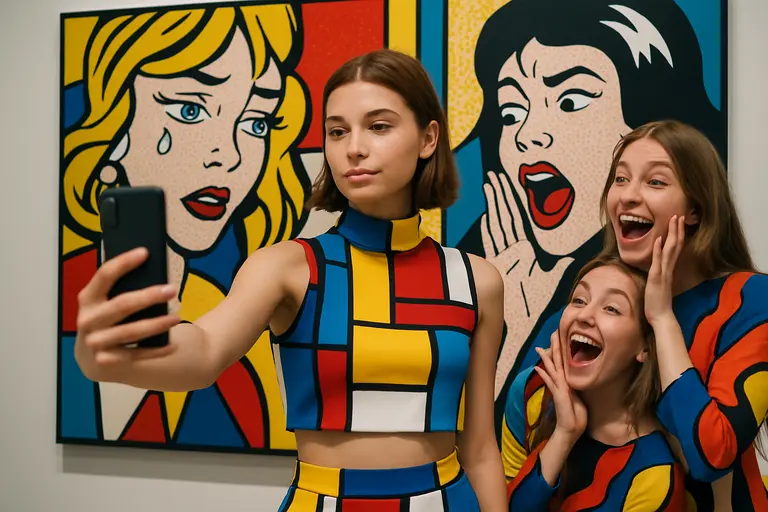
The Roy Lichtenstein Exhibition arrives at a moment when many artists, designers, costume makers, and independent sellers think carefully about references, quotation, and rights clearance. The point is not to collapse museum Pop art into commercial craft or fashion production. The legal, ethical, and market conditions are different. Still, Lichtenstein’s work can provide a useful case study in how recognizable visual languages circulate and acquire new meanings when shifted into another format.
For those with an interest in theatrical clothing, fantasy styling, and image-led culture, a related site like Fairytale Fashion emphasizes how visual references often traverse through dress, performance, photography, and handmade objects. This movement can be inventive but also demands careful consideration. Responsible creators should be cautious not to assume that a museum context grants permission for commercial reuse of protected characters, living artists’ work, celebrity likenesses, or distinctive contemporary designs.
Rights Caution For Makers And Sellers
This is not legal advice, and no single exhibition can answer whether a specific product, costume, print, or design is lawful. The safer cultural point is narrower: originality is not only an art-historical question. It is also a practical concern for creators deciding how to cite, adapt, parody, or distance their work from recognizable sources. Lichtenstein’s art can sharpen that conversation because it makes acts of selection and translation visible.
For independent sellers, the useful lesson is not to imitate Lichtenstein’s look as a shortcut. It is to study how visual systems communicate: dots, outlines, scale, framing, and the tension between mechanical appearance and handmade execution. Learning from those strategies differs from presenting confusingly similar goods or implying authorization that has not been established.
What Roy Lichtenstein: Like New Puts At Stake
The Roy Lichtenstein Exhibition is positioned to revisit an artist whose work remains difficult because it looks familiar before it becomes unsettled. The Whitney’s announced framework places that difficulty at the center. Rather than asking viewers to choose between originality and copying as fixed opposites, the exhibition appears to ask how images survive by changing form.
That question suits a retrospective spanning early work through the 1990s, roughly 130 works, multiple media, a 1962 reunion, and mural re-creations. The strongest assessment, though, will have to follow the public opening on October 11, 2026. Until then, the evidence supports measured anticipation: Roy Lichtenstein: Like New has the ingredients for a serious reconsideration of Pop art’s relationship to image culture, but its full argument can only be judged once the works are seen together in the Whitney’s galleries.