Blog

  • Stanley Boxer Exhibition And Paint As Object

    Stanley Boxer Exhibition And Paint As Object

    The Stanley Boxer exhibition at Madelyn Jordon Fine Art in White Plains, New York, marked the centennial of the artist’s birth with a focused presentation held from June 17 to August 14, 2026. The gallery’s presentation brought together works spanning four decades, including examples from the Ribbon Painting Series and later material-driven paintings, according to the exhibition information published by Artsy. As a review subject, the show is useful because it does not ask viewers to treat abstraction as a single style. It asks them to study how gesture, surface, and material can change over time while still belonging to one artist’s sustained practice.

    Reading The Stanley Boxer Exhibition

    What The Stanley Boxer Exhibition Shows

    The exhibition’s strongest interpretive value lies in its range. A centennial display can easily become ceremonial, but the available description points toward a more analytical structure: early-1970s ribbon works, 1980s impasto surfaces, and late paintings using unconventional materials. That arc helps viewers see Boxer not only as a painter of abstract marks, but as an artist who tested what a painting’s surface could hold.

    For a community arts reader, the Stanley Boxer exhibition also raises a practical question: how do galleries make a past practice legible to present audiences without reducing it to biography? The show’s date range and selected series appear to answer through material evidence. Rather than relying only on reputation, it places bodies of work in contact with one another, allowing changes in surface, scale, and density to become the argument.

    Why A Centennial Frame Matters

    Boxer was born in New York City in 1926, served in the Navy during World War II, and later studied at the Art Students League. Those facts matter, but they should not be treated as a shortcut to reading the work. Postwar American abstraction included many positions on gesture, objecthood, color, and material presence. Boxer’s case is best approached through what the paintings do: they gather, resist, thicken, suspend, and sometimes appear to push beyond the flat rectangle.

    The centennial format gives viewers permission to slow down. In a single-artist exhibition, differences between decades become easier to read because the comparison is internal. The viewer is not simply asking whether Boxer fits a movement label. The more precise question is how his works modify the expectations that viewers bring to postwar abstract painting.

    Ribbon Paintings And Suspended Motion

    Gesture After Illness

    The Ribbon Painting Series, dated 1971 to 1976 in the exhibition notes, forms an especially clear point of study. The research states that the series was developed after a period of illness in late 1970 and that the works are marked by rhythmic, ribbon-like gestures. That context should be handled with care. Illness can be relevant to artistic production, but it should not be used to over-explain the work or turn it into a sentimental key. The paintings still need to be read as formal decisions.

    In those works, ribbon-like movement suggests energy held in suspension. The term “ribbon” is helpful because it implies both line and body: something linear, but not weightless; something moving, but not fully free of matter. That double quality makes the series important within the Stanley Boxer exhibition, since it shows an artist thinking about gesture as a physical event rather than a simple trace of the hand.

    Movement Without Narrative

    The Ribbon Paintings appear to depend on movement, but not on storytelling. This is one reason they can still feel active in a gallery setting. A viewer does not need to identify a figure, scene, or symbol to sense the work’s pressure. Instead, the movement is built through recurrence, direction, and the interval between marks. The “suspended” quality described in the research is not passive; it suggests motion held in a charged state.

    That distinction matters for art criticism because abstraction is sometimes discussed as if it were detached from bodily experience. Boxer’s ribbon gestures suggest the opposite. They ask the eye to follow, pause, and return. In community viewing, this can make the work approachable without making it simple. People can disagree about mood or rhythm while still attending to the same visible structures.

    Surface, Material, And Community Seeing

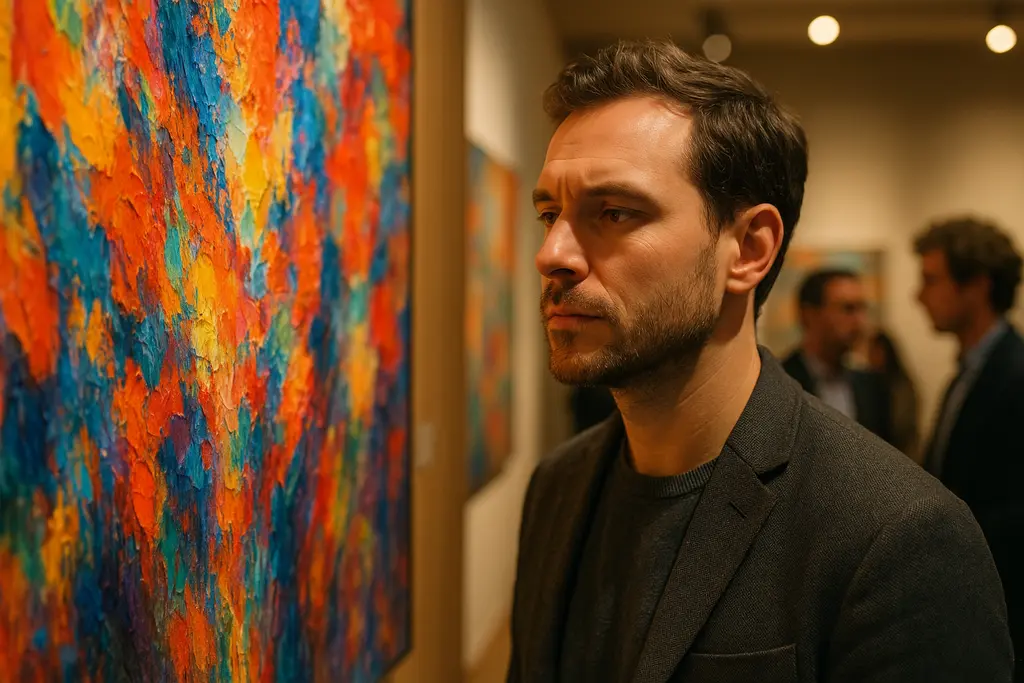
    Close view of thick paint and mixed materials on an abstract canvas

    Paint Treated As Matter

    Boxer has often been described as a “sculptor of paint,” a phrase used in coverage of the centennial show by Art & Object. The phrase is persuasive because it directs attention away from painting as image alone. It suggests that paint in Boxer’s work can behave as substance, relief, weight, and accumulated action.

    The 1985 work “Hotjoustatdusk,” named in the research, represents the 1980s phase of heavily manipulated surfaces, with dense impasto and textured brushwork. Such details matter because they help viewers avoid vague praise. “Texture” is not merely an effect; it is a structural condition of the work. Thick paint changes how light falls, how the eye moves, and how a painting occupies physical space.

    Why Tactility Reaches Beyond Painting

    From the 1990s onward, the research notes that Boxer’s paintings incorporated materials such as pebbles, glitter, and strings. This material shift expands the question of painting’s boundary. A canvas that includes such elements is not only a support for pigment. It becomes a site where matter is arranged, pressed, embedded, and made visible as part of the work’s meaning.

    That material attention also connects with wider cultural practices of making. Costume artists, fiber makers, set designers, and community art groups often understand texture as a social form of communication: something that changes how people gather around an object. Readers interested in related conversations about fantasy, dress, and material imagination can explore more at Fairy Tale Fashion. The point is not to collapse painting into fashion or craft, but to recognize that tactile decisions can help many audiences talk about art with precision.

    The community value of a show like this rests partly in that shared language. Viewers who may not have a specialist vocabulary for postwar abstraction can still speak carefully about weight, shine, drag, roughness, rhythm, and edge. Those are not lesser observations. They are often the first steps toward a more exact reading of abstract work.

    Stanley Boxer Exhibition In Postwar Abstraction

    Reputation And Evidence

    Boxer’s career included more than 100 solo exhibitions, a Guggenheim Fellowship in 1975, and a National Endowment for the Arts Visual Artists Fellowship Grant in 1989, according to the provided exhibition research. His work is also reported as being held in major museum collections, including the Museum of Modern Art, the Solomon R. Guggenheim Museum, the Whitney Museum of American Art, and Tate Modern. Those markers establish institutional recognition, but they should not replace looking.

    The value of the Stanley Boxer exhibition is that it gives reputation a visible test. If the works from different decades can speak to one another across changes in technique, then the exhibition does more than honor an anniversary. It offers evidence of continuity through change. The Ribbon Paintings, the impasto works, and the later material pieces suggest an artist repeatedly asking how far painting can move toward objecthood while remaining painting.

    What Viewers Can Carry Forward

    The most useful way to leave this show is not with a slogan about Boxer’s place in art history, but with a sharper set of viewing habits. Look at where gesture becomes structure. Notice when surface stops acting like a background and starts behaving like an event. Ask whether added materials clarify the painting’s force or risk overwhelming it. These questions respect the work because they stay close to what can be seen.

    The Stanley Boxer exhibition is strongest as a study in sustained material inquiry. Based on the available research, it appears to have presented a rare chance to follow four decades of an artist’s practice through works that test the boundary between painted image and physical object. For postwar American abstraction, that boundary remains one of the most productive places to look.

  • Leonora Carrington Sketchbooks and Surrealism

    Leonora Carrington Sketchbooks and Surrealism

    Leonora Carrington Sketchbooks offer one of the clearest routes into the artist’s thinking because they place image-making close to uncertainty, repetition, and private symbolic testing. Carrington, a British-Mexican artist and writer who lived from 1917 to 2011, is often discussed through finished paintings and fiction, yet the drawings connected with her Santander period ask for a slower kind of looking. They do not simply confirm a familiar account of Surrealism. They show how a woman artist shaped Surrealist language under pressure from war, confinement, mythology, psychology, and occult symbolism.

    For students of visual art, the value of the sketchbook is not that it reveals a single key to Carrington’s work. Sketches rarely behave like footnotes. They are closer to evidence of process: provisional marks, recurring creatures, bodily transformations, and scenes that resist easy explanation. That makes them especially useful in a learning context, where the goal should be interpretation built from visible details and supported context rather than a fixed myth of the artist as an isolated visionary.

    Why Leonora Carrington Sketchbooks Matter

    Leonora Carrington Sketchbooks As Working Evidence

    The phrase Leonora Carrington Sketchbooks can sound archival, as if the drawings mainly serve scholars who want to date an idea or trace a motif. Their importance is broader. A sketchbook can expose how an artist tests structure before public presentation. In Carrington’s case, that process is bound to a Surrealist vocabulary of hybrid beings, altered interiors, symbolic animals, and ritualized encounters. The drawings make visible an imagination that is not decorative fantasy but an inquiry into power, identity, and psychic disturbance.

    This matters because Carrington’s contribution to Surrealism is often reduced to biography: her relationship with Max Ernst, her flight from Europe, or her later life in Mexico. Those elements are part of the record, but they should not crowd out the work itself. The drawings encourage viewers to start with form and image. What kinds of bodies appear? How do animals and humans cross into each other? Which spaces feel domestic, theatrical, medical, or mythic? Those questions keep interpretation grounded in the page.

    From Private Mark To Art-Historical Claim

    A cautious reading begins with what can be seen, then tests that observation against documented context. If a drawing contains an anthropomorphic figure, a viewer can describe the figure before assigning meaning. If a composition suggests ritual or transformation, that can be noted without claiming that one symbol has only one meaning. Carrington’s use of esoteric material, mythology, and psychological imagery supports a wide interpretive field, but responsible criticism should separate visible evidence from speculation.

    Santander Drawings And The Symptomatic Surreal

    Early 1940s Pressure And The Drawn Image

    The Freud Museum London’s 2026 exhibition The Symptomatic Surreal was described as the first institutional exhibition dedicated to Carrington’s drawings from the Santander sketchbooks. The museum connects those works to the early 1940s, a period marked by personal and political upheaval, including Carrington’s internment in a Spanish sanatorium. That context does not make the drawings simple illustrations of trauma, but it does make the conditions of their production impossible to ignore.

    The Santander material is significant because it sits at the meeting point of lived experience and Surrealist method. Surrealism had long been interested in dreams, automatism, and psychic fracture, but Carrington’s drawings complicate any detached fascination with the unconscious. Her images are not clinical case studies. They are acts of image-making by an artist negotiating fear, dislocation, and symbolic self-definition.

    Psychology, Myth, And Occult Reference

    The research around the exhibition points to themes including mythology, psychology, and the occult. In Carrington’s work, those categories often overlap. A creature may feel like a mythic familiar, a psychological double, or an alchemical figure without settling into only one reading. This is one reason her sketchbooks remain instructive: they teach viewers to tolerate ambiguity while still making disciplined observations.

    For learners, that balance is essential. A drawing can invite symbolic interpretation without permitting any claim a viewer wants to make. The stronger approach is comparative. Track repeated figures, note changes in posture and setting, and ask whether a motif reappears in painting or writing. If a claim cannot be supported by the work or by reliable scholarship, it should remain a possibility rather than a conclusion.

    Feminizing Surrealism Without Flattening It

    Autonomy Against A Predominantly Male Movement

    Carrington is frequently discussed as an artist who brought a female perspective to a Surrealist movement often dominated by men. The New Yorker framed this legacy through the idea that she “feminized Surrealism,” emphasizing how her work challenged inherited roles and centered women’s autonomy in art New Yorker profile. That phrasing is useful if handled with care. It should not imply that all women artists share one perspective, nor that Carrington’s work can be reduced to gender alone.

    What the idea does clarify is the pressure Carrington placed on Surrealist imagery. In much male Surrealist work, women were often positioned as muses, fantasies, or symbolic vehicles. Carrington’s figures do not sit easily in that structure. They act, mutate, withhold, gather knowledge, and inhabit strange systems of relation. Her images suggest autonomy not by making power simple, but by refusing passive placement.

    Animals, Women, And Self-Fashioning

    Students should pay attention to Carrington’s hybrid beings without treating them as mere eccentric decoration. Animal-human figures can stage questions about transformation, protection, instinct, and social constraint. They can also unsettle stable identity. In this sense, Leonora Carrington Sketchbooks help readers see Surrealism not only as dream imagery but as a field where gendered assumptions could be challenged through form.

    This reading also speaks to costume culture, fantasy fashion, and handmade creator communities that draw inspiration from historical art. Carrington’s symbolic universe may inspire study of texture, silhouette, and creaturely form, but creators should distinguish homage, education, and original interpretation from copying specific protected works or presenting derivative imagery as licensed. For readers interested in comparing art education resources, Shimply is part of the same network, providing further insights into creative communities.

    How Students Can Read The Drawings Responsibly

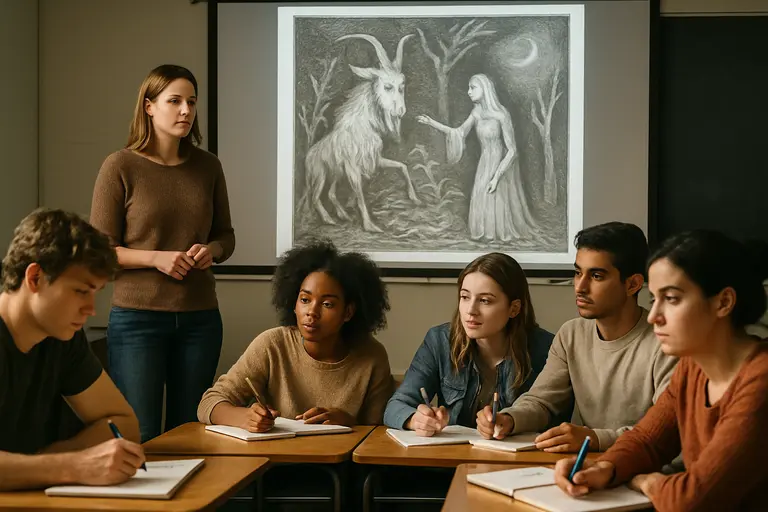
    Student taking notes beside an art book and a reproduction of a drawing

    From Visual Motif To Supported Claim

    For students, Leonora Carrington Sketchbooks are best approached as a set of questions rather than a puzzle with one answer. The first task is close looking. Before naming a symbol, describe the line, scale, gesture, and setting. A thin figure in an enclosed room communicates differently from a crowded scene of animated beings. A creature looking outward asks for a different response than one absorbed in action.

    • Begin with visible form: figure, setting, movement, and relation between bodies.
    • Record repeated motifs before assigning symbolic meaning.
    • Use exhibition material and reputable criticism to test claims.
    • Keep biography in view, but do not let it replace analysis of the drawing.

    This method is especially useful for emerging artists studying Surrealism. Carrington’s drawings show that influence is not imitation. The lesson is not to copy her creatures or borrow the atmosphere of her work as a surface style. The more serious lesson is structural: build a symbolic language through repeated inquiry, private testing, and attention to the relation between form and lived experience.

    What The Sketchbook Can And Cannot Prove

    A sketchbook can show that an artist returned to certain images. It can suggest patterns of thought. It can document a moment when private drawing and public art were connected. It cannot, on its own, prove every psychological or spiritual interpretation proposed by a later viewer. That limit is not a weakness. It is what makes the material intellectually valuable. The page asks for restraint.

    Carrington’s Sketchbooks And Surrealist Study

    A Careful Path For Further Learning

    Studying Leonora Carrington Sketchbooks gives art learners a disciplined way to understand influence. Carrington’s work matters to Surrealism because it does more than add a woman artist to an existing canon. It tests the movement’s assumptions about the body, dreams, transformation, and power. Her Santander drawings, especially in the context presented by the Freud Museum, make that testing visible at a charged historical moment.

    The strongest reading of Carrington begins with respect for uncertainty. Her sketchbooks do not hand over a simple story about suffering, liberation, mysticism, or gender. They hold those elements in tension. That is why they remain valuable for art history classrooms, studio research, and critical writing. They teach that influence can be quiet, strange, and resistant to easy summary, and that the page where an artist thinks may be as revealing as the finished work on the wall.

  • Assembly Art Fair And Seattle Gallery Culture

    Assembly Art Fair And Seattle Gallery Culture

    Assembly Art Fair arrived in Seattle with a stated emphasis on curated gallery presentations rather than standard booth arrangements. The inaugural event took place July 22 to 26, 2026, at West Canal Yards, described by the fair as a newly adapted historic fisheries building with expansive exhibition spaces on waterfront property near downtown Seattle, according to the official fair site. That setting matters because art fairs are never only about objects on walls; they also shape how viewers move, pause, compare, and speak with the people presenting the work.

    For Seattle, the fair sits within a wider conversation about how regional galleries can meet collectors, curators, artists, and public audiences without flattening local identity into a sales floor. The available reporting supports a careful reading: this was a gallery-led, invitational event with a defined Western U.S. focus, not a general open call or a citywide survey. That narrower structure gave the fair a clear frame, while also leaving open questions about access, representation, and how future editions might broaden participation.

    Assembly Art Fair And The Gallery-Led Format

    What Assembly Art Fair Changes About Pace

    The Assembly Art Fair format is best understood as a shift in viewing conditions. Traditional fairs often rely on compact booths that encourage quick scanning and frequent comparison. Assembly’s stated model emphasized curated exhibitions, giving each participating gallery more room to shape a distinct encounter. This does not guarantee deeper engagement by itself, but it can create better conditions for slower looking when the installation, lighting, and staff conversations are handled with care.

    Artnet reported that the fair featured 18 leading galleries from the Western U.S., including Traver Gallery, Greg Kucera Gallery, and PDX CONTEMPORARY ART, in a gallery-led invitational structure, as noted in its coverage of Assembly. That roster indicates a regional emphasis rather than a nationally diffuse fair identity. In cultural terms, such a choice can help viewers understand how galleries from nearby art centers speak to one another, even when their programs differ in medium, scale, and market position.

    Curatorial Space Versus Commercial Compression

    A curated fair presentation asks different questions from a standard booth. Instead of simply asking how many works can be shown, a gallery has to ask what relationship the works have to one another. Does a presentation build around one artist, several artists, or a material conversation? Does it reward extended looking, or does it depend on quick visual impact? These questions are familiar to museum and gallery visitors, but they carry different pressure inside a fair, where sales, introductions, press attention, and institutional interest can happen in the same room.

    At Assembly Art Fair, the emphasis on intimate art encounters should be treated as an organizing aim, not as proof that every visitor had the same experience. Fairs remain uneven by nature. A collector with appointments may encounter the event differently from a student, artist, or neighborhood visitor. Still, a curated format can reduce some of the visual noise that often makes art fairs difficult, especially for audiences trying to understand why a gallery has placed certain works together.

    West Canal Yards As A Cultural Setting

    A Waterfront Site With Industrial Memory

    West Canal Yards gave the fair a physical identity tied to Seattle’s working waterfront. The research describes the site as a historic fisheries building adapted for exhibition use, with seven acres of waterfront property and access by car, transit, and boat. Those details are not decorative. They affect how an art event feels, who can reach it, and how the city’s industrial past is placed beside contemporary cultural activity.

    Adaptive reuse can be compelling for art presentation, but it also deserves caution in how we describe it. A historic industrial building can offer scale and atmosphere, yet those qualities do not automatically produce public benefit. The more grounded question is whether the venue supports clear movement, adequate time with the work, and respectful conditions for artists and visitors. Based on the fair’s stated focus on expansive exhibition spaces, West Canal Yards appears to have been chosen as part of the curatorial proposition, not merely as a container.

    How Place Shapes Community Reading

    Community arts coverage often turns too quickly to celebration. A more useful approach asks how a site shapes cultural meaning. Seattle’s waterfront carries associations with labor, trade, food systems, transport, and development. Presenting contemporary art inside that context can open productive tension: art is seen not in isolation, but in relation to the city’s material life. That does not mean every artwork directly addresses those histories. It means the audience’s experience is formed partly by the building and the route to reach it.

    For galleries, a site like West Canal Yards can also shift the social rhythm of a fair. Visitors may spend longer in a destination venue than they would in a convention setting, though that depends on programming, transport, weather, and visitor goals. The available information does not support broad claims about attendance or public response, so the safer observation is formal: the venue choice aligned with the fair’s preference for curated, spatially distinct presentations.

    Galleries, Collectors, And Curatorial Contact

    Gallery staff speaking with visitors beside contemporary artworks

    Regional Galleries In Shared Conversation

    The presence of galleries from the Western U.S. places Seattle in conversation with nearby cultural markets rather than isolating it as a local-only event. That regional scale is significant. It allows audiences to compare gallery programs across cities while still keeping the focus tighter than a large international fair. For artists, this kind of gathering can create visibility among curators and collectors, though the degree of benefit varies and should not be assumed without later evidence.

    The named participants in the research point to galleries with established public profiles, but the fair’s invitational structure also raises fair questions. Who gets invited? Which media receive attention? How are emerging spaces considered? These are not criticisms by themselves. They are the normal questions that help an art community evaluate whether a new fair strengthens existing networks, repeats existing exclusions, or does some combination of both.

    Why Curatorial Perspective Matters

    Curatorial perspective is not limited to museums. Galleries make interpretive decisions whenever they select, group, and present work. In a fair setting, those choices are highly compressed. A strong presentation can help a visitor understand an artist’s material language or a gallery’s point of view in minutes. A weaker one can reduce artworks to inventory. The distinction matters for community trust because artists are not interchangeable content providers; their practices deserve context, time, and accurate representation.

    Those interested in regional cultural dynamics can find additional insights by exploring related content on Kay Granger’s platform. This source can enhance understanding of how art fairs integrate broader social and economic frameworks, beyond just artistic merit.

    What Assembly Art Fair Signals For Seattle

    The most persuasive reading of Assembly Art Fair is not that Seattle suddenly has a single answer to the art-fair model. The stronger point is more measured: the event tested a gallery-led format that favored curated presentations, a regional gallery network, and a venue with a distinct Seattle setting. Those choices give critics, artists, collectors, and visitors something concrete to assess.

    Future judgment should rest on evidence: which artists were supported, how audiences experienced the site, whether galleries found the format sustainable, and whether the fair created lasting curatorial relationships. For now, the documented facts support a cautious but meaningful claim. Seattle’s art community gained a new fair format in 2026, one that asked galleries to present with intention and asked visitors to look beyond the quick booth-to-booth rhythm common to many art fairs.

    That is where the community story sits. Not in spectacle, and not in unsupported claims about a market shift, but in the practical meeting of place, presentation, and regional artistic labor. If the fair continues, its value will be measured less by novelty than by how responsibly it serves artists, galleries, and publics who bring Seattle’s art conversations into view.

  • America 250 Art at Art League of New Britain

    America 250 Art at Art League of New Britain

    America 250 art will receive a local, juried forum in New Britain, Connecticut, through the Art League of New Britain’s planned exhibition, America 250: The Art of Independence. The exhibition is scheduled for July 24 through August 23, 2026, with an opening reception on Friday, July 24, from 6:00 PM to 8:00 PM. According to the Art League of New Britain, the show commemorates the 250th anniversary of American independence while inviting artists to address independence, liberty, justice, and renewal.

    The stated theme is broad, but not vague. It asks artists to reflect on the cultures and histories that have shaped American identity, a phrase that leaves room for celebratory, critical, personal, and community-based interpretations. For a juried exhibition, that breadth can matter: artists working in different mediums may bring distinct visual languages to subjects often discussed through speeches, textbooks, monuments, or public ceremonies.

    America 250 Art And The Civic Exhibition Frame

    Why America 250 Art Uses Open Themes

    The exhibition’s theme places independence beside liberty, justice, and renewal rather than treating independence as a single fixed symbol. That choice gives artists several possible points of entry. A painter might work through allegory. A photographer might focus on public space or community memory. A sculptor or mixed-media artist might respond through materials, fragments, or forms associated with repair. The call does not require any one political reading, and the available information does not name accepted artists or works, so any forecast about tone would be speculative.

    What can be said with confidence is that America 250 art, as framed here, is being organized around interpretation rather than reenactment. The Art League of New Britain is not only marking a national anniversary; it is asking artists to consider how national ideas are seen, disputed, carried, and renewed in creative practice. That distinction is useful because art exhibitions often do their strongest civic work by slowing down familiar language. Words such as liberty and justice can be repeated so often that they lose texture. Art can make those words material again without forcing a single answer.

    A Local Site For National Questions

    The exhibition will be held at the Art League of New Britain, 30 Cedar Street, New Britain, CT 06052. The location matters in a modest but meaningful way. A national commemoration can feel distant when it is presented only through large institutions or official ceremonies. A community art venue can invite a different scale of attention: individual makers, regional audiences, and works that may speak from lived experience rather than from a national script.

    That does not mean every submitted piece will be autobiographical or local in subject. The eligibility rules are open to artists aged 18 and older, and artists may submit work in any medium. Still, the setting supports a grounded reading of the theme. Independence and renewal are not only abstract ideals; they can also be visible in neighborhood memory, family stories, migration, labor, education, protest, care, and the shifting symbols communities choose to keep or question.

    Submission Rules And Ethical Boundaries

    Original Work, Medium Choice, And Recent Production

    The submission requirements are clear on several points. Artists may submit up to five original works in any medium. The works must have been completed in the past three years and must not have been previously exhibited at ALNB. These conditions shape the exhibition toward recent artistic thinking rather than archival selection. They also create a practical boundary: artists are being asked to present new or recent work that has not already appeared in that venue.

    For artists considering America 250 art as a theme, the three-year window may encourage direct engagement with current questions of civic identity. The research notes do not specify preferred styles, sizes, or media beyond “any medium,” so artists should rely on the official exhibition page for registration details and any practical display requirements. Caution is warranted here: without the full call text beyond the provided facts, it would be inappropriate to infer rules about framing, installation hardware, shipping, or digital documentation.

    AI Disclosure And Trust In The Viewing Room

    The exhibition’s guidance states that AI-generated imagery is not acceptable, while AI-assisted artwork must be clearly disclosed. That distinction reflects a wider concern in contemporary art presentation: viewers, jurors, and fellow artists need enough process information to understand how an image or object was made. The rule does not, from the information provided, define every possible use of software assistance. Artists who use digital tools should treat disclosure as a practical and ethical matter, not as a footnote.

    This is not a legal judgment about authorship or copyright. It is a curatorial boundary set by the exhibition. For a show centered on independence, liberty, justice, and renewal, process transparency may affect how audiences read the work. If an image speaks about civic memory but its production method is unclear, the conversation can shift away from the artwork’s subject and toward questions of trust. Clear disclosure helps protect that exchange.

    Dates, Fees, Awards, And Sales Structure

    Key Dates For Artists

    The schedule gives artists a defined submission period and a short interval between the deadline and notification. Registration runs from June 24 through July 8, 2026, and the submission deadline is July 8, 2026, at 11:59 PM. Entry notification is scheduled for July 12, 2026. Artwork drop-off is listed for July 18 and July 21 during specified hours, while artwork pick-up is listed for August 23 and August 25 during specified hours.

    • Exhibition dates: July 24 – August 23, 2026.
    • Opening reception: Friday, July 24, 2026, 6:00 PM – 8:00 PM.
    • Registration: June 24 – July 8, 2026.
    • Submission deadline: July 8, 2026, at 11:59 PM.
    • Entry notification: July 12, 2026.

    Because the drop-off and pick-up windows include specified hours not reproduced in the research notes, artists should confirm those details directly with ALNB before planning transport. That is especially relevant for fragile works, larger pieces, or works requiring careful handling.

    Costs, Prizes, And Commission

    The entry fees differ for members and non-members. ALNB members pay $15 for the first entry and $10 for each later entry. Non-members pay $25 for the first entry and $15 for each later entry. The listed awards are First Prize at $200, Second Prize at $100, Third Prize at $50, and Honorable Mention at $25. ALNB receives a 30% commission on art sales.

    These figures help artists assess participation in practical terms. Entry fees, potential awards, and sales commission are not only administrative details; they affect how artists price work, plan submissions, and decide whether the opportunity fits their current studio goals. No claim can be made from the available information about expected sales volume, juror preferences, or acceptance rates.

    Reading Liberty Through Material Culture

    Mixed media artwork with fabric, paper, and painted surfaces in a gallery

    From Gallery Walls To Community Stories

    One strength of the exhibition format is that civic ideas can be tested through material choices. A textile work may carry associations of domestic labor, inheritance, or public display. A print may recall political circulation and reproducibility. A ceramic object may evoke utility, fragility, or ceremony. These are interpretive possibilities, not announced categories for the show, but they show why an open-medium call can support multiple readings of independence and renewal.

    For readers interested in how clothing, costume, and imaginative design also carry cultural meaning, Fairy Tale Fashion explores similar themes within the network. This site enriches understanding by highlighting the cultural narratives woven into fashion, identity, and storytelling.

    America 250 art at ALNB may therefore be best understood as an invitation to look closely at how artists convert civic language into visible form. The exhibition’s success cannot be assessed before the selected works are known. What is already clear is the structure: a juried call, a defined anniversary context, recent original work, disclosed limits around AI use, and a theme that permits both reflection and challenge.

    America 250 Art In New Britain’s Community Setting

    What Viewers Can Watch For

    Visitors to the exhibition may want to pay attention to how artists handle scale, symbol, and point of view. Does a work use national imagery directly, or does it approach independence through personal experience? Does it present liberty as aspiration, memory, conflict, or renewal? Does justice appear as an ideal, a demand, a story, or an unresolved question? These viewing questions respect the exhibition’s theme without presuming what any artist will make.

    As a Discover topic, the value of America 250: The Art of Independence lies in its local staging of a national anniversary. The Art League of New Britain’s call gives artists a framework, but the selected works will determine the final conversation. Until then, the supported facts point to a carefully bounded opportunity: America 250 art presented through a juried exhibition, open to adult artists, shaped by recent original work, and centered on independence, liberty, justice, and renewal.

  • Laguna Beach Pageant Highlights for Arts Fans

    Laguna Beach Pageant Highlights for Arts Fans

    The Laguna Beach Pageant and the Festival of Arts Fine Art Show sit at the center of Laguna Beach’s summer arts calendar, pairing juried visual art with a theatrical format that asks viewers to look slowly. For the 2026 season, the supported highlights are clear: the Festival of Arts Fine Art Show is scheduled for July 7 to September 3, 2026, and is described as featuring more than 100 award-winning Orange County artists at 650 Laguna Canyon Road, according to the official Festival of Arts site.

    That pairing matters because the event is not simply an exhibition with an evening performance attached. It places local artists, art education, stagecraft, music, and art-historical reference in close contact. For community organizers, collectors, visiting families, and artists watching audience behavior, the season offers a useful case study in how an arts festival can gather different publics without reducing art to a single kind of experience.

    2026 Festival Season At A Glance

    What Is Firmly Supported For 2026

    The Festival of Arts Fine Art Show is presented in the research as running from July 7 through September 3, 2026. The same research states that the show features more than 100 award-winning Orange County artists. Those details support a practical reading of the event: visitors can treat the Fine Art Show as a sustained summer exhibition rather than a single-night program. That longer run gives audiences more than one way to engage, whether through a focused art visit, an evening paired with the Pageant, or a return trip after seeing work that invites closer attention.

    The season also includes the Pageant of the Masters, with the 2026 theme listed as “The Greatest of All Time.” The published event description names artists including Michelangelo, Picasso, Monet, Van Gogh, Kahlo, and Rockwell as part of the 2026 framing, according to SparkOC’s event listing. That selection signals a theme built around widely recognized figures, though recognition alone should not be confused with simple interpretation. Each name carries a different set of cultural, historical, and visual associations.

    How To Read The Schedule Claims Carefully

    The research notes nightly Pageant performances from July 9 to September 4, 2026, at 8:30 PM in the Irvine Bowl amphitheater. Because event details can change, especially ticketing, access, and day-by-day availability, readers should verify timing directly with official event channels before making plans. That caution is not a lack of confidence in the season; it is a fair standard for arts coverage. The difference between a general season highlight and a dated itinerary matters for visitors booking travel, arranging group attendance, or coordinating accessibility needs.

    For arts communities, the long season also changes the rhythm of participation. A local painter showing work across many weeks may meet casual tourists, returning collectors, students, and other artists. A theater crew supporting a nightly production may be working within a repeatable structure while still relying on precision, stamina, and live audience energy. Those two modes of presentation sit side by side, and that is part of the event’s appeal.

    Laguna Beach Pageant As A Living-Art Form

    Why The Laguna Beach Pageant Format Matters

    The Laguna Beach Pageant is best understood through its “living pictures” format, in which people are staged to recreate artworks. The basic concept may sound direct, yet its effect depends on a layered collaboration among scenic design, costume work, lighting, makeup, music, narration, and disciplined stillness. The audience is not only seeing a reproduction. It is watching human labor create the illusion of a painted or sculpted image.

    That distinction is useful for anyone thinking about art history in public life. A museum wall text usually asks a viewer to stand before an object. The Pageant asks the viewer to consider how an image can be restaged by bodies and craft teams. This does not replace the original artwork, and it should not be treated as a substitute for studying the artist’s context. It can, however, prompt questions that are valuable for arts education: What makes an image recognizable? Which details carry the identity of a work? How much does lighting guide interpretation? What happens when a still artwork becomes a timed performance?

    Respecting The Source Art And The Stage Artists

    A cautious reading also respects the many hands involved. The named masters in the 2026 theme are famous, but a live production is not carried by fame alone. It depends on contemporary artists and technicians who build the audience experience. In community arts coverage, that point deserves care. Celebrating recognizable art-historical references should not erase the people who construct scenery, fit costumes, prepare performers, arrange music, or guide visitors through the site.

    Rights and reproduction questions should also be framed with care. Public presentations inspired by artworks can involve different permissions, public-domain considerations, estate interests, venue policies, and production choices. This article is not offering legal advice. For artists, sellers, and educators, the safer principle is to avoid assuming that a famous image is free to reuse commercially and to check the relevant rights status before making derivative goods, marketing materials, or fan merchandise.

    Reading The Artist List With Care

    Gallery visitor studying a painting beside other framed artworks

    Familiar Names Do Not Mean Simple Meanings

    The 2026 Laguna Beach Pageant title, “The Greatest of All Time,” invites comparison across very different artistic traditions. Michelangelo and Monet do not ask the same things of a viewer. Picasso and Rockwell occupy different positions in art discourse and popular memory. Van Gogh and Kahlo are both globally recognizable, yet their public images are often shaped by biography as much as formal analysis. That makes the theme appealing, but it also calls for restraint in how we speak about influence and greatness.

    Ranking artists can be entertaining, but it can flatten history if handled carelessly. A stronger reading asks what each selection contributes to the evening’s visual argument. Does the production draw attention to composition, color, gesture, cultural symbolism, or public memory? Does it invite audiences to revisit an artist they thought they already knew? The answer may differ from scene to scene, and the value of the Pageant may lie partly in that variation.

    Festival Viewing Beyond The Famous Names

    The Fine Art Show adds a counterweight to the canon-centered Pageant theme. More than 100 Orange County artists are presented in the research, which means visitors have a chance to move from historical reference into current regional practice. That movement is healthy for an arts audience. It reminds us that art is not only preserved in major names; it is also made, discussed, priced, taught, and collected within living communities.

    A summer art show can reveal how artists present bodies of work, speak with visitors, price original pieces, and build trust without relying on exaggerated claims. None of that requires unsupported trend language. It requires patient looking and fair attention to the maker’s own stated practice.

    • Visitors interested in collecting can ask artists about medium, process, edition size, and care instructions.
    • Students can compare how contemporary artists use color, scale, subject, and materials after seeing staged references to historic works.
    • Community groups can treat the event as a model for pairing performance, exhibition, education, and public gathering.

    Laguna Beach Pageant Community Context

    Why The Event Still Rewards Slow Attendance

    The Laguna Beach Pageant works best when visitors allow time for both sides of the experience. Arriving only for a performance may satisfy a schedule, but it can miss the dialogue between the Fine Art Show and the staged production. The exhibition gives viewers contact with working regional artists. The Pageant then places art history into a theatrical frame. Together, they create a broader civic arts experience than either format would offer alone.

    From a community-organizing perspective, that combination is worth studying. The event connects tourism with local creative labor, but the relationship should not be romanticized. Large seasonal events require planning, staffing, crowd management, and clear visitor information. They also depend on audiences who treat artists, workers, volunteers, and fellow guests with respect. Good cultural participation is not passive consumption; it is a form of attention.

    The 2026 season’s most useful highlight may be this balance: a fine art show centered on Orange County artists, paired with a Pageant theme that draws on major names from art history and popular visual memory. If visitors approach the season with curiosity rather than checklist thinking, the event can support both enjoyment and deeper art literacy. That is the kind of public arts gathering Laguna Beach continues to be associated with in the research provided: not just a night out, but a structured meeting point for art, performance, and community life.

  • Inside Indie Touring Life: Long Drives, Small Venues and Big Dreams

    Inside Indie Touring Life: Long Drives, Small Venues and Big Dreams

    When you think of the tour lifestyle, you might picture wild parties and fancy hotel rooms. But the real deal is much less flashy. Ryan Cassata jokes that the parties and groupies are rare for indie artists on tour.

    It’s more about the daily struggles than the glamour. You might be worried about filling ice buckets instead of living like a rock star. The truth is far from the MTV Cribs fantasy.

    This life is more like running a small business on wheels than being a rock star. You could be looking at Google Maps, trying to decide if you can afford a second hot dog at a gas station. It’s chaotic, but it teaches you a lot about money and people.

    From trying to get a venue to book you to dealing with the logistical mess, the tour lifestyle is both strange and fulfilling. So, get ready to learn the real side of life on the road.

    Booking the route anchors soft holds and radius clauses

    Booking shows as an indie artist can be like searching for a needle in a haystack. Every email you send is a step into the unknown. Your pitch might get lost among spam, making it tough to stand out. Ryan Cassata says, “I send dozens of emails. I explain who I am, what I’ve done, and when I want to perform. But most venues never reply.”

    The first win is the soft hold. It’s not a sure thing but a “maybe” that can vanish fast. It’s a small victory but vital for indie artists. This stage is delicate, like holding a glass ornament that can break easily.

    Then, there’s the challenge of planning your tour route. It’s not just about drawing a line on a map. You must avoid the radius clause, a no-go zone around venues. You can’t just play in the next town because of this rule. One wrong move can ruin your tour, leading to lost money and long, silent drives.

    The email abyss and the art of the soft hold

    When you’re lost in emails, patience is key. The soft hold is an art that requires balance. You must keep in touch without seeming too eager. It’s like walking a tightrope, where too much pressure can scare off venues, and too little might lose you your spot.

    Radius clauses: why you can’t play two towns over

    Radius clauses are a necessary part of indie touring. They protect venues but can limit artists. You might not be able to play in nearby towns for weeks or months. This can be frustrating, knowing there’s an audience just a short distance away.

    Aspect Soft Hold Radius Clause
    Definition Tentative booking Contractual restriction
    Impact on Touring Uncertain Limits performance locations
    Negotiation Requires finesse Non-negotiable
    Outcome Potential booking Possible lost opportunities

    In conclusion, booking your tour is a complex challenge. It needs artistic talent and strategic thinking. Deal with the chaos of emails, master the soft hold, and handle radius clauses wisely. Only then can you make your indie touring dreams come true.

    Budget sheet fuel tolls crew per diems and break even math

    For indie artists, the budget sheet is a constant reminder that dreams often come with a price tag. The romantic notion of touring fades when you dive into the numbers. Fuel isn’t just a line item; it’s a hungry beast that devours your merch money faster than you can say “next gig.”

    Tolls? They’re the surprise micro-aggressions of the highway system, popping up when you least expect them. And let’s not forget the crew—the noble souls you’re paying in experience and, if the math gods smile, a per diem that might just cover a sad gas-station sandwich.

    The break-even point isn’t merely a goal; it’s a shimmering oasis that constantly recedes. You’ll find yourself doing mental gymnastics to justify a $30 t-shirt sale as “covering the hotel.” When profit feels like a statistical anomaly, you learn to redefine success in units of “didn’t have to sleep in the van” and “no one quit to go to law school.”

    The break even illusion when profit feels like a miracle

    Cassata puts it bluntly: “An indie tour is definitely not going to make you rich; I mean, we consider ourselves very lucky if we break even.” This stark reality hits hard. Each dollar spent feels like a gamble, and every sale becomes a desperate prayer for financial survival.

    When you look at the budget sheet, you realize that breaking even is often the only win you can count on. The margins are thin, and the expenses pile up faster than you can track them. You might sell a few more t-shirts, but is it enough to cover the gas? The numbers often don’t lie, but they can be misleading.

    Crew per diems feeding the family on $15 a day

    Now, let’s talk about crew per diems. Imagine trying to feed three more mouths on just $15 a day. It’s a challenge that requires creativity and a healthy dose of denial. Those who are part of the indie touring experience know that every dollar counts.

    In a world where the average meal costs more than your entire daily budget, finding ways to stretch that per diem becomes an art form. It’s about choosing between a hot meal or a few snacks that will last until the next show. The struggle is real, but it’s also a shared experience that bonds the crew.

    In a bustling tour van interior illuminated by soft, warm lighting, a young indie band evaluates their budget on a rustic wooden table cluttered with colorful receipts and spreadsheets. In the foreground, a close-up reveals detailed line items on a budget sheet, emphasizing fuel costs, tolls, crew salaries, per diems, and break-even calculations. In the middle ground, band members, dressed in casual yet professional attire, actively discuss the financial challenges, their expressions a mix of concentration and concern. The background shows an open window revealing a scenic highway stretching into the sunset, symbolizing the journey ahead. The atmosphere is filled with a sense of camaraderie, determination, and the realities of life on the road. The image is captured with a shallow depth of field, creating a warm and intimate feel.

    Gear pack van Tetris fly rig vs backline rentals insurance

    Packing for a tour is like solving a Rubik’s Cube blindfolded. Your van is a space battle with amplifiers, guitars, and merch bins. It’s van life chaos, where finding space is a daily struggle.

    Van Tetris is a game of spatial reasoning. One wrong move could damage your gear. But, a fly rig offers a minimalist solution. It’s a pedalboard that fits in an overhead bin, simplifying your setup.

    Backline roulette is another risk. You might get a stranger’s gear that could be great or terrible. And don’t forget the bass amp that might smell bad. It’s a gamble, but sometimes it’s the only choice.

    Insurance looms over these decisions. It’s the policy you hope you’ll never use. Yet, it protects you from minor mishaps. Touring requires preparation and a bit of luck.

    Daily rhythm load in soundcheck meet and greet set and strike

    Every day on the road starts with a routine that’s tough but familiar. As soon as you step out of the van, the heat hits you hard. It’s time to load everything into the venue, turning you into a human pack mule.

    With the sun beating down, you carry the equipment into the venue. You joke, “People always ask how I have muscles; this is how! I don’t lift weights. I lift amps!!” This isn’t just a workout; it’s the start of your daily performance.

    After sweating through the load-in, you move to soundcheck. Here, you control the sound, but briefly. You might fix a pedal, adjust levels, and get ready for the chaos ahead.

    The 90 degree load in a cardiovascular event with a purpose

    Then, it’s time for the show. The performance is a 45-minute rush of music, where all pain and tiredness disappear. You’re lost in the music, in the moment, until reality hits hard again.

    After the show, the meet-and-greet begins. You become a smiling therapist, a merchandise model, and a selfie stick all at once. Amidst the chaos, you’re planning the strike, dismantling the dream you just built.

    This is the cruelest part: taking everything apart in just 20 minutes. The venue has a club night starting, and the bouncer is already eyeing you. You must quickly change from performer to packer, testing your efficiency.

    The post show strike dismantling the dream in 20 minutes flat

    This daily rhythm of van life is a mix of hard work and emotional ups and downs. It’s a cycle of building and taking apart, creating moments that are brief but deep. Each day, you repeat this dance, knowing the music is worth every drop of sweat.

    A vibrant scene depicting the daily rhythm of van life for a modern indie music act. In the foreground, a diverse group of musicians, dressed in casual yet professional attire, engage in a lively soundcheck near their colorful camper van. Instruments, like guitars and a keyboard, are set up, creating a dynamic atmosphere. In the middle ground, fellow band members participate in a friendly meet and greet with fans, radiating warmth and connection. In the background, a picturesque landscape of mountains and trees bathes in soft golden hour light enhances the serene vibe. The angle is slightly elevated to capture both the intimate band activities and the expansive nature setting, evoking a sense of adventure and camaraderie. The overall mood is relaxed yet energized, embodying the essence of life on the road.

    Merch science placement pricing bundles and square vs cash

    Mastering your merch strategy can turn a simple table into a bustling retail spot. The merch table is where the real excitement happens, often overshadowed by the stage. It’s not just about selling t-shirts; it’s about creating an experience that can fund your next meal.

    Placement is key. Imagine your merch table stuck in a dark corner, fighting for attention against the bar’s bright lights. You’re not just selling; you’re competing for attention. Every person who walks by is a possible buyer, and your goal is to draw them in. A good spot can mean the difference between eating well and going hungry.

    The Merch Table as a Retail Pop-Up in a Dark Corner

    Think of your merch table as a pop-up shop. It’s not just about showing products; it’s about creating a memorable moment. This is where you can turn casual fans into brand ambassadors. Offer bundles, like a t-shirt and sticker together, to make a deal that feels like a value.

    When someone buys a bundle, they’re not just getting a good price; they’re investing in your brand. This is how you build a community, one t-shirt at a time.

    Square vs Cash: The Psychology of the Tap

    Now, let’s talk about how you take payments. Square makes it easy and fast, giving you a quick digital payment. But cash is different. It’s private and doesn’t cost you any fees. Watching people decide between Square and cash can be interesting. You get to see the hesitation and the choice between digital and physical.

    In the end, whether you use Square or cash, each sale brings you closer to making it on the road. With the right merch strategy, you’re not just selling; you’re building a community, one t-shirt at a time.

    Item Price Bundle Option
    T-Shirt $25 T-Shirt + Sticker for $30
    Hoodie $50 Hoodie + T-Shirt for $70
    Sticker $5 3 Stickers for $12

    A vibrant scene of a merchandise strategy meeting in a modern indie act's tour setting. In the foreground, a young artist in casual yet professional clothing discusses a colorful array of merchandise items, including t-shirts, vinyl records, and hats, all displayed on a polished wooden table. In the middle ground, a diverse group of team members, wearing smart-casual attire, examines pricing charts and bundle options on their laptops. The background showcases a well-decorated tour bus with artistic stickers and posters, reflecting the indie music scene. Use warm, natural lighting to create an inviting atmosphere, with a slightly tilted angle to add dynamism to the composition, emphasizing collaboration and creativity in the world of merch strategy.

    Health hacks sleep stacking vocal care stretching and post show calm

    Health is a key partner when you’re touring. Cassata says, “sleep is essential because touring is a lot of hard work.” But getting enough sleep can feel like a luxury. That’s where sleep stacking comes in, making sleep a strategic game.

    Sleep Stacking: Why 6 Hours is a Luxury Suite for Your Brain

    Think of sleep as a valuable resource. Six hours might seem little, but it’s precious on the road. It’s like strategic unconsciousness to keep your brain sharp during long drives and early sound checks.

    Quality sleep is hard to get in a small van or motel room. You might need earplugs and blackout curtains. Every minute is important, and getting sick is a risk you can’t afford.

    Vocal Care on a Diet of Gas Station Coffee and Hope

    Vocal care is often overlooked, but it’s vital. With a diet of gas station coffee and sandwiches, keeping your voice healthy is tough. Steam showers and silence become rare treats.

    It’s important to treat your voice like an instrument. Stay hydrated and avoid things that can hurt your throat. When the show ends, recovery is key.

    Stretching: Un-Pretzel Your Spine After a 10-Hour Drive

    Stretching is essential after a long drive. It helps you feel like a rock star, not a pretzel.

    Here are some stretches to help:

    • Neck rolls to ease tension
    • Shoulder shrugs to release tightness
    • Hamstring stretches to counteract long hours of sitting
    Health Hack Description Benefits
    Sleep Stacking Strategically accumulating sleep in chunks Improves cognitive function
    Vocal Care Hydration and steam treatments Maintains vocal health
    Stretching Regular stretching exercises Reduces muscle tension

    After the show, finding calm is hard. Your body is like a cymbal ringing. Winding down is a process. It’s like convincing your body that the danger is over.

    Keeping healthy on the road is about thriving, not just surviving. With the right hacks, you can stay in top shape. This way, the music never stops.

    For more on recovery, read this article on recovery for local athletes and weekend warriors.

    Safety protocols boundaries for fans theft prevention and driving plans

    Every road warrior knows that a successful tour hinges on more than just talent; safety is key. Physical safety is the foundation of health on the road. It may sound paranoid, but these protocols often prove prophetic. Setting boundaries with fans can be a delicate diplomatic dance.

    To avoid theft, you must make your van look like a boring sedan. Not a treasure chest of vintage synthesizers. Here are some tips for theft prevention:

    Tip Description Effectiveness
    Park Wisely Choose well-lit areas with security cameras. High
    Keep Gear Out of Sight Hide equipment to deter thieves. Medium
    Use Decoy Bags Fill fake bags with less valuable items. High

    Understanding urban geography is vital. Knowing which parking lots offer light, cameras, and low foot traffic is key. Your driving plan is a contract with sanity. It’s a promise not to become a cautionary tale, another band wrapped around a guardrail.

    Before you hit the road, remember Cassata’s advice: “My car needs an oil change and tune-up before I drive thousands of miles.” Take care of your vehicle; it’s your lifeline. Following these safety protocols will ensure you stay healthy on the road, allowing you to focus on what you do best—creating music.

    Green touring efforts reusable bottles offset choices and local sourcing

    Making tours green is like juggling while riding a unicycle. It’s impressive but hard. Reusable water bottles are a symbol of trying to do good. But, often, we forget to fill them up, and the tap water tastes bad.

    Choosing to offset carbon emissions is like paying for peace of mind. But, the real change comes from buying local. It’s not just about food; it’s about connecting with the place you’re in.

    Choosing local food means skipping big chains for small, family-owned places. It’s about finding a taco truck instead of a fast food joint. It’s also about walking to a store for breakfast, like Cassata does. This way, you see more of the city and eat better, all while saving money.

    The reusable bottle as a symbol of hope and forgotten hydration

    Reusable bottles are more than just green; they’re a statement. They remind us to drink water and care for our planet. But, they often sit unused in our bags, reminding us of our forgetfulness.

    Local sourcing eating your way through a city’s soul on a budget

    Buying local is about embracing the culture of the places we visit. It’s about finding unique spots instead of sticking to what we know. Imagine eating a burrito with ingredients from the local farmers. Each bite tells a story of the city’s food history.

    City Local Dish Source
    Los Angeles Taco Truck Tacos Corner of 5th and Main
    Austin Brisket from a Local BBQ Franklin Barbecue
    New Orleans Gumbo Central Grocery

    The tour lifestyle is about more than music; it’s about the connections and stories we collect. For more on sustainable tours and which artists are leading the way, read this article.

    Post tour decompression archiving footage content cadence

    The van is empty, but your mind is buzzing. Post-tour life is like a jigsaw puzzle with pieces scattered everywhere. First, you need to count the merch and tally the cash.

    This isn’t just about the t-shirts. It’s about measuring the value of your hard work and sleepless nights. Each dollar is a moment, a memory, and a bit of exhaustion.

    Then, you start archiving. You go through hours of shaky footage, looking for those special moments. This turns you into a media archivist and a content strategist.

    You craft a story from chaos. The result is a content cadence that turns three weeks of madness into a month of engaging posts.

    With a solid merch strategy, you can keep the tour’s spirit alive. The audience craves that connection. This calculated drip-feed of nostalgia keeps them engaged.

    As you start booking again, remember that every end is just a new beginning.

  • Built on Water and Port Memory in San Pedro

    Built on Water and Port Memory in San Pedro

    Built on Water: Contemporary Art Reflections on the Port of Los Angeles is an exhibition at Angels Gate Cultural Center in San Pedro, California, scheduled from June 27 to August 22, 2026. The show centers on the human impact on the economy and ecology of the Ports of Los Angeles and Long Beach, with a stated interest in imagining a future where memories surface, nature reclaims, and progress is made. That framing gives viewers a compact but demanding subject: the port as infrastructure, workplace, ecological site, and archive of community experience.

    How Built on Water Frames A Working Port

    Port Infrastructure As Cultural Subject

    The Ports of Los Angeles and Long Beach are not treated here as neutral background. Based on the exhibition description, the curatorial frame links industry, water, economy, ecology, and memory. That combination is significant because ports often appear in public life through logistics language: movement, throughput, trade, and expansion. Contemporary art can slow that vocabulary down. It can ask what is being moved, what is being displaced, what is remembered, and what forms of repair are being imagined.

    Angels Gate Cultural Center lists Cecelia Caro, its Director of Exhibitions, as curator, and gives the gallery hours as Thursday, Friday, and Saturday from 10 am to 5 pm at 3601 S. Gaffey St. in San Pedro Angels Gate event page. Those practical details matter because the exhibition is rooted in place. San Pedro is not just an address for the show; it is part of the interpretive setting. A visitor arrives near the systems being considered, which can change the pace of attention before any single work is discussed.

    Built on Water As A Public Learning Setting

    Built on Water works especially well as a public learning subject because it joins visual art with civic literacy. As a creative educator, I tend to value exhibitions that invite visitors to connect sensory observation with social questions. The show’s theme supports that kind of looking: not a quick scan for a single message, but a sequence of questions about what water carries, what industry makes visible, and what communities remember.

    There is also a wellness dimension, handled cautiously. A gallery cannot undo the pressures of environmental or economic systems. Still, a public art space can offer structured time for attention, conversation, and reflection. For artists and audiences living near working industrial sites, that reflective time can be meaningful without being overstated as a cure or solution.

    Artists, Materials, And Port Memory

    The Five Featured Artists

    The exhibition features Flora Kao, Kaya & Blank, Jennifer Gunlock, Hilary Norcliffe, and Katie E. Stubblefield. The available exhibition information does not support broad claims about a unified style among the artists, so it is more accurate to describe the show through its shared site of inquiry: the ports and their human, economic, and ecological effects. That distinction is respectful to the artists. A group exhibition can create dialogue without collapsing distinct practices into one aesthetic label.

    • Flora Kao
    • Kaya & Blank
    • Jennifer Gunlock
    • Hilary Norcliffe
    • Katie E. Stubblefield

    Hilary Norcliffe is identified by California State University, Long Beach as both a lecturer and alumna, with her participation noted in connection with this group show at Angels Gate Cultural Center CSULB School of Art note. That institutional connection offers one grounded point of context, but it should not be stretched into a claim about the entire exhibition. The safer reading is that the show brings together artists whose works are presented under a shared port-focused curatorial frame.

    Memory, Ecology, And The Limits Of Interpretation

    Rather than treating Built on Water as a simple celebration of harbor imagery, the exhibition description points toward a more charged set of concerns. Human impact is named directly. Economy and ecology are paired directly. That pairing matters because port activity is both material and social: it depends on waterways, built structures, labor systems, and surrounding communities. Art criticism should be careful here. Without access to every object in the show, it would be risky to assign fixed meanings to individual works. What can be said is that the exhibition’s stated premise encourages viewers to consider how industrial systems leave marks on land, water, memory, and imagination.

    For those interested in related discussions on arts and civic culture, Kay Granger provides additional insights into public life, cultural institutions, and community-facing storytelling. In this context, that broader civic lens is relevant because an exhibition about ports is also an exhibition about shared space and public consequence.

    Viewing The Exhibition With Care

    Small group in an art gallery discussing work near a harbor-facing community

    A Slow-Looking Approach

    A thoughtful visit can begin with form before theme. What materials are visible? Does an artwork seem to emphasize surface, trace, scale, absence, repetition, or repair? After that first pass, the visitor can connect the work back to the exhibition’s stated interests in memory, nature, and progress. This order helps avoid forcing the art into a prewritten argument. It also gives each artist’s work room to operate on its own terms.

    Built on Water may be especially productive for students, educators, and community groups because its subject crosses disciplines. Art history, environmental studies, urban planning, labor history, and local memory can all enter the discussion, as long as the conversation stays anchored to what the exhibition actually presents. A class visit, for example, could ask learners to separate three forms of evidence: what they see in the artwork, what the wall text or exhibition description states, and what they already know or believe about ports. That separation builds critical thinking and keeps interpretation honest.

    Wellness, Attention, And Community Respect

    For artists and audiences, exhibitions dealing with environmental pressure or industrial change can be emotionally demanding. A wellness-aware viewing practice does not mean softening the subject. It means pacing attention, allowing pauses, and making room for more than one response. Some viewers may focus on ecological concern. Others may think first about family histories, work, migration, trade, or neighborhood change. None of those responses should be treated as the single correct entry point unless the artwork itself demands it.

    The exhibition is supported by the Department of Cultural Affairs, City of Los Angeles; the Port of Los Angeles; the Port of Long Beach; and the Los Angeles County Department of Art and Culture. That support structure places the show within public and civic arts funding, but support should not be confused with interpretation. Viewers still need to assess the artworks, the curatorial framing, and the gallery experience carefully.

    Built on Water At Angels Gate Cultural Center

    Why The San Pedro Setting Matters

    San Pedro gives the exhibition a direct geographic relationship to the Port of Los Angeles. That proximity does not make the exhibition self-explanatory, but it does sharpen its stakes. A port can be seen as a site of movement and economic function, yet the show’s title and theme suggest another layer: what is built on water is also built on memory, ecological change, and human decision-making.

    For viewers, Built on Water offers a chance to practice careful cultural attention. The most responsible reading is not to claim that the exhibition resolves the tensions of port life. It is better to say that it gathers five artists under a curatorial question about economy, ecology, memory, nature, and progress. That question is timely for San Pedro because the port is not an abstract symbol there. It is a nearby system with visible forms and lived effects.

    Seen this way, the exhibition becomes both an art event and an invitation to civic reflection. Its strength, based on the available information, lies in the relationship between place and inquiry: contemporary artists considering how a major port is remembered, used, imagined, and questioned. Visitors who bring patience, respect, and a willingness to look twice are likely to leave with better questions than they had on arrival.

  • Andrew Edlin Show On American Place Traditions

    Andrew Edlin Show On American Place Traditions

    The Andrew Edlin Show gives culture readers a useful case study in how art about place can hold several arguments at once. The exhibition, presented in New York City in summer 2026, gathers works that approach terrain, memory, built space, national identity, and cultural belonging through different materials and levels of public recognition. Based on the published exhibition information, its structure is not limited to a single school, period, or medium. That breadth makes the show especially relevant for viewers interested in how older pictorial traditions are being re-read through contemporary questions about identity and environment.

    Any account of this exhibition should remain careful about scale and meaning. The available sources identify the dates, venue, participating artists, media, and stated commemorative frame, but they do not provide a full checklist in the research notes here or visitor-response data. For that reason, the strongest reading is not that the exhibition proves a broad cultural trend. It is better understood as a curated argument: one gallery’s summer grouping of artists from North and South America, arranged to test how images of place can carry personal, social, and historical weight.

    What The Andrew Edlin Show Establishes

    Andrew Edlin Show Dates And Setting

    The gallery lists the exhibition dates as July 1 to August 14, 2026, at Andrew Edlin Gallery, 392 Broadway, 2nd Floor, New York, NY 10013. It also gives weekday hours of Monday to Friday, 10 am to 6 pm, and identifies the presentation as connected to America’s 250th anniversary Andrew Edlin Gallery details. Those facts matter because the show is framed not only as a seasonal group exhibition, but as a reflection on national identity through images and objects centered on place.

    For visitors, the Andrew Edlin Show is positioned in a commercial gallery rather than a museum, yet the premise has museum-like stakes. The 250th anniversary frame invites viewers to ask how America is pictured, who is included in that act of picturing, and how regional or imagined spaces contribute to cultural memory. A gallery exhibition cannot answer those questions by itself, but it can stage them through selection and proximity.

    Why The Venue Context Matters

    Andrew Edlin Gallery was established in 2001 and is described in the exhibition notice as specializing in emerging and seminal self-taught American artists as well as European art brut masters. The same notice states that the show features more than 50 artists from North and South America and includes paintings, drawings, photographs, collages, and mixed-media works Meer exhibition notice. That institutional context is significant. It suggests that the exhibition’s comparison set is not restricted to academic painting or familiar art-historical categories.

    Bringing self-taught, art brut, emerging, lesser-known, and widely recognized names into one presentation can unsettle an easy hierarchy between trained and non-trained production. The risk, if handled poorly, would be flattening distinct practices into a single theme. The promise, if handled with care, is that viewers can compare how different makers build meaning from place without requiring every work to share the same artistic vocabulary.

    Artists, Media, And Curatorial Friction

    Recognized Names Beside Less Familiar Voices

    The gallery information names Henry Darger, Agnes Denes, Jane Freilicher, and Stephen Shore among the included artists. Even that short list signals a wide set of approaches. Darger is often discussed in relation to self-taught art; Denes is associated with conceptual and ecological concerns; Freilicher is linked with painting and intimate observation; Shore is widely known for photography. The research notes do not specify which works by each artist are included, so it would be misleading to infer exact visual pairings. Still, their presence indicates a curatorial field where place is not treated as one stable genre.

    This is where the exhibition’s friction becomes productive. A painting of a seen place, a photograph of a road or built environment, a mixed-media construction, and a drawn imagined world do not function in the same way. Each medium handles evidence differently. Photography may suggest direct encounter, although it is still composed and selected. Drawing can make interior geographies visible. Collage can join fragments that would not coexist in ordinary space. Mixed media can make the support, surface, and material choices part of the work’s meaning.

    Media Range As An Interpretive Clue

    The reported inclusion of paintings, drawings, photographs, collages, and mixed-media works helps viewers resist a narrow definition of art about place. A traditional reading might look for horizon lines, countryside, weather, or urban views. A broader reading asks how artists map experience. That map may be geographic, psychological, ecological, political, or domestic. The exhibition’s cross-media format supports that broader reading, while still leaving room for close attention to individual works.

    For makers and culture workers, this also raises a useful creator-commerce point. Artists who work with images of place often depend on more than scenic appeal. Titles, materials, scale, edition format, and presentation context shape how audiences read the work. Sellers and curators should avoid reducing such works to decorative backdrops, especially when the subject touches identity, displacement, land use, or collective memory. Respectful presentation means naming what is known, avoiding claims that cannot be sourced, and letting the work’s stated context guide interpretation.

    Why The Andrew Edlin Show Matters For Place

    Identity Without A Single National Image

    The Andrew Edlin Show is tied, through the gallery’s stated theme, to America’s 250th anniversary. That anniversary frame can invite patriotic certainty, but the exhibition’s reported range points in a more open direction. With artists from North and South America and works spanning several media, the show appears to treat America as a contested cultural idea rather than a single fixed image. That distinction is important. A country can be pictured through monuments, farms, cities, coastlines, interiors, roads, ruins, speculative scenes, or traces of environmental change.

    Because the sources describe the exhibition as creating unexpected dialogues, the value of the show likely sits in comparison rather than uniformity. A viewer may move from a recognizable view to an imagined scene, or from a refined surface to a rougher material language. Those shifts can make the category of place feel less passive. It becomes a site where memory is edited, where belonging is questioned, and where visual form carries cultural pressure.

    Environment, Memory, And Belonging

    The research notes state that the exhibition reflects on identity and cultural diversity through art centered on place. That framing aligns with a long-standing tension in American art: views of land and settlement have often been used to build national stories, yet those stories can exclude as much as they reveal. A cautious reading should not assign one politics to every work in the show. It should, instead, ask what each artist does with distance, scale, emptiness, density, weather, architecture, human presence, and absence.

    For audiences interested in costume, fashion image-making, and fantasy-inflected visual culture, the exhibition also has a useful point of contact. Place is not only a background; it can shape mood, character, silhouette, and myth. Related cultural coverage at Fairy Tale Fashion often addresses similar themes—analyzing how visual settings and designed appearances combine to form meaning. This comparison should not oversimplify by equating gallery art with fashion imagery, but it can illuminate how space influences interpretation across different creative mediums.

    How Culture Readers Can Approach The Exhibition

    Viewer taking notes while comparing framed artworks in a gallery

    Questions For Viewing

    A productive visit begins with slow comparison. Rather than asking whether each work is a good depiction of a place, ask what kind of place the work constructs. Is it observed, remembered, imagined, altered, or symbolic? Does the work seem to invite entry, keep distance, or refuse easy location? Are people present, absent, implied, or replaced by structures and traces? These questions keep the viewer from treating the subject as simple scenery.

    • Start with medium: note whether the work relies on paint, drawing, photographic framing, collage, or mixed materials.
    • Look for scale shifts: compare intimate scenes with more expansive views or imagined spaces.
    • Track signs of time: weathering, growth, ruins, roads, and interiors can all suggest memory.
    • Notice what is missing: absence can carry as much meaning as visible detail.

    This approach is especially useful in a group exhibition with more than 50 artists. No viewer can fairly absorb every relationship at once. It is better to build small clusters: works that share a medium, works that handle built space, works that feel dreamlike, works that seem documentary, or works that treat the environment as fragile. Those clusters can then be tested against the stated anniversary frame.

    What Not To Overclaim

    There are also limits to what can be said from the available information. The research notes do not establish attendance, sales, critical consensus, or direct artist statements about the exhibition. They do not specify the full checklist or installation order. Claims about market influence, audience demographics, or a new movement would need stronger evidence. A careful review should stay close to documented facts and visible curatorial structure.

    The same caution applies to influence. It is reasonable to discuss how placing recognized artists beside emerging and lesser-known voices may expand a viewer’s sense of the genre. It is not sound to claim that any artist in the show directly influenced another unless a reliable source says so. Respect for artists means resisting easy lineage-making when the record is not available.

    Andrew Edlin Show As A Measure Of American Place

    The Andrew Edlin Show does not need to solve the question of American identity to be culturally useful. Its value, based on the documented premise, lies in how it gathers many forms of place-making under one anniversary frame. The show brings together artists from across the Americas, a range of media, and a gallery context already associated with self-taught and art brut practices. That combination makes it a notable site for thinking about how images of land, city, memory, and belonging continue to carry public meaning.

    For viewers, the most rewarding stance is neither passive admiration nor quick judgment. The better task is to compare carefully, ask what each work does with place, and remain alert to the difference between documented fact and interpretation. In that sense, the exhibition offers a disciplined cultural exercise: looking at America not as one image, but as a set of visual arguments made by many hands.

  • Proper Nouns Are Becoming The Trickiest Clues In Daily Community Word Games

    Proper Nouns Are Becoming The Trickiest Clues In Daily Community Word Games

    Daily puzzle games increasingly reward more than vocabulary. A solver may recognize every word on the screen and still miss the answer if one clue points to a company, sports organization, platform, place, title, or person. That makes proper nouns one of the most demanding parts of modern clue solving. The challenge is less about knowing a definition and more about identifying which entity the puzzle setter intends.

    That shift matters for players who enjoy category games, trivia ladders, crosswords, and short daily puzzles. A name can belong to several unrelated subjects, and the first interpretation that comes to mind may be the wrong one. Strong solvers learn to delay commitment, test the category, and look for context before revealing another hint.

    Why Category Games Make Ambiguous Names Harder

    LinkedIn describes Pinpoint as a word-association game built around five clues that lead to one common category. Its official Pinpoint game rules make the central tension clear: players can guess after each reveal, yet a wrong guess exposes another clue. That structure rewards restraint.

    Why Category Games Make Ambiguous Names Harder

    Proper nouns raise the difficulty since a short phrase can have several identities. “Mercury” can refer to a planet, an element, a Roman figure, or a former car brand. “Giants” can point to mythology or professional sports. A surname may be an actor, athlete, politician, fictional character, or company founder.

    The best move is to ask what the clue is doing inside the group. Does it share a naming pattern with the other clues? Is the connection geographic, commercial, historical, linguistic, or sports-related? A solver who treats every clue as a dictionary definition can miss the intended relationship.

    Sports Terms Create Their Own Disambiguation Problem

    Sports vocabulary is packed with words that escaped the stadium long ago. Draft, pitch, club, match, draw, field, strike, and division can all carry meanings far outside athletics. Brand names make the problem harder since a phrase that sounds like a youth program, media outlet, team, or league may identify a commercial company instead.

    “Heritage Sports” is a useful example. The phrase sounds broad enough to describe sports history, a community program, or an organization built around traditional athletics. In another context, it refers to a sportsbook-related brand. An explainer such as Who is Heritage Sports? can establish which entity a reference points to before a solver decides whether that meaning fits the clue set. The goal here is identification, not wagering guidance.

    This is the same research habit useful in trivia. Identify the entity first. Then test whether its category matches the remaining evidence. If it does not, discard that interpretation and keep searching.

    Daily Games Reward Controlled Information Use

    The modern daily-game format makes clue management part of the skill. LinkedIn’s current Games hub includes word, trivia, number, path, and logic games, with titles such as Pinpoint, Crossclimb, Queens, Tango, Zip, Mini Sudoku, Patches, and Wend. New puzzles create a short repeatable challenge rather than a long campaign.

    That design changes how hints feel. Every extra reveal can solve the immediate problem, yet it can reduce the satisfaction of reaching the answer through inference. Spoiler-sensitive puzzle coverage works best under the same principle. Give the player enough structure to continue without printing the final answer too early.

    For proper-noun clues, a useful hint might identify the type of entity instead of naming the solution. Saying that a clue refers to a company, sports organization, film title, geographic location, or historical person narrows the field without destroying the puzzle.

    A Better Method For Solving Proper-Noun Clues

    Start with the clue that has the fewest plausible meanings. If four clues look broad and one looks like a distinctive surname or brand, use that clue as the category anchor. Then test each remaining clue against that hypothesis.

    Daily Games Reward Controlled Information Use

    Next, separate recognition from certainty. Recognizing a name is not the same as knowing why it appears. Write down two possible identities if the clue feels ambiguous. A category puzzle often becomes easier once one interpretation fails to connect with the rest.

    Context should beat familiarity. The most famous meaning of a word is not always the intended one. Puzzle setters can use secondary meanings, homonyms, shared names, abbreviations, and cultural crossover to create misdirection.

    The last step is verification. If the puzzle depends on a real organization, title, platform, or person, check an authoritative or clearly sourced page after the solve. That prevents a mistaken association from becoming part of your mental clue bank.

    Why Entity Awareness Makes Better Puzzle Solvers

    Daily clue games reward a compact form of research thinking: recognize, classify, compare, reject, and verify. Proper nouns make that process visible since they force players to distinguish between a familiar word and the exact entity intended by the puzzle.

    For NextClues readers, that is the useful takeaway. A hard clue is not always obscure. Sometimes it is familiar in too many ways. The solver who keeps several meanings open for a little longer gains an advantage without needing a spoiler, a copied answer, or a brute-force search.

  • From First Chord to Final Chorus: How Indie Collaborations Shape New Music

    From First Chord to Final Chorus: How Indie Collaborations Shape New Music

    Ever wondered how some of the most captivating songs come to life? It often starts in a room, filled with creative energy and shared dreams. Imagine a couple of talented individuals, armed with nothing but their instruments and ideas, coming together to craft something extraordinary. The magic of collaboration turns mere notes into a symphony of emotions.

    In this exploration, we’ll dive into the fascinating world of these musical partnerships. What drives them? What challenges do they face? And most importantly, how do they turn a spark of inspiration into a polished piece of art? The stories are as varied as the genres they represent, yet they all share a common thread—an unyielding passion for creating something meaningful.

    As we peel back the layers of these collaborations, we’ll discover not just the *how*, but the *why*. Why do these creators choose to work together? What do they learn from each other? And how does this dynamic shape the final product? Join me as we navigate the intricacies of creativity, where every note played tells a story.

    The first collab DM coffee or backline chat how it started

    Every indie artist collaboration starts with a moment that’s almost too funny for a movie. It might be a DM that looks like a ransom note—“love your sound, let’s make something weird”—or a chat at a dive bar. You bond over hating the stairs you have to carry your gear up.

    In the world of indie artist collaborations, real connections come from unexpected places. I’ve seen partnerships start with a spilled latte or a shared playlist. It’s not about how you meet; it’s about feeling like you’re not alone in making art.

    Those first awkward moments are key. They set the stage for what’s to come. Before you start making plans, there’s usually a “what if” text sent at 1 a.m. It’s then that two solo artists see they can do more together.

    So, whether it’s a late-night DM or a coffee chat, remember: every great collaboration begins with something awkward. Embrace it, because it often leads to amazing things.

    Chemistry check shared values tempo taste and humor tests

    Before starting a duet songwriting session, it’s important to check the chemistry. You wouldn’t marry someone after one date, so why start a long project with a stranger? The key to success is understanding if you can work well together, even when disagreements arise.

    Think about shared values. Do you both see a tempo change as a good thing or annoying? This is the base of your collaboration. Sam Bentley from The Paper Kites says friendship is first, then music. If you respect and understand each other, you’ll handle challenges better.

    Humor is also key. Can they make you laugh, even when things get tough? If not, they might not be the right person. Humor keeps the creative process going, even when it’s hard.

    Test Importance Outcome
    Shared Values High Stronger collaboration
    Tempo Compatibility Medium Fluid songwriting process
    Sense of Humor High Reduced tension
    Conflict Resolution Critical Lasting partnership

    The chemistry check is more than just music. It’s about creating a space where both artists can grow. So, before starting, ask: can we laugh together? If yes, you might have the right chemistry for a great collaboration.

    Writing room etiquette who leads who edits and when to break

    A writing room is more than a space; it’s a place where creativity meets collaboration. It’s a delicate ecosystem, like a small republic. Here, the currency is managing egos, and the constitution is unwritten.

    In a producer collab, things get even more complex. Is the producer a co-writer, editor, or a therapist with a MIDI controller? It depends on the room’s vibe and the people in it.

    I’ve seen sessions fall apart because no one knew who had the final say on a lyric. It’s like a jazz band, where someone starts the theme, others improvise, and everyone knows when to stop. Bentley’s focus on “humanity” and “soul” should guide you. If your edits remove the emotional depth, you’re doing it wrong.

    So, what are the unwritten rules of the writing room? Here’s a quick guide:

    Etiquette When to Lead When to Edit When to Break
    Establish Roles At the start of the session After the first draft When energy dips
    Communicate Openly During discussions While refining lyrics After intense brainstorming
    Respect Ideas Throughout the process Before finalizing After every major decision

    Remember, breaks aren’t a sign of weakness; they’re strategic resets. Sometimes, you need to order pizza and admit defeat to come back stronger. And one last tip: the person who books the studio should never decide when the session ends. Trust me on this one.

    A cozy, well-lit writing room filled with musical instruments and recording equipment. In the foreground, two indie music producers collaborate at a large table cluttered with notebooks and laptops, one gesturing animatedly while the other listens intently, showcasing a dynamic exchange. In the middle ground, a whiteboard filled with song lyrics and ideas reflects the creative process, while guitars and a keyboard rest nearby. The background features warm, inviting lighting, enhancing the atmosphere of collaboration and creativity. The producers wear professional business attire, exuding a focused yet relaxed vibe, highlighting the etiquette of teamwork. The image captures a moment of inspiration and artistic synergy, embodying the essence of creativity in a collaborative setting, shot with a soft focus to emphasize warmth and approachability.

    Remote collab best practices stems naming vocal chain and latency fixes

    Welcome to the world of remote co-write sessions. Here, magic happens despite tech issues. Artists can’t always meet in person. So, they face digital challenges that can make anyone nervous.

    One big challenge is naming audio stems. Files like “final_final_v3_REAL.wav” can be hard to find. A simple naming system, like SongTitle_Version_Initials.wav, helps everyone stay organized.

    Then, there’s the vocal chain. You want your vocals to sound great, not like a bad internet connection. Good plugins and a quality mic are key. A well-set vocal chain can elevate a track, capturing emotion and energy from afar.

    Latency is another issue. It’s frustrating when your collaborator sounds delayed. Low-latency monitoring can help. It makes it feel like you’re in the same room, even if you’re far apart.

    Lastly, visual inspiration is vital. Bentley uses films to inspire while composing. Screen sharing can spark creativity and connect people across distances. Technology can be a challenge, but it also opens up new creative possibilities.

    Split sheets and credits money talk without killing the vibe

    Nothing kills the vibe of artistic collaboration faster than a spreadsheet. Yet, here we are, discussing the essential but often unsexy world of split sheets. Think of them as the prenup of the music industry—necessary, albeit lacking in romance. They are the safety net that can prevent friendships from unraveling over a mere 5% publishing dispute.

    So, how do you approach this money talk without sounding like a corporate raider? Here are some tips:

    • Start Early: Fill out the split sheets before the track is mixed. This proactive step ensures everyone is on the same page.
    • Be Transparent: Open the conversation with honesty. Frame it as a sign of respect for each other’s contributions.
    • Keep It Casual: Approach the topic during a relaxed moment, perhaps over coffee or during a jam session.
    • Document Everything: Once agreed upon, make sure to document the splits. This protects everyone involved.

    When discussing split sheets, remember that it’s not about killing the creative vibe. Instead, it’s about nurturing a professional relationship that allows for future collaborations. After all, the vibe you’re protecting isn’t just the one in the room—it’s the one that keeps you from subtweeting each other three years later.

    A cozy, well-lit music studio setting focused on a round table covered with split sheets and documents, symbolizing collaboration among musicians. In the foreground, diverse indie artists, a Black woman and a Hispanic man, are engaged in a friendly discussion while reviewing paperwork, dressed in professional casual attire. In the middle ground, an acoustic guitar leans against a nearby wall, and a music producer with glasses glances over a laptop, absorbing the atmosphere of teamwork. The background features soundproof panels and colorful artwork, with soft lighting creating a warm, inviting mood that emphasizes creativity and collaboration. The angle captures the interaction, highlighting the importance of clear communication and shared understanding in music creation.

    Live collabs rehearsals setlist placement and encore strategy

    When indie artists share the stage, it’s a mix of magic and chaos. The live show tests their chemistry in ways the studio doesn’t. It’s a high-stakes performance where every little mistake is on display.

    Rehearsals are key, not just a casual run-through. They’re a strategic planning session. Questions like who soundchecks first and if the guest vocalist gets a spotlight are vital. A well-structured rehearsal can turn a chaotic performance into a seamless collaboration.

    Choosing the right spot for the collab song in the setlist is important. Don’t put it first; you want to build up to it. Place it in the middle, where the energy is highest. This way, the audience is already excited, and your talents can shine together.

    The encore is a delicate dance. It should feel spontaneous but also planned. The best live collabs feel like a moment of pure chance, even when they’re carefully planned.

    Here’s a quick overview of essential elements for a successful live collaboration:

    Element Importance Tips
    Rehearsals Critical for coordination Schedule multiple sessions
    Setlist Placement Maintains audience engagement Place collab songs strategically
    Encore Strategy Creates memorable moments Plan but keep it flexible

    In conclusion, artist collaborations on stage need a mix of planning and spontaneity. The magic happens when both artists connect with the audience and show their unique styles. So, embrace the chaos, and let the music take over!

    A vibrant and dynamic rehearsal space featuring a diverse group of indie musicians collaborating on their setlist. In the foreground, a female singer plays an acoustic guitar, deeply focused, and a male drummer adjusting his kit, both dressed in casual yet professional attire. In the middle ground, a keyboardist enthusiastically scribbles notes on a tablet, while a bassist shares ideas, creating a sense of teamwork and excitement. The background showcases a wall decorated with posters of their previous performances and an array of instruments. Soft, warm lighting casts a cozy ambiance, highlighting the artists' passion and creativity. The scene captures a sense of anticipation and collaboration, with instruments in disarray, reflecting the creative process.

    Pitfalls to avoid mismatched branding missed deadlines PR confusion

    When two artists come together, the chance for greatness is huge. But, the risk of failure is just as big. In duet songwriting, the biggest problem is often mismatched branding. Imagine a gothic folk artist teaming up with a hyperpop producer. It could be amazing, or it might sound like a weird mix.

    Deadlines can also cause trouble. One artist might be very relaxed, while the other is super strict. This can lead to misunderstandings and frustration. Here are some things to watch out for:

    • The collaborator who announces the project before you’ve agreed on a name.
    • The one who tags you in low-res artwork that doesn’t reflect your brand.
    • The sudden realization that your “aesthetic” is their “sellout move.”

    Knowing these problems early can help your collaboration succeed. In duet songwriting, it’s not just about making music. It’s about creating a unified image that fans will love.

    Three mini case studies from idea to release to tour

    Indie collaborations can take many paths. Let’s explore three unique stories of producer collabs in indie music.

    The Paper Kites started busking in Melbourne. Over a decade, they built their sound slowly. They focus on being true to their music, not chasing fame.

    Imagine a bedroom producer and a singer-songwriter meeting on SoundBetter. They make a hit single that goes viral on TikTok. Then, they must perform live without feeling like a karaoke act.

    Lastly, think of a supergroup that became a hit by accident. It turns into a serious project, needing talks about money and who gets top billing. This shows the challenges of success in a collaboration.

    These stories show the journey from the first message to the final encore. They teach us about the ups and downs of indie music.

    Case Study Key Challenges Outcomes
    The Paper Kites Slow build, lineup changes Authentic fan base, seventh studio album
    Bedroom Producer & Singer-Songwriter Live performance anxiety Viral success, need for stage presence
    Supergroup Side Project Unexpected charting, split sheets Tour planning, branding decisions

    Toolkit recommended tools for file share and feedback loops

    A rusty hammer won’t build a house, and a cluttered Gmail thread won’t sustain your co-write session. The right toolkit doesn’t just make collaboration possible; it makes it smooth. Ideas flow quickly, without any hitches. Let’s explore the tools indie artists rely on.

    First, think about cloud storage. You need a service that keeps your files safe and sound. Google Drive or Dropbox are great, letting you share high-quality files easily.

    Feedback platforms are next. You want to leave comments right on the waveform. Tools like Frame.io are perfect for this, making video collabs easier. It’s like having a virtual studio for everyone to share their thoughts.

    Lastly, project management tools are essential. They keep your plans organized and on track. Notion or Trello help you manage tasks and deadlines. You’ll spend less time on emails and more on creating music.

    In conclusion, this isn’t just a list—it’s a survival kit. The right tools can transform your co-write session. Use them, and watch your collaboration grow.

    Fan role voting remixes art contests and release day storms

    The collaboration doesn’t end when the final track is mastered. In today’s indie music scene, fans have evolved into essential collaborators. They can turn a simple release into a cultural phenomenon. Yet, managing this energy requires a clear strategy.

    Artists often run remix contests, finding amazing reworks and some not-so-great ones. These sound like a malfunctioning printer.

    Fan voting on setlists can deepen loyalty. But beware; you might find yourself performing the most emotionally draining song night after night. This is because the internet deemed it a “vibe.” Release day becomes a carefully orchestrated storm of pre-saves, listening parties, and fan art.

    This chaos can either elevate a debut or lead to a missed opportunity.

    Understanding the implications of split sheets is key when a fan remix goes viral. Who owns what? Did you clear that sample? A copyright strike can quickly sour a beautiful fan moment.

    Building a community that amplifies collaboration is key, not one that hijacks it.

    For more ideas on how to engage fans effectively, check out fan meetup ideas. These strategies can help create an environment where both artists and fans thrive together.