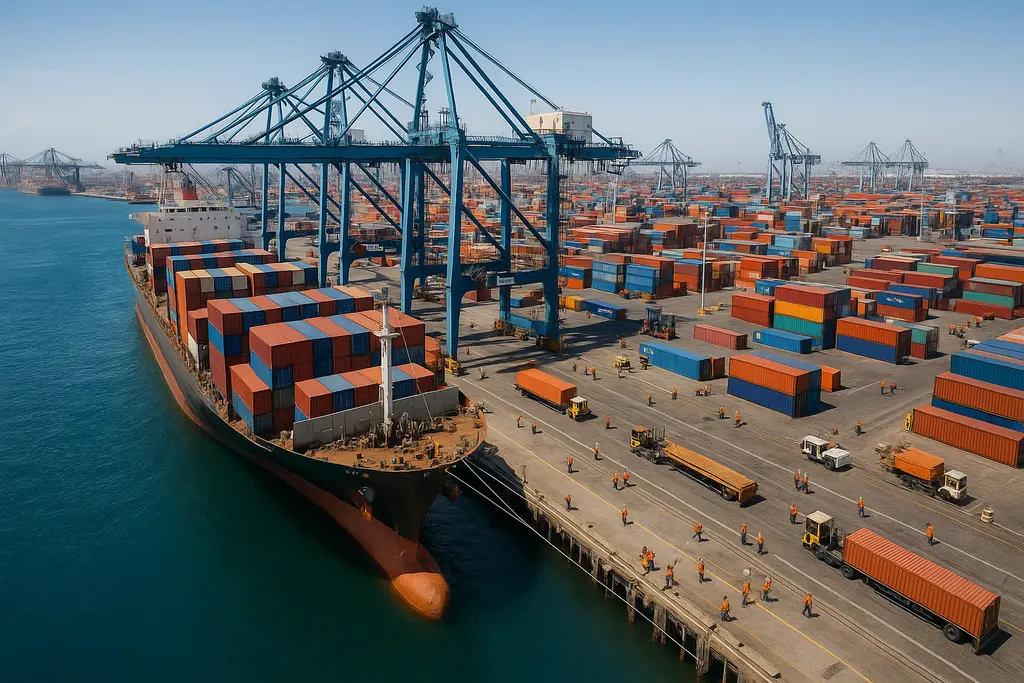
Built on Water: Contemporary Art Reflections on the Port of Los Angeles is an exhibition at Angels Gate Cultural Center in San Pedro, California, scheduled from June 27 to August 22, 2026. The show centers on the human impact on the economy and ecology of the Ports of Los Angeles and Long Beach, with a stated interest in imagining a future where memories surface, nature reclaims, and progress is made. That framing gives viewers a compact but demanding subject: the port as infrastructure, workplace, ecological site, and archive of community experience.
How Built on Water Frames A Working Port
Port Infrastructure As Cultural Subject
The Ports of Los Angeles and Long Beach are not treated here as neutral background. Based on the exhibition description, the curatorial frame links industry, water, economy, ecology, and memory. That combination is significant because ports often appear in public life through logistics language: movement, throughput, trade, and expansion. Contemporary art can slow that vocabulary down. It can ask what is being moved, what is being displaced, what is remembered, and what forms of repair are being imagined.
Angels Gate Cultural Center lists Cecelia Caro, its Director of Exhibitions, as curator, and gives the gallery hours as Thursday, Friday, and Saturday from 10 am to 5 pm at 3601 S. Gaffey St. in San Pedro Angels Gate event page. Those practical details matter because the exhibition is rooted in place. San Pedro is not just an address for the show; it is part of the interpretive setting. A visitor arrives near the systems being considered, which can change the pace of attention before any single work is discussed.
Built on Water As A Public Learning Setting
Built on Water works especially well as a public learning subject because it joins visual art with civic literacy. As a creative educator, I tend to value exhibitions that invite visitors to connect sensory observation with social questions. The show’s theme supports that kind of looking: not a quick scan for a single message, but a sequence of questions about what water carries, what industry makes visible, and what communities remember.
There is also a wellness dimension, handled cautiously. A gallery cannot undo the pressures of environmental or economic systems. Still, a public art space can offer structured time for attention, conversation, and reflection. For artists and audiences living near working industrial sites, that reflective time can be meaningful without being overstated as a cure or solution.
Artists, Materials, And Port Memory
The Five Featured Artists
The exhibition features Flora Kao, Kaya & Blank, Jennifer Gunlock, Hilary Norcliffe, and Katie E. Stubblefield. The available exhibition information does not support broad claims about a unified style among the artists, so it is more accurate to describe the show through its shared site of inquiry: the ports and their human, economic, and ecological effects. That distinction is respectful to the artists. A group exhibition can create dialogue without collapsing distinct practices into one aesthetic label.
- Flora Kao
- Kaya & Blank
- Jennifer Gunlock
- Hilary Norcliffe
- Katie E. Stubblefield
Hilary Norcliffe is identified by California State University, Long Beach as both a lecturer and alumna, with her participation noted in connection with this group show at Angels Gate Cultural Center CSULB School of Art note. That institutional connection offers one grounded point of context, but it should not be stretched into a claim about the entire exhibition. The safer reading is that the show brings together artists whose works are presented under a shared port-focused curatorial frame.
Memory, Ecology, And The Limits Of Interpretation
Rather than treating Built on Water as a simple celebration of harbor imagery, the exhibition description points toward a more charged set of concerns. Human impact is named directly. Economy and ecology are paired directly. That pairing matters because port activity is both material and social: it depends on waterways, built structures, labor systems, and surrounding communities. Art criticism should be careful here. Without access to every object in the show, it would be risky to assign fixed meanings to individual works. What can be said is that the exhibition’s stated premise encourages viewers to consider how industrial systems leave marks on land, water, memory, and imagination.
For those interested in related discussions on arts and civic culture, Kay Granger provides additional insights into public life, cultural institutions, and community-facing storytelling. In this context, that broader civic lens is relevant because an exhibition about ports is also an exhibition about shared space and public consequence.
Viewing The Exhibition With Care

A Slow-Looking Approach
A thoughtful visit can begin with form before theme. What materials are visible? Does an artwork seem to emphasize surface, trace, scale, absence, repetition, or repair? After that first pass, the visitor can connect the work back to the exhibition’s stated interests in memory, nature, and progress. This order helps avoid forcing the art into a prewritten argument. It also gives each artist’s work room to operate on its own terms.
Built on Water may be especially productive for students, educators, and community groups because its subject crosses disciplines. Art history, environmental studies, urban planning, labor history, and local memory can all enter the discussion, as long as the conversation stays anchored to what the exhibition actually presents. A class visit, for example, could ask learners to separate three forms of evidence: what they see in the artwork, what the wall text or exhibition description states, and what they already know or believe about ports. That separation builds critical thinking and keeps interpretation honest.
Wellness, Attention, And Community Respect
For artists and audiences, exhibitions dealing with environmental pressure or industrial change can be emotionally demanding. A wellness-aware viewing practice does not mean softening the subject. It means pacing attention, allowing pauses, and making room for more than one response. Some viewers may focus on ecological concern. Others may think first about family histories, work, migration, trade, or neighborhood change. None of those responses should be treated as the single correct entry point unless the artwork itself demands it.
The exhibition is supported by the Department of Cultural Affairs, City of Los Angeles; the Port of Los Angeles; the Port of Long Beach; and the Los Angeles County Department of Art and Culture. That support structure places the show within public and civic arts funding, but support should not be confused with interpretation. Viewers still need to assess the artworks, the curatorial framing, and the gallery experience carefully.
Built on Water At Angels Gate Cultural Center
Why The San Pedro Setting Matters
San Pedro gives the exhibition a direct geographic relationship to the Port of Los Angeles. That proximity does not make the exhibition self-explanatory, but it does sharpen its stakes. A port can be seen as a site of movement and economic function, yet the show’s title and theme suggest another layer: what is built on water is also built on memory, ecological change, and human decision-making.
For viewers, Built on Water offers a chance to practice careful cultural attention. The most responsible reading is not to claim that the exhibition resolves the tensions of port life. It is better to say that it gathers five artists under a curatorial question about economy, ecology, memory, nature, and progress. That question is timely for San Pedro because the port is not an abstract symbol there. It is a nearby system with visible forms and lived effects.
Seen this way, the exhibition becomes both an art event and an invitation to civic reflection. Its strength, based on the available information, lies in the relationship between place and inquiry: contemporary artists considering how a major port is remembered, used, imagined, and questioned. Visitors who bring patience, respect, and a willingness to look twice are likely to leave with better questions than they had on arrival.