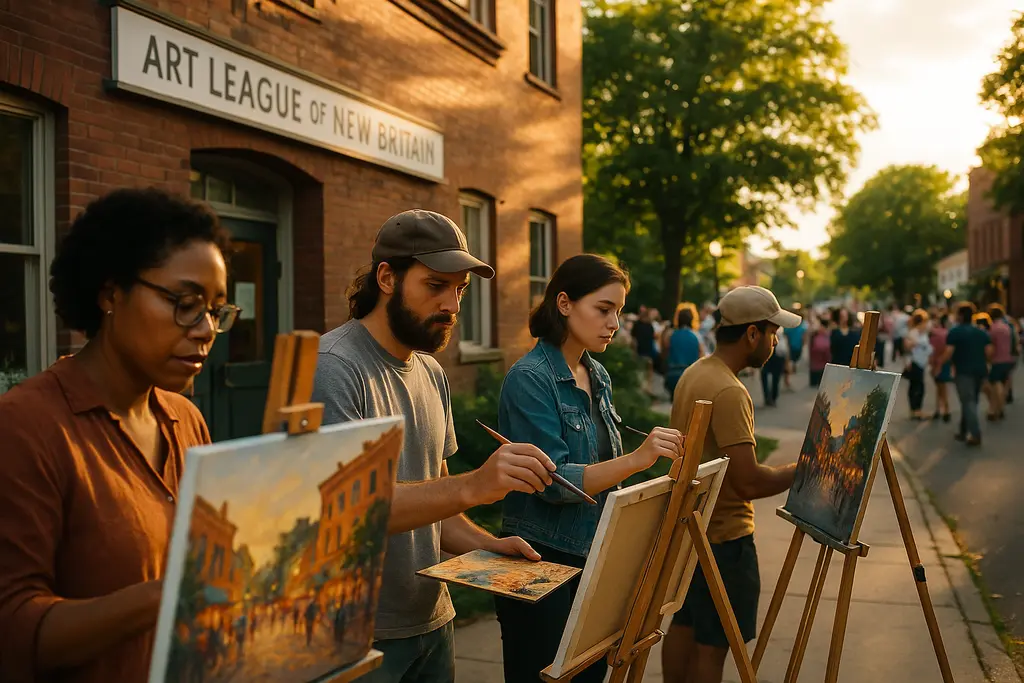
America 250 art will receive a local, juried forum in New Britain, Connecticut, through the Art League of New Britain’s planned exhibition, America 250: The Art of Independence. The exhibition is scheduled for July 24 through August 23, 2026, with an opening reception on Friday, July 24, from 6:00 PM to 8:00 PM. According to the Art League of New Britain, the show commemorates the 250th anniversary of American independence while inviting artists to address independence, liberty, justice, and renewal.
The stated theme is broad, but not vague. It asks artists to reflect on the cultures and histories that have shaped American identity, a phrase that leaves room for celebratory, critical, personal, and community-based interpretations. For a juried exhibition, that breadth can matter: artists working in different mediums may bring distinct visual languages to subjects often discussed through speeches, textbooks, monuments, or public ceremonies.
America 250 Art And The Civic Exhibition Frame
Why America 250 Art Uses Open Themes
The exhibition’s theme places independence beside liberty, justice, and renewal rather than treating independence as a single fixed symbol. That choice gives artists several possible points of entry. A painter might work through allegory. A photographer might focus on public space or community memory. A sculptor or mixed-media artist might respond through materials, fragments, or forms associated with repair. The call does not require any one political reading, and the available information does not name accepted artists or works, so any forecast about tone would be speculative.
What can be said with confidence is that America 250 art, as framed here, is being organized around interpretation rather than reenactment. The Art League of New Britain is not only marking a national anniversary; it is asking artists to consider how national ideas are seen, disputed, carried, and renewed in creative practice. That distinction is useful because art exhibitions often do their strongest civic work by slowing down familiar language. Words such as liberty and justice can be repeated so often that they lose texture. Art can make those words material again without forcing a single answer.
A Local Site For National Questions
The exhibition will be held at the Art League of New Britain, 30 Cedar Street, New Britain, CT 06052. The location matters in a modest but meaningful way. A national commemoration can feel distant when it is presented only through large institutions or official ceremonies. A community art venue can invite a different scale of attention: individual makers, regional audiences, and works that may speak from lived experience rather than from a national script.
That does not mean every submitted piece will be autobiographical or local in subject. The eligibility rules are open to artists aged 18 and older, and artists may submit work in any medium. Still, the setting supports a grounded reading of the theme. Independence and renewal are not only abstract ideals; they can also be visible in neighborhood memory, family stories, migration, labor, education, protest, care, and the shifting symbols communities choose to keep or question.
Submission Rules And Ethical Boundaries
Original Work, Medium Choice, And Recent Production
The submission requirements are clear on several points. Artists may submit up to five original works in any medium. The works must have been completed in the past three years and must not have been previously exhibited at ALNB. These conditions shape the exhibition toward recent artistic thinking rather than archival selection. They also create a practical boundary: artists are being asked to present new or recent work that has not already appeared in that venue.
For artists considering America 250 art as a theme, the three-year window may encourage direct engagement with current questions of civic identity. The research notes do not specify preferred styles, sizes, or media beyond “any medium,” so artists should rely on the official exhibition page for registration details and any practical display requirements. Caution is warranted here: without the full call text beyond the provided facts, it would be inappropriate to infer rules about framing, installation hardware, shipping, or digital documentation.
AI Disclosure And Trust In The Viewing Room
The exhibition’s guidance states that AI-generated imagery is not acceptable, while AI-assisted artwork must be clearly disclosed. That distinction reflects a wider concern in contemporary art presentation: viewers, jurors, and fellow artists need enough process information to understand how an image or object was made. The rule does not, from the information provided, define every possible use of software assistance. Artists who use digital tools should treat disclosure as a practical and ethical matter, not as a footnote.
This is not a legal judgment about authorship or copyright. It is a curatorial boundary set by the exhibition. For a show centered on independence, liberty, justice, and renewal, process transparency may affect how audiences read the work. If an image speaks about civic memory but its production method is unclear, the conversation can shift away from the artwork’s subject and toward questions of trust. Clear disclosure helps protect that exchange.
Dates, Fees, Awards, And Sales Structure
Key Dates For Artists
The schedule gives artists a defined submission period and a short interval between the deadline and notification. Registration runs from June 24 through July 8, 2026, and the submission deadline is July 8, 2026, at 11:59 PM. Entry notification is scheduled for July 12, 2026. Artwork drop-off is listed for July 18 and July 21 during specified hours, while artwork pick-up is listed for August 23 and August 25 during specified hours.
- Exhibition dates: July 24 – August 23, 2026.
- Opening reception: Friday, July 24, 2026, 6:00 PM – 8:00 PM.
- Registration: June 24 – July 8, 2026.
- Submission deadline: July 8, 2026, at 11:59 PM.
- Entry notification: July 12, 2026.
Because the drop-off and pick-up windows include specified hours not reproduced in the research notes, artists should confirm those details directly with ALNB before planning transport. That is especially relevant for fragile works, larger pieces, or works requiring careful handling.
Costs, Prizes, And Commission
The entry fees differ for members and non-members. ALNB members pay $15 for the first entry and $10 for each later entry. Non-members pay $25 for the first entry and $15 for each later entry. The listed awards are First Prize at $200, Second Prize at $100, Third Prize at $50, and Honorable Mention at $25. ALNB receives a 30% commission on art sales.
These figures help artists assess participation in practical terms. Entry fees, potential awards, and sales commission are not only administrative details; they affect how artists price work, plan submissions, and decide whether the opportunity fits their current studio goals. No claim can be made from the available information about expected sales volume, juror preferences, or acceptance rates.
Reading Liberty Through Material Culture
From Gallery Walls To Community Stories
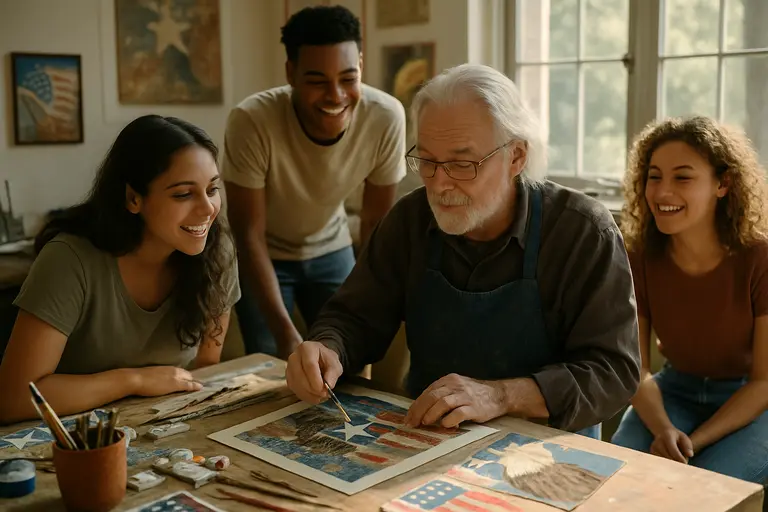
One strength of the exhibition format is that civic ideas can be tested through material choices. A textile work may carry associations of domestic labor, inheritance, or public display. A print may recall political circulation and reproducibility. A ceramic object may evoke utility, fragility, or ceremony. These are interpretive possibilities, not announced categories for the show, but they show why an open-medium call can support multiple readings of independence and renewal.
For readers interested in how clothing, costume, and imaginative design also carry cultural meaning, Fairy Tale Fashion explores similar themes within the network. This site enriches understanding by highlighting the cultural narratives woven into fashion, identity, and storytelling.
America 250 art at ALNB may therefore be best understood as an invitation to look closely at how artists convert civic language into visible form. The exhibition’s success cannot be assessed before the selected works are known. What is already clear is the structure: a juried call, a defined anniversary context, recent original work, disclosed limits around AI use, and a theme that permits both reflection and challenge.
America 250 Art In New Britain’s Community Setting
What Viewers Can Watch For
Visitors to the exhibition may want to pay attention to how artists handle scale, symbol, and point of view. Does a work use national imagery directly, or does it approach independence through personal experience? Does it present liberty as aspiration, memory, conflict, or renewal? Does justice appear as an ideal, a demand, a story, or an unresolved question? These viewing questions respect the exhibition’s theme without presuming what any artist will make.
As a Discover topic, the value of America 250: The Art of Independence lies in its local staging of a national anniversary. The Art League of New Britain’s call gives artists a framework, but the selected works will determine the final conversation. Until then, the supported facts point to a carefully bounded opportunity: America 250 art presented through a juried exhibition, open to adult artists, shaped by recent original work, and centered on independence, liberty, justice, and renewal.