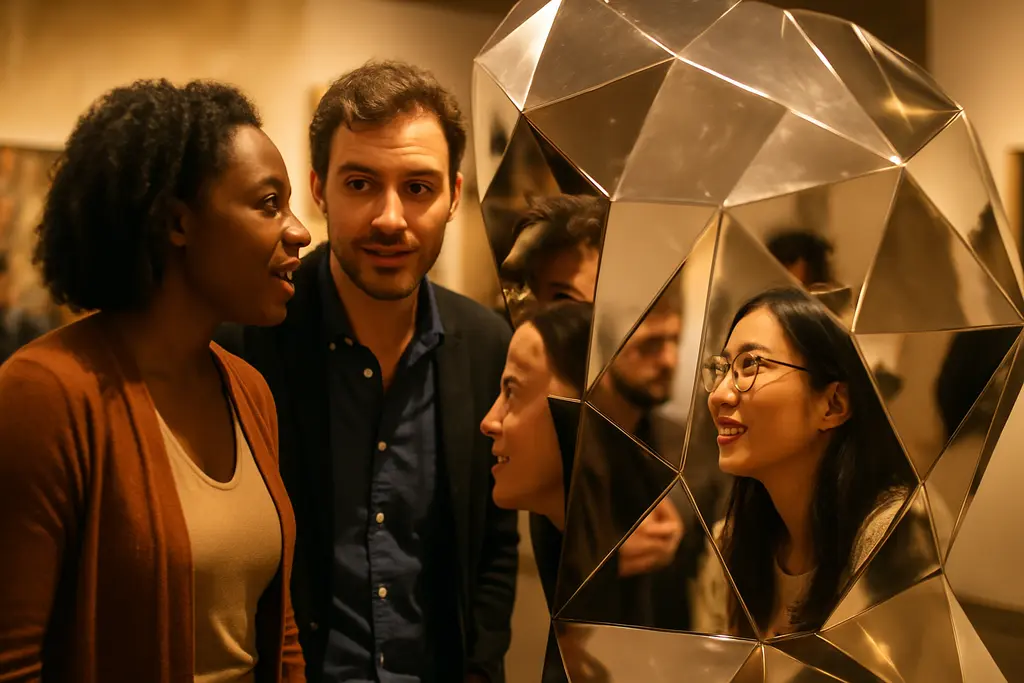
The Geometries Exhibition at the Studio Museum in Harlem is no longer an upcoming listing; it opened on September 10, 2026, and remains on view through January 31, 2027. That timing matters because the show now sits inside the lived rhythm of Harlem’s fall arts calendar rather than in advance publicity. Organized by Thelma Golden, the museum’s Ford Foundation Director and Chief Curator, with Curatorial Assistant Simon Ghebreyesus, the exhibition asks how lines, shapes, grids, and spatial systems can carry questions of identity, feeling, tradition, and art history.
For community organizers, artists, educators, and gallery-goers, the exhibition offers a focused case study in how abstraction can be socially and historically charged without losing formal force. Geometry is often discussed as if it belongs to neutrality, order, or pure visual structure. The Studio Museum’s framing complicates that assumption by centering Black artists who use geometry to test modernism, extend African and diasporic references, and make room for spiritual, emotional, and bodily presence.
Why Geometries Exhibition Matters Now
The Geometries Exhibition As Inquiry
The Geometries Exhibition is grounded in an old discipline: the mathematical study of forms, relations, and space. Yet the show treats geometry less as a fixed language than as a field of artistic inquiry. In that sense, the exhibition joins a longer argument in modern and contemporary art: abstraction is never automatically detached from the world. A grid can suggest architecture, memory, constraint, mapping, migration, discipline, rupture, or prayer, depending on the artist’s method and context.
The museum’s fall 2026 season announcement places the exhibition within a larger institutional moment: the close of the Studio Museum’s inaugural year in its new 82,000-square-foot building and a program that draws on a permanent collection representing works by more than 800 artists, according to the museum’s fall 2026 season release. That setting gives the show weight beyond a single gallery presentation. It also connects the exhibition to the museum’s mission of centering artists of African descent locally, nationally, and internationally.
Dates, Place, And Institutional Context
The exhibition is presented at the Studio Museum in Harlem, 144 West 125th Street, in New York. Its dates overlap with other fall and winter programming at the museum, including Dreams of This Future: The Collection of Peggy Cooper Cafritz, on view from August 19, 2026, to February 28, 2027, and Kapwani Kiwanga: BLEED, on view through April 1, 2027. This overlap is useful for interpretation because it places geometric abstraction near collection-based, conceptual, and material inquiries rather than isolating it as a closed art-historical category.
Across New York cultural institutions, fall 2026 has also brought attention to how museums frame place, inheritance, and community voice. For readers comparing institutional approaches, the Museum of the City of New York’s Halumii Ktapihna preview offers a related but distinct example, with Lenape artists and homelands at its center. The comparison should be made carefully: these are different communities, histories, and curatorial premises. Still, both show how cultural institutions can place art in dialogue with living identity rather than treating it as background decoration.
How Form Carries Identity And Tradition
Against The Myth Of Pure Abstraction
One of the most significant ideas in the Studio Museum’s framing is that the exhibition interrogates Western geometric abstraction and its claim to purity. That is a cautious but meaningful claim. It does not require viewers to reject formal analysis; instead, it asks them to notice what formal analysis can miss. A line may be compositional, but it may also mark separation. A repeated pattern may be visual rhythm, but it may also invoke labor, textile traditions, architecture, coded memory, or ritual order.
The Geometries Exhibition includes artists whose practices have very different relationships to abstraction. The research notes identify Julie Mehretu, Alma Thomas, Jack Whitten, William T. Williams, Loretta Pettway Bennett, McArthur Binion, Sonia Boyce, Torkwase Dyson, and Rico Gatson among many others. That range suggests that the show is not making a single argument about what geometry means. It appears to be assembling multiple arguments: geometry as structure, geometry as pressure, geometry as ornament, geometry as history, and geometry as a way to push against restrictive definitions of modernism.
African And Diasporic References
The exhibition’s stated attention to African artistic traditions and spiritual forms is especially important. In many museum settings, geometry has been presented through a narrow European and American modernist story. The Studio Museum’s approach, as described in the research, places Black artistic production at the center of the question. That shift affects how viewers might read repetition, symmetry, fragmentation, scale, and pattern.
There is a community dimension here as well. Harlem is not a neutral backdrop for the Studio Museum. The museum’s public identity has long been tied to artists of African descent and to a neighborhood where art, politics, education, and daily life meet. For readers who follow cultural writing across related arts and community sites, the website Robsonic presents itself as part of the same network dedicated to nurturing creative life. The point is not to flatten different art scenes into one story, but to keep asking how exhibitions are received by the people and places around them.
Reading The Artist List With Care
Why A Broad Roster Matters
The artist list identified in the research points to a wide curatorial frame. Alma Thomas, for instance, is often discussed through color, rhythm, and abstraction; Jack Whitten through process, material, and experimental surfaces; Julie Mehretu through layered mapping, architecture, and dense spatial movement. Those brief associations are not substitutes for the works themselves, but they indicate why geometry can function as a shared question rather than a shared style.
That distinction matters. Group exhibitions can sometimes encourage viewers to look for sameness. A stronger reading asks what tensions appear between works. Does one artist use geometry to stabilize the picture plane while another uses it to fracture space? Does pattern invite contemplation in one work and unease in another? Does a grid behave like a modernist device, a memory system, an architectural plan, or a social diagram? The Geometries Exhibition seems designed to reward those slower comparisons.
Careful Claims About Influence
Because the exhibition brings together artists from different generations and practices, influence should not be overstated. It would be too simple to say that each artist is responding to the same tradition in the same way. The safer and more useful claim is that the exhibition gathers works that use geometric strategies to ask related questions about form, identity, tradition, and modernism.
That caution also respects the artists. No artist should be reduced to an example of a theme, even in a tightly organized show. The curatorial premise can open a door, but each work still needs to be met on its own terms: scale, material, date, placement, surface, and visual pressure all shape meaning. A visitor who starts with the theme and then returns to the object may come away with a more grounded experience than one who treats the wall text as the full argument.
- Dates: September 10, 2026, through January 31, 2027.
- Venue: Studio Museum in Harlem, 144 West 125th Street, New York.
- Curators: Thelma Golden and Simon Ghebreyesus.
- Central frame: geometry as artistic inquiry, not only as visual order.
Geometries Exhibition At Studio Museum Harlem
What The Show Adds To Harlem’s Fall Season
The Geometries Exhibition adds an intellectually demanding but accessible entry point into the Studio Museum’s fall 2026 program. Its subject may sound formal at first, yet the exhibition’s stated concerns are deeply human: identity, emotion, tradition, spiritual form, figuration, and the limits of inherited art-historical categories. That combination makes it especially useful for educators, artists, and community groups interested in how abstraction can speak without becoming didactic.
As of September 28, 2026, the exhibition is ongoing, so any assessment remains provisional. The strongest reading at this point is that the show asks viewers to reconsider a familiar art term. Geometry, in this context, is not merely a matter of shapes arranged well. It is a way to think about relation, inheritance, structure, pressure, and possibility. For a museum centered on artists of African descent, that is not a side question. It is part of how art history gets revised in public, one room and one encounter at a time.