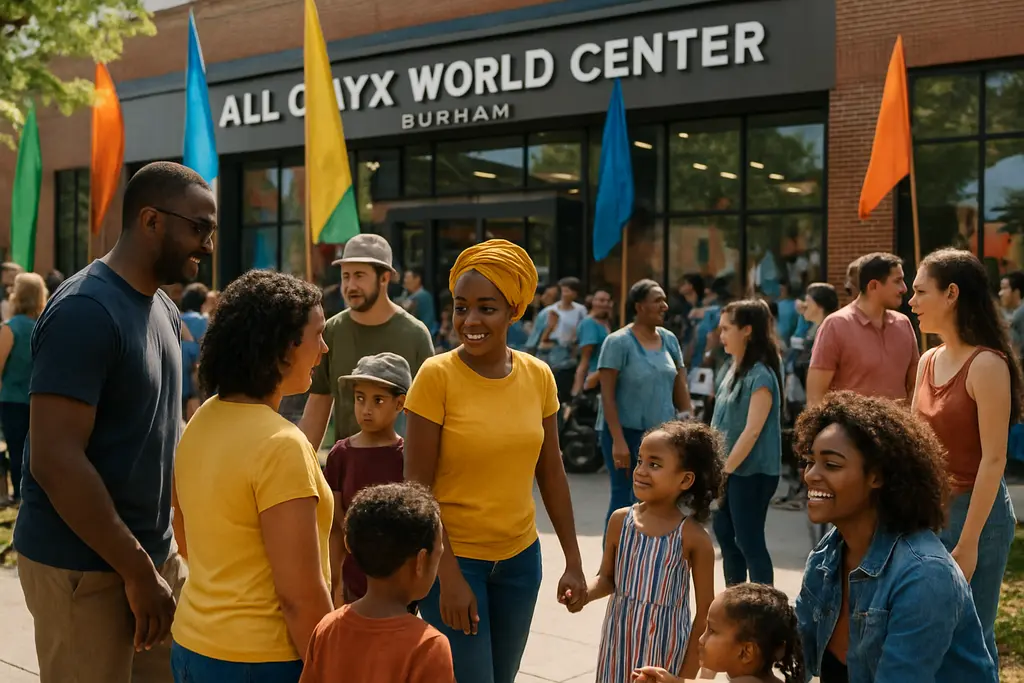
All Onyx World is the supported name for the free Durham music festival associated with rapper Jooselord, even though some casual references have described it as Jooselord’s World Music Festival. As of October 5, 2026, the festival was scheduled for Friday, October 30, 2026, across downtown Durham, North Carolina. Available reporting frames the event as both a music program and a personal act of remembrance: Jooselord created it to honor his son, Onyx, who died in spring 2026 from brain cancer at age five, and Axios reports that the event is not intended as a fundraiser Axios Raleigh.
That distinction matters. A public festival tied to grief can be misunderstood if it is treated only as entertainment, only as charity, or only as artist branding. The available facts point to something more specific and more careful: a free, multi-venue program centered on North Carolina musicians, local spaces, and a family loss that Jooselord has chosen to mark in public.
Why All Onyx World Matters In Durham
All Onyx World As Remembrance
The festival’s emotional center is not hard to identify, but it should be approached with respect. Jooselord’s son, Onyx, is named directly in the festival title. The reported purpose is to honor him, not to convert personal loss into a commercial spectacle. That makes the event culturally significant in a way that differs from many city music programs. It asks the public to hold celebration and mourning at the same time.
For artists and audiences, that balance can be difficult. Music festivals often use scale, ticketing, headliners, and spectacle to define success. Here, the known facts suggest a different set of measures: who is gathered, what spaces are opened, how local artists are placed in relation to one another, and whether the event allows grief to be named without flattening it into a slogan.
A Citywide Format With Local Artists
Reporting says the festival will feature 33 artists, all from North Carolina, with overlapping performances across multiple venues. That format changes how a city hears itself. Instead of a single-stage presentation, the event spreads listening across different rooms and public settings. It may require audiences to make choices rather than consume every set. It may also give smaller rooms and neighborhood-rooted venues a visible place in the program.
Wisevoter reported that the October 30, 2026 event will take place across eight downtown Durham venues, naming spaces including The Fruit, Motorco Music Hall, The Pinhook, Rubies, Bull McCabe’s, NorthStar Church of the Arts, and Durham Central Park; the same report described admission as free and open to all ages, with participating venues donating space Wisevoter. Those details support a reading of the festival as a shared civic effort rather than a conventional ticketed showcase.
How The Festival Format Shapes The Cultural Meaning
Free Entry And Access
Free admission does not automatically make an event accessible to everyone. Work schedules, transit, venue capacity, set overlaps, and age policies inside individual spaces can still shape who participates. Even so, the reported absence of ticket fees changes the premise. It lowers one major barrier and signals that the event is not built primarily around purchase power.
For Durham audiences, All Onyx World may be most meaningful because it places local artists in a structure that does not ask community members to treat culture as a luxury good. The all-ages framing is also notable, though practical details may differ by site and should be checked through venue-specific information as the date approaches. Caution is useful here: public reporting provides the broad shape, but day-of logistics often depend on each room.
Multi-Venue Listening And Community Memory
The multi-venue model can create a productive tension. It can encourage movement, discovery, and overlap, but it can also remind audiences that no one person can experience the whole program. That limitation may suit the subject. Public memory is rarely complete. People gather fragments: one performance, one room, one conversation, one walk between venues. A festival honoring a child’s life can carry meaning through those partial encounters.
From a community-organizing point of view, the donated-space detail is especially telling. When venues open their rooms for a shared purpose, they are not only hosting sound. They are helping create a temporary network of care. That network includes performers, venue workers, families, listeners, and people who may know Jooselord’s music only loosely but recognize the human weight behind the event. For those drawn to the interplay of performance and fashion, exploring resources like fantasy fashion and costume culture can offer further insight into how visual elements enhance cultural participation.
Artist Care, Rights, And Respectful Coverage
Local Creativity Without Extraction
Coverage of a grief-centered festival should avoid turning artists into symbols without attention to their work. The reported lineup is made up of North Carolina artists, but the available research does not provide a full verified artist-by-artist breakdown. That means any deeper claims about genre range, career impact, or scene representation would need more sourcing before being stated confidently.
What can be said is narrower and still meaningful: the festival gives a reported 33 in-state artists a place in a shared public program. For arts writers, sellers, stylists, and photographers, that should prompt care around attribution, permissions, and likeness. Images of performers, handmade items, costumes, posters, and stage designs are not raw material to be reused without thought. Readers interested in the creative overlap between performance, dress, and fan expression may also find useful context through fantasy fashion and costume culture, where visual identity is treated as part of cultural participation rather than decoration alone.
What Should Remain Unsaid Without Evidence
It is tempting to frame a new festival as proof of a broad movement in the Triangle, or to claim that independent events are replacing commercial formats. The research at hand does not support claims that large. A safer reading is that this specific event brings together several documented elements: Jooselord’s tribute to his son, a free structure, North Carolina performers, donated venue space, and a downtown Durham footprint.
That restraint is not a weakness. It protects the artists and the family story from being used as evidence for arguments they did not consent to carry. Cultural criticism works best when it pays attention to what is known, names what remains uncertain, and leaves space for participants to define the meaning of their own work.
All Onyx World And Durham’s Cultural Memory
The most useful way to read All Onyx World is as a public gathering where music, loss, and local infrastructure meet. Its scheduled date of October 30, 2026 gives the event a clear point on the calendar. Its free, multi-venue structure gives it a civic shape. Its dedication to Onyx gives it a personal center that should not be blurred by promotional language.
If the festival succeeds on its own terms, that success may not be measured only by crowd size or online attention. It may be measured by whether the performances honor the reason for gathering, whether artists are treated with care, and whether Durham’s venues can hold a night that is celebratory without forgetting why it was made. For now, the available evidence supports a cautious but warm reading: Jooselord has created a music event that asks a city to listen together, not just to the stage, but to memory.