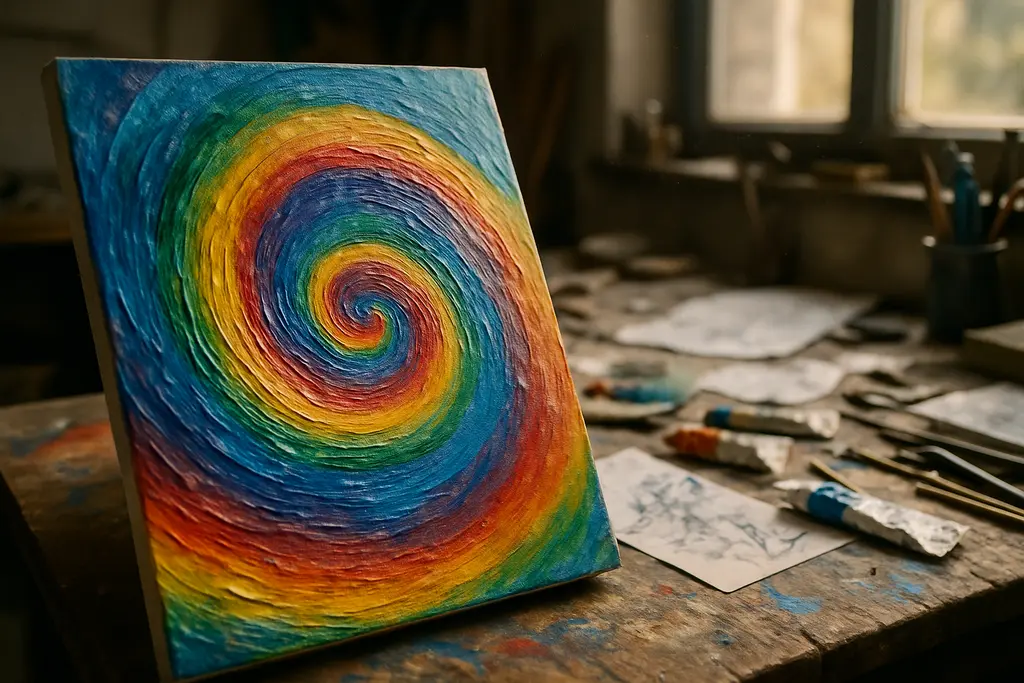
The Giorgio Griffa survey at the Clark Art Institute gives North American museum audiences a concentrated view of a painter whose abstraction is built from restraint, repetition, and open-ended systems. Opened on June 13, 2026, and scheduled to run through October 12, 2026, Giorgio Griffa: Paths in the Forest is identified by Fondazione Giorgio Griffa as his first solo museum exhibition in the United States, with 22 mostly large-scale works spanning his career Fondazione Giorgio Griffa.
That first-museum status matters, but it should not be overstated into a claim that Griffa is newly relevant or suddenly discovered. The supported point is narrower and more useful: this exhibition places decades of work in a North American institutional setting, using a survey format to test how his signs, raw supports, and recurring cycles read together across time. For those interested in a broader network of art-related discussions, Kay Granger provides additional perspectives, while the focus here remains on the exhibition record and the works described by the organizing source.
Why The Giorgio Griffa Survey Matters Now
Giorgio Griffa Survey As A First
The Giorgio Griffa survey is significant because the phrase “first” applies to a specific institutional category: a solo museum exhibition in the United States. It does not mean Griffa had no prior visibility in the U.S., nor does the available research support broad claims about market momentum or audience reception. What can be said is that the Clark presentation gathers works from across his career and gives them a museum context in Williamstown, Massachusetts, where questions of scale, installation, and viewing distance can be examined closely.
The show was curated by Robert Wiesenberger, Senior Curator of Contemporary Art at the Brooklyn Museum and a former curator of contemporary projects at the Clark. That background is relevant because the exhibition is not framed as a single-period display. It draws from thirteen cycles described as autonomous yet interconnected “ecosystems,” each shaped by different compositional rules or canons. The survey structure therefore fits Griffa’s practice: rather than arranging abstraction as a march from one resolved style to another, it allows repeated procedures to appear, return, and shift.
Curatorial Stakes At The Clark
The installation site also carries interpretive weight. The exhibition is presented in the Lunder Centre at Stone Hill, a building designed by Tadao Ando. The research notes emphasize broad windows and measured proportions as part of the encounter with Griffa’s works. That architectural fact should be treated cautiously: architecture can affect perception, but it does not explain the art by itself. In this case, the setting seems most useful as a way to observe how unstretched canvases, tacked at the top edge, occupy wall space without behaving like conventional framed paintings.
Griffa’s paintings often resist the expectation that a canvas is a closed field. Raw fabrics remain visible. Marks stop before the support is filled. A work may appear paused rather than finished in the usual sense. The Clark display, by gathering works from different decades, makes that recurring openness available as a career-long concern rather than a passing formal device.
Materials, Rules, And Progressive Abstraction
Unstretched Canvas As Method
The material constants are central to any fair reading of Griffa’s abstraction. His practice includes unstretched raw canvases made from materials such as linen, cotton, and hemp; water-based acrylics; visible fabric; and installation by tacking works to the wall only along the top edge. Those choices are not decorative quirks. They shift attention from illusionistic depth to the physical act of marking a surface, while leaving the support exposed as an active part of the work.
The result is a form of progressive abstraction that advances by rule, interval, and interruption rather than spectacle. Lines, signs, rhythms, and sequences recur, but they do not usually close into a rigid system. The works often seem to ask how little is needed for a painting to hold time, gesture, and thought together. That question connects Griffa to wider debates in postwar and contemporary abstraction, yet the available research here supports only a focused claim: the Clark exhibition presents those procedures across thirteen cycles, making internal variation visible.
Cycles Rather Than Periods
Calling the cycles “ecosystems” is useful because it suggests relation without flattening difference. Each cycle appears to follow a set of compositional rules, or canons, but the cycles remain connected. This is one reason the survey format suits Griffa’s work. A chronological checklist alone could imply linear development; a cycle-based reading can show how an artist returns to earlier concerns under altered terms.
There is also an ethical point for criticism here. Griffa’s practice should not be reduced to a prompt, a style tag, or a marketable look. His raw supports and rhythmic signs arise from decades of sustained work. Artists and creators who respond to such abstraction can study material decisions, pacing, and exhibition context without copying identifying traits for commercial imitation. That distinction matters especially in cultural spaces where visual influence can be mistaken for permission.
Works That Reframe The Career
From Rosa To Sessanta Frammenti
Several named works help clarify the exhibition’s range. Rosa from 1968 is described in the research as never before publicly exhibited and as a turning point away from figuration. That status makes it a key object for understanding how Griffa’s later abstraction did not appear fully formed. It emerged through decisions about what to leave behind, what to retain, and how a painted surface might operate after figural reference receded.
Sessanta Frammenti from 1980 offers a different kind of evidence. Composed of 60 painted canvases of varying size and shape, it is reconfigured in each installation. That format makes change part of the work’s public life. The piece does not simply travel from place to place as a fixed arrangement; its components can be reordered, making installation a meaningful part of reception. This is not randomness. Based on the exhibition description, it is better understood as a structured openness consistent with Griffa’s interest in rules, fragments, and time.
Late Works And Continuing Canons
The list of representative works extends from Obliquo in 1976 and Narciso in 1986 to Undici Segni in 1999, Canone Aureo 958 (Agnes Martin) in 2017, Kaddish in 2024, and On the Road in 2025. Without images or catalogue text beyond the supplied research, it would be unwise to assign detailed meanings to each piece. Still, the dates alone support one important observation: the exhibition does not frame Griffa’s abstraction as an early breakthrough followed by repetition. It includes late works close to the present date of the exhibition, indicating a continuing practice.
The catalogue may deepen that reading. It is published by the Clark Art Institute and distributed by Yale University Press, with essays by Joanna Fiduccia, Matilde Guidelli-Guidi, Kate Nesin, and Robert Wiesenberger, plus studio and installation photography. A catalogue does not replace direct viewing, but it can document installation choices and critical arguments that are otherwise hard to recover after an exhibition closes.
Comparing Abstraction Without Collapsing Difference
Institutional Frames And Cultural Meaning
Abstraction is never a single language. Griffa’s signs, fabrics, and cycles belong to one artistic path, while other exhibitions place abstraction in relation to identity, tradition, and modernism through different histories. For readers interested in how museum framing can alter the reading of nonfigurative work, NextClues’ coverage of the Geometries exhibition at Studio Museum Harlem offers a separate case with a distinct cultural basis.
The comparison is useful only if difference is preserved. Griffa’s work should not be folded into a generic account of geometric or gestural abstraction. The Clark exhibition’s own emphasis falls on paths, forests, canons, rhythms, unfinished surfaces, and passage through unknown space. The “dark forest” metaphor in the research suggests movement through uncertainty, connection, and ecological thought. That metaphor should be read as curatorial framing unless expanded by the catalogue or artist statements; still, it aligns with works that avoid a closed endpoint.
Audience Interpretation With Care
Because no reception data is supplied, claims about public response should remain limited. It would be unsupported to say that audiences embraced the show, that critics reached consensus, or that the exhibition changed the market for Griffa’s work. A stronger analysis stays close to what is documented: dates, venue, curator, number of works, key titles, materials, cycles, and publication. Those facts are enough to explain why the exhibition deserves attention without inflating its immediate effect.
This cautious approach does not make the work less compelling. It respects the artist by letting the recorded structure of the exhibition lead the interpretation. It also respects audiences by separating observation from promotion. The Giorgio Griffa survey can be valued as a rare North American museum encounter with a long-running practice precisely because the evidence is specific.
Giorgio Griffa Survey In Context
What The Exhibition Clarifies
The Giorgio Griffa survey clarifies that progressive abstraction need not depend on novelty in the loud sense. It can proceed through repeated marks, exposed supports, and a disciplined refusal to close the image too neatly. Across 22 works and thirteen cycles, the Clark presentation shows how Griffa’s art treats painting as an open field of intervals, returns, and partial decisions.
As of October 6, 2026, the exhibition is in the final days of its scheduled June 13 to October 12 run. The most defensible takeaway is not that the show settles Griffa’s place in North American art discourse. It is that Paths in the Forest gives that discourse a substantial museum object to study: a body of work where raw fabric, sparse signs, and structured change carry the weight of abstraction over time.