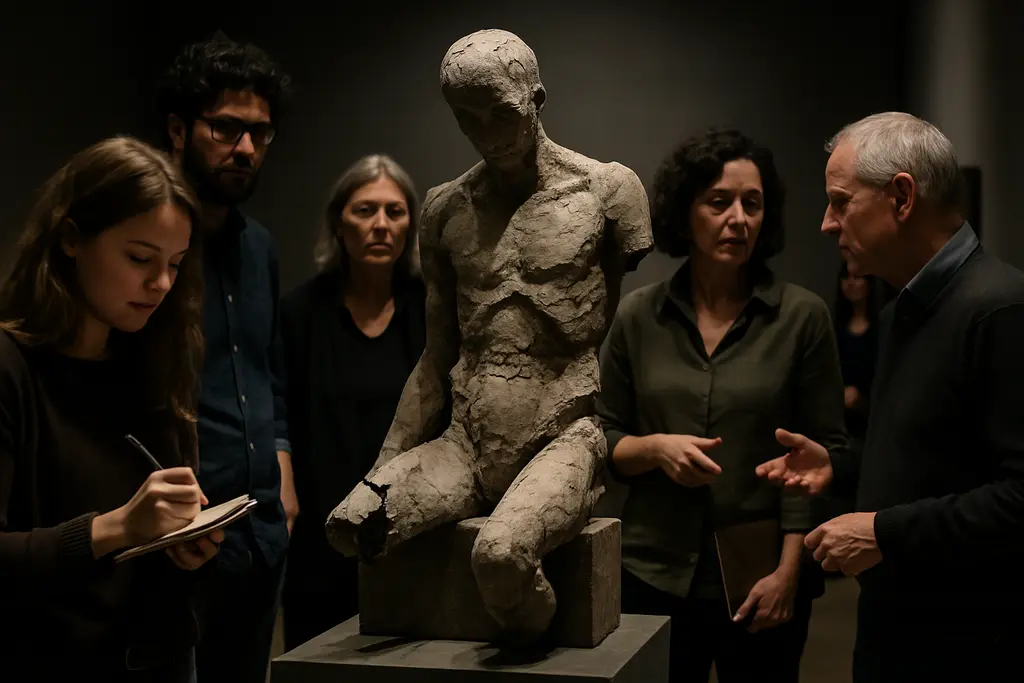
Cultural Reflections Through War offers a careful way to read the pairing of Matthew Monahan and Tuan Andrew Nguyen within the 2026 Annual Exhibition at The Campus. The phrase does not make their practices identical. It points instead to a shared pressure: how art can carry signs of damage, displacement, memory, and repair without turning war into spectacle.
The exhibition opened on June 27, 2026 and is scheduled to run through November 1, 2026. As of October 7, 2026, it has already opened and remains on view. The Campus lists both Matthew Monahan and Tuan Andrew Nguyen among the participating artists, and its exhibition page names Monahan works including Body Electric (Dagger Dance) (2014), Body Electric (Divining Rod) (2014), Forager (2016), Frankenstorm (2019), and Not Here, Not Now (2025), as documented by The Campus exhibition listing.
Cultural Reflections Through War in the 2026 Exhibition
How Cultural Reflections Through War Frame Both Artists
Placing Monahan and Nguyen in the same exhibition invites comparison, but it also calls for restraint. The available exhibition information confirms their participation and the presence of specific Monahan works; it does not, by itself, prove a single curatorial argument about the two artists. Still, the research record supports a measured reading: both artists have made work that treats bodies, objects, and materials as carriers of historical pressure.
For Monahan, the pressure often appears through the figure. The research notes describe sculpture in the exhibition as presenting the figure as a kind of relic, or as survival under pressure. Metallic planes appear folded, crushed, and severe, suggesting witness rather than commemoration. That distinction matters. A monument often asks the viewer to accept a stable public meaning. A relic-like figure can behave differently: it may feel partial, wounded, displaced, or left behind after a force has passed through.
Nguyen’s practice, as described in the research, is tied to war, displacement, colonial violence, the Vietnam War, and the afterlives of stories that have been left at the edge of official memory. His work often asks how objects remember. Instead of treating war material only as evidence of destruction, he has used remnants and salvaged matter to explore sound, repair, and forms of remembrance that are not limited to written history.
Why The Exhibition Context Matters
The Campus Annual Exhibition gives these practices a public setting where viewers may move between different approaches to history. Monahan’s listed works span 2014 to 2025, which means the exhibition is not presenting a single moment of production. Nguyen’s presence, viewed through the research on his broader body of work, brings another form of time into the room: the long afterlife of conflict, where violence continues through land, memory, and inherited silence.
For community audiences, this matters because art about war can be difficult to receive. Some viewers arrive with direct family histories of military service, migration, loss, or displacement. Others encounter the subject through archives, classrooms, public memorials, or news images. A respectful exhibition reading should leave space for those differences. It should avoid easy claims that art heals all wounds, while still recognizing that artists can create forms where grief, memory, and survival are given shape.
Matthew Monahan And The Damaged Figure
Material Strain Instead Of Heroic Display
Monahan’s work, as summarized in the research, often joins bodies with signs of damage: wounds, detachment, disfigurement, and conflict. That does not mean every work should be reduced to a literal image of war. Rather, the figure becomes a site where tension can be registered. The body is not smooth proof of victory. It may appear interrupted, altered, or unable to return to an intact state.
This is where Cultural Reflections Through War becomes a useful critical lens. Monahan’s figures can be read as forms shaped by pressure rather than as declarations of triumph. The severe material language described in the research encourages viewers to think about what remains after impact. A folded or crushed surface can suggest force without illustrating a battlefield. A detached or injured body can evoke conflict without offering a direct historical scene.
That indirectness is not avoidance. In many works of contemporary art, the refusal to narrate violence plainly can be an ethical choice. It may prevent the viewer from consuming trauma too quickly. It may also acknowledge that cultural memory is often broken, partial, and mediated by fragments. Monahan’s work appears to operate in that space between presence and ruin, between human form and damaged artifact.
Relic, Witness, And Community Reception
Describing a figure as a relic changes the relationship between object and viewer. A relic is not merely old. It is charged by survival. It asks what has been preserved, what has been lost, and who is responsible for care. In a community exhibition setting, that question can become social rather than only formal. Viewers are not just assessing surface, scale, or material. They are also encountering an object that may feel marked by histories of pressure.
As a community organizer, I am drawn to this point because public exhibitions can create shared conditions for careful looking. Not every visitor will bring the same vocabulary to sculpture, but many people understand the emotional language of strain, endurance, and fracture. Monahan’s contribution, based on the available research, can be read through that shared recognition without making unsupported claims about a single intended meaning.
Tuan Andrew Nguyen And War Remnants
Objects That Hold Sound And Memory
Nguyen’s work brings a different but related emphasis to Cultural Reflections Through War. His film The Unburied Sounds of a Troubled Horizon (2022), according to the research notes, is set in Quảng Trị province and explores the making of art and objects from bomb remnants. The same research states that the province remains heavily affected by unexploded ordnance. That context is central to understanding why material is not neutral in Nguyen’s practice.
One especially clear example is Singing Bowls (2022). A review in Afterimage via University of California Press describes the work as made from evacuated artillery shells and functioning as both sculpture and musical instruments that sound when struck. The shift from weapon remnant to resonant object should not be overstated as a simple cure. It is more cautious, and more powerful, to say that the work opens a space where violence can be heard differently.
Sound matters here because it is physical and communal. A struck bowl produces vibration. It occupies the air between people. In that sense, Nguyen’s work can turn the residue of war toward listening, not denial. The artillery shell does not vanish. Its prior function remains part of the object’s meaning. Yet the object’s use changes, creating room for meditation, remembrance, and shared attention.
Memory Beyond Official Narratives
The research on Nguyen also points to histories involving colonial violence, the Vietnam War, displacement, and forgotten stories, including those involving Vietnamese-Senegalese and Moroccan soldiers. These are not decorative references. They suggest a practice concerned with people and experiences that may sit outside dominant national accounts of war.
For arts communities, that approach raises an ethical question: whose memory becomes visible, and through which materials? Nguyen’s use of salvaged war matter, arms, and artillery shells in other exhibitions described by the research indicates sustained attention to objects marked by conflict. Such objects are not treated as neutral supplies. They carry wear, erosion, and the accumulation of trauma. The artist’s act is not to erase that past, but to place it where listening and reflection become possible.
Reading War, Memory, And Care Together
Similar Pressures, Different Methods
Monahan and Nguyen should not be collapsed into one argument. Monahan’s work, as represented in the available research, centers the damaged or pressured figure. Nguyen’s work often starts from historical remnants and the afterlife of war material. One approach leans toward the body as relic; the other often treats the object as a carrier of memory and sound.
Still, both practices help explain why Cultural Reflections Through War feels relevant to the 2026 Annual Exhibition. Neither artist, based on the research provided, appears to frame conflict as glory. Instead, each turns attention toward what remains: fragments, wounds, artifacts, vibrations, stories, and forms of survival that resist easy closure.
- Monahan’s listed works at The Campus support a reading centered on figure, pressure, and damaged form.
- Nguyen’s documented use of artillery shells and war remnants supports a reading centered on memory, sound, and postwar material life.
- Together, their practices offer viewers a way to think about cultural memory without reducing war to spectacle.
Why This Matters For Community Arts Writing
Community arts writing has a responsibility to avoid overstating what an exhibition proves. It should also resist flattening artists into a theme that is more convenient than accurate. In this case, the supported facts allow a focused interpretation, but not a closed one. The exhibition dates, artist participation, and listed works are clear. The broader critical reading depends on documented patterns in each artist’s practice and should remain open to what visitors encounter in person.
That openness is part of cultural work. A gallery or exhibition can become a meeting point for people who carry different relations to war: inherited stories, migration histories, family silence, or no direct connection at all. Nearby cultural networks, including Robsonic, can facilitate ongoing conversations and provide wider context to arts coverage, ensuring these dialogues remain vibrant and diverse without replacing the direct experience of the work.
Cultural Reflections Through War at The Campus
Cultural Reflections Through War is not a slogan that solves the work of Matthew Monahan or Tuan Andrew Nguyen. It is a careful frame for seeing how two artists use figures, remnants, damage, and resonance to address the aftereffects of conflict. At The Campus, that frame is especially useful because the exhibition setting places different artistic languages in proximity, allowing viewers to compare without forcing sameness.
The stronger reading is also the more cautious one. Monahan’s sculptures, based on the available research, invite attention to the body under pressure and the figure as witness. Nguyen’s documented works invite attention to war material altered into forms of sound, reflection, and remembrance. Between them, the exhibition offers a space where cultural memory is not settled. It is carried, struck, fractured, heard, and reconsidered in public.