As of October 12, 2026, Designing the Gilded Age is still ahead: The Met has scheduled the exhibition for October 22, 2026 through February 7, 2027 at The Met Fifth Avenue. For readers who care about art as a civic experience, the show offers more than a polished view of luxury design. It centers the drawings, studies, and workshop evidence that sit behind finished objects, giving visitors a clearer view of how artistic labor, studio systems, patronage, and public taste intersected around Louis C. Tiffany’s celebrated production.
The exhibition is planned for Galleries 691–693 and will include nearly 120 works, including design drawings, working sketches, design watercolors, and select loans, according to The Met announcement. The museum says many of these works have rarely been displayed because of their fragility, and many have received recent conservation and scholarly study. That matters because drawings can shift the story from finished prestige objects toward process, collaboration, and decision-making inside a studio.
Why Designing the Gilded Age Matters Now
Designing The Gilded Age And The Working Drawing
Decorative arts exhibitions often face a familiar tension: audiences admire the final object, while the preparatory materials that explain how it came into being remain in storage or are treated as secondary. This show appears to move those preparatory works to the center. Based on the museum’s description, the drawings are not simply illustrations of later glass, lighting, or interior work. They are evidence of artistic choice, revision, division of labor, and client-facing presentation.
That focus is useful for community arts readers because it makes visible the labor structures behind beauty. A stained-glass window or lamp can be admired as a single object, but a studio object usually carries many hands within it. Drawings can show where a motif was tested, where scale mattered, where color and pattern were negotiated, and where the needs of a domestic, ecclesiastical, commercial, or public setting shaped the result.
A Show Built Around Process
The Met’s stated thematic organization covers domestic interiors, ecclesiastical settings, public and commercial commissions, and lighting design. That structure suggests an exhibition less concerned with a simple timeline and more concerned with how Tiffany Studios adapted design thinking across different social uses. A private interior does not ask the same things of an object as a church, hotel, public hall, or commercial site. In each setting, materials and motifs carry different expectations.
For arts organizers, that framing is worth watching. It supports a broader conversation about how design circulates through shared spaces. Tiffany’s work has often been associated with elite interiors and collectors, but the research notes indicate that the exhibition will also address public and commercial commissions. That gives the show a wider civic lens, even while keeping its focus on the studio’s own materials and documented production.
The Tiffany Studio Network On View
Named Designers Beyond Louis C. Tiffany
One of the strongest reported features is the attention to designers whose contributions have been underrecognized. The research notes identify Clara Driscoll, Agnes Northrop, Frederick Wilson, Jacob Holzer, and Julia Munson among the figures highlighted by the exhibition. That emphasis matters because Tiffany Studios was not only the expression of a single name. It was a working environment in which women designers and emigré designers contributed to the visual identity now associated with Tiffany.
Care is needed here: the exhibition materials, not speculation, should guide how authorship is discussed. Still, the decision to foreground these figures can help visitors ask better questions. Who drew? Who translated designs into glass or metal? Who handled client expectations? Who shaped floral, figural, or architectural motifs? These questions do not reduce Louis C. Tiffany’s importance; they place him within a studio culture where credit, labor, and reputation were distributed unevenly.
Media, Commissions, And Geography
The works on view are reported to span roughly the 1890s through the 1920s, a period that allows the exhibition to follow Tiffany Studios across several decades and media. The research also notes designs connected with commissions in the United States, Canada, Mexico, Cuba, and Switzerland. That geographic range is significant because it shows the studio’s reach beyond a single New York story, while still requiring close attention to the particular commission contexts behind each work.
For readers tracking the link between art and public life, that geographic spread raises useful interpretive questions. Did certain settings favor particular motifs? How did clients outside New York use Tiffany’s design language? What changed when work moved from domestic interiors to ecclesiastical or commercial projects? The exhibition may not answer every question fully, but the grouping described by The Met should create a stronger basis for asking them.
The Window Reunion And Conservation Context
A Rare Reunion Of Glass Elements
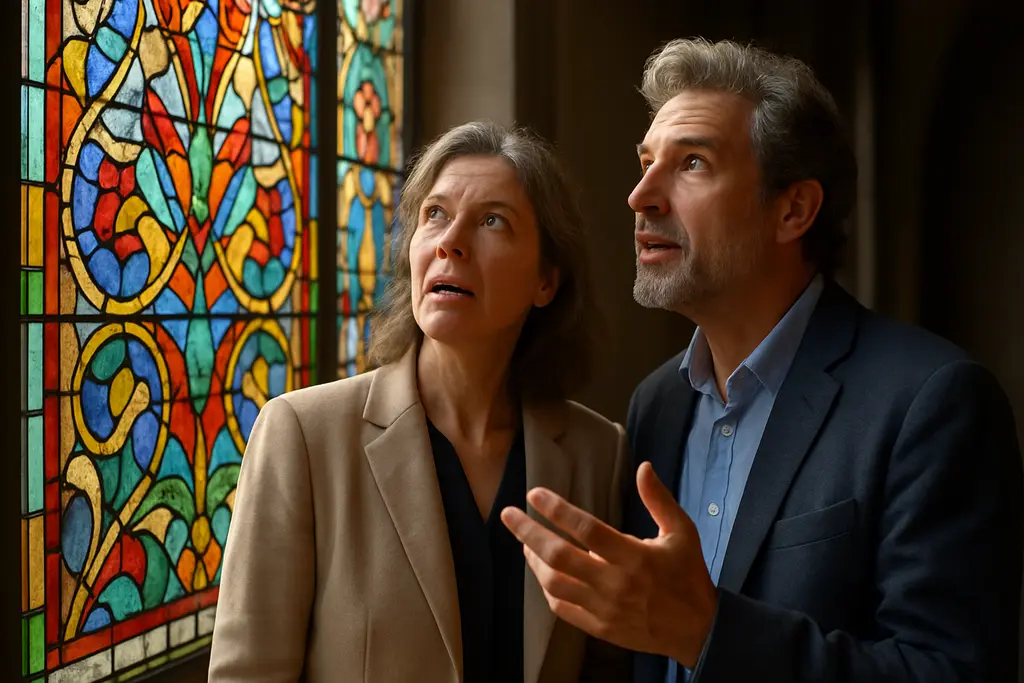
A major loan will be the stained-glass window Woman in a Pergola with Wisteria from 1911, from the Chrysler Museum of Art. The research notes state that it will be shown with its original wisteria transom panels, which were recently rediscovered in a private Arizona home. The Met’s announcement says this marks the first time in at least 50 years that the window and transoms have been reunited.
That kind of reunion is not merely a display event. It can affect how viewers understand scale, rhythm, and intended architectural setting. A panel separated from its related elements may still be beautiful, but the original ensemble can clarify how Tiffany Studios framed a scene, used repeated natural forms, and balanced vertical and horizontal components. For audiences, this can be a reminder that museum objects often arrive with interrupted histories.
What Conservation Changes For Viewers
The exhibition also draws attention to conservation and study. Many drawings described in the research have undergone recent conservation, which restored visual clarity and supported new scholarship. Because works on paper are sensitive to light and handling, their display tends to be limited. That scarcity can shape public memory: the objects most often seen are not always the objects most important for understanding process.
Conservation, in this context, is not just repair. It is a form of access. When drawings can be stabilized, examined, and safely shown, audiences gain a fuller sense of decision-making within the studio. The cautious point is that conservation does not automatically settle every authorship question or interpretive debate. It does, however, create better conditions for evidence-based looking.
Visitor Context At The Met Fifth Avenue

Dates, Galleries, And Admission
According to visitor information reported by Metropolitan Museum coverage, the special exhibition is included with regular Met admission. The listed admission prices are US$30 for adults, US$22 for seniors 65 and older, US$17 for students, and free admission for children 12 and under. The same source notes that The Met is closed on Wednesdays. Because pricing and hours can change, visitors should verify details directly with the museum before making plans.
- Exhibition dates: October 22, 2026 through February 7, 2027.
- Location: The Met Fifth Avenue, Galleries 691–693.
- Scope: nearly 120 works, including drawings, sketches, watercolors, and select loans.
- Status on October 12, 2026: not yet open to the public.
Permanent Displays That Add Context
The temporary exhibition can be read alongside related permanent displays at the museum. The research notes identify the Worsham-Rockefeller Dressing Room in Gallery 742 of the American Wing, an original room from 4 West 54th Street dated 1881–82. They also identify Tiffany objects in Gallery 743, including a table lamp from about 1895–98, and the exotic loggia from Laurelton Hall, Tiffany’s Long Island estate, around 1905, in Gallery 701.
These permanent displays are not described as part of the special exhibition, but they can deepen context for viewers who want to compare drawings, interiors, and completed objects. The distinction matters. A special exhibition can make a focused argument, while permanent galleries provide adjacent evidence. Holding those categories apart helps prevent overstatement while still encouraging a fuller museum visit. For readers who follow culture, public life, and arts coverage across our network, related civic arts writing can also be found at Kay Granger, a related site in the same network.
Designing the Gilded Age For Community Arts Readers
Designing the Gilded Age offers a promising case study in how museums can present decorative arts through labor, design practice, and attribution rather than spectacle alone. Its reported strengths are specific: a large group of drawings, a thematic structure tied to use, conservation-led access to fragile works, attention to underrecognized studio contributors, and the reunion of a major stained-glass window with its transoms.
For community arts organizers, the exhibition’s value may lie in how it reframes creativity as collective work. The Tiffany name remains central, but the studio record points toward many forms of expertise: drawing, patterning, glass selection, metalwork, presentation, and installation. That is a useful model for talking about art beyond the single-genius frame, especially in local cultural settings where collaboration often sustains the work audiences eventually see.
The strongest way to approach the show will be with attention to evidence. Look for what the drawings reveal, what labels attribute carefully, and where the museum signals uncertainty. If the exhibition succeeds on its own terms, it will not simply celebrate Gilded Age beauty. It will help viewers see how design ideas became objects, how studio labor shaped public taste, and why fragile paper records can change the way a community understands art history.