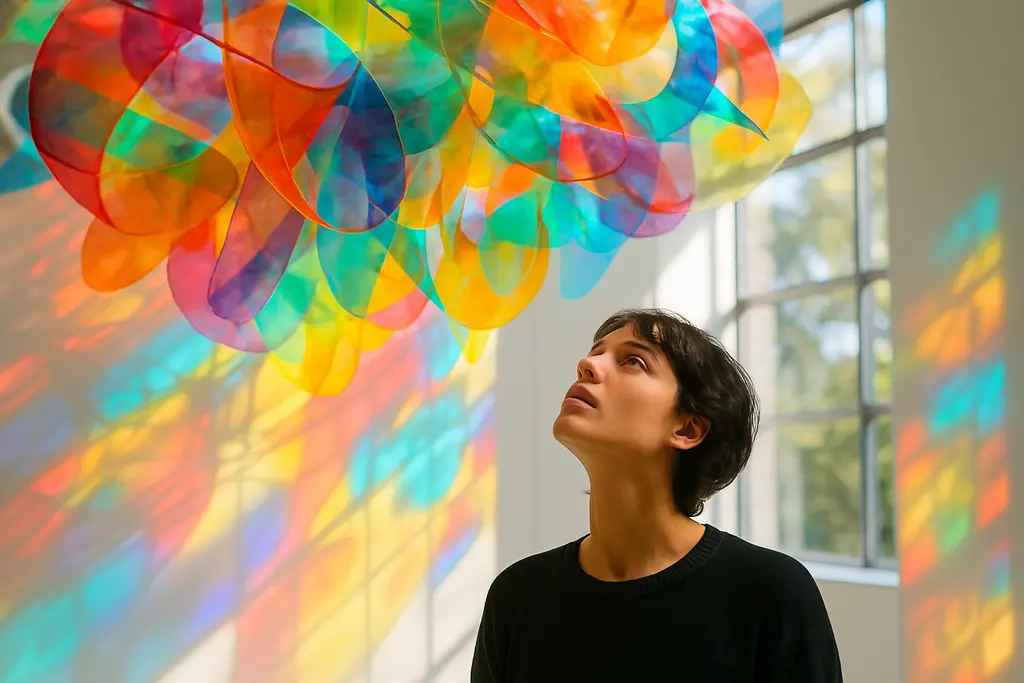
Sandra installations at Tanya Bonakdar Gallery ask for slow attention rather than quick categorization. Reading the Waves, on view in New York from September 10 to October 29, 2026, remained open as of October 20, 2026, according to Tanya Bonakdar Gallery. The exhibition is described in the research notes as Sandra Vásquez de la Horra’s first exhibition with the gallery in New York, and it brings together historical works from a career of nearly four decades with new pieces made on-site over the past month.
That timing matters because the show does not read as a single-room display of drawings alone. It is presented through placement, suspension, folding, scale, and orientation. Vásquez de la Horra’s works are primarily drawings using graphite, gouache, and watercolor on paper, often dipped in beeswax. The resulting sheets retain translucency, a quality that becomes central when the works are installed in space rather than held flat against a wall.
How Sandra installations Shape The Room
Sandra installations And The Chapel-Like Plan
The main gallery features monumental drawings arranged in a circular, chapel-like structure. The research notes state that the structure is aligned with the cardinal points and the sun. That description points toward an installation logic based on orientation, rhythm, and bodily movement. Viewers are not simply facing images; they are placed in relation to them. The circular plan invites comparison with ritual space, though any interpretation should stay close to what is documented: the exhibition draws on spiritual mythologies and includes references to Orisha, Andean, Yoruba, and Mapuche traditions.
In this sense, Sandra installations do not treat paper as fragile background support. Paper becomes an active spatial material. Beeswax changes the surface, while suspension changes how images meet light and air. A drawing can still function as an image, yet it also behaves as a threshold, veil, or membrane. That dual status is part of the show’s force: it keeps the medium intimate while expanding the room around it.
Water, Waves, Clouds, And Environmental Attention
The exhibition title, Reading the Waves, fits the documented motifs of water, waves, clouds, and environmental consciousness. These references should not be reduced to decoration. In the available description, they sit beside spiritual mythologies and indigenous knowledge, suggesting a mode of attention in which natural forms carry symbolic, ecological, and cosmological weight. The show’s imagery appears to join weather, bodies, land, and belief without forcing them into a single explanatory system.
Upstairs, suspended leporellos pay tribute to Yemanyá, identified in the research as an Orisha associated with ocean and rivers. The accordion-like format matters because a leporello can be extended, folded, hidden, and revealed. It resists a single fixed view. That physical structure suits a show concerned with waves and movement, where meaning seems to gather through sequence and return.
Materials, Wax, And Folded Paper
Drawing As Object, Image, And Offering
Vásquez de la Horra’s materials are modest in name but expansive in effect: graphite, gouache, watercolor, paper, and beeswax. None of those materials requires spectacle to carry presence. Wax has a long association with preservation, bodily warmth, ritual, and the softening of boundaries between surface and depth. In the exhibition, the research notes describe paper remaining translucent, which means light is not an afterthought. It participates in the viewing experience.
For readers interested in crossing between arts writing and civic-cultural coverage, exploring websites like Kay Granger might offer a related perspective, particularly within the same network.
Why Installation Changes The Drawings
One cautious way to read the show is to see it as a shift from drawing as isolated sheet to drawing as environment. That does not mean the individual image disappears. Rather, the installation design asks the viewer to weigh each work against spatial direction, adjacent forms, and the act of walking through the gallery. Sandra installations gain meaning from this tension between singular work and gathered structure.
The smaller galleries, according to the research notes, include plants and auras as dominant elements. Those motifs extend the show’s concern with life forces, perception, and atmosphere. The word “aura” can easily become vague in criticism, so here it is best handled descriptively: the works appear to address the space around bodies and beings, not only their outlines.
Works, Scale, And Institutional Context
Reading Sandra installations Through Scale
Several listed works give a sense of how scale operates in the exhibition. Los Hermafroditas from 2023 is listed at about 62 by 41.75 inches, while Volcánica from 2023 is about 80.1 by 51.75 inches. The Rainbow I Carry Within Me from 2026 is listed as four parts, each 118.1 by 47.25 inches, with a total size of about 118.1 by 188.9 inches, according to Daily Art Fair. These measurements help explain why the works can hold the room without abandoning the drawn line.
Scale also affects how a viewer encounters the body in the work. A sheet near human height may invite face-to-face reading. A multi-part work extending across a broad span asks for lateral movement. A suspended or folded work asks for time. In that way, the show’s surreal qualities are not only iconographic. They arise through bodily encounter, partial views, and shifting relations among image, paper, wax, and light.
Recognition Without Overstatement
The research notes place Vásquez de la Horra within a significant institutional frame. She was born in Viña del Mar, Chile, in 1967, lives and works in Berlin, and studied at Kunstakademie Düsseldorf and Kunsthochschule für Medien in Cologne. The notes also identify her as the recipient of the Käthe Kollwitz Prize in 2023, the Hans Theo Richter Prize in 2021, and the Guerlain Prize in 2019. Her work is listed as held in collections including MoMA in New York, Tate in London, Centre Pompidou in Paris, Pinakothek der Moderne in Munich, the Art Institute of Chicago, and the Philadelphia Museum of Art.
Recent exhibitions provide further context. Soy Energía at Haus der Kunst in Munich ran from November 14, 2025, to May 17, 2026. The Awake Volcanoes at ICA Los Angeles ran from October 11, 2025, to March 1, 2026. A solo exhibition at MALBA in Buenos Aires ran from April 11 to July 28, 2025. These dates show that Reading the Waves follows a period of substantial institutional presentation, though the available research does not include critical reviews of the Tanya Bonakdar show.
Sandra Vásquez de la Horra’s Reading The Waves
What Can Be Said With Care
The strongest supported reading of Reading the Waves is that it joins drawing, installation, mythic reference, and environmental imagery through a careful use of material and space. The exhibition’s chapel-like structure, suspended leporellos, waxed paper, and water-linked imagery give viewers several points of entry without requiring a single interpretation.
The best way to discuss Sandra installations is to respect both their visual intensity and their cultural references. Orisha, Andean, Yoruba, and Mapuche sources should not be treated as loose aesthetic labels. Based on the research provided, the exhibition frames them as part of a wider concern with spiritual knowledge, natural forces, and forms of seeing that exceed ordinary description. That is enough to make the show a serious case study in how drawing can occupy a gallery as image, object, and communal space for reflection.