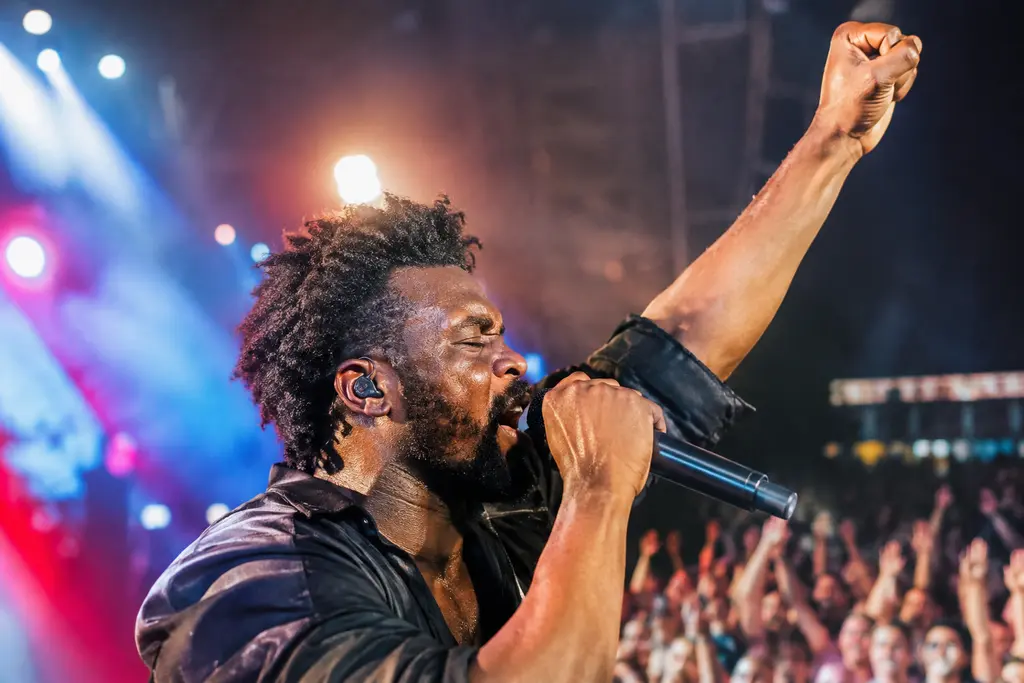
Protest Music Influence from the Power to the People Festival is best understood with some caution: one concert does not prove a new movement by itself. Still, the October 3, 2026 event gave a clear public example of how contemporary artists can use a festival stage to connect songs, memory, and civic action without separating art from community life.
The inaugural Power to the People Festival, curated by Tom Morello, was held on Saturday, October 3, 2026, at Merriweather Post Pavilion in Columbia, Maryland. The festival was described by its organizers as a one-day celebration of “peace, justice, solidarity, music and community action,” and the official announcement placed artists associated with several generations of political music in the same program, including Bruce Springsteen, Joan Baez, Public Enemy, Serj Tankian, The Linda Lindas, and The Neighborhood Kids festival announcement.
How Protest Music Influence Was Staged
The festival’s clearest cultural signal came from its structure. It did not treat protest music as a museum piece, nor did it frame younger artists as detached from earlier traditions. Instead, the event placed legacy performers and newer voices inside one shared program. That choice mattered because protest music often travels through reuse: songs are covered, lyrics are recontextualized, and performance settings change the meaning of familiar material.
Protest Music Influence Across Generations
Protest Music Influence at the festival showed up through proximity. The same bill could hold artists with long public associations with dissent and younger bands whose political language comes through punk, rock, and direct social critique. Based on the reported lineup, The Linda Lindas and The Neighborhood Kids appeared beside performers whose work has been tied for decades to anti-war, labor, civil-rights, or anti-authoritarian themes. That pairing did not prove a single lineage, but it made lineage visible.
For contemporary artists, that kind of bill can work as a public permission structure. It suggests that protest songs need not sound like one era, genre, or instrumentation. A punk song about racism and sexism, a hip-hop performance with direct political speech, and a folk-rock cover can all operate within the same civic frame. The lesson is less about copying a style and more about understanding how artists use form, audience, and timing to give songs public force.
Covers As Shared Civic Memory
Reported set choices also made historical memory part of the event’s method. The Washington Post reported performances and covers connected to Woody Guthrie, John Lennon, Creedence Clearwater Revival, and Bob Dylan, including “This Land Is Your Land,” “Power to the People,” “Deportees,” “Fortunate Son,” and “Chimes of Freedom.” The same report described political statements from the stage, Freedom Village spaces for civic engagement, and voter-registration appeals about one month before the 2026 U.S. midterm elections Washington Post report.
Covers can be artistically risky because they invite comparison with well-known recordings. At this festival, the reported function was not novelty alone. Familiar songs carried earlier struggles into a 2026 civic setting. That is one way protest music can remain active: not by freezing an older song in its original moment, but by asking whether its questions still fit a new public crisis or audience.
What Contemporary Artists Could Take From It
The event offered several observable strategies for artists working with political material. These strategies should not be treated as rules, since political art depends on context, audience trust, and the artist’s own relationship to the subject. Yet the festival did show how performance choices can carry meaning beyond a setlist.
Direct Speech Without Replacing The Song
One reported feature of the festival was the mixing of songs with direct political language. Grandson was reported to have sung the refrain “My president’s a felon,” while Killer Mike urged concertgoers to “vote locally in thirty days” and to hold elected officials accountable. Those statements show a performance model in which artists did not leave political meaning to inference alone.
For contemporary musicians, the artistic question is balance. Direct speech can sharpen a performance when it grows from the song’s concerns and the artist’s public commitments. It can also flatten the art if the music becomes merely a container for slogans. The strongest festival evidence points toward a combined method: songcraft, stage speech, and community infrastructure working together, each doing a different kind of cultural work.
Collaboration As A Public Method
The festival also used collaboration as a visible form of continuity. Reports described Dave Matthews joining Morello, Baez, and Nathaniel Rateliff for folk and rock classics, while Jack Black, performing as “Jack Sabbath,” took part in Black Sabbath covers with kids. These pairings matter because protest music often depends on transmission. A song moves from one singer to another, from one generation to another, and from one political setting to another.
That transmission has community value. Festivals can make artistic inheritance legible in real time: a younger listener hears an older song in a new arrangement; an older listener sees a newer artist carrying political urgency through a different sound. For readers interested in related coverage of cultural events and public life, our network also includes community arts writing at this related site.
Limits Of The Evidence
Any claim about influence needs boundaries. The available research supports the idea that the Power to the People Festival gave protest music a major public platform on October 3, 2026. It also supports that artists used covers, direct statements, cross-generational collaborations, and civic-action spaces. It does not, from the information provided here, prove measurable changes in streaming numbers, chart performance, songwriting trends, or audience behavior after the event.
Visibility Is Not The Same As Measured Impact
Media coverage and a sold-out event can point to visibility, but visibility is not the same as demonstrated influence. To measure post-festival effects, researchers would need reliable data from streaming services, ticketing records, surveys, chart movement, publishing activity, or interviews with artists about work made after October 3, 2026. Without those materials, the safer claim is that the festival modeled a public-facing approach to protest music rather than proving a broad industry shift.
That caution does not weaken the cultural reading. In arts criticism, influence can be discussed at several levels. There is direct influence, where an artist names a work or event as a source. There is institutional influence, where festivals, venues, and curators create platforms that make certain approaches more visible. There is also community influence, where audiences encounter artistic traditions together and carry those references into local conversations. The evidence here is strongest for the second and third categories.
NextClues has also examined how performance, nonprofits, and voting appeals shaped civic meaning in political messages in music at the same festival. Read alongside the present analysis, that angle reinforces a careful point: the event’s artistic influence cannot be separated from its civic design.
Power To The People Festival And Protest Music Influence
The strongest reading of the Power to the People Festival is that it treated protest music as a living practice. On October 3, 2026, artists did not only revisit famous songs; they placed those songs beside new voices, spoken appeals, community organizations, and collaborations across age and genre. That combination gave contemporary artists a visible example of how protest performance can work on more than one level.
A Community Reading Of The Night
From a community arts perspective, the festival’s value lies in its mix of sound and civic gathering. Freedom Village, voter-registration appeals, and nonprofit spaces meant the event was not only a concert program. It was also a site where music and public participation were placed side by side. That design matters for artists who want their work to meet people where they gather, not only where they stream or buy recordings.
Protest Music Influence after the festival should therefore be described with both respect and restraint. The event offered a vivid public case study in how contemporary artists can borrow from older protest traditions, adapt them to present concerns, and share the stage with community action. What remains uncertain is how far that influence will travel in recorded music, touring practices, or local organizing beyond the festival date. The supported takeaway is still meaningful: on October 3, 2026, protest music was presented not as nostalgia alone, but as an active artistic and civic method.