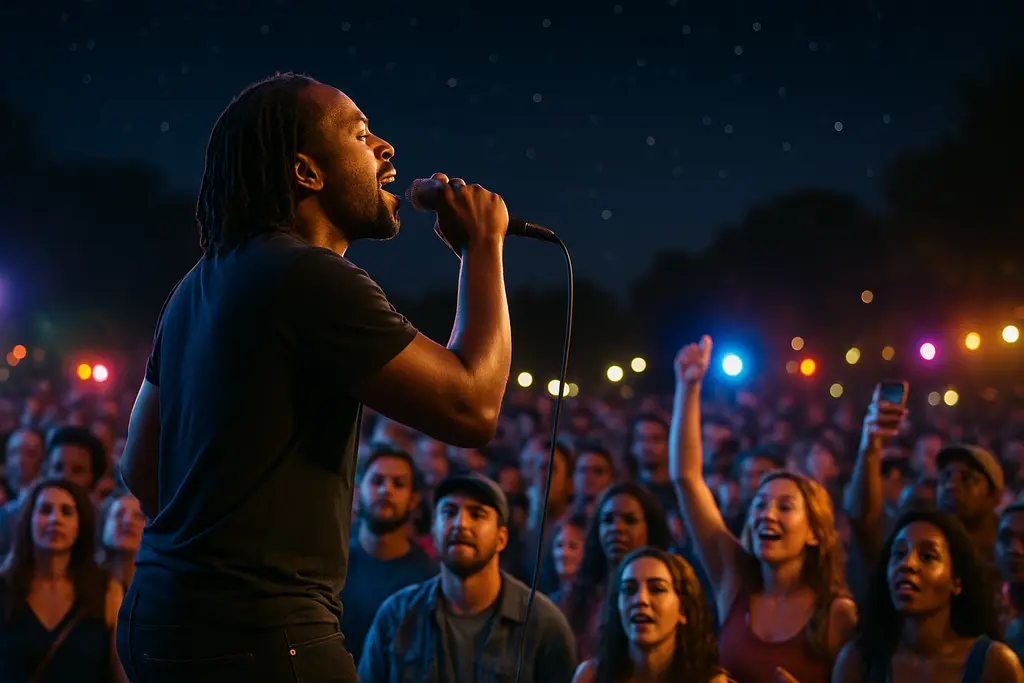
Political Messages in Music at the Power to the People Festival were not a side feature of the event; they were part of its stated design. The one-day, two-stage festival took place on October 3, 2026, at Merriweather Post Pavilion in Columbia, Maryland, one month before the U.S. midterm elections. That date matters because the event linked performance, voter participation, and community action rather than treating music as separate from public life.
The festival was organized by Tom Morello, the Rage Against the Machine guitarist whose public work has often connected rock performance with labor, antiwar, and civil rights themes. Reporting before the event noted that Morello’s festival was bringing artists including Bruce Springsteen and Foo Fighters to the Washington, D.C., area, with the event framed around political urgency and collective response The Washington Post. After the event, the clearest reading was not that every performer made the same argument, but that the festival gave artists a shared civic frame.
Why The Festival Made Civic Speech Audible
A Date That Carried Electoral Pressure
The October 3, 2026, timing placed the festival close enough to the midterm elections that voter participation was not an abstract theme. The Jamaica Gleaner reported that the event promoted “peace, justice, solidarity, music and community action,” with an explicit goal of increasing voter turnout, and that a portion of ticket proceeds was pledged to VoteRiders and HeadCount Jamaica Gleaner. Those details give the event a measurable civic structure: not only songs and speeches, but also named organizations connected to voting access and turnout.
That structure is useful for analysis because it limits overstatement. A festival cannot be assumed to change an election simply because it takes place near one. The supported claim is narrower and stronger: the organizers placed voter engagement inside the cultural program and tied part of the event’s economic activity to organizations working on election participation. For community arts observers, that is a meaningful design choice.
Community Framing Rather Than Campaign Branding
The reported language of “peace, justice, solidarity, music and community action” set a broad civic frame rather than a single-candidate campaign frame. That distinction matters. Political art can endorse a policy, condemn an abuse, honor a movement, challenge state power, or ask people to vote; those are related but not identical acts. The Power to the People Festival appeared to gather several of those forms in one setting.
As a community event, it also blurred the line between stage and gathering space. The music supplied emotional force, while the civic organizations supplied a practical route for audience members who wanted to act beyond applause. A cautious reading would not assume what every attendee did afterward. It can say, based on the reported format, that the event reduced the distance between cultural participation and civic participation.
How Political Messages in Music Moved Onstage
Political Messages in Music As Direct Address
One of the most direct examples came from Killer Mike. During his set, he urged the audience to vote locally in thirty days and to hold elected officials accountable, adding that the republic is run by the people. The wording, as reported, placed responsibility on both the act of voting and the longer work of public accountability. That is a sharper message than a generic request to participate, because it joins electoral action to post-election scrutiny.
From an arts perspective, such speech changes the function of the set. The performer is not only presenting songs; he is using the shared attention of a live audience to define citizenship as a continuing practice. That does not make the moment neutral, and it was not presented as neutral. It does show how live music can host civic instruction without becoming a lecture hall. Rhythm, crowd response, and reputation all shape how the message lands.
Lineups As Signals Of Shared Values
The reported lineup included major artists from rock, folk, hip-hop, punk, and related traditions. Bruce Springsteen, Foo Fighters, Dave Matthews, Joan Baez, Brittany Howard, Killer Mike, Dropkick Murphys, Jack Black, Serj Tankian, and the Linda Lindas were among the names listed in research on the event. That range matters less as a genre survey than as a coalition signal. Each artist brings a different audience memory: protest folk, arena rock, rap activism, punk defiance, or youth-centered guitar music.
Political Messages in Music often depend on that memory. A song may carry meaning because of its lyrics, but a performer’s public identity and the audience’s prior knowledge also shape reception. Joan Baez’s presence, for instance, evokes decades of protest-song association. Killer Mike’s remarks draw on his long public profile as a politically engaged artist. Morello’s role as organizer gives the festival a clear link to rock’s confrontational activist strain. These associations are interpretive, so they should be handled with care, but they help explain why a mixed-genre lineup can still feel politically coherent.
Community Action Beside The Stages
Nonprofits As Part Of The Event Design
The festival’s civic emphasis did not rest only on speeches from performers. Research on the event described a Freedom Village area with nonprofit and activist organizations, including groups such as the ACLU, Farm Aid, National Domestic Workers Alliance, and Oxfam. In a festival setting, that kind of space can turn waiting time, walking time, and social time into moments of contact with public-interest organizations.
That does not mean every booth produced a lasting commitment. Community organizers know that an information table can be meaningful for one person and invisible to another. Still, placing organizations inside a music event changes the terms of encounter. Someone who did not plan to attend a civic meeting may still speak with an organizer, pick up voter information, or learn the name of a group working on labor, civil liberties, food systems, or global poverty.
The Audience As A Visible Civic Body
Research also noted that audience members wore shirts with messages such as “Immigrants Make America Great,” “Bring on the Matriarchy,” and “No one is illegal on stolen land.” Clothing at concerts is not formal policy speech, but it is part of the visual culture of public assembly. It tells other attendees what concerns are present in the crowd and can help people recognize allies, tensions, or shared commitments.
Political Messages in Music also appeared through this audience layer. A festival audience is never a single mind, and it would be careless to claim total agreement among attendees. Yet visible slogans, nonprofit booths, and artist speeches together created a setting where civic identity was displayed as much as it was spoken. For readers comparing event design across music culture, our related analysis of political music at Daisy Chain offers another example of how performance spaces can organize public meaning.
Artistic Risk, Rights, And Public Meaning
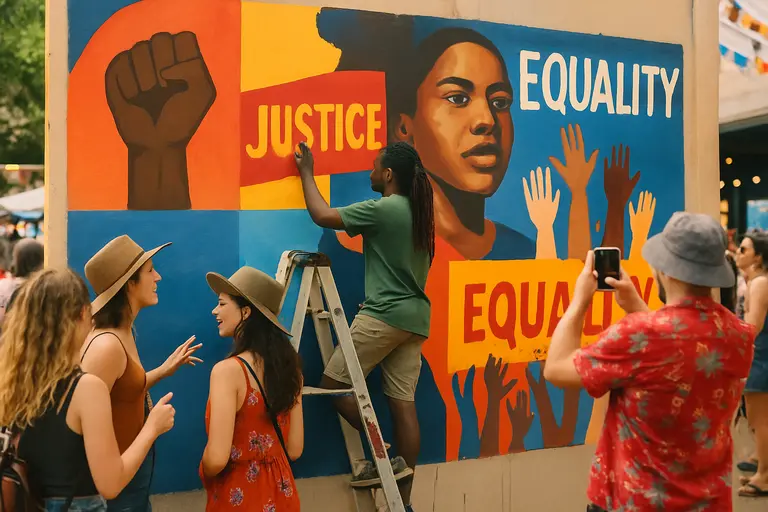
Protest Performance Needs Careful Reading
Politically charged festivals invite strong reactions because they compress art, identity, and public conflict into a few hours. That is part of their power, but it is also why evidence matters. A responsible analysis should separate documented statements from assumed motives. If a performer calls for voting, that can be reported. If an audience member wears a slogan, that can be described. Claims about broader public opinion, electoral impact, or national mood require data that was not included in the available research.
This caution is not a retreat from interpretation. It is what makes interpretation fair to artists and communities. The supported evidence shows that the Power to the People Festival joined music with voter participation, nonprofit presence, and anti-authoritarian language. It does not prove how every listener understood those messages, nor does it establish any single political outcome.
Community Networks Extend The Conversation
Music events rarely end at the venue gate. Reviews, neighborhood conversations, artist interviews, organizer follow-ups, and community media all shape what remains after the final song. Sites in related cultural networks, including Robsonic, provide an ongoing dialogue about how music interacts with public life, offering deeper insights without reducing artists to slogans.
That extended conversation should respect both the craft and the cause. Protest music is still music: arrangement, pacing, voice, collaboration, and stagecraft affect how the message is heard. Community action is still action: voter access, labor advocacy, civil liberties work, and mutual aid require structures beyond symbolic performance. The festival’s significance sits in the meeting point between those two forms of work.
Political Messages in Music At Power To The People
Political Messages in Music worked at the Power to the People Festival through timing, lineup, speech, organizational partnerships, and audience display. The event took place close to the November 2026 midterms, named voter turnout as a goal, directed a portion of ticket proceeds to voting-focused nonprofits, and gave performers room to speak directly about public accountability.
The most defensible reading is that the festival treated music as a civic gathering practice. It did not merely present artists who happen to hold political views; it arranged a public event around the idea that songs, speeches, booths, and shared presence can push people toward participation. That is not proof of electoral effect. It is evidence of cultural intent, and for community arts coverage, that intent is worth taking seriously.