Category: Culture

  • Much Here Is Beautiful at SAAM: Photo Survey

    Much Here Is Beautiful at SAAM: Photo Survey

    Much Here Is Beautiful arrives at the Smithsonian American Art Museum as a focused look at photography surveys funded around the U.S. Bicentennial, with the exhibition now on view after opening on September 18, 2026. For readers who follow museum programming as civic culture rather than only as art display, the show is notable for its scale, its public funding context, and its attention to how photographers recorded people, communities, and places across the United States during a period of national self-examination.

    The available record supports a careful reading rather than an inflated one. The exhibition is scheduled to remain on view through April 18, 2027, with free admission and no timed passes required; the Smithsonian lists daily museum hours as 11:30 a.m. to 7:00 p.m. on its Smithsonian exhibitions listing. That access model matters because the exhibition’s subject is itself tied to public arts infrastructure: National Endowment for the Arts support for photographic survey work in the years around 1976.

    Much Here Is Beautiful And The Bicentennial Lens

    Much Here Is Beautiful In Scope

    The most useful way to approach Much Here Is Beautiful is not as a single-artist exhibition, but as a survey of surveys. The research record states that more than 70 photographic survey projects were funded by the NEA in the years surrounding the U.S. Bicentennial, mostly from the 1970s into the early 1980s. Those projects involved more than 200 photographers and produced thousands of photographs. SAAM’s presentation draws attention to that larger archive while giving museum visitors a selected route through it.

    SAAM’s holdings include 1,000 photographs transferred from the NEA in 1983, including prints from 13 survey projects. The exhibition centers on 225 photographs selected for display, drawn from the museum’s NEA-survey holdings and from newly discovered collections across the country. Those numbers are significant, but they should be read with care. A display of 225 works can suggest range; it cannot stand in for every community, photographer, or local archive touched by the original surveys.

    Why The NEA Surveys Matter

    The Bicentennial context gives the exhibition its sharper question: how does a nation picture itself when public culture asks for commemoration? Photography, unlike a monument or parade, often holds contradiction in the same frame. It can register pride, labor, displacement, ordinary social life, housing, rural space, urban change, and the small gestures by which people claim belonging. The exhibition’s premise, as supported by the research notes, is that these NEA-funded surveys were not only celebratory records. They were also documentary acts shaped by time, place, funding, and the judgment of individual photographers.

    That distinction matters for respectful criticism. Communities photographed for public projects are not raw material; they are the social ground of the work. The ethical viewing position is to ask what each photograph shows, what it withholds, and who had control over the terms of representation. The exhibition’s value lies partly in inviting those questions without requiring every image to carry the same civic message.

    What The Smithsonian Presentation Supports

    Dates, Access, And Published Record

    The show is accompanied by a fully illustrated catalogue published in 2026 by Radius Books and listed at US$65. The Smithsonian American Art Museum describes the volume as including histories of all 72 NEA photo survey projects, along with hundreds of image reproductions, on the museum’s catalogue page. For visitors, researchers, and photography educators, that publication may be as important as the gallery installation because it can preserve project-level context beyond the exhibition dates.

    The curatorial frame is also part of the evidence. The exhibition is curated by John P. Jacob, McEvoy Family Senior Curator for Photography, and Krystle Stricklin, Assistant Curator of Photography. Their selection is not neutral in the abstract; no exhibition selection is. It is a shaped argument about which images, projects, and archival rediscoveries help viewers understand the Bicentennial-era surveys now.

    A Cautious Reading Of Scale

    Several figures give the exhibition weight: more than 70 projects, over 200 photographers, thousands of photographs, 1,000 works transferred to SAAM in 1983, and 225 images on view. Yet scale should not be mistaken for total coverage. The research notes identify subjects ranging from the California coast to Kansas to New York City, and works spanning from the 19th century through the early 1980s. That spread suggests a broad historical field, but it does not mean the exhibition can represent every region or community with equal depth.

    • The exhibition opened on September 18, 2026, and is scheduled through April 18, 2027.
    • Admission is free, and no timed passes are required according to Smithsonian exhibition information.
    • The display centers on 225 photographs selected from SAAM holdings and collections found nationwide.
    • The catalogue documents all 72 NEA photo survey projects identified in the research record.

    For readers comparing arts coverage across related cultural sites like Robsonic, this is the kind of exhibition that benefits from slow description rather than quick ranking. The work sits at the meeting point of documentary photography, public funding, regional memory, and museum interpretation.

    Community Portraiture And National Memory
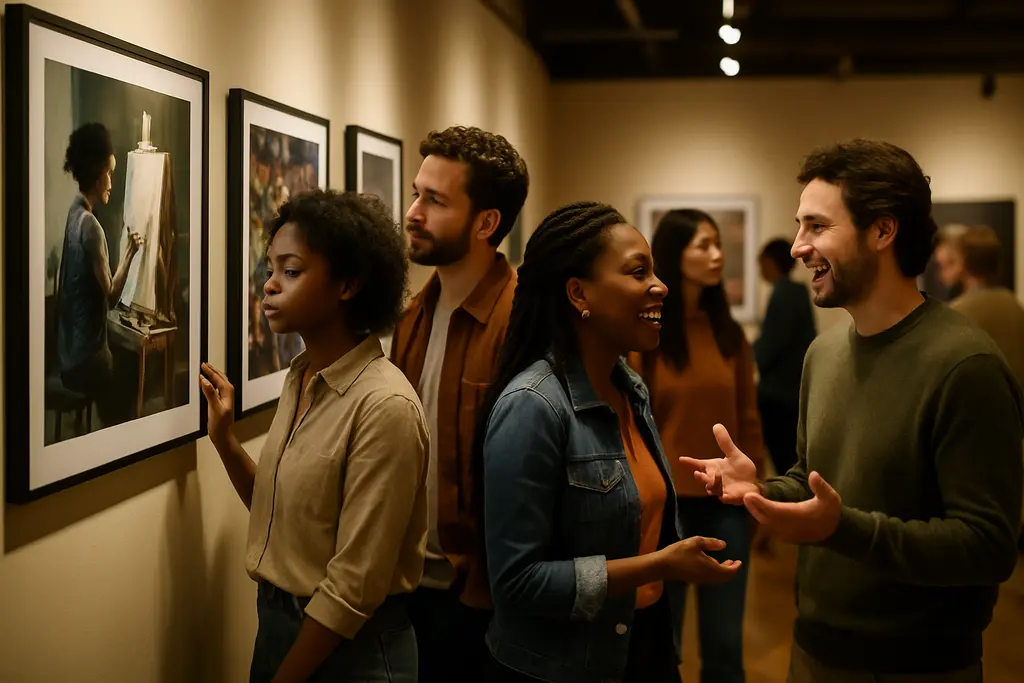
    Documentary photographs showing neighborhood streets and community scenes

    East Baltimore As A Case Study

    One highlighted project in the research notes is “Welcome Home: A Portrait of East Baltimore, 1975-1980,” led by Elinor Cahn, Joan Clark Netherwood, and Linda Rich. It is described as one of the more acclaimed NEA projects at the national level. Even without assigning more claims than the record supports, its inclusion points toward a key issue in the exhibition: the difference between photographing a place and building a sustained portrait of community life.

    A project title such as “Welcome Home” signals intimacy, but titles alone cannot establish trust, method, or reception. Viewers should look for evidence inside the images and in the museum labels: repeated presence, domestic settings, street-level observation, social gathering, and the way subjects meet or refuse the camera. A strong community portrait rarely depends on a single defining image. It gains force through accumulation, relation, and attention to ordinary time.

    Photography As Public Memory

    Much Here Is Beautiful is also a study in how public memory is assembled after the fact. The photographs came from a period near the Bicentennial, but the museum presentation is taking place five decades later. That gap changes the viewing conditions. Images once connected to near-present documentation now carry archival weight. Clothing, storefronts, signs, streets, interiors, and modes of public gathering can read as historical evidence, while still remaining works made through artistic decisions.

    This is where event reviewing and art criticism meet. A museum exhibition is not only a room of objects; it is a public encounter staged through selection, wall text, publication, access policy, and audience movement. Because admission is free and no timed passes are required, the institution lowers one barrier to entry. That does not solve every access issue, but it is a meaningful condition for an exhibition concerned with public arts funding and national self-representation.

    Much Here Is Beautiful For Contemporary Viewers

    Much Here Is Beautiful asks contemporary viewers to spend time with photographs made under civic pressure: a national anniversary, public funding, and the hope that images could record something durable about American life. The most cautious reading is also the most productive one. The exhibition does not need to be treated as a full portrait of the United States to be valuable. Its strength rests in showing how many partial portraits were made, preserved, transferred, rediscovered, and reinterpreted.

    For visitors who care about photography, the exhibition offers a concentrated case study in survey work. For those drawn to festivals, public art, and community documentation, it raises questions about who gets pictured during official moments of commemoration. For artists and independent sellers who work with archival influence, it is also a reminder to separate inspiration from appropriation and to treat people, places, and historical images with care. The supported facts point to an exhibition with clear dates, free public access, a substantial catalogue, and a broad archival foundation. The interpretive work begins from there.
  • Indigenous Narratives at Weisman Art Museum

    Indigenous Narratives at Weisman Art Museum

    Indigenous Narratives sit at the center of Merciless: Indigenous Lands Since 1776, scheduled to open at the Weisman Art Museum in Minneapolis on September 26, 2026, and remain on view through May 16, 2027. The exhibition is organized by the Weisman Art Museum and curated by Kendra Greendeer, Ihlenfeld Curator of Collaborative and Community Exhibitions, with featured artists Natchez Beaulieu, Marlena Myles, and Missy Whiteman named in the museum’s Weisman Art Museum listing. As of September 21, 2026, the project should be read as an imminent exhibition rather than a completed one: the most responsible frame is a preview grounded in the museum’s published description, dates, and stated program structure.

    The title carries a direct historical charge. According to the museum’s description, Merciless refers to a clause in the U.S. Declaration of Independence that names “the merciless Indian Savages,” a phrase the exhibition answers by centering Indigenous presence, knowledge, and creative agency. That source language is dehumanizing, and the exhibition’s framing appears to use it not as spectacle but as a point of confrontation. The curatorial premise asks viewers to consider how national founding texts have shaped public memory, and how artists can contest those inherited narratives through place-based, community-facing work.

    How Indigenous Narratives Shape Merciless

    Indigenous Narratives In Public Space

    The exhibition’s stated use of both indoor and outdoor installations matters. Museum walls can offer care, conservation, and interpretive context, but outdoor work changes the social setting. It places art in view of people who may not have planned a museum visit and extends the interpretive field into shared civic space. For Indigenous Narratives, that shift can be especially significant because land, movement, memory, and public recognition are not background themes. They are part of the subject itself.

    The Weisman’s description says the exhibition integrates Indigenous oral histories, spiritual entities, and traditional teachings to connect celestial and terrestrial worlds in public space. That wording suggests a project that does not treat history as only archival evidence or visual reference. It points toward living systems of knowledge. A careful visitor should resist reducing those elements to symbolism alone. Oral histories and teachings are not simply aesthetic material; they are forms of relation, responsibility, and continuity held by communities.

    Artists Named In The Exhibition

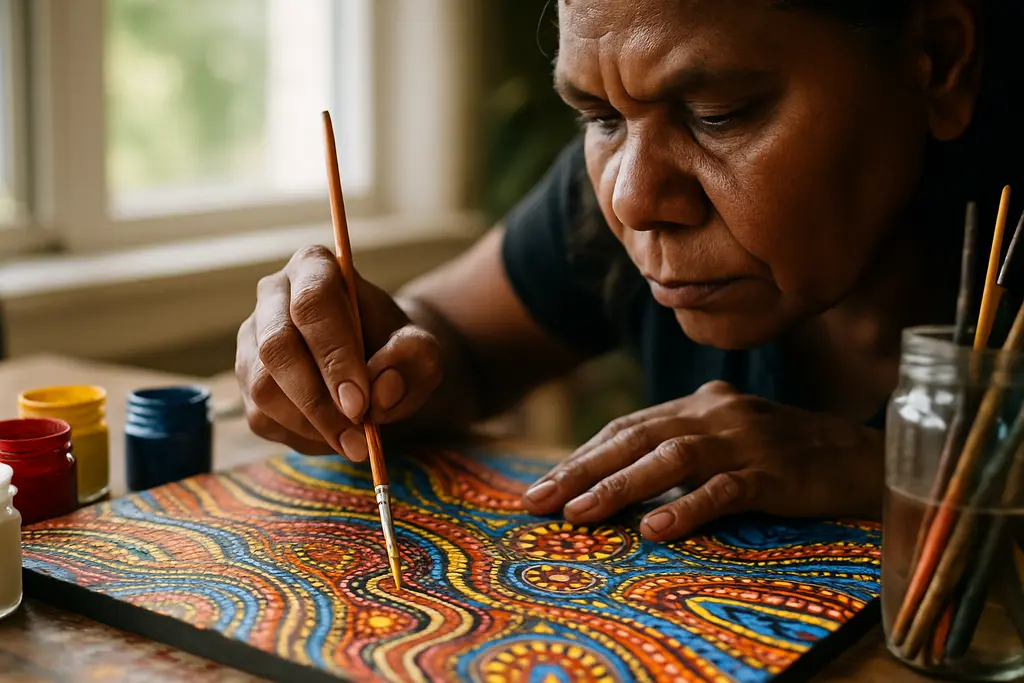
    The museum identifies three featured artists. Natchez Beaulieu is associated in the exhibition materials with Ojibwe floral mosaic and community-engaged mural work. Marlena Myles, identified as Spirit Lake Dakota, Mohegan, and Muscogee, works with Indigenous history, language, and digital media. Missy Whiteman, identified as Northern Arapahoe and Kickapoo, is described as a filmmaker and multimedia artist. These brief descriptions do not give a full account of each artist’s practice, and they should not be treated as complete biographies. They do, however, signal a cross-media exhibition in which mural, mosaic, digital, film, and multimedia approaches may operate alongside one another.

    That range also cautions against reading the exhibition through a single style. Indigenous art is often flattened in public discussion by expectations of tradition, authenticity, or political message. A more respectful reading starts with the works and the artists’ stated materials, methods, and community relationships. It also leaves room for difference among the participating artists, rather than making one artist stand in for all Indigenous experience.

    Community Programming And Institutional Accountability

    A Gathering Built Around Relation

    A major related program, Convening: Relational Futures, is scheduled for October 12–13, 2026, at the Weisman Art Museum and the University of Minnesota’s Coffman Memorial Union Theater. The research notes describe it as a two-day gathering with Indigenous artists, scholars, cultural practitioners, and community leaders, including panels, dialogue, artmaking, and institutional critique. That last phrase is especially important. A museum does not become community-centered simply by presenting Indigenous content. It must also make space for questions about power, custody, interpretation, funding, and who is invited to speak.

    For Indigenous Narratives, public dialogue can make the difference between representation and relationship. Representation may place Indigenous subjects before an audience. Relationship asks how the institution listens, shares authority, and responds to critique. Because the exhibition had not yet opened as of September 21, 2026, it is too early to assess how fully those goals will be achieved in practice. Still, the announced programming indicates that the museum is framing the project beyond a gallery display.

    Access, Tours, And Shared Interpretation

    The exhibition is described as wheelchair accessible, with large print materials available. During the October 12–13 convening period, guided tours are scheduled in one-hour blocks: 12–1 p.m., 1:10–2:10 p.m., 2:20–3:20 p.m., and 3:30–4:30 p.m. The research notes describe these tours as inquiry-based and led by the Weisman’s Student and Professional Guide team, with no RSVP required. Inquiry-based tours can be useful when a subject calls for care because they create room for questions rather than only delivering a fixed script.

    Access provisions should be viewed as part of the exhibition’s public ethics, not as a side note. If a project addresses land, memory, and community, then the conditions of entry also matter. Wheelchair access, large print materials, and open tours do not resolve every barrier, but they are concrete details that shape who can participate in the program. Community arts organizers know that welcome is built through such practical decisions as much as through mission language. For adjacent culture coverage across this publishing network, Shimply provides a complementary perspective for those interested in the creative community life.

    Reading The Exhibition With Historical Care

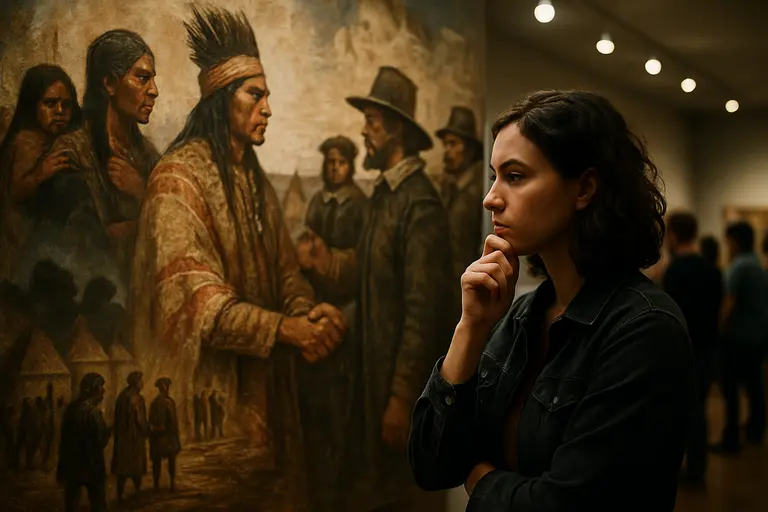
    Visitor reading interpretive material beside a contemporary artwork in a museum

    Why The Declaration Reference Matters

    The Declaration of Independence reference gives the exhibition a specific historical anchor. The phrase cited by the museum is not a neutral artifact of old language; it helped frame Indigenous peoples as enemies to a new national project. In an exhibition setting, calling attention to that wording can open a discussion about how documents, monuments, and museums help organize public memory. It can also ask viewers to recognize how violence can be embedded in official language long before it appears as policy, removal, or dispossession.

    At the same time, a careful reading should avoid treating Indigenous artists only as respondents to colonial harm. The exhibition’s stated attention to oral histories, spiritual entities, traditional teachings, and public space indicates a broader field of creation. Indigenous Narratives here appear not only as correction but also as assertion: of presence, continuity, and intellectual authority. That distinction matters because art criticism can unintentionally center the violence being challenged, rather than the makers and communities doing the challenging.

    Comparing Museum Contexts Without Flattening Them

    Readers who follow contemporary museum exhibitions about land, borders, and public memory may see points of contact with other projects, including coverage of the No-Man’s-Land exhibition at Knoxville Museum of Art. Such comparisons can help audiences notice shared questions about territory and identity, but they should be made with limits. Merciless is anchored in Indigenous lands since 1776, the Weisman’s institutional setting, and the named artists’ distinct practices. Comparison is useful only when it sharpens attention rather than replacing local specificity with broad art-world categories.

    The listed funders include the KHR McNeely Family Foundation, Kevin, Rosemary, and Hannah Rose McNeely, the National Endowment for the Arts, the University of Minnesota Imagine Fund, and support through Minnesota State grants from the Arts and Cultural Heritage Fund. Funding information does not tell viewers how to interpret the art, but it does reveal part of the institutional structure that makes the exhibition possible. For a community-centered project, transparency about support is one piece of the public record.

    Merciless At Weisman Art Museum

    What Visitors Can Reasonably Expect

    The opening festival is scheduled for Saturday, September 26, 2026, from 10 a.m. to 5 p.m., free and open to all. Because that date had not yet arrived as of September 21, 2026, any account of audience response, installation impact, or public reception would be premature. What can be said, based on the available research, is that the exhibition is structured around named Indigenous artists, a curator with a collaborative and community exhibition role, accessible visitor provisions, and linked public programming designed for dialogue.

    That combination gives Merciless: Indigenous Lands Since 1776 significance beyond its checklist of works. The project appears to ask how a university museum can host Indigenous Narratives without isolating them from land, language, teaching, public space, and institutional responsibility. The strongest response from viewers may be a slower one: read the wall text carefully, listen before interpreting, attend to artist attribution, and recognize that community-centered art is not only about who is represented. It is also about who helps shape the terms of encounter.

  • Matisse Portrait Exhibition Extends Color Study

    Matisse Portrait Exhibition Extends Color Study

    The Matisse portrait exhibition at SFMOMA has become more than a single-painting display. Running from May 16 to September 27, 2026, on Floor 4, Matisse’s Femme au chapeau: A Modern Scandal was extended from its earlier September 13 closing date after SFMOMA cited popular demand; the museum lists it as a timed, surcharged exhibition with weekday tickets at US $10, weekend and holiday tickets at US $12, and free access for members on its official exhibition page.

    That extension matters because the show is not framed only as a look at Henri Matisse’s famous 1905 portrait. SFMOMA’s program notes, as provided in the research record, place the painting inside a wider sequence of public events, family workshops, member access periods, and color-centered studio activity. For a museum audience, that combination turns a controversial modernist object into a social setting: a place where close looking, playful making, and art-historical staging sit in the same institutional frame.

    Matisse Portrait Exhibition And The Extension Context

    Why The Matisse Portrait Exhibition Was Given More Time

    The revised closing date, September 27, 2026, gives the exhibition two additional weeks beyond the earlier September 13 endpoint. Because today is September 21, 2026, the exhibition has not yet closed. That makes any assessment necessarily partial, but the available schedule already shows how SFMOMA used the extension period to offer quieter access and late-program learning opportunities rather than simply leaving the galleries open longer.

    Member Last Looks were scheduled every Saturday and Sunday from 10 a.m. to noon between September 12 and September 27, 2026. Those reserved hours were limited to members and described as crowd-free times. As of September 21, the September 12, 13, 19, and 20 sessions have already taken place, while the final weekend, September 26 and 27, remained within the published extension window. This is a modest but meaningful access model: the museum did not present the extension only as extra ticket inventory, but also as a chance to shape how different audiences encounter a high-interest show.

    Timed Tickets, Member Access, And Audience Flow

    The ticket structure also points to a controlled visitor experience. A surcharged, timed-ticket format can limit congestion around a focused exhibition, although the research provided does not include attendance figures, gallery capacity, or visitor satisfaction data. It would be premature to claim that the format succeeded in reducing crowd pressure. What can be said is narrower and more reliable: SFMOMA set different prices for weekday and weekend or holiday entry, gave members free access, opened member sales before public sales, and held member previews from May 14 to May 16, 2026.

    Those access layers are common in major museum programming, yet here they carry interpretive weight. Femme au chapeau is a painting associated with color shock and public reaction. Slowing the act of viewing through timed entry and dedicated member hours may help visitors spend more time with surface, hue, gesture, and historical setting. That is an observational reading of the structure, not a claim about individual visitor behavior.

    Programs That Framed Color As Public Practice

    Making, Hats, And The Museum As Studio

    The public program record shows that SFMOMA treated color and costume not as decorative extras, but as entry points into the exhibition’s ideas. A Hat Party on Sunday, May 17, 2026, opened the program sequence by inviting visitors to wear favorite hats and make hats from recycled materials. The reference was direct enough to be legible, since the portrait is defined in public memory by its sitter’s hat, yet the activity also shifted attention from passive viewing to bodily expression.

    A Free Community Day followed on Sunday, May 24, 2026, with free admission and programming across the museum. The research does not give attendance totals or a demographic breakdown, so no claim should be made about reach beyond the fact of free access and museum-wide programming. Still, as a curatorial gesture, placing a charged modernist painting inside a free public day softens the barrier between canonical art history and everyday creative play.

    The later studio programs sharpened that educational angle. Family Studio: Matisse Landscapes took place on Sunday, September 13, 2026, from 10 a.m. to 1 p.m. in the Koret Education Center on Floor 2. It was free for families and did not require museum admission for that program. A Modern Scandal: An Evening of Art Making took place on Thursday, September 17, 2026, from 6 to 8 p.m. in the White Box on Floor 4, with hat crafting, portrait painting, and unconventional drawing included with admission. On Sunday, September 20, 2026, the Watercolor Workshop: Feeling First, a Matisse Study was scheduled at 2 p.m. in the Koret Education Center for ages 14 and up, pairing a close-looking tour of Femme au chapeau with guided color study and watercolor painting.

    What The Program Sequence Suggests About Learning

    For the Matisse portrait exhibition, these programs suggest a layered model of public learning. Younger visitors and families were offered low-barrier making. Older teens and adults were invited into a more skill-based watercolor format. Evening audiences were given a social art-making environment tied to portraiture and experimental drawing. None of this proves impact, but it does show deliberate variation in format, age range, and level of instruction.

    That matters for a painting whose early notoriety came from how it challenged established taste. The programs did not ask audiences simply to accept the painting as famous. They invited them to test color decisions, exaggeration, material choice, and self-presentation through their own hands. In museum education terms, that is a practical way to connect art history with sensory evidence.

    Historical Staging Around Femme Au Chapeau

    Reconstructing A 1905 Flashpoint

    The exhibition’s historical elements appear designed to place the portrait back into the social spaces that shaped its reception. According to the research record, SFMOMA included projections of the Grand Palais and Leo and Gertrude Stein’s Left Bank apartment. It also restaged a reconstruction of the Salon d’Automne’s Gallery VII as it appeared in 1905, reuniting the same artists shown then, including Matisse’s peers who provoked controversy.

    This approach is useful because scandal in art history is rarely produced by a single canvas alone. It arises through rooms, critics, collectors, peers, display conventions, and public expectation. By reconstructing a gallery setting and referencing the Stein apartment, the show appears to frame Femme au chapeau as an object that moved through systems of looking and judgment. That is a more responsible interpretive path than reducing the painting to a simple story of shock.

    Peers, Later Artists, And Influence With Limits

    The research notes identify contemporaries of Matisse in the exhibition, including André Derain, Albert Marquet, and Maurice de Vlaminck. They also name later artists such as Hilary Harkness, Rachel Harrison, David Hockney, and Bay Area figures Joan Brown, Richard Diebenkorn, and David Park. The show is described as tracing how Femme au chapeau influenced both its era and later artistic practice.

    Influence, however, should be handled carefully. Without detailed object-by-object comparisons, it is safer to say that the exhibition places Matisse’s painting in conversation with works by peers and later artists rather than claiming direct influence in every case. That distinction respects the artists and avoids turning art history into a chain of unproven imitation.

    Color, Costume, And Creator Culture

    Handmade hats and watercolor tools arranged for a creative workshop

    What Artists And Makers Can Responsibly Take From The Show

    The Matisse portrait exhibition has clear relevance for costume culture, handmade objects, and creator-commerce audiences, but that relevance should be framed with care. The public programs encouraged hats, recycled materials, watercolor studies, and portrait experiments. Those are broad creative prompts. They are not a license to reproduce protected images, market copied museum works, or imply affiliation with SFMOMA or the Matisse estate.

    For independent makers, the stronger lesson is formal rather than extractive: study how color can carry emotion, how an accessory can alter a portrait, and how public display changes an object’s meaning. Those are transferable creative questions. Readers who track maker markets and adjacent culture coverage across this network may also find related creator-commerce context at Shimply, especially when thinking about handmade presentation, audience fit, and responsible product framing.

    This distinction is not legal advice. It is a cultural caution. Museum exhibitions can inspire study, sketching, teaching, and conversation, but commercial reuse of images, artist names, or likenesses can raise rights questions that require case-specific review. A respectful response to Matisse’s example begins with looking closely, then making work that reflects one’s own decisions rather than borrowing the authority of a famous painting.

    Matisse Portrait Exhibition As A Color Commons

    A Careful Reading Of The Remaining Week

    As of September 21, 2026, the final days of the exhibition were still ahead, with the published closing date set for September 27. The Matisse portrait exhibition therefore sits in a brief closing phase: most announced public programs have already occurred, while the galleries and final member access weekend remain part of the active schedule. Any later assessment would need confirmed attendance data, visitor accounts, or institutional reporting to judge public response beyond the museum’s stated reason for extension.

    What is supported now is a more grounded claim. SFMOMA built an exhibition around a single landmark portrait and expanded it through timed access, historical reconstruction, family activity, evening making, and watercolor study. That structure treated color as both an art-historical problem and a public practice. For a painting once associated with scandal, the 2026 presentation offered a calmer but still energetic proposition: color can disturb expectations, invite play, and create shared attention inside a museum setting.

  • Halumii Ktapihna At MCNY: A Culture Preview

    Halumii Ktapihna At MCNY: A Culture Preview

    Halumii Ktapihna: Lenape Legacies and Futures is scheduled to open to the public at the Museum of the City of New York on September 25, 2026, with a press preview set for September 22, 2026. Because today is September 21, 2026, any responsible preview has to speak in advance, not as if visitors have already formed a public response. What can be assessed now is the exhibition’s stated structure: a show built around Lenape identity, cultural continuity, displacement, land, language, and future-making.

    For community arts organizers, that framing matters. Museum exhibitions about Native nations can either repeat older habits of speaking about communities from the outside, or they can make space for living voices, contemporary artists, and community advisors. The available information suggests that this exhibition is designed around the latter approach, while still requiring careful attention from critics, educators, and visitors who enter a museum setting shaped by long histories of collecting and interpretation.

    Why Halumii Ktapihna Matters At MCNY

    Halumii Ktapihna And A Shared Museum Frame

    According to the Museum of the City of New York, the exhibition includes work by over 30 artists alongside archival materials, historic objects, videos, and interactive listening stations, and it was developed in collaboration with the Éenda-Lŭnaapeewáhkiing (Land of the Lenape) Collective and Lenape/Lunáapeew community advisors from the United States and Canada MCNY exhibition page. That collaboration is central to how the show should be read before opening: not simply as a museum display of cultural material, but as a public cultural project shaped by contemporary Lenape participation.

    The exhibition is staged at the Museum of the City of New York, located at 1220 Fifth Avenue at 103rd Street in Manhattan, as reported in coverage of the opening Manhattan location report. The site is not incidental. A museum devoted to New York City carries a particular responsibility when presenting Lenape histories and futures, since the city occupies Lenape homelands. A preview cannot judge the installation design before the galleries open, but it can recognize the stakes of placing this material inside a civic museum visited by residents, students, and tourists.

    Contemporary Artists Beside Historical Materials

    The value of Halumii Ktapihna may rest partly in how it places new artwork near historical objects without freezing Lenape culture in the past. The research notes identify rare artifacts such as wampum belts, historical tools, textiles, historic maps, and documents, alongside new works by Lenape artists exploring identity, sovereignty, and belonging. That combination can support a dialogue across time, if the installation lets contemporary voices carry interpretive weight rather than using living artists as a decorative add-on to historical narrative.

    This is where arts criticism should be precise and humble. Preview writing should not claim that an exhibition has succeeded before the public can see it. Still, the stated mix of artists, archival materials, video, and listening stations points toward a multi-sensory presentation. The interactive listening stations are especially significant because sound and language can resist the stillness of display cases. They may also ask visitors to slow down, listen, and understand culture as practice, not only as object.

    How The Exhibition Organizes Place, Memory, And Future

    Three Sections, Three Public Questions

    The exhibition is organized into three thematic sections: The Lunáapeew Today, Homelands, and Creating the Future. Those titles suggest a structure that resists a single chronological path. Instead of beginning and ending with colonial disruption, the exhibition appears to place present-day Lenape life at the center, then connect that presence to ancestral lands and future-facing visions. That order matters because it can shift the visitor’s first question from “What happened to this people?” to “Who is speaking now?”

    The research states that the show centers Lenape identity and culture across more than 12,000 years, including governance, trade networks, and relationships with land and water. That is a long span for any exhibition to hold. The challenge will be scale: how to communicate deep time without compressing distinct periods, communities, and practices into a single museum storyline. The three-section structure may help by separating present identity, homelands, and future imagination while still allowing them to inform one another.

    Land, Water, Language, And Stewardship

    The announced themes include land stewardship, language revitalization, resilience, displacement, and erasure. These are not abstract museum topics. They touch the ways institutions name places, collect objects, teach history, and decide whose knowledge is treated as authority. A culture exhibition built around these themes asks more of viewers than passive appreciation. It invites an ethical form of attention: visitors have to consider how city life, land use, and public memory are connected.

    Language revitalization is especially meaningful in a museum context. If students and general visitors encounter Lenape words, voices, and pronunciation practices, they are not merely learning labels for objects. They are meeting a living knowledge system. The school field trip program connected to the exhibition, Lenape Legacies and Futures, is scheduled to become available on October 13, 2026. The research notes that it will let students engage with contemporary Lenape voices, artifacts, speaking Lenape, and reflection on Native nations today. For educators, that date gives the exhibition a life beyond the gallery opening.

    What A Respectful Preview Can And Cannot Claim

    Notebook and exhibition materials on a museum bench before a gallery visit

    Evidence Before Interpretation

    Preview coverage has limits. It can describe announced dates, themes, collaborators, materials, and educational plans. It should not invent visitor reactions, assume critical consensus, or treat the exhibition as a settled achievement before it opens. That caution is not a lack of enthusiasm. It is respect for the artists, advisors, and communities whose work deserves careful response after the public installation can be experienced.

    Based on the available research, a cautious preview can say the following:

    • The exhibition opens to the public on September 25, 2026, after a September 22, 2026 press preview.
    • It is presented at the Museum of the City of New York in Manhattan.
    • It includes over 30 artists, historical materials, video, and listening stations.
    • It addresses Lenape identity, homelands, language, stewardship, displacement, and future visions.

    What a preview cannot fairly say is how well each gallery will balance art, history, and community voice. That judgment belongs to careful viewing after the installation opens. The distinction matters because exhibitions concerning Indigenous communities have often been burdened by outside interpretation. A respectful critic should let documented facts set the frame and then allow the work, artists, and advisors to meet the public on their own terms.

    Community Context Beyond The Museum Visit

    As an arts organizer, I often think about what happens after people leave a museum. A powerful exhibition can reshape a classroom discussion, a neighborhood program, a family conversation, or a local reading group. For readers who keep up with cultural coverage and seek insights from a wider network, Shimply offers a platform that connects to how creative work influences everyday lives. That broader context is useful here because this exhibition is not only an art event; it is also a civic encounter with place and memory.

    The funding notes in the research identify support from The Puffin Foundation and Valerie & John W. Rowe, along with public support from the New York City Department of Cultural Affairs and the New York State Council on the Arts. Funding acknowledgments do not determine artistic quality, but they do show that the exhibition sits within both private and public cultural support systems. That matters for accountability, access, and the educational use of museum space.

    Halumii Ktapihna As Cultural Dialogue

    A Preview Framed By Care

    For Halumii Ktapihna, the phrase “dialogue between cultures” should be used carefully. It should not imply two equal and abstract sides meeting without history. The exhibition’s announced subjects include displacement and erasure, which means the dialogue is shaped by power, land, memory, and institutional responsibility. A better way to frame it is as a museum-based encounter in which Lenape artists and advisors help define how Lenape presence, continuity, and futures are presented to a broad public.

    That is why the exhibition’s emphasis on contemporary artists matters so much. If the show keeps living Lenape voices in the foreground, it can challenge visitors who still imagine Indigenous culture mainly through the past tense. If its sections succeed as described, The Lunáapeew Today, Homelands, and Creating the Future may give viewers a way to connect identity, place, and futurity without reducing any of them to a single lesson.

    The public opening on September 25, 2026 will provide the first real test of those ambitions. Until then, the most responsible preview is one that names the evidence, respects the participating communities, and makes room for response after viewing. On the available facts, the exhibition deserves attention not as a simple cultural event on a calendar, but as a significant moment in how a New York museum presents Lenape legacies and futures within the city’s public memory.

  • Nick Cave Louder Still Opens at Glenstone

    Nick Cave Louder Still Opens at Glenstone

    Nick Cave Louder Still opens at Glenstone Museum in Potomac, Maryland, on September 19, 2026, and the early facts suggest a commission built around forceful contrasts: beauty and protest, costume and sculpture, silence and imagined sound. Glenstone says the work will be installed in Room 1 of the Pavilions building and remain on view through spring 2028, according to the museum’s official announcement.

    Because the installation had not yet opened as of September 14, 2026, any assessment of audience response would be premature. What can be evaluated now is the information Glenstone has released: the work’s scale, materials, relationship to Cave’s Soundsuit practice, and its placement within a museum architecture that asks viewers to move around objects rather than consume them from one fixed angle.

    What Glenstone Has Announced

    Date, Room, And Viewing Conditions

    Louder Still is scheduled to open on Saturday, September 19, 2026, in Room 1 of Glenstone’s Pavilions building. Glenstone describes it as a site-specific installation designed for that room and installed directly on the terrazzo floor. That detail matters because it frames the work less as a pedestal-bound sculpture and more as an encounter within a shared architectural space.

    The museum also notes that the installation is intended for 360-degree viewing. For a Soundsuit-related work, that physical arrangement is significant. Cave’s practice often asks what a body reveals, hides, protects, or amplifies. A fully walkable installation places pressure on the viewer’s position: no single angle can claim full authority over the figures.

    Nick Cave Louder Still And The Soundsuit Lineage

    Glenstone identifies the work as Cave’s largest multi-figure Soundsuit to date. It is composed of eleven discrete figures joined by a monolithic textile. The Soundsuit lineage began in 1992, when Cave created his first Soundsuit in response to the beating of Rodney King and ensuing racial violence. That origin has long shaped how the series is discussed: not only as wearable sculpture, but as a language of concealment, protection, movement, and public address.

    Glenstone describes the broader Soundsuit series as merging performance, protest, fashion, and visual art. The museum also states that these worn figures conceal identity while addressing themes of race, class, gender, and joy. Those terms should not be flattened into a single message. Cave’s work often holds more than one register at once, and the Glenstone commission appears to continue that practice through scale, sound references, and handworked material.

    How Nick Cave Louder Still Uses Scale

    Eleven Figures And One Textile Body

    In Nick Cave Louder Still, scale is not only a matter of size. Eleven figures welded together by one textile structure create a collective body. That arrangement invites a reading of assembly: separate presences bound into one larger form. Given the Soundsuit series’ long connection to visibility, identity, and social vulnerability, the number of figures may encourage viewers to think about group action without reducing the work to a literal protest scene.

    The textile is covered in hand-sewn buttons made from iridescent mother-of-pearl shells. Glenstone’s phrasing stresses labor as well as surface effect. Buttons are small, repeatable, domestic, and functional objects; mother-of-pearl carries shimmer and delicacy. On a large multi-figure commission, those small units may generate a visual field that rewards slow looking while still producing impact at a distance.

    Sound Without A Recorded Score

    Each figure has an oversized headpiece that echoes a gramophone or tuba horn. Glenstone connects these forms to music and protest, and reports that Cave considers sound produced through movement integral to the work. The reference is direct enough to read visually, yet the museum’s description leaves open how visitors will experience sound in the room.

    This is where caution is useful. Before the public opening on September 19, 2026, it would be speculative to claim how the work sounds in person or how often it may be activated. What is supported is that sound, movement, and bodily presence are part of the commission’s conceptual structure. The horn-like headpieces suggest address: a body that does not only appear, but announces.

    Activism Through Craft And Concealment

    Beauty As Public Address

    Glenstone describes the work as holding a magnitude of labor, emotion, and ideology in its design and construction, positioning visual opulence as a vehicle for social commentary. That description is useful because it resists the false split between ornament and seriousness. In Cave’s Soundsuit practice, dazzling surface can function as invitation, shield, and confrontation.

    The mother-of-pearl buttons are not neutral decoration in this context. Their repetition signals labor. Their shine can attract viewers before the social charge of the work fully registers. This tension is part of why Cave’s costume-sculptures occupy an important position in contemporary art discourse: they allow joy and grief, protection and exposure, festivity and critique to occupy the same object.

    Cultural References With Care

    Glenstone lists a broad set of influences for Cave’s work, including funk, jazz, gospel, club culture, fashion, West African ceremonial regalia, New Orleans funeral processions, painter Barkley Hendricks, and choreographer Alvin Ailey. That range should be handled with care. These references are not interchangeable aesthetic labels; they point to living and inherited cultural forms with their own communities, histories, and disciplines.

    For those interested in handmade communities and creator culture, Shimply offers related insights. However, it is crucial to recognize that Cave’s artistic journey is distinctive and should not be seen merely as a model for replication. The ethical distinction matters, especially when costume, identity, and ceremonial reference meet commercial image-making.

    Visitor Access And Critical Caution

    Visitors walking calmly through a spacious contemporary art museum gallery

    Free Admission, Reserved Entry

    Glenstone states that admission is always free and that the museum is open Thursdays through Sundays, 10 a.m. to 5 p.m., year-round. Visitors must reserve tickets ahead of time. Since Louder Still is scheduled to remain on view through spring 2028, the commission is not framed as a short-run event, though access still depends on the museum’s reservation system.

    • Opening date: September 19, 2026.
    • Location: Room 1 of the Pavilions building at Glenstone Museum.
    • Scheduled duration: through spring 2028.
    • Admission: free, with advance ticket reservations required.

    What Cannot Be Claimed Yet

    As of September 14, 2026, the commission had not opened to the public. That limits what responsible criticism can say. There are no supported visitor reactions in the supplied research, and no basis here to describe public consensus, attendance patterns, or reception. A critic can analyze the announced structure and artistic context, but lived response belongs to the period after opening.

    This restraint is not a weakness. It keeps the work from being turned into a marketing slogan before it has met its audience. Cave’s art deserves close attention, and the communities and cultural forms referenced around it deserve language that does not overclaim.

    Nick Cave Louder Still At Glenstone

    A Commission Built For Slow Encounter

    What makes Nick Cave Louder Still notable before opening is the way its announced elements converge: eleven figures, a unifying textile, mother-of-pearl buttons, horn-like headpieces, a direct relationship to movement, and a room that allows viewers to circle the work. None of those facts alone defines the commission. Together, they point toward an installation concerned with collective presence and amplified identity.

    For Glenstone, the placement of this work in Room 1 of the Pavilions gives Cave’s Soundsuit language an architectural frame. For viewers, the challenge will be to remain attentive to the tension between spectacle and critique. The work’s beauty may be immediate, but its activist charge is tied to labor, concealment, history, and the body’s power to sound out against harm.

    On September 19, 2026, the public phase of that encounter begins. Until then, the most accurate reading is a careful one: Glenstone has announced a major site-specific Cave commission grounded in the Soundsuit tradition, shaped by craft, protest, fashion, performance, and joy, and designed to be experienced in the round through spring 2028.

  • 2016 fashion trends and the 2026 Culture Mood

    2016 fashion trends and the 2026 Culture Mood

    On September 11, 2026, 2016 fashion trends read less like a simple comeback and more like a cultural edit. Vogue described the early-2026 attention around the phrase “2026 is the new 2016,” connecting it to reposted memes, familiar online aesthetics, and renewed interest in clothing codes associated with that year, including chokers, bomber jackets, slip dresses, off-the-shoulder tops, velvet, and merch culture Vogue’s 2026 account. The useful question is not whether 2016 has returned whole. It has not. The sharper reading is how selected garments and posting habits have been recast for a public that remembers the period as expressive, social, and less algorithmically strained.

    The nostalgia also carries an emotional charge. The New York Times reported on January 17, 2026, that the renewed pull of 2016 is tied to “millennial optimism,” including memories of Instagram and Twitter as comparatively novel social spaces and a desire for simpler online life amid present political and social strain New York Times reporting on 2016 nostalgia. That framing matters for culture coverage because clothes are not acting alone. They sit inside a wider recall of parties, posts, concerts, fandom, and youth-coded confidence.

    Why 2016 fashion trends Returned

    How 2016 fashion trends Returned Online

    The online revival appears to have gathered force from late 2025 into early 2026, based on the research available here. That timing suggests a memory cycle shaped by social platforms rather than by runway calendars alone. People did not simply rediscover a choker in a drawer; they encountered a year as a package: beauty references, memes, filters, celebrity-era silhouettes, music fandom, and casual streetwear. The effect is cultural shorthand. A black velvet choker or satin slip dress can now signal not only a garment category but a remembered mood of posting, dressing up, and being seen by peers.

    This is why the revival should be read with caution. Nostalgia often edits out discomfort, exclusion, overexposure, and commercial pressure. Aesthetic memory can soften the rougher parts of a period, especially for people who experienced that year through youth, nightlife, fan communities, or early creator culture. For people outside those circles, the memory may feel less personal. The trend is visible, but it is not universal.

    What The Nostalgia Leaves Out

    To treat 2016 fashion trends as a single visual code would flatten the evidence. The cited reporting points to specific items and habits rather than a full replay of the year. Chokers, bomber jackets, slip dresses, off-the-shoulder tops, velvet, merch, and sporty silhouettes are easier to revive than the exact social setting that made them feel immediate in 2016. That distinction protects the analysis from overclaiming. The return is selective, and selectivity is the point.

    The difference between imitation and reinterpretation is visible in styling. A bomber jacket can be worn as a nostalgic streetwear sign, but it can also be folded into a cleaner, more adult wardrobe. A slip dress can carry party associations without being styled like a mid-2010s influencer post. A choker can read playful, gothic, romantic, or ironic depending on fabric, scale, and context. The garment is familiar; the meaning changes with the room.

    Garments, Images, And Community Signals

    Chokers, Bombers, Slip Dresses

    The garment list matters because it is compact and legible. Chokers sit close to the face, so they photograph clearly and register quickly in short-form visual culture. Bomber jackets offer volume, ease, and gender-flexible styling. Slip dresses carry a minimal line that can move between partywear and layered daywear. Velvet gives surface depth without requiring ornate construction. These traits help explain why these pieces travel well across feeds, concerts, markets, and informal gatherings.

    From an event-review perspective, the most interesting part is not the item alone but how groups style it together. At music nights, art-adjacent parties, campus events, and maker markets, a revived piece can become a social cue: it says the wearer recognizes the reference but is not necessarily recreating the full past. That is where community style becomes more revealing than a single runway image. NextClues has also considered seasonal dress through community behavior in its community style report, a related frame for reading how trends move beyond editorial pages.

    Lo-Fi Posting And Event Style

    The image culture around the revival is just as important as the garments. The research notes a move away from heavily polished online presentation toward grainier, lo-fi, less edited images that echo Tumblr-era and raw Instagram habits. That does not mean every image is unmediated or sincere. Lo-fi style can itself become a performance. Still, the preference for less perfected images helps explain why 2016 references feel plausible in 2026: the clothing and the camera language reinforce each other.

    This shift also affects how festivals, exhibitions, and local creative gatherings are remembered. A glossy promotional image can make an event feel distant. A grainy mirror photo, crowd fragment, or backstage-style snapshot can make it feel socially reachable. Curators and organizers should be careful, though, not to mistake casual image style for open consent. Artists, attendees, and makers still deserve clear credit, respectful documentation, and control over how their work or likeness is used.

    Commercial Memory Without Copying The Past

    Independent maker table with blank apparel, fabric swatches, and hang tags

    Merch, Drops, And Rights Awareness

    Vogue’s reporting also links the revival to merch and fandom fashion, noting how band tees, tour hoodies, and limited-edition drops have moved between concert support, streetwear, and luxury contexts. That connection is especially relevant for creator-commerce sellers. Nostalgia can create demand for familiar formats, but it does not remove the need to respect trademarks, artist names, celebrity likenesses, band identities, and copyrighted imagery. This is not legal advice; it is a cultural caution. Reference a period with materials, fit, color, and mood before assuming that protected names or images are available for commercial use.

    For independent makers, the safer creative opportunity may be structural rather than literal: cropped proportions, satin surfaces, velvet texture, olive or black outerwear, simple hardware, and event-ready layering. Those elements can evoke an era without copying a specific performer, brand logo, or artwork. Respectful nostalgia leaves room for new authorship.

    Why Retail Evidence Needs Limits

    The research also notes that late-2025 shopping signals included renewed interest in bombers and leather jackets, with Vogue citing Lyst’s Q3 2025 index and the Nour Hammour “Hatti” leather bomber as one example. That kind of data point is useful, but it should not be stretched too far. Search and shopping indexes can show heat around a product category; they do not prove that every community, price point, or city is dressing the same way.

    • Use retail signals as evidence of attention, not as proof of universal adoption.
    • Separate nostalgia for a silhouette from nostalgia for the social conditions around it.
    • Credit living artists, designers, photographers, stylists, and communities when their work shapes an aesthetic reference.
    • Let 2016 fashion trends inform mood and proportion without turning cultural memory into a costume.

    What 2016 fashion trends Mean Now

    A Curator’s Read

    The current revival is best understood as a negotiation between memory and use. People are not returning to 2016 as a fixed archive; they are borrowing the parts that feel emotionally portable. Chokers, bombers, slips, velvet, merch, and lo-fi images offer quick access to a remembered social tone: expressive, casual, online, and group-facing. The appeal is real, but the evidence supports a measured claim. This is a selective revival shaped by nostalgia, commerce, and platform behavior, not a full cultural reset.

    The most durable use of 2016 fashion trends may be as a prompt for better cultural reading. Ask who is reviving the look, where it appears, who benefits from its circulation, and whether the people who shaped the reference are credited. For readers comparing fashion with music, events, and creator culture, robsonic.org offers insights within the same network. The strongest 2026 styling does not freeze 2016 in amber. It treats memory as material, then lets present communities decide what still fits.

  • No-Man’s-Land Exhibition and Border Culture

    No-Man’s-Land Exhibition and Border Culture

    The No-Man’s-Land Exhibition at the Knoxville Museum of Art asks a question that feels both local and expansive: what happens in spaces that do not fit one settled category? According to the museum, the temporary exhibition opened with a reception on Thursday, August 13, 2026, at 5:30 PM and is scheduled to remain on view through November 8, 2026. That timing matters because, as of September 8, 2026, the show is not a memory or a future promise; it is an active cultural project in Knoxville.

    The exhibition is grounded in borderlands, thresholds, spiritual passage, speculative bodies, and uncertain jurisdictions. Its point of entry is Harrison Mayes, a Kentucky coal miner turned evangelist, born in 1898 and deceased in 1986, who placed concrete markers described as beacons in ambiguous strips between state and private lands. KMA describes those spaces as no-man’s lands, areas often without clear jurisdiction, on its official exhibition page. The show’s value is not only in the unusual story of Mayes, but in the way that story becomes a structure for reading borders between cultures, bodies, countries, spiritual traditions, and even planets.

    Dates, Sources, And The Museum Frame

    What The Exhibition Record Supports

    The museum identifies ten artists in the show: Seba Calfuqueo, Ada Friedman, Guillermo Galindo, Eddie Owens Martin, also known as St. EOM, Harrison Mayes, Erin Jane Nelson, Sarah M. Rodriguez, Suzanne Treister, Saya Woolfalk, and Joseph Elmer Yoakum. That list is unusually wide in subject matter, but the exhibition record gives a clear curatorial thread. These artists are not presented as if they share one background or one medium. They are brought together through questions about passage, limits, spiritual signs, imagined geographies, ecological change, and the pressure of human systems on bodies and places.

    For a cultural reader, the most useful caution is to avoid reducing the show to one regional identity or one political message. The material available from the museum supports a reading centered on liminality rather than a simple statement about Appalachia, migration, gender, ecology, or spirituality alone. Each of those themes appears, but the exhibition’s structure depends on the friction between them.

    Why Temporary Status Matters

    Temporary exhibitions create a specific form of civic attention. They gather artists, archives, objects, and interpretive language for a limited period, then leave behind memory, documentation, and public conversation. Because this exhibition runs only from August 13 to November 8, 2026, the public record around it may remain relatively compact. For that reason, claims about reception, attendance, or influence should be made carefully unless supported by museum data or reliable reporting.

    For readers comparing coverage within the same arts cluster, the related NextClues note on the No-Man’s-Land Exhibition at Knoxville Museum offers a nearby reference point. Furthermore, those aware of broader cultural coverage may find Kay Granger intriguing as part of a connected site within the network. This emphasizes the exhibition’s themes and records.

    No-Man’s-Land Exhibition And The Meaning Of Threshold

    No-Man’s-Land Exhibition As A Threshold Study

    The No-Man’s-Land Exhibition uses thresholds as both subject and method. A threshold can be geographic, as in border territory. It can be bodily, as in gender, transformation, aging, or adaptation. It can be spiritual, as in markers meant to guide or warn. It can also be speculative, as in works that imagine other forms of being. The term is useful because it does not force the show into a single category. Instead, it helps explain why artists working with concrete beacons, sculptural instruments, maps, textiles, natural forms, video, and installation can share one curatorial space.

    Mayes is central because his concrete markers were placed in spaces with uncertain legal and social status. The exhibition’s interpretation of those markers does not need to romanticize ambiguity. Ambiguous territory can be dangerous, contested, or neglected. Yet such spaces can also expose how categories are made. Who decides where public land ends, where private land begins, and which bodies are treated as belonging? The exhibition appears to take those questions seriously by placing Mayes beside artists whose work addresses migration, Indigenous worldviews, colonial legacies, ecological relations, and imagined futures.

    Borderlands Without A Single Border

    The show’s borderlands are not limited to one national line. Guillermo Galindo’s contribution, as described by the museum, involves sculptural instruments made from objects recovered along the U.S.–Mexico border, including shoes, clothing, water bottles, and fencing fragments. Through sound and performance, those materials evoke passage, migration, memory, and spiritual transition. The objects themselves carry signs of movement and risk, but the exhibition framing asks viewers to consider how sound can change discarded or displaced material into witness.

    Seba Calfuqueo’s work brings a different threshold into view. Born in Santiago, Chile, in 1993, Calfuqueo identifies as trans and Mapuche. The museum describes work using performance, installation, ceramics, and video to address the collision between Indigenous worldviews and Western colonial legacies, with connections to feminism, environmental rights, and gender studies. Here, the border is not only a line on a map. It is the pressure between knowledge systems, body politics, and land relations.

    Artists, Bodies, Memory, And Material Evidence

    Speculative Bodies And Ecological Change

    Saya Woolfalk’s Empathics series imagines beings who can genetically merge with plants. In the context of this exhibition, that speculative premise is not escapist decoration. It stages a body that refuses to remain separate from its environment. Sculpture, textiles, video, and installation become ways to think about transformation as ritual and speculative science. The museum’s description supports a reading of Woolfalk’s work as a bridge between bodily change and ecological imagination, though it would be too strong to claim one fixed meaning for the series in this setting.

    Sarah M. Rodriguez’s work offers another material route into adaptation and survival. The museum describes sculptures made through casting techniques that use natural materials such as seed pods, branches, shells, and bones, with organic matter burned out to create aluminum forms. That process leaves a tension between origin and result. A branch or shell may begin as evidence of organic growth, but the final object belongs to a human-made material system. The work can be read as a negotiation between natural form and human intervention, a theme that fits the exhibition’s interest in categories under strain.

    • Mayes frames uncertain jurisdiction through concrete beacons and spiritual marking.
    • Galindo turns recovered border objects into sculptural instruments tied to passage and memory.
    • Calfuqueo addresses Indigenous, colonial, environmental, feminist, and gendered thresholds.
    • Woolfalk imagines plant-human merging through speculative bodies.
    • Rodriguez uses casting to shift organic materials into aluminum traces.

    Memory, Geography, And Imagined Place

    Joseph Elmer Yoakum adds a geography of memory and imagination. The museum states that Yoakum produced more than 2,000 works in his later years after a spiritual awakening. His drawings use what the museum calls psycho-geography, joining memory, imagination, and observation. Place names in his work span Tennessee, Mexico, Sweden, Antarctica, and other locations, while often departing from realistic geography. That departure is not a failure of mapping. Within the exhibition’s logic, it becomes a way to ask whose maps count and what kinds of memory formal geography leaves out.

    The No-Man’s-Land Exhibition gains strength from this range of materials without collapsing them into sameness. Concrete, cast aluminum, recovered border objects, textiles, video, ceramics, installation, and drawing do different kinds of cultural work. Some hold residue. Some stage possible futures. Some mark spiritual urgency. Some make unstable identities visible without turning artists into symbols. That distinction matters in community arts writing, because respect begins with allowing each artist’s practice to retain its own terms.

    Appalachian Imaginary And Community Reading

    Small group discussing contemporary art in a regional museum gallery

    How The KMA Frame Expands Regional Thinking

    The exhibition also connects to a wider KMA initiative described by director Steven Matijcio and curator Conley through the phrase Appalachian Imaginary. Inside of Knoxville reported in 2025 that this concept involves rethinking what Appalachia is and could be through folklore, boundary crossing, spiritual expression, and challenges to conventional representations, in its interview on the Appalachian Imaginary. That context helps explain why a Knoxville exhibition might place a Kentucky evangelist alongside artists working across Chilean, Mapuche, U.S.–Mexico border, speculative ecological, and imagined geographic references.

    This is not a claim that Appalachia contains all these experiences in any simple sense. A more cautious reading is that KMA is using Appalachian cultural questions as an opening rather than a boundary. Folklore, spiritual markers, self-taught or visionary practices, and contested land histories can connect to global conversations without erasing their differences. The risk in such framing is always overextension; the opportunity is a more open account of how regional museums can host art that unsettles fixed definitions of place.

    Community Life Beyond The Gallery Wall

    Community response to an exhibition like this cannot be assumed without documented evidence. Still, the supported themes suggest why the show may matter for public conversation in Knoxville. It gives viewers a shared vocabulary for discussing borders that are not always visible: between public and private land, inherited and chosen identity, human and nonhuman life, memory and map, spiritual sign and civic territory. Those are not abstract concerns for communities. They shape how people understand belonging, stewardship, migration, belief, and care.

    As a community organizer, I find the strongest public value in exhibitions that do not demand instant agreement. The No-Man’s-Land Exhibition appears to invite slower looking. A visitor can begin with Mayes’s concrete beacons, move toward Galindo’s border materials, then encounter Calfuqueo’s engagement with colonial legacies, Woolfalk’s speculative plant-human beings, Rodriguez’s cast natural forms, and Yoakum’s imagined geographies. The result is not one answer, but a set of carefully staged cultural questions.

    No-Man’s-Land Exhibition As Community Inquiry

    What This Exhibition Lets Knoxville Ask

    The No-Man’s-Land Exhibition is most persuasive when read as an inquiry into how cultures mark the uncertain. Its artists work with borders that are legal, spiritual, ecological, bodily, and imaginative. The show’s evidence comes from objects and practices rather than slogans: markers in ambiguous territory, border remnants turned into instruments, bodies imagined beyond fixed biological categories, organic forms translated into metal, and maps shaped by memory rather than standard measurement.

    For Knoxville, that inquiry sits inside a museum context committed, at least through the Appalachian Imaginary frame, to reconsidering regional identity without treating region as a closed container. The show asks whether the spaces between categories can be read not as empty zones, but as charged sites of memory, risk, creativity, and responsibility. That is a careful and useful question for any arts community willing to think beyond simple labels.

  • Smithsonian Exhibitions On Democracy And Identity

    Smithsonian Exhibitions On Democracy And Identity

    Smithsonian Exhibitions as of September 4, 2026, offer a concentrated view of how museums can stage national identity without pretending that the nation speaks in one voice. The exhibitions listed in the research cluster are not all the same kind of civic project: some center founding documents, some foreground music or community memory, and others examine how portraiture, material culture, or car culture become evidence of belonging. Their shared value lies in the questions they put before visitors rather than in a single answer about democracy.

    That distinction matters. Exhibitions about democracy can slip into commemoration alone, while exhibitions about identity can be reduced to representation checklists. The strongest reading of this 2026 Smithsonian grouping is more demanding: it asks who is visible in national memory, what objects carry civic weight, and how cultural forms such as salsa, lowriding, portraiture, and community history shape public understanding.

    Smithsonian Exhibitions And The Civic Imagination

    Why Smithsonian Exhibitions Matter Now

    The civic emphasis is clearest in Voices and Votes: Exploring Democracy Across America, presented at the Arts & Industries Building from June 16, 2026, through September 7, 2026. The Smithsonian described the exhibition as using artifacts and multimedia to consider U.S. democracy from the American Revolution through suffrage and modern voting rights, including questions about who has a voice in democracy and how the exhibition fits within the institution’s “Our Shared Future: 250” initiative Smithsonian release.

    That framing is useful because it resists treating democracy as a static inheritance. A visitor encountering objects from revolutionary politics, suffrage movements, and voting-rights debates is asked to see democracy as a practice repeatedly argued over. The exhibition’s timing, ending on September 7, 2026, also places it within a short public window. As of September 4, 2026, it remained open, but only for its final days.

    Democracy As A Visitor Question

    American Aspirations, at the Smithsonian Institution Building, known as The Castle, opened on June 2, 2026, and also runs through September 7, 2026. MySmithsonian describes it as presenting more than 30 treasured objects connected to the Declaration of Independence and asking how generations have interpreted ideals such as freedom, opportunity, and a shared future American Aspirations.

    Placed beside Voices and Votes, the exhibition shifts attention from the mechanisms of democratic participation to the language of national aspiration. The Declaration of Independence can be displayed as a founding document, but the research notes indicate that the exhibition treats it as a prompt for reflection. That is a significant curatorial move: it allows the document to be read through time, including through the hopes and exclusions that different communities have brought to its promises.

    Identity Through Music, Portraiture, And Community Memory

    Cultural Form As Historical Evidence

    Several exhibitions in the 2026 group broaden the idea of what counts as historical material. ¡Puro Ritmo! The Musical Journey of Salsa, at the National Museum of American History from April 18, 2026, through November 26, 2028, traces salsa’s movement from Latin America to its wider cultural impact in the United States. Based on the research notes, its subject is not music as entertainment alone; it is music as a record of migration, community formation, and identity.

    Corazón y vida: Lowriding Culture, also at the National Museum of American History, opened on September 26, 2025, with no announced end date in the research provided. Its bilingual presentation of lowrider car culture positions design, customization, and public display as cultural expression. That matters for art and festival audiences because style often becomes a social archive: paint, sound, bodywork, and gathering practices can all signal place, kinship, and pride without needing to imitate museum categories inherited from fine art.

    The same point can be extended cautiously to costume, performance, and fantasy fashion communities, where self-presentation often carries memory and invention at once. Readers interested in those adjacent visual practices may find additional insights at Fairy Tale Fashion, a related site in the same network, though the Smithsonian exhibitions discussed here should be understood on their own documented terms.

    Community History Without A Single Center

    How Can You Forget Me: Filipino American Stories, open at the National Museum of American History from December 23, 2025, through November 28, 2027, focuses on Filipino American communities in California from the 1910s through the 1970s. The research notes identify themes of migration, labor, citizenship, cultural memory, and identity. Those themes are not marginal to democracy; they are part of how democracy is lived and contested in workplaces, neighborhoods, archives, and family stories.

    We Make History, at the Anacostia Community Museum from May 30, 2026, through January 2, 2028, appears to ask a parallel question: how is history made, preserved, and shared? Its stated focus on who is included in historical narratives makes the exhibition especially relevant to community museums and local cultural organizers. It suggests that historical authority is not only produced by national institutions; it can also be shaped by community memory, preservation choices, and the willingness to ask whose records were saved.

    Reading The 2026 Exhibition Calendar With Care

    Museum calendar and exhibition notes on a desk

    Dates, Status, And Evidence

    Any discussion of Smithsonian Exhibitions in September 2026 needs date discipline. As of September 4, 2026, several shows remained open but were close to closing. Describing them as long-running would be misleading. It is more accurate to name their windows and acknowledge where the research does not provide an end date.

    • Voices and Votes: Exploring Democracy Across America ran from June 16, 2026, through September 7, 2026, at the Arts & Industries Building.
    • American Aspirations ran from June 2, 2026, through September 7, 2026, at The Castle.
    • American Winners: Athletes and Entertainers Who Shaped the Nation ran from September 26, 2025, through September 7, 2026, at the National Portrait Gallery.
    • Nick Cave: Mammoth runs from February 13, 2026, through January 3, 2027, at the Smithsonian American Art Museum.
    • We Make History runs from May 30, 2026, through January 2, 2028, at the Anacostia Community Museum.

    The National Portrait Gallery’s Declaration of Independence Diorama, which opened on July 2, 2026, has no end date in the research notes. Its focus on a newly conserved Revolutionary War-era diorama depicting signers of the Declaration places national origin stories in a visual and spatial form. Dioramas can make history feel settled, but conservation and renewed display can also expose how narratives are staged, repaired, and reinterpreted.

    Portraiture, Fame, And The Shape Of A Nation

    American Winners: Athletes and Entertainers Who Shaped the Nation adds another layer to the civic discussion. The exhibition included more than fifty works and examined how athletes and entertainers helped shape national identity through race, fame, influence, and social change. Its closing date, September 7, 2026, places it in the same final stretch as Voices and Votes and American Aspirations.

    Nick Cave: Mammoth, open through January 3, 2027, takes a different path through identity. The research notes describe new works by Nick Cave that examine connections between race, identity, history, and environment, drawing from personal biography and natural history. Without overstating the exhibition beyond the available notes, it is fair to say that this places identity in relation to ecology and memory, rather than treating it only as a demographic category.

    Smithsonian Exhibitions On Identity And Democracy

    What The Grouping Suggests

    Taken together, Smithsonian Exhibitions in this cluster show democracy as a cultural question as much as a governmental one. Founding documents appear beside music, portraiture, community archives, lowrider aesthetics, and the histories of migration and labor. That mix does not flatten difference. It asks visitors to consider how public identity is assembled from many forms of evidence, some official and some deeply communal.

    The caution is that exhibitions should not be treated as neutral containers. Their choices of objects, dates, labels, and institutional setting shape interpretation. Still, the 2026 Smithsonian grouping provides a useful model for cultural coverage: cite what is documented, respect the communities represented, and keep asking how art, history, and public memory change the way democracy is seen.

  • Daisy Chain Fields Review: Art And Protest

    Daisy Chain Fields Review: Art And Protest

    Daisy Chain Fields arrived on August 29, 2026, at Great Park in Irvine, California, as a finished event that already invites cultural assessment rather than advance hype. Founded and headlined by Olivia Rodrigo, the festival joined music, feminist memory, visual art, and fundraising into one day of public expression, according to NME’s review. Its strongest artistic claim was not simply that well-known performers shared a bill. It was that nostalgia could be staged as a living civic language, with past feminist music cultures placed beside contemporary pop, rap, indie, and performance practices.

    As a community organizer, I tend to read festivals by asking who is centered, what kinds of participation are invited, and whether the design of the space supports the stated values. On those terms, this festival appeared unusually intentional. The reported all-women lineup linked Riot Grrrl-era figures and 1990s alternative touchstones with newer artists whose audiences carry different generational memories. That structure gave the event a built-in argument: cultural inheritance is not passive admiration. It can be performed, revised, and challenged in public.

    Daisy Chain Fields As Cultural Memory

    Daisy Chain Fields And Lilith Fair Echoes

    The festival’s nostalgic references were direct. The research notes identify Lilith Fair, the 1997–1999 feminist touring festival, as a key point of inspiration, with appearances by Lilith Fair founder Sarah McLachlan, Stevie Nicks, and Alanis Morissette. That choice matters because nostalgia can often soften political memory into branding. Here, the reference worked best when treated as a conversation across eras rather than a museum display.

    At Daisy Chain Fields, the older reference points were not isolated from the contemporary lineup. Bikini Kill, Garbage, and The Breeders stood beside Mitski, Doechii, Chappell Roan, and the rising pop figure Eli. The artistic effect was less about ranking eras and more about hearing how feminist anger, theatricality, tenderness, and self-invention have taken different forms across decades. That does not prove a clean lineage; art histories rarely move that neatly. Still, the bill made generational contact visible.

    Riot Grrrl Across Generations

    Riot Grrrl’s presence gave the day a sharper edge than nostalgia alone could provide. Bikini Kill’s placement in the lineup connected the festival to punk-rooted feminist performance, zine culture, and confrontational stage speech. Paired with Rodrigo’s pop authorship and Doechii’s direct crowd address, that older influence did not appear as costume. It became one reference among many for artists speaking to gender, power, and belonging.

    This gave Daisy Chain Fields a useful tension. Its scale and star power placed it inside mainstream festival culture, but its artistic references leaned toward scenes that historically questioned commercial music systems. A cautious reading should not overstate that tension as a solved contradiction. A large festival can amplify political art, but it can also package it. The most persuasive moments were those in which the artists and installations made that friction feel visible rather than decorative.

    Political Speech And Shared Space

    Onstage Language As Cultural Framing

    The festival’s political themes were not implied only through programming. They were spoken. Teen Vogue reported that Kathleen Hanna of Bikini Kill told the crowd, “This government hates us and wants us dead,” in comments tied to healthcare, rights, and displacement issues; the same report noted that Doechii ended her set with “We do this for women! We do this for the gays” Teen Vogue reported. Those statements framed the festival as a space where performance and political address overlapped.

    Such speech can divide audiences, and responsible criticism should not pretend that every listener receives it in the same way. Yet it would be inaccurate to treat these moments as incidental. They were part of the event’s artistic culture. In music festivals built around identity, memory, and public gathering, a stage is not only a sound platform. It is a place where artists mark the conditions under which their work is heard.

    Care, Funding, And Accountability

    The reported fundraising structure also shaped the event’s meaning. According to the research notes, performers played free, 100 percent of net proceeds went to 10 nonprofits benefiting women and girls, and the named organizations included Planned Parenthood, National Women’s Law Center, Black Mamas Matter Alliance, and Baby2Baby. The reported total was $10 million, with Melinda French Gates pledging to match it for a combined $20 million.

    Those figures are significant, but they should be read with care. Fundraising does not automatically settle questions of access, labor, heat safety, or who gets to feel fully represented at a large event. It does, however, show that the festival’s public mission included material support beyond symbolic visibility. For cultural events, that distinction matters. A slogan can create atmosphere; funding can support work after the lights come down.

    Art Installations Beyond The Stage

    Visitors writing messages on a public chalk wall at an outdoor festival

    Participatory Art And Public Feeling

    The visual art program extended the festival’s political and nostalgic structure into the grounds. Research notes identify installations by women artists including Yoko Ono’s Wish Tree, work by Jenny Holzer, and the Guerrilla Girls’ “Complaints Department” chalk-board walls. These projects mattered because they asked visitors to do more than consume performances. They created spaces for inscription, grievance, memory, and collective witnessing.

    Ono’s Wish Tree format, as described in the research, invited desire and hope into a public setting. Holzer’s presence brought text-based art into the festival frame. The Guerrilla Girls’ complaint walls reportedly became places where people expressed thoughts ranging from personal grievances to pro-Palestinian slogans. That mix is not tidy, but public art rarely is. Its value often rests in making social feeling legible without forcing every participant into the same statement.

    Designing Movement Through Meaning

    The site design also carried interpretive weight. The festival used two main stages named Marigold and Dandelion, multiple chill-out zones, a central walkway called Daisy Lane painted with quotes from women pioneers, and art installations spread across the grounds. These choices suggest an effort to make the physical route through the festival part of the cultural message.

    That kind of spatial design can help a festival avoid becoming only a sequence of set times. When people move between stages, rest areas, and art spaces, they build their own rhythm of attention. For community-based cultural work, those pauses matter. They are where strangers talk, where an installation changes the mood after a loud set, and where political statements may become personal reflection. Readers interested in related arts and culture coverage within the same network may also find useful context at Robsonic’s culture coverage.

    Daisy Chain Fields Review In Community Terms

    The strongest reading of the festival is that it used nostalgia as an active structure, not a retreat. Lilith Fair references, Riot Grrrl performers, major contemporary artists, participatory installations, and explicit political speech all pointed toward a shared question: how can a large music event honor earlier feminist cultural forms without freezing them in the past?

    What made Daisy Chain Fields artistically compelling was the way it held joy and discomfort together. The event included star appearances, genre-spanning performance, and communal celebration, but it also made room for complaint, grief, anger, and public demand. That balance is not easy to sustain. Too much polish can weaken political art; too little care can leave audiences exhausted rather than gathered.

    A cautious review should avoid declaring the festival a model for all future events. One day in Irvine cannot answer every question about representation, access, safety, or cultural memory. Still, based on the supported reporting, this festival offered a serious case study in how music, visual art, and mutual aid can share the same public field. Its achievement was not nostalgia alone, and not politics alone, but the decision to let both shape the artistic experience.

  • Oversized Textured Brooches Shape Fall Style

    Oversized Textured Brooches Shape Fall Style

    Oversized Textured Brooches have become one of the clearer accessory signals in Fall 2026 fashion coverage, but the evidence should be read with care. As of August 27, 2026, calendar autumn had not fully arrived for many readers, so the strongest support comes from runway reporting, editor styling, and early new-season imagery rather than complete consumer sales data.

    That distinction matters. A runway accessory can be visually persuasive without proving mass adoption. Still, the brooch is useful to study because it sits between ornament, closure, sculpture, and personal symbol. It can change the character of a coat, knit, scarf, or dress without requiring a new silhouette. For culture watchers, that makes the piece more than a decorative afterthought: it is a small object carrying design intent, craft cues, and social signaling.

    Why Oversized Textured Brooches Are Registering Now

    Oversized Textured Brooches On The Runway

    The runway case is substantial enough to take seriously. Fashionista reported that New York Fashion Week Fall 2026 showed designers using brooches as dramatic pin-on accessories, including appearances at Ralph Lauren, Khaite, Tory Burch, Altuzarra, Sergio Hudson, Coach, and Sandy Liang Fashionista runway report. The detail is important because those examples were not limited to quiet lapel jewelry. The brooch was treated as a fastening device, a surface accent, and a focal point.

    This is where scale changes the reading. A small pin often signals sentiment or polish. A large brooch, especially one with surface texture, can read closer to wearable assemblage. It draws the eye to the shoulder, collarbone, chest, waist, or scarf knot, depending on placement. That gives stylists a way to redirect attention without changing the garment underneath.

    Texture As A Visual Cue

    Who What Wear described big, tactile brooches as one of the defining accessories for Fall 2026, comparing their seasonal role with the way bandanas dominated summer styling, and noting feathery, fuzzy, and tactile versions in new-season looks Who What Wear accessory analysis. The comparison is helpful because it frames the brooch as an easy-to-move item rather than a head-to-toe trend system.

    Texture also softens the formality that brooches can carry. A polished metal pin may evoke heirloom dressing or ceremonial dress codes. A fabric rosette, feathered piece, or fuzzy shape can feel closer to costume culture, craft markets, or art-school styling. None of those references cancel the others. The most interesting Fall 2026 readings place the brooch in the overlap between tailoring and play.

    How Scale Changes Styling

    Placement Beyond The Lapel

    Traditional lapel placement still works, but the Fall 2026 styling conversation is wider. Oversized Textured Brooches can sit at a collar, gather a scarf, break up a plain knit, or act as a visual clasp on a coat. These uses matter because the pin is both accessory and editing tool. It can create asymmetry, concentrate color, or make a familiar garment feel newly composed.

    For readers tracking how fashion signals move through street style, festivals, and creator commerce, the related discussion of Fall 2026 fashion trends gives useful context. Accessories often travel faster than full runway silhouettes because they require less commitment and can be adapted across personal style codes. That said, available research here supports visibility in fashion media and runway settings, not a claim that every region or age group is adopting the same item at the same pace.

    Neutral Garments And Pin-On Drama

    The strongest styling logic is contrast. A neutral sweater or coat gives a large brooch room to register, while a textured pin prevents the outfit from becoming flat. A clustered arrangement across a collar can feel ceremonial; a single oversized piece at the shoulder can read more sculptural. The line between elegance and costume depends on proportion, fabric weight, and whether the brooch looks integrated with the garment.

    • Scale: larger pieces work best when the garment can physically support the pin.
    • Surface: fuzzy, feathered, floral, or rosette-like textures create softness and depth.
    • Placement: collars, scarf knots, lapels, waistlines, and coat fronts each shift the mood.
    • Restraint: one statement pin may carry more force than several competing ornaments.

    Because brooches are portable, they also invite repeat styling. A single piece can move from daywear to evening dress, from a coat to a scarf, or from a knit to a bag. That portability helps explain why editors are watching them closely, even before stronger retail or resale data is available.

    Community Style, Craft, And Rights Awareness

    Handmade fabric brooches arranged beside sewing tools and textured cloth

    Festival Dressers And Handmade Sellers

    Oversized Textured Brooches have clear appeal for festival dressers, cosplay-adjacent communities, and handmade sellers because they allow expressive styling without a full costume build. A large fabric flower, soft animal-like form, or abstract textured pin can give an outfit a point of view while staying detachable. For more on community expression and related topics, Robsonic is a useful resource within the network of interest.

    For makers, the format has practical appeal: a brooch is a contained object with room for handwork, material experimentation, and personal symbolism. Still, creator-commerce claims require restraint. The research supplied here supports fashion-media attention, not verified sales volume by marketplace, city, or demographic group. Sellers should treat the signal as one input rather than proof of demand.

    Caution Around Motifs And Likeness

    The brooch format can invite references to animals, bows, flowers, fantasy dressing, awards-season polish, and archival costume codes. It can also raise rights questions when a maker uses recognizable characters, celebrity likenesses, brand marks, or another artist’s identifiable work. This article is not legal advice, and it does not determine whether a specific motif is protected. The safer cultural practice is to develop original forms, document sources of licensed materials where applicable, and avoid presenting imitation as authorization.

    That caution protects both artists and buyers. A handmade pin can quote broad visual languages such as romance, surrealism, punk repair, or formalwear sparkle without copying a protected image. The brooch is persuasive precisely because it leaves room for invention.

    Oversized Textured Brooches As Fall 2026 Signals

    What The Evidence Supports

    The strongest supported claim is that Oversized Textured Brooches are receiving notable runway and fashion-editor attention for Fall 2026. The evidence points to scale, tactility, and flexible placement as the main reasons the accessory feels current. It does not yet prove uniform consumer adoption, nor does it justify treating every large pin as part of one single movement.

    That measured reading is more useful than hype. Brooches offer a low-commitment way to test shape, texture, and personal symbolism. They also connect high-fashion styling with craft practice and event dressing. If Fall 2026 accessories are judged by how much expression they can add to existing clothing, the brooch has earned its place in the conversation.