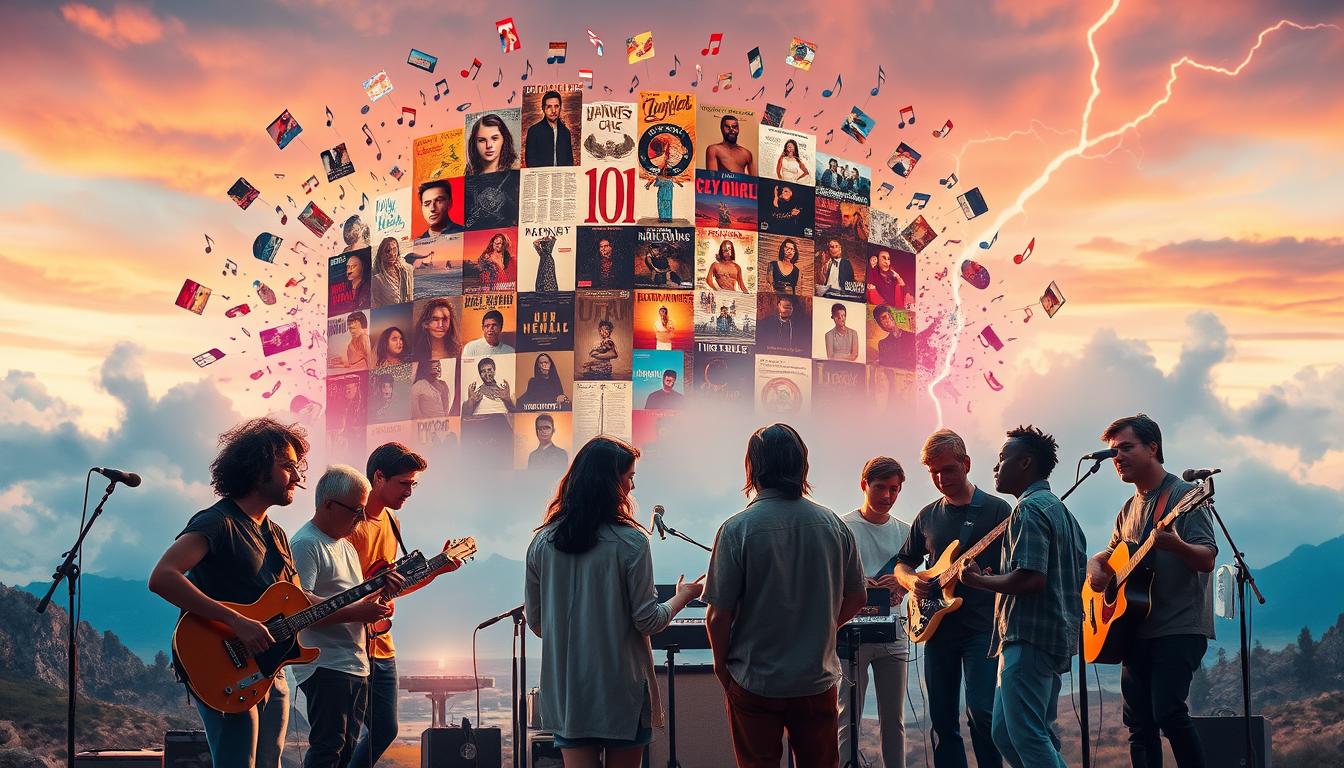
Before the first chord strikes, the groundwork is laid in a living room. It’s filled with the crackle of vinyl and the scent of well-loved books. This isn’t a fairy tale; it’s how an artist’s sound is formed.
Imagine a parent’s love for 70s folk-rock setting the stage. A sibling’s 90s hip-hop obsession adds a touch of rhythm. These are the roots of creativity, often overlooked but key to understanding a musician’s journey.
Clint Black once noted, “My Texas upbringing shaped & inspired my music from the very beginning of my career.” His words show how a place can define sound. Willow Smith describes Joni Mitchell’s “Coyote” as a cinematic experience, where the listener can almost visualize the sky’s planes.
This shows how songs transcend mere sound; they become vivid experiences. Books and art also play their part. The narratives you devour at fourteen mold your storytelling, while museum visits teach you about composition and space.
These early impressions aren’t just nostalgic memories; they are the operating system for future creativity. So, what’s in your starter pack? Because I assure you, it’s influencing your creative choices today.
Scene heroes local bands and venues that set the bar
A small venue can hold magic that big stadiums dream of. Forget the big names; it’s the local legends that truly ignite the scene. Each intimate gig offers a raw experience, where the bass rattles your fillings and the lead singer’s sweat might just land on your notebook. These moments become etched in memory, shaping an artist’s journey.
Every artist has their pantheon of local demigods. Think of the band that opened for everyone but never quite “made it.” Or the vocalist whose voice could shatter glass with a whisper. These scene heroes are not just performers; they are educators. They teach us that greatness isn’t a destination; it’s a frequency, a feeling that resonates deep within.
Venues themselves are characters in this story. Consider the dive bar with its sticky floor and transcendent acoustics, or the all-ages club where you first understood the political weight of a mosh pit. Each place carries its own history, its own vibe, shaping the music that flows through it.
Willow Smith’s admiration for Björk speaks to this connection. Björk embodies a sense of being “connected to the star people,” a sentiment likely sparked by the electric jolt of witnessing someone on a small stage who rewired your understanding of performance. These influences are not merely musical; they are pedagogical, setting the bar for authenticity and risk.
Who taught you that a show could be a séance? It’s this lineage of local bands and venues that truly matters. They remind us that music is not just about the sound; it’s about the sacred pact between performer and audience, a bond that transforms every performance into something profound.
Non musical inputs architecture fashion poetry and places
Music is deeply connected to life’s non-musical elements. Think about the brutalist building you see every day. It teaches us about structure and repetition. Every sound we make reflects the world around us.
How a poet breaks a line can inspire music. Fashion is more than clothes; it’s about identity and protection. Each outfit tells a story, shaping our sound perception. I’ve even created chord progressions inspired by sunsets and city skylines.
Willow Smith once said, “I studied physics for four years. It made me believe in magic.” The magic is in seeing patterns across different fields. The gravity that holds planets in orbit is like the force that brings a chorus back to the start.
Architecture gives form, while poetry uses few words. Fashion adds texture and surprise. Places also play a role in our music. The air in a Southern summer or the subway’s hum can become part of our sound.
When we call an artist “cinematic,” we mean they’ve absorbed the world. The key is to turn a building’s weight into a bass note’s weight. Are you noticing the world outside your headphones? That’s where the real music is made.

Reference playlist commentary on 10 key tracks and what they borrowed
A reference playlist is like a musical treasure map. It shows the tracks that inspire artists. This playlist is more than a mixtape; it’s a deep dive into influence.
Each song is a marker, guiding you through the sounds that shape an artist’s identity. Willow Smith once said, “It needs to have a strong enough energy to transport you into its world.” This captures the essence of a great playlist.
Track one might teach you the power of silence. Track four could show you how a bridge can change everything. These tracks influence your own work in amazing ways.
Maybe a catchy bassline comes from Sly Stone, but with a post-punk twist. Or a lyrical turn might come from Joni Mitchell, but with a Black woman’s perspective. A reference playlist is a mix of homage and innovation.
Originality is just a myth we tell ourselves. The real magic is in mixing old with new, creating something fresh and exciting.
Mood board colors textures fonts and artwork process
The journey of a song often starts with colors and textures on a mood board. This canvas turns sound into sight, guiding the artist’s vision. It’s more than just images; it’s an emotional landscape, like a blueprint for sound.
Colors are key, not just for looks but for emotions. A certain purple shade might match the bridge in a song. Textures also play a big role. The feel of a 35mm film can add warmth to the sound. Each part helps set the mood before music starts.
Fonts are important too. The way an album title is set can show if the music is bold or cozy. Typography can really stir emotions, you know?

Willow Smith once said, “It’s almost like you’re not even listening to what she’s saying, you’re in the picture of what she’s saying… It’s like a freaking movie.” This idea starts with the mood board’s visual design.
The artwork process is just as vital as the music. When I’m stuck on a lyric, looking at a Rothko print helps. It’s like using synesthesia to guide production, even if the audience never sees the mood board.
In the end, the mood board turns a bunch of songs into a unified world. So, what’s on your wall? That’s what your next album will sound like.
How influence becomes originality avoiding pastiche and legal lines
Walking the line between influence and originality is tricky. Artists often wonder: if we’re made of our influences, where do we start? The line between paying homage and copying is thin, watched closely by lawyers. But the real danger isn’t just legal trouble; it’s losing your artistic voice.
Pastiche is like karaoke with better lights. True originality happens when you’ve fully absorbed your influences, making them unrecognizable. This is like a dream remixing your day. Willow Smith says the ego protects us, and in art, our influences are like our ego, guiding or limiting us.
The secret is to heal this relationship. For example, you might use a jazz chord progression but add your own twist, like the sadness of a specific Tuesday. Or, you could take a poet’s structure but make it your own, like your grandmother’s kitchen cadence. This turns influence into a creative legacy, not theft.
Legally, make sure to clear samples and credit your sources. Remember, the law protects how you express ideas, not the ideas themselves. A broken heart in a certain chord progression is common, but how you express it is yours alone.
| Aspect | Influence | Originality |
|---|---|---|
| Definition | Borrowing elements from existing works | Creating something uniquely yours |
| Risk | Potential for pastiche | Artistic authenticity |
| Legal Concerns | Copyright issues | Protected expression |
| Creative Process | Inspiration | Transformation |

Seasonal phases of influence winter vs summer writing habits
As the seasons change, so does our creative expression. Winter and summer bring unique vibes that shape our writing. Winter’s chill invites a focused, quiet creativity. Songs emerge slowly, revealing the raw emotion.
Summer writing, on the other hand, bursts with energy. Inspiration flows freely, fueled by the heat and life around us. Winter might draw you into quiet introspection, while summer brings chaotic joy.
Willow Smith calls these moments of inspiration “glimmers.” In winter, a glimmer might be frost on a windowpane, evoking beauty. In summer, it’s the vibrant music from a passing car, stirring joy.
Understanding these seasonal influences helps map our creative processes. Your winter record might be precise, while your summer record is expansive. The mistake? Trying to write a beach anthem in February. Instead, let the season guide your creativity.
| Season | Writing Style | Key Influences | Glimmers |
|---|---|---|---|
| Winter | Introspective, slow | Quiet moments, solitude | Frost on glass |
| Summer | Impulsive, energetic | Festivals, noise | Block parties |
So, what season are you in? Are you writing with it or against it? Our creativity is dynamic, like the weather. Embrace the seasons and let them shape your art.
Current obsessions what’s looping this month and why
My musical favorites are like a map to new discoveries. This month, my playlist is a mirror of my soul. It’s filled with sounds that speak to me deeply.
I keep coming back to a 1972 Ethiopian jazz record. The saxophone melodies ask questions I’ve been trying to answer. It’s like they’re speaking directly to me.
I’m also exploring a contemporary classical composer’s work. Their use of silence creates a haunting atmosphere. It’s like listening to the universe itself.
Willow Smith once said, “Recently, I’ve been waking up with the sunrise… I’ll open my eyes, and there’s a window right next to my bed. The sun is peeking out from behind the mountain, and I’m just like, ‘Damn. What a beautiful view.’” This shows how our current favorites are essential for our creativity.
Every song, podcast, or TikTok account we enjoy adds to our creative journey. That podcast on medieval monasticism might inspire a new sound in my music. And that TikTok on Brutalist architecture could shape my next album cover.
To find your true favorites, think of them as a curated gallery. Don’t let algorithms decide for you. Seek out the unusual, the challenging, and the beautiful. Remember, what you’re listening to now is the foundation for your next big idea.
| Track/Artist | Influence | Emotional Resonance |
|---|---|---|
| 1972 Ethiopian Jazz Record | Saxophone melodies | Questioning and introspective |
| Contemporary Classical Composer | Use of silence | Reflective and meditative |
| Podcast on Medieval Monasticism | Historical insights | Inspiring and thought-provoking |
| TikTok on Brutalist Architecture | Visual aesthetics | Innovative and challenging |
Fan homework collaborative playlist invites and cover challenge
Art thrives in collaboration, and your input is the secret ingredient. This isn’t just about me; it’s about us. Music is a tapestry woven from countless threads. I want to add yours to the mix.
Let’s build a collaborative playlist that reflects our shared influences. What song did your parent play on repeat? Which local band from your hometown should have made it big? Share your tracks and let’s create a sonic map of our collective history.
But wait, there’s more! I’m also launching a cover challenge. Take one of my songs—or a track from the reference playlist—and reinterpret it through your unique lens. Change the key, swap the genre, or even translate the lyrics into a different emotional language.
Remember Willow Smith’s vision of “a space of intention everywhere”? That’s the spirit we’re channeling here. This is about proving that influence is a living, breathing network, not just a one-way street.
The best covers don’t merely replicate; they reveal something hidden in the original. They spark conversations across time and taste. So, roll up your sleeves and do the homework.
Not for a grade, but because the lineage of music needs your voice to keep mutating. The playlist is live, and the challenge is open. Let’s see what you’ve been borrowing and how you’ll reinterpret it!
Closing reflections on evolving taste and longevity
Taste changes over time, and that’s a good thing. Artists who stick to the same old influences miss the point. Music longevity isn’t about being trendy. It’s about staying curious and letting your influences grow.
Willow Smith shows us the beauty of evolving. She wants her legacy to be about care and devotion. What if we focused on building a legacy of love instead of proving our genius? This view is bold in a world obsessed with new things.
My own tastes have changed over the years. I’ve moved from trying to be like my heroes to understanding their questions. I find beauty in the quiet moments and the small details of life. This isn’t just growing up; it’s about creating lasting art.
So, let’s look forward to the next decade. Let’s celebrate our uniqueness and let our tastes become even more diverse. The spark of creativity hasn’t faded; we’ve just learned where to find it. Let’s keep that spark alive.