Blog

  • No-Man’s-Land Exhibition At Knoxville Museum

    No-Man’s-Land Exhibition At Knoxville Museum

    The No-Man’s-Land Exhibition at the Knoxville Museum of Art runs from August 13, 2026 through November 8, 2026, and remains open as of September 3, 2026, according to the museum’s Knoxville Museum of Art listing. The museum listed the opening reception for Thursday, August 13, 2026, beginning at 5:30 PM, with a members’ and artists’ hour from 5:30 to 6:30 PM.

    The exhibition gathers work by ten artists: Seba Calfuqueo, Ada Friedman, Guillermo Galindo, Eddie Owens Martin, Harrison Mayes, Erin Jane Nelson, Sarah M. Rodriguez, Suzanne Treister, Saya Woolfalk, and Joseph Elmer Yoakum. Its organizing idea is not a single border line, but a set of threshold spaces between bodies, spiritual traditions, cultures, countries, private property, public ground, and imagined planets. That breadth calls for care. Rather than treating borders as simple metaphors, the exhibition appears to ask how people make meaning in places where ownership, identity, belief, and movement do not settle neatly.

    What The No-Man’s-Land Exhibition Asks Of Viewers

    How The No-Man’s-Land Exhibition Uses Border Thinking

    The No-Man’s-Land Exhibition is centered, in part, on Harrison Mayes, a Kentucky coal miner turned evangelist who was born in Tennessee in 1898 and died in Middlesboro, Kentucky, in 1986. For more than 60 years, Mayes installed concrete beacons inscribed with spiritual messages in ambiguous strips of land between state and private property. Those sites, described as “no-man’s-lands,” give the show a grounded point of departure. The title is not only poetic; it is tied to a specific practice of placing hand-built markers where authority and access could be unclear.

    That focus is useful because it keeps the exhibition from becoming too abstract. A boundary can be political, legal, spiritual, bodily, ecological, or cosmic, but Mayes’ concrete beacons remind viewers that boundaries are also lived through materials and placement. A sign set in a contested strip of ground carries a different pressure than a sign inside a gallery. By bringing such ideas into the museum, the exhibition can frame the border as both a physical fact and an imaginative condition.

    Spiritual Messages And Public Ground

    Mayes’ work also raises questions about how personal conviction enters public space. The available research does not claim how passersby responded to his beacons, so that should remain uncertain. What can be said is that the practice combined religious language, durable concrete, and roadside or in-between locations. That combination matters because it places art-adjacent activity outside conventional art systems while still asking viewers to read form, message, and site together. In that sense, the show’s attention to Mayes opens a wider discussion about who gets to mark space and how those marks are later interpreted inside a museum.

    Artists And Materials In Border Spaces

    Found Objects, Sound, And Migration Memory

    Guillermo Galindo’s work, as described in the exhibition materials, uses found objects from the U.S.–Mexico border, including shoes, clothing, and fragments of fencing. He changes these remnants into sculptural instruments activated through sound. This practice should be approached with respect for the people and histories implied by the materials. The objects are not neutral studio supplies; they are tied to movement, exposure, loss, and memory along a heavily charged border. Sound, in this context, can make absence perceptible without pretending to resolve the conditions that produced it.

    The full artist list shows how broad the exhibition’s border concept is:

    • Seba Calfuqueo
    • Ada Friedman
    • Guillermo Galindo
    • Eddie Owens Martin, also known as St. EOM
    • Harrison Mayes
    • Erin Jane Nelson
    • Sarah M. Rodriguez
    • Suzanne Treister
    • Saya Woolfalk
    • Joseph Elmer Yoakum

    Speculative Bodies And Invented Worlds

    Saya Woolfalk’s contributions are described as reimagining beings who can alter genetic makeup and merge with plants. Her installations combine video, sculpture, textiles, and speculative environments, treating change as an ongoing state rather than a single before-and-after event. That position connects bodily boundaries to ecological imagination. It also shifts the exhibition away from border thinking as only a matter of national lines. A border can also be the unstable edge between human and plant, body and costume, biology and myth, or self and collective identity.

    Joseph Elmer Yoakum adds another register. Born in 1890 and deceased in 1972, Yoakum began producing art later in life and made more than 2,000 works over his final decade. His psycho-geographies, grounded in memory, imagination, and places ranging from Tennessee to Antarctica, suggest that geography can be internal as well as mapped. The available research does not provide individual object titles for this presentation, so close interpretation should wait for direct viewing or fuller documentation. Still, the inclusion of Yoakum supports the exhibition’s interest in places that are remembered, invented, crossed, or reconfigured.

    Access, Place, And The Museum Setting
    Museum exterior near a public park with visitors approaching the entrance

    Dates, Hours, And Local Access

    The Knoxville Museum of Art is located at 1050 World’s Fair Park Drive, Knoxville, TN 37916. The research notes list regular gallery hours as Tuesday through Saturday from 10 AM to 5 PM and Sunday from 1 to 5 PM. A local events listing states that exhibition admission and parking are free for Knox County residents, a practical detail that can affect who is able to spend time with the work rather than only know about it through images or announcements Find Knoxville.

    Access is not a secondary issue for a show about boundaries. If an exhibition studies cultural, spiritual, political, and bodily thresholds, then the conditions of entry matter. Free admission and parking for Knox County residents do not answer every access question, and the research does not specify every visitor circumstance. Even so, that policy is relevant because it reduces one barrier for nearby audiences. Readers can explore further creative-community perspectives at Robsonic, a related site in the same network.

    Support And Institutional Framing

    The exhibition is supported by McCarty, Holsaple, McCarty Architects, Inc.; Vicki S. Kinser and John Jarnagin; Debbie and Jimmy Jones; and Susan French. Sponsorship information is often easy to skip, yet it belongs in the record because exhibitions depend on institutional, financial, and community support. This does not define the meaning of the artworks, but it helps identify the setting in which audiences encounter them.

    Ada Friedman’s biography adds a university-linked thread to the presentation. The museum materials state that Friedman received the Grant Wood Fellowship and holds a Visiting Professorship in Painting and Drawing at the University of Iowa for 2025–26. They also note a prior role as Visiting Artist in Painting and Drawing at the University of Tennessee, Knoxville, in 2021–22. Such details are not proof of how a work should be read, but they place one artist within teaching, regional exchange, and institutional art education.

    No-Man’s-Land Exhibition At KMA

    A Cautious Reading Of Cultural Boundaries

    For Knoxville audiences, the No-Man’s-Land Exhibition offers a concentrated study of cultural boundaries without reducing them to one meaning. The available facts point to an exhibition that joins roadside spiritual markers, border-found sculptural instruments, speculative plant-human beings, imagined geographies, and other artistic approaches to threshold spaces. That range is significant, but caution is still needed. The research provided does not include critical reviews, visitor feedback, installation photographs, or object-by-object labels, so any broader judgment about reception would be premature.

    What can be said with confidence is that the show places materially different practices in relation to borderlands: concrete beacons, found objects, sound, textiles, sculpture, video, drawing, and imagined environments. Its strength, based on the documented theme, lies in treating boundaries as things people build, cross, inherit, imagine, and contest. The museum setting gives these works a shared frame, while the artists’ varied practices resist a single answer. That tension is the most useful reason to read the exhibition closely: it asks viewers to consider where a boundary begins, who names it, and what creative acts become possible at its edge.
  • TikTok Shop Policies and Handmade Sellers

    TikTok Shop Policies and Handmade Sellers

    As of September 3, 2026, TikTok Shop Policies had already changed several practical conditions for creators, affiliates, artists, and handmade sellers. The clearest shifts were not only about visibility or short-form video performance. They were about product quality thresholds, payout timing, commission ceilings, creator eligibility, return workflows, pricing rules, and the new presence of fine art inside shoppable social commerce.

    For handmade sellers, these changes deserve a careful reading. A ceramicist, textile artist, printmaker, or small-batch candle maker does not operate like a warehouse brand with deep inventory, wide margins, and a staff trained on compliance operations. Handmade commerce often depends on trust, clear communication, repeat buyers, and realistic production capacity. Platform rules can support that trust when they reduce deceptive selling. They can also strain small studios if payout delays, shipping deadlines, or affiliate economics are hard to absorb.

    Why TikTok Shop Policies Matter For Handmade Sellers

    Quality Rules Can Favor Prepared Studios

    On May 7, 2026, TikTok Shop updated its Affiliate Product Quality Thresholds, setting a Voice of Customer Index requirement below 1.5 for continued eligibility and disqualifying products above 3.0. That type of rule puts customer satisfaction data closer to the center of seller access. For handmade creators, the effect depends on how clearly expectations are set before purchase.

    These TikTok Shop Policies may reward sellers who explain materials, dimensions, finish variation, care instructions, and processing times with unusual clarity. A hand-thrown mug may have small differences in glaze pooling. A linocut print may vary slightly between impressions. A made-to-order garment may need more time than a mass-produced item. None of that is a defect by itself, but it can become a complaint if the buyer expected factory uniformity.

    The practical point is cultural as much as commercial. Handmade buyers are often invited into an artist’s process, yet that invitation must be matched by plain product information. Strong listings can respect the work without turning every object into a mystery. For community-based artists, better listing discipline may protect both sales and reputation.

    Settlement Timing Affects Studio Cash Flow

    The May 2026 policy updates also described a commission settlement timeline adjustment. Creator commission payouts that might otherwise settle after 15 days could be delayed to 31 days after delivery when extra policy or security review is required. On May 12, 2026, TikTok also simplified return and refund review workflows into a single two-step process, with stricter penalties for repeated serious violations, including extended settlement periods.

    Those dates matter because cash flow is not abstract for small studios. Many makers buy materials before a drop, pay booth fees for local markets, ship from home or shared workspaces, and reserve time for packing rather than paid production. A longer wait for funds can affect the next kiln firing, fabric order, or wholesale sample run. The risk is not that every creator will face delays. The risk is that sellers with narrow margins may need a larger cushion before treating social commerce as their main sales channel.

    Commission Cuts And The Creator Relationship

    TikTok Shop Policies And Creator Roles

    TikTok Shop Policies also separated creator participation into more defined roles. The U.S. Creator Eligibility Policy updated on July 2, 2026, described Official Shop Creators, Marketing Creators, and Affiliate Creators, each with different permissions and requirements. The research notes for this article state that Affiliate Creators needed at least 1,000 followers, while some bound Official or Marketing creators could operate without a minimum follower count.

    That structure may help brands formalize who is speaking for a shop, who is promoting products, and who is earning affiliate revenue. Still, handmade sellers should be cautious about assuming that a creator relationship will feel personal simply because it happens through short videos or livestreams. Clear expectations around samples, usage rights for video clips, discount codes, payment timing, and product claims remain necessary.

    Affiliate Economics Became Less Predictable

    In late May 2026, TikTok Shop reduced maximum affiliate commission ceilings in several high-volume U.S. categories, including beauty, personal care, and home goods, according to Ecommerce Times reporting. Home goods is especially relevant to handmade commerce because it can include decor, functional objects, textiles, and giftable studio goods.

    Lower commission ceilings can change the relationship between seller and promoter. If a maker cannot offer a commission that feels worthwhile to affiliates, the maker may need to depend more on direct storytelling, customer referrals, email lists, local events, or repeat collectors. That is not necessarily a failure. In many arts communities, slower trust-building has always been part of sustainable commerce. The concern is that sellers who priced goods around a prior affiliate model may need to recalculate margins, shipping costs, discounts, and sample expenses.

    Fine Art Sales Entered A Different Commerce Frame

    Fine Art Was Added On April 28, 2026

    On April 28, 2026, TikTok Shop added a Fine Art category under Collectibles, Art, and Cultural items, a change reported by The Art Newspaper. The same report described artist Sophie Tea selling original works through live sales and noted conditions such as mandatory descriptive titles, two-day shipping deadlines, and built-in buyer discounts, including 20 percent off for first-time purchasers.

    Fine art entering a shoppable video environment is not automatically good or bad. It changes the frame. A live sale can create immediacy, but original works often need careful documentation, condition checks, packing, insurance decisions, and collector communication. A two-day shipping deadline may be workable for some small works already prepared for dispatch. It may be harder for framed pieces, fragile sculpture, or work requiring special handling.

    Discounting also needs care. A discount can help a new collector take a first step, but it can confuse pricing if an artist has gallery relationships, studio collectors, or prior editions sold at established rates. Artists should not assume that every platform incentive fits every practice. A community organizer’s view is simple: access matters, but so does the dignity of the work and the sustainability of the person making it.

    Rights And Attribution Need Restraint

    Creator commerce often blurs inspiration, fandom, remix culture, and commercial sale. Sellers should treat rights questions with restraint and should not rely on social media norms as proof that a design is cleared for sale. This is not legal advice. It is a practical reminder that artists, character owners, photographers, estates, brands, and performers may have rights that affect product design, promotion, likeness use, and ad copy.

    Across creator marketplaces, trust is shaped by rules as well as tone. A related NextClues review of maker trust standards looks at policy signals in handmade commerce, including seller rules, AI limits, and intellectual property expectations. The same habit applies here: read the public policy pages, keep records, use accurate titles, and avoid implying affiliation where none has been confirmed.

    How Handmade Sellers Can Respond Without Overcorrecting

    Small business owner checking orders beside fabric samples and boxes

    Operational Choices Before Marketing Spend

    The safest response is not panic. It is preparation. Handmade sellers can review the parts of their shop that generate avoidable complaints before they spend more on promotion. Many disputes begin with mismatched expectations: size, delivery time, color, texture, scent strength, care needs, or what counts as a natural variation.

    • Audit listings for clear measurements, materials, processing time, and care instructions.
    • Photograph handmade variation honestly rather than presenting one object as a perfect template.
    • Price with fees, samples, commissions, discounts, packaging, returns, and delayed payouts in mind.
    • Keep shipping charges explainable, especially after the June 24, 2026 U.S. Fair Pricing Policy took effect.
    • Limit affiliate promises to claims that the seller can document and fulfill.

    These steps may sound modest, but they can reduce the pressure created by quality thresholds and return workflows. They also protect relationships with buyers who came to the shop because they value human-made objects.

    Community Signals Still Matter

    TikTok Shop can be a sales channel, but it should not be mistaken for an arts community by itself. Community is built through repeated care: answering questions, crediting collaborators, showing process honestly, paying artists fairly, and maintaining relationships beyond a single transaction. Local fairs, studio tours, nonprofit arts spaces, newsletters, and cooperative retail models still matter because they give buyers context that a product tile cannot carry alone.

    Policy literacy is part of that community work. Readers who follow public-facing coverage across related sites may recognize a related site in the same network. Here, civic and cultural questions can sit close together, providing artists with invaluable insights. For artists, the shared lesson is that rules shape participation. Knowing those rules early can preserve energy for making, teaching, exhibiting, and serving local audiences.

    TikTok Shop Policies For Handmade Commerce

    The practical reading of TikTok Shop Policies is that handmade sellers gained access to wider social commerce tools while facing tighter operational expectations. The April 28 Fine Art category made original art more visible inside TikTok Shop. The late May affiliate commission cuts changed promotional economics in U.S. categories that overlap with handmade goods. The May, June, July, and September 2026 policy dates in the research notes point toward a platform that was refining eligibility, pricing, returns, account controls, and seller incentives.

    For creators, the best path is neither withdrawal nor unquestioning adoption. Treat the platform as one venue among several. Protect margins before offering discounts. Write listings that honor handmade variation without hiding practical details. Keep rights and attribution questions conservative. Build direct community ties so that a policy change does not break the relationship between artist and buyer. That measured approach respects both the creative labor behind the object and the buyer who wants to support it with confidence.

  • Producer Chair Interview The Ears Behind Your Favorite Indie Records

    Producer Chair Interview The Ears Behind Your Favorite Indie Records

    Let’s skip the small talk. You didn’t click here to talk about the weather in Nashville. You want to know who made your favorite music.

    Imagine being in a control room. We’ll look at everything from the first sound to the last note. We’ll talk about how a career starts in a basement and grows into something big.

    We’ll share the real story behind making music. It’s not always easy, but it’s worth it. Get ready for a deep dive into the world of music production.

    Philosophy capture vs construct and when to say stop

    Every producer wonders: are we capturing moments or creating masterpieces? This question is central to my studio philosophy. There are two main views: the “capture” side, like Rudy Van Gelder, who sees magic in the room. They aim to keep it simple.

    The “construct” camp, inspired by Brian Eno, views the studio as a tool. They build layers of sound until the spark is lost under a heap of overdubs.

    I find a balance between these views. It’s about capturing the energy of a performance and adding production artistry. But the real skill is knowing when to stop. A record overmixed sounds like a stuffed animal—lifeless.

    Stopping early is key. The last 10% of tweaking can ruin the first 90% of soul. Knowing when to stop makes an album timeless, not just a demo. It’s like Mies van der Rohe’s “less is more” in sound, with more echo.

    Pre production arranging keys tempo map and lyric trims

    Pre-production is where music dreams become reality. It’s a critical phase for making your song impactful. It’s not just about tuning guitars; it’s about arrangement coaching. This involves fine-tuning lyrics and melodies.

    Why does the second verse sound the same as the first? Why does the bridge feel like a detour? These are the questions we answer in pre-production. We aim to make tempo changes feel natural, like a human heartbeat. Finding the right key is key; it should match the singer’s voice, avoiding strain.

    Once, I spent three hours tweaking a single word in a chorus. It was a word that stood out too much. Our goal is to make the song feel like it was always meant to be. It’s like editing a script for the ears; even famous writers need editors.

    Element Importance Tip
    Arrangement Shapes the song’s flow Focus on transitions
    Keys Affects vocal performance Test different keys
    Tempo Sets the song’s energy Experiment with variations
    Lyric Trims Enhances clarity Be ruthless in editing

    Mic choices drum phase vocal chain and room tricks

    When it comes to mic choices, the price doesn’t matter. What’s important is the personality of the mic. For example, a Shure SM7B gives your vocals a warm feel. On the other hand, a Neumann U87 shows every detail, even the ones you might not want to see.

    Drum phase is a key element in mixing. It can make your mix sound amazing or fall flat. Flipping a polarity switch can make the kick drum sound like it’s hitting you in the chest. This is the power of phase alignment.

    My approach to mixing vocals is all about finding the right balance. I start with a fast compressor to add some edge. Then, I use a Pultec-style EQ to smooth things out. And sometimes, I add a slap delay for that Sun Records vibe.

    Room tricks can really make your mix stand out. I’ve placed mics in weird places like stairwells and bathrooms. This adds a unique reverb to your vocals, making them sound like they’re in a snow globe.

    These mixing tips are more than just technical advice. They’re about finding that special something in your mix. For more on kick and snare recording, check out this resource.

    Microphone Character Best Use
    Shure SM7B Warm and smooth Vocals
    Neumann U87 Detailed and bright Studio vocals
    Akg C414 Versatile and rich Instruments

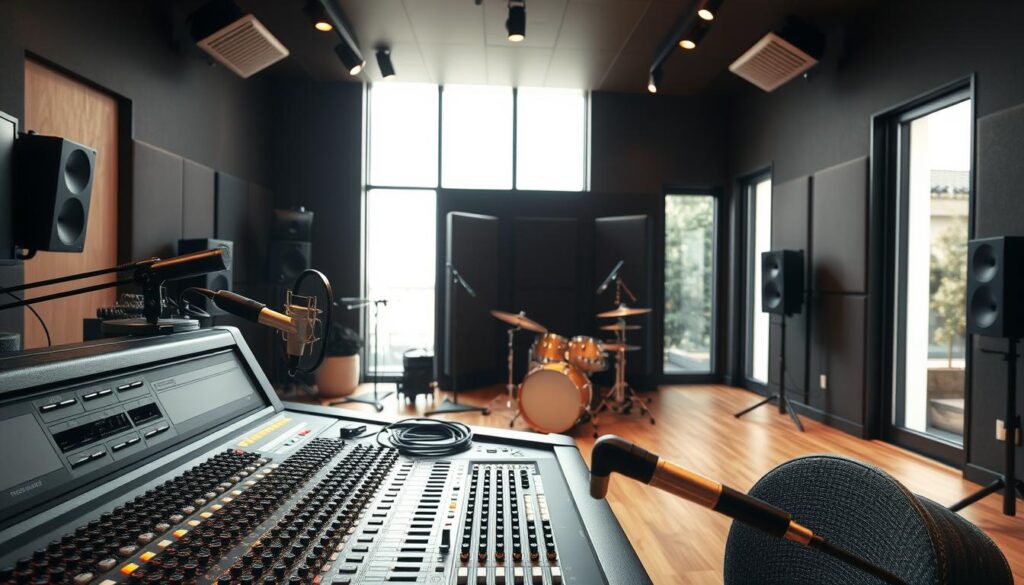
    A sleek, modern recording studio interior featuring a professional audio mixing console as the focal point in the foreground, with a variety of high-end microphones and cables neatly organized around it. In the middle ground, a well-constructed vocal booth with soundproofing panels, and a vintage drum kit subtly visible to the side. The background showcases large windows letting in soft, natural light, illuminating the studio's creative atmosphere. Use a wide-angle lens to capture the depth of the space, with warm, inviting lighting that suggests a collaborative spirit. The overall mood reflects focused creativity and professionalism, appealing to music producers and sound engineers.

    Coaching artists confidence takes and “one more for safety”

    Coaching artists is a mix of psychology and performance. In the studio, I act as both a therapist and a drill sergeant. It’s not about perfecting every note; it’s about finding the imperfect one that will connect with someone.

    Confidence is key, but it’s hard to see. Without it, the recording process feels crippled.

    I use weird analogies and even shadowboxing to get real emotion. Each session is a journey to find raw emotion. The artist’s vulnerability turns into powerful art.

    The phrase “one more for safety” often kills the magic of a perfect take. These extra takes are like participation trophies. True arrangement coaching means knowing when to stop and not chase perfection.

    Take Number Emotional Impact Producer’s Insight
    1 Raw Great energy, but lacks polish.
    2 Authentic Captures the essence of the song.
    3 Lightning Perfect blend of emotion and skill.
    4 Thunder Overthought and less genuine.

    In music production, the goal is to catch that moment of inspiration. The right coaching can make an artist shine. But knowing when to stop is just as important. So, when you hear “one more for safety,” remember: sometimes, the best take is the one you didn’t chase.

    Mixing perspective depth color panning mono checks and bus glue

    Mixing is like painting with sound, adding depth and color. It’s like creating a sonic diorama. You need to think about where the vocalist is and how they sound.

    Depth comes from using reverb and delay wisely. It’s not just about making things sound big. You want to create a space that feels real and a bit mysterious.

    Color is key too. It’s the warmth that makes digital recordings feel real. This warmth invites listeners into the music.

    Panning is more than just left and right. It’s about arranging instruments like a stage play. Each one should have its own spot, adding to the mix’s harmony.

    Mono checks are important. If your mix sounds bad in mono, it’s not good. Always check it in mono to keep things clear and balanced.

    Bus glue is the final touch. It’s achieved with a compressor or console emulation. It’s like a host at a party, making sure everyone gets along.

    These tips are gold for indie producers. Using them will take your mixing to the next level.

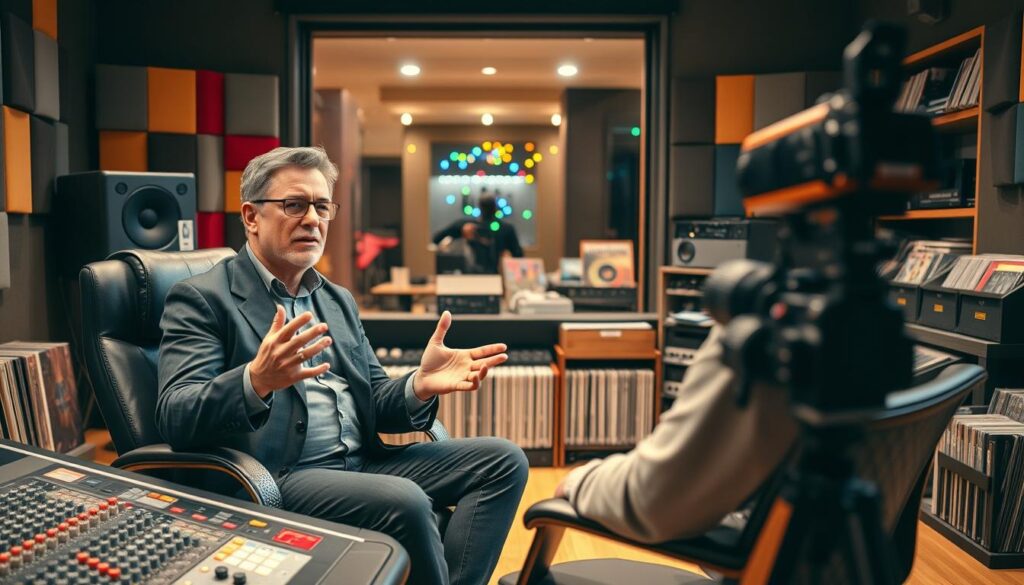
    In a cozy recording studio, an indie music producer is being interviewed, seated comfortably on a stylish producer chair. The foreground features the producer, a middle-aged individual in smart casual attire, sharing insights passionately. Their hands gesture expressively in front of a large mixing console adorned with various knobs and sliders. In the middle background, a large window reveals colorful sound panels while subtle reflections of colorful LED lights create a vibrant ambiance. Shelves filled with vinyl records and musical equipment can be seen, highlighting the independent music scene. Soft, warm lighting illuminates the scene, creating an inviting atmosphere, while a professional camera captures the image from a slightly angled perspective, emphasizing depth and focus on the subject.

    Mastering handoff loudness targets and sequencing flow

    Handing off your mix to a mastering engineer is like sending your child to school for the first time. You’ve put your heart into the mix, and now it’s time for someone else to add the final touches. The loudness wars are over, and LUFS is the new standard. But my studio philosophy is about more than just numbers; it’s about creating an emotional journey.

    Sequencing flow is the lost art of the album era. It makes Side A of “Rumours” feel like a journey, not just a playlist. I focus on the space between tracks, making sure it’s just right. Do you want a seamless transition or a moment of silence to let the music fade away? Mastering is about making it loud and making it translate, not just loud.

    Whether it’s for earbuds or a car stereo, mastering is all about the details. Here’s a look at common loudness targets and their uses:

    Loudness Target (LUFS) Application Typical Genre
    -14 Streaming Services Pop, Indie
    -10 Radio Broadcast Rock, Hip-Hop
    -6 Club Play EDM, Dance
    -16 Classical Music Classical, Jazz

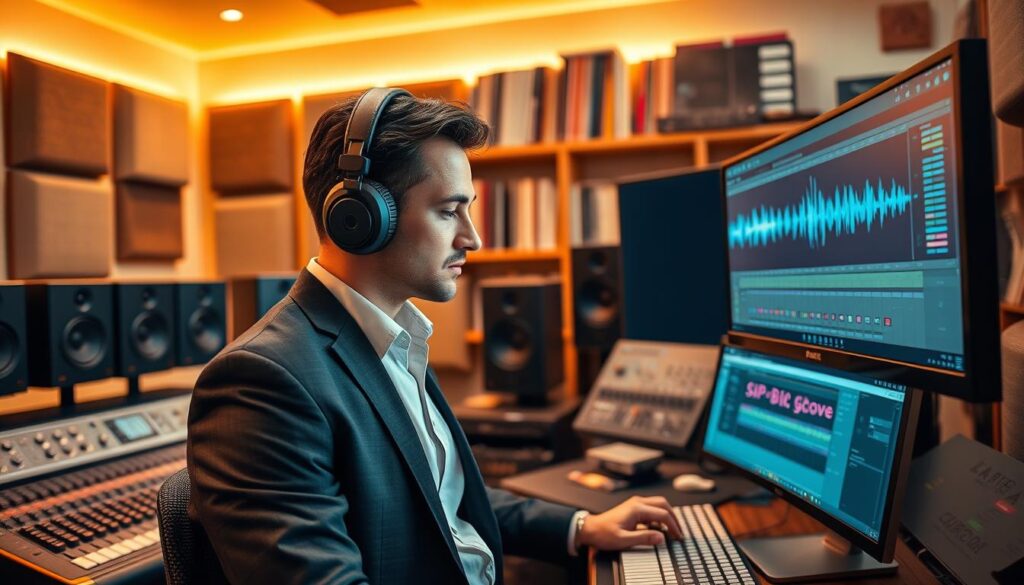
    A cozy mastering studio filled with high-end audio equipment, featuring a large mixing console, studio monitors, and a computer displaying an audio editing software interface with waveforms. In the foreground, a professional audio engineer, dressed in smart business casual attire, is intently analyzing sound levels on the screen using an array of high-quality headphones. The middle layer highlights sound treatment panels along the walls, with warm, ambient lighting that creates a focused yet inviting atmosphere. In the background, shelves filled with vinyl records and music production books add character. A subtle focus on the engineer's expression conveys dedication and expertise as they balance loudness targets and sequencing flow, capturing the essence of the mastering process in a serene setting.

    Mastering is all about the emotional journey of your music. It’s about making sure your music sounds great in any setting. So, when you hand off your mix, remember: it’s not just about being loud; it’s about creating a lasting experience.

    Business transparency budgets timelines and revision policy

    The business side of music production can be dull. But, in indie production, money matters a lot. I’m open about budgets to avoid any surprises.

    Timelines are key too. I don’t promise “two weeks” and then disappear. I add buffers for unexpected delays. These extra days can prevent a meltdown.

    My revision policy is clear: two changes, then it’s time to move on. I once had a client ask for 47 mix changes. That’s not art; it’s a test of patience. Setting clear limits helps keep the project on track and avoids resentment.

    In short, being open about budgets and timelines is vital. It keeps the creative process healthy. Let’s keep communication clear and surprises rare.

    Reference track playlist and what to listen for

    Exploring sound is like navigating a dense forest. Without a reference track, you might get lost. Reference tracks are like maps for mixing, guiding you through the sound world.

    But, most people listen to references casually, not deeply. It’s like attending a party without a purpose.

    To really get the most from reference tracks, you need to analyze them closely. Here’s what to look for:

    • Kick and Bass Relationship: Are they working together or fighting? Their interaction is key to a great mix.
    • Stereo Image Width: Does it feel wide and immersive or narrow? The way sounds are arranged can make your track stand out.
    • Vocal Placement: Is the vocal clear and upfront or lost in the mix? Getting the vocal right is essential for a clear sound.

    I’ve curated a playlist with tracks from Steely Dan to Spoon. This mix helps you tune your ears to a standard, like a pilot checks instruments before flying. Without these tracks, you’re just guessing, and guessing can lead to mistakes.

    Reference tracks are not about copying; they’re about tuning your ears. Take on the challenge and let your mixes shine.

    Advice to indie artists preparing for studio week

    Booking the studio can feel like a rollercoaster ride. You’re excited, but panic might creep in. Here’s the real talk every artist needs before they step into that creative space. First, know your songs inside and out. You should be able to play them in your sleep. The studio is not your rehearsal room; it’s where magic happens.

    Next, bring reference tracks. These are not for imitation but for inspiration. Saying “I want the drums to sound like ‘When the Levee Breaks’” gives your producer a clear vision. It’s far more effective than vague requests. Leave your ego at the door but don’t forget your conviction. When I question a lyric or chord, it’s not to rattle you. It’s to ensure we’re on the same page as the audience.

    Don’t underestimate the basics. Sleep well, hydrate, and steer clear of the hangover trap. You can’t channel your inner Aretha when you’re running on fumes. Think of studio week as a marathon, not a sprint. Treat it like the artistic summit it is, and you’ll create something that resonates deeply.

    For more tips on organizing community events and maximizing engagement, check out this resource. Embrace the process, and let’s make some magic happen.

  • Online Sellers Bill Tests Creator Commerce Rules

    Online Sellers Bill Tests Creator Commerce Rules

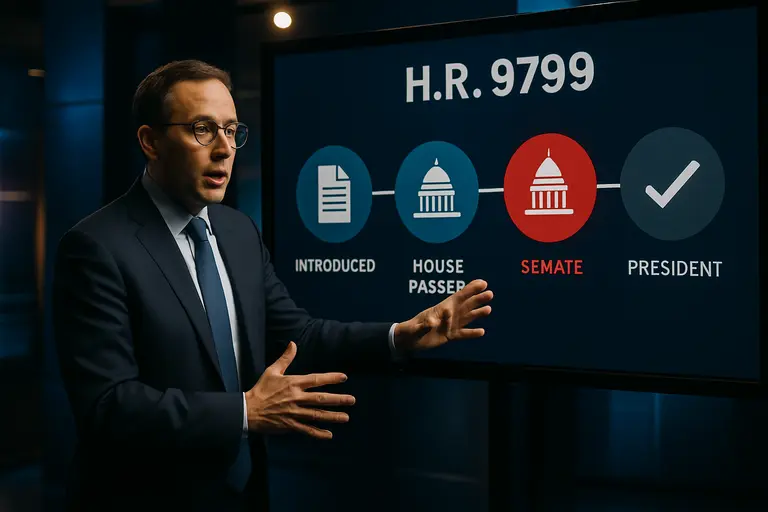
    The Online Sellers Bill has entered the creator-commerce debate at a point when many artists, costume makers, handmade sellers, and small studios depend on third-party marketplaces for visibility, fulfillment, and sales infrastructure. Formally introduced as H.R. 9799 on July 21, 2026, the proposal has not become law as of September 2, 2026. That distinction matters: the bill signals a policy argument about marketplace power, but it does not yet create enforceable rights for sellers.

    For visual artists and design-led sellers, the bill is worth reading with care rather than celebration or alarm. Its stated aim is to establish a bill of rights for third-party sellers on large online marketplaces, described in the bill as critical trading partners. Those platforms can shape whether a maker’s inventory moves, whether a shop can appeal enforcement action, and how quickly withheld funds are released. The proposal responds to those pressure points, but the legislative process remains unfinished.

    What The Online Sellers Bill Proposes

    Online Sellers Bill Protections At Issue

    H.R. 9799 was introduced in the U.S. House of Representatives by Rep. Becca Balint of Vermont, with eight cosponsors, under the full title, “To establish a bill of rights for third-party sellers on critical trading partners, and for other purposes,” according to the bill text published by 119th Congress records. The proposal focuses on sellers whose businesses may be affected by dominant online marketplaces’ policy changes, enforcement systems, funds holds, and inventory restrictions.

    The Online Sellers Bill would require covered platforms to give advance notice before policy changes that affect inventory or fulfillment. That provision is especially relevant to sellers working with seasonal drops, handmade batches, limited materials, or event-driven merchandise. A ceramicist, printmaker, costume accessory seller, or fantasy-fashion maker may plan production weeks or months ahead. A sudden fulfillment or listing-policy change can turn completed inventory into a financial risk.

    The bill also addresses enforcement notice. The research record states that platforms would need to provide clear details of allegations when enforcing terms-of-service violations, including proposed penalties, relevant facts, and appeal steps. For creators, that process matters because an enforcement decision can be tied to product safety, listing language, intellectual-property complaints, or restricted-product rules. The bill does not settle those disputes in advance; it would require more structured notice and a clearer path to challenge adverse action.

    Inventory, Funds, And Appeal Rights

    Several proposed protections concern what happens after a platform restricts products already inside its fulfillment network. Under the bill, a seller could either have remaining inventory sold over a reasonable period of not less than 30 calendar days or have that inventory returned at no cost. The bill would also limit certain funds and inventory holds to 30 days unless there is direct evidence of wrongdoing. Those provisions are significant because creator businesses often operate with narrow cash-flow margins and cannot easily replace withheld revenue or inaccessible stock.

    The proposal includes a private right of action for injured sellers, allowing sellers to sue for damages, attorney’s fees, and three-fold damages, while overriding mandatory arbitration agreements in those circumstances. That is one of the bill’s more consequential features and likely one of the areas that would attract close scrutiny if the measure advances. This article does not offer legal advice; sellers facing enforcement or funds issues should consult qualified counsel or appropriate professional support.

    • Introduced on July 21, 2026, as H.R. 9799.
    • Referred to the House Judiciary Committee.
    • Not enacted as of September 2, 2026.
    • No reported hearing or markup in the research provided.
    • FTC rulemaking would be required if the bill became law.

    Why Creator Commerce Is Watching Marketplace Rules

    Small Studios Often Carry The Risk First

    Creator commerce is not only a retail category. It includes artists who sell prints, independent designers who produce wearable work, cosplay makers who sell original accessories, textile artists, illustrators, small publishers, and gift makers. Some operate from studios; others work around caregiving, day jobs, disability access needs, or local market schedules. Their businesses can be highly sensitive to platform rules because they may lack backup distribution channels.

    The Online Sellers Bill should be read against that practical background. If a seller’s inventory is stored in a marketplace fulfillment system, platform decisions can affect both access to stock and access to revenue. If a shop is suspended or a listing is removed without detailed explanation, the seller may have to interpret a short notice while fielding customer questions and production deadlines. The bill’s emphasis on notice, facts, appeals, and time limits speaks to that asymmetry.

    For arts-adjacent sellers, there is a parallel conversation around aesthetic identity, costume culture, and handmade presentation. Sites such as Fairytale Fashion often track how visual storytelling, dress, and independent making intersect. Those creative practices can flourish through online shops, but they also depend on stable rules around fulfillment, listing standards, and rights clearance.

    Rights Clearance Still Remains Separate

    The proposal should not be mistaken for a shield against intellectual-property claims or marketplace safety rules. The research notes indicate that H.R. 9799 would require clearer information and appeal steps when a platform takes adverse action. It does not say that sellers may use copyrighted characters, celebrity likenesses, trademarked names, or other protected material without permission. For artists and fan-adjacent makers, that distinction is central.

    A fairer enforcement process can help reduce confusion, but it does not remove the need for rights clearance, original design work, accurate listing descriptions, and attention to marketplace policies. Sellers should avoid assuming that a bill about procedural fairness would decide whether a specific image, costume element, phrase, or likeness can be used commercially. Those questions are fact-specific and should be handled cautiously.

    Where H.R. 9799 Stands On September 2, 2026

    Calendar, legislative notes, and seller documents on a desk

    Pending Means No New Seller Rights Yet

    As of September 2, 2026, the bill remains pending. It has been introduced and referred to the House Judiciary Committee, but it has not been enacted, and no hearing or markup has been reported in the research record. AMZBase describes the measure as not yet law and outlines what it would change if enacted in its H.R. 9799 explainer. That status should shape how creators respond: the bill is a policy proposal, not an active compliance rule.

    The Federal Trade Commission would have a defined role if the proposal became law. The bill directs the FTC to promulgate rules to promote fair terms between critical trading partners and online sellers. Violations of those rules would be treated as unfair methods of competition under the FTC Act. Since that rulemaking has not occurred, sellers should not treat the proposal as a current regulatory system.

    The Online Sellers Bill also uses the phrase critical trading partners to describe dominant marketplaces whose practices can disproportionately affect small and independent sellers. That language frames marketplace fairness as a competition and dependency issue, not merely a customer-service issue. Still, the bill’s definitions and enforcement mechanics would need close attention if the legislation moved forward.

    What Sellers Can Track Without Overreacting

    For artists and independent sellers, the most constructive response is recordkeeping. Even before any legal change, sellers can document policy notices, enforcement messages, inventory status, funds holds, appeal timelines, and customer communications. Those records can help a shop understand its own risk profile and prepare more coherent responses to platform actions.

    Creators can also reduce exposure by reviewing whether their product descriptions, materials claims, and rights-related language are accurate. A seller who makes original fantasy accessories, for example, should avoid implying affiliation with protected entertainment properties unless proper permission exists. A print seller should be careful with likenesses and titles. These are not new concerns, and H.R. 9799 does not erase them.

    What The Online Sellers Bill Means For Creator Commerce

    The Online Sellers Bill is best understood as an attempt to impose clearer procedural standards on powerful marketplaces. Its proposed notice rules, appeal requirements, inventory provisions, funds-hold limits, private right of action, and FTC role all point toward a central concern: small sellers can be harmed when platform decisions arrive without enough explanation, time, or recourse.

    For the arts community, the bill’s importance is not limited to large-volume sellers. Many creative businesses are small, specialized, and reputation-driven. A disruption to one listing, one fulfillment channel, or one seasonal inventory batch can affect studio rent, material purchases, collaborator payments, and future production. That does not prove the bill will pass, nor does it prove every provision would work as intended. It does explain why the proposal deserves careful attention from artists, makers, and policy observers.

    As of September 2, 2026, no seller should describe H.R. 9799 as enacted law. The useful position is more measured: the bill documents a live debate over fairness in creator commerce, marketplace accountability, and the procedural rights of third-party sellers. Whether that debate produces federal law will depend on the next stages of the legislative process.

  • Mesa Arts Partnership Reshapes Live Events

    Mesa Arts Partnership Reshapes Live Events

    The Mesa Arts Partnership began on September 1, 2026, after Mesa City Council approved a five-year management agreement with Legends Global in late August 2026. The deal placed operations, marketing, and strategic work for the Mesa Convention Center and Mesa Amphitheatre under a private venue-management firm while Mesa retained ownership of both public facilities. That distinction matters: this was not a sale of civic arts infrastructure, but a decision to hire outside management for assets that remain part of the city’s cultural and event system.

    What The Mesa Arts Partnership Changes

    Under The Five-Year Agreement

    The approved agreement gave Legends Global responsibility for operations, marketing, and strategy at the Convention Center and Amphitheatre. Mesa agreed to pay the company $14,000 per month for those services, according to an Axios Mesa report. Based on the available reporting, no public detail has shown that Legends Global assumed the cost of major capital upgrades. That leaves a key financial question unresolved for residents: management strategy can change booking and promotion, but building repairs and facility modernization still require funding decisions.

    Mesa Arts Partnership And Public Ownership

    The Mesa Arts Partnership sits at a careful boundary between public cultural stewardship and private operating expertise. Mesa still owns the Convention Center and Amphitheatre, which keeps the sites within the city’s civic portfolio. Legends Global now manages tasks tied to venue use, including operations and marketing. For artists, promoters, neighborhood groups, and audiences, that structure may affect how events are booked and supported, though any measurable outcome will need to be assessed after operating data becomes available.

    For residents, the Mesa Arts Partnership should be judged by practical evidence rather than by promotional language. Useful indicators would include the range of events booked, use of public space, maintenance progress, accessibility improvements, and whether smaller community uses remain visible beside commercial bookings. None of those results can be confirmed on the first day of the agreement. The careful reading is that Mesa changed the management model before it could prove the cultural effect.

    Why Venue Conditions Shaped The Decision

    The Upgrade Gap

    A 2025 city-commissioned study estimated that the Convention Center needed about $30 million in upgrades and that the Amphitheatre required about $17 million. The research notes identify green rooms and sound systems among the areas needing modernization. Those details are not minor for performing artists. Backstage conditions, technical reliability, and production capacity shape whether a venue can host certain tours, festivals, conferences, or civic performances without creating avoidable pressure on crews and performers.

    Artists and promoters had noted that Mesa Amphitheatre was at a competitive disadvantage because of aging infrastructure and fewer resources. The partnership aimed to address part of that gap through management, marketing, and strategic support. Still, the available facts point to a staged problem. A stronger booking operation can help position a venue, but some limits on larger acts may remain until physical improvements are made.

    Capacity And Campus Use

    The Convention Center and Amphitheatre campus already offers a mix of indoor and outdoor spaces. The official campus planning page lists nearly 40,000 square feet of indoor meeting and exhibit space, including a 19,000-square-foot main exhibit hall and a 9,000-square-foot ballroom. It also identifies 40,000 square feet of outdoor function space, with the Amphitheatre able to accommodate up to 5,000 people for outdoor festival-style events.

    Those numbers help explain why the site remains culturally significant even with upgrade needs. A campus that can hold meetings, exhibits, outdoor functions, and concerts can serve several kinds of community activity. The challenge is matching the scale of the site with production quality, marketing reach, and a booking calendar that reflects both regional competition and local use.

    What The Mesa Arts Partnership Still Cannot Solve

    Management Is Not The Same As Capital Funding

    The Mesa Arts Partnership can reorganize who handles day-to-day venue responsibilities, but the research available as of September 1, 2026, does not show a new capital funding source for the estimated upgrade costs. That point should temper expectations. A management company can bring industry experience and booking relationships, but public venues with documented infrastructure needs still require money, planning, and phased execution.

    Legends Global already operates major Valley venues, including State Farm Stadium and Desert Diamond Arena, according to the research notes. That experience may help Mesa compete for acts and events that had been bypassing the Amphitheatre for newer facilities. Even so, competition among venues is not decided by management alone. Sound, backstage conditions, scheduling, rental terms, audience access, and promoter confidence all shape whether an event lands in one city rather than another.

    Community Value Needs A Wider Test

    Arts and live-event policy should not be measured only by headline bookings. A city-owned venue also carries public meaning. It can support local festivals, cultural gatherings, nonprofit events, touring artists, civic ceremonies, and forms of creative work that may not always produce the highest commercial return. The available research does not document how Mesa will balance those interests under the new management structure, so any claim about community benefit remains provisional.

    • Track whether public-facing events become more frequent or more varied.
    • Watch whether upgrade plans become funded, dated, and transparent.
    • Compare large commercial bookings with community and cultural uses.
    • Assess accessibility goals against specific facility changes.

    Arts Strategy, Creator Commerce, And Local Identity

    Artists arranging handmade items at an outdoor community event

    How A Venue Deal Touches Makers

    Mesa’s 2024-2026 Strategic Plan, as described in the research notes, included goals tied to placemaking, arts and cultural integration, signature events, visitor economy, and accessibility. The new agreement fits within that policy frame, but fit is not proof of success. For community artists and independent makers, the clearest value would come from visible chances to participate in events, sell work with fair terms, and connect with audiences without being treated as decoration around larger productions.

    That point is especially relevant for handmade gift sellers, costume artists, printmakers, food vendors, small labels, and local performers whose work often circulates through festivals and civic gatherings. Readers interested in exploring how other venues support craftspeople and artists might find the larger network’s resources, including sites like Shimply, useful for additional perspectives. For Mesa, the cultural question is whether venue management can support a calendar where local creative labor is seen, credited, and paid in ways that respect the people making the work.

    Mesa Arts And Live Events After September 1, 2026

    What Can Be Said On Day One

    As of September 1, 2026, the cautious assessment is clear. The city approved a five-year management agreement, Legends Global started its role, Mesa retained ownership of the Convention Center and Amphitheatre, and major upgrade needs remained part of the discussion. The first month under the agreement began in September 2026, so claims about results would be premature without attendance data, booking records, budget actions, or public reports.

    The Mesa Arts Partnership now sits between aspiration and evidence. It has a defined management structure, a monthly fee, known facility capacities, and a documented need for major upgrades. Its cultural value will depend on what happens next: which artists are booked, which community events are supported, how renovation priorities are funded, and whether public ownership continues to serve public access. For a city seeking stronger arts and live-event activity, the agreement is a starting point, not a finished measure of success.

  • Daisy Chain Fields Review: Art And Protest

    Daisy Chain Fields Review: Art And Protest

    Daisy Chain Fields arrived on August 29, 2026, at Great Park in Irvine, California, as a finished event that already invites cultural assessment rather than advance hype. Founded and headlined by Olivia Rodrigo, the festival joined music, feminist memory, visual art, and fundraising into one day of public expression, according to NME’s review. Its strongest artistic claim was not simply that well-known performers shared a bill. It was that nostalgia could be staged as a living civic language, with past feminist music cultures placed beside contemporary pop, rap, indie, and performance practices.

    As a community organizer, I tend to read festivals by asking who is centered, what kinds of participation are invited, and whether the design of the space supports the stated values. On those terms, this festival appeared unusually intentional. The reported all-women lineup linked Riot Grrrl-era figures and 1990s alternative touchstones with newer artists whose audiences carry different generational memories. That structure gave the event a built-in argument: cultural inheritance is not passive admiration. It can be performed, revised, and challenged in public.

    Daisy Chain Fields As Cultural Memory

    Daisy Chain Fields And Lilith Fair Echoes

    The festival’s nostalgic references were direct. The research notes identify Lilith Fair, the 1997–1999 feminist touring festival, as a key point of inspiration, with appearances by Lilith Fair founder Sarah McLachlan, Stevie Nicks, and Alanis Morissette. That choice matters because nostalgia can often soften political memory into branding. Here, the reference worked best when treated as a conversation across eras rather than a museum display.

    At Daisy Chain Fields, the older reference points were not isolated from the contemporary lineup. Bikini Kill, Garbage, and The Breeders stood beside Mitski, Doechii, Chappell Roan, and the rising pop figure Eli. The artistic effect was less about ranking eras and more about hearing how feminist anger, theatricality, tenderness, and self-invention have taken different forms across decades. That does not prove a clean lineage; art histories rarely move that neatly. Still, the bill made generational contact visible.

    Riot Grrrl Across Generations

    Riot Grrrl’s presence gave the day a sharper edge than nostalgia alone could provide. Bikini Kill’s placement in the lineup connected the festival to punk-rooted feminist performance, zine culture, and confrontational stage speech. Paired with Rodrigo’s pop authorship and Doechii’s direct crowd address, that older influence did not appear as costume. It became one reference among many for artists speaking to gender, power, and belonging.

    This gave Daisy Chain Fields a useful tension. Its scale and star power placed it inside mainstream festival culture, but its artistic references leaned toward scenes that historically questioned commercial music systems. A cautious reading should not overstate that tension as a solved contradiction. A large festival can amplify political art, but it can also package it. The most persuasive moments were those in which the artists and installations made that friction feel visible rather than decorative.

    Political Speech And Shared Space

    Onstage Language As Cultural Framing

    The festival’s political themes were not implied only through programming. They were spoken. Teen Vogue reported that Kathleen Hanna of Bikini Kill told the crowd, “This government hates us and wants us dead,” in comments tied to healthcare, rights, and displacement issues; the same report noted that Doechii ended her set with “We do this for women! We do this for the gays” Teen Vogue reported. Those statements framed the festival as a space where performance and political address overlapped.

    Such speech can divide audiences, and responsible criticism should not pretend that every listener receives it in the same way. Yet it would be inaccurate to treat these moments as incidental. They were part of the event’s artistic culture. In music festivals built around identity, memory, and public gathering, a stage is not only a sound platform. It is a place where artists mark the conditions under which their work is heard.

    Care, Funding, And Accountability

    The reported fundraising structure also shaped the event’s meaning. According to the research notes, performers played free, 100 percent of net proceeds went to 10 nonprofits benefiting women and girls, and the named organizations included Planned Parenthood, National Women’s Law Center, Black Mamas Matter Alliance, and Baby2Baby. The reported total was $10 million, with Melinda French Gates pledging to match it for a combined $20 million.

    Those figures are significant, but they should be read with care. Fundraising does not automatically settle questions of access, labor, heat safety, or who gets to feel fully represented at a large event. It does, however, show that the festival’s public mission included material support beyond symbolic visibility. For cultural events, that distinction matters. A slogan can create atmosphere; funding can support work after the lights come down.

    Art Installations Beyond The Stage

    Visitors writing messages on a public chalk wall at an outdoor festival

    Participatory Art And Public Feeling

    The visual art program extended the festival’s political and nostalgic structure into the grounds. Research notes identify installations by women artists including Yoko Ono’s Wish Tree, work by Jenny Holzer, and the Guerrilla Girls’ “Complaints Department” chalk-board walls. These projects mattered because they asked visitors to do more than consume performances. They created spaces for inscription, grievance, memory, and collective witnessing.

    Ono’s Wish Tree format, as described in the research, invited desire and hope into a public setting. Holzer’s presence brought text-based art into the festival frame. The Guerrilla Girls’ complaint walls reportedly became places where people expressed thoughts ranging from personal grievances to pro-Palestinian slogans. That mix is not tidy, but public art rarely is. Its value often rests in making social feeling legible without forcing every participant into the same statement.

    Designing Movement Through Meaning

    The site design also carried interpretive weight. The festival used two main stages named Marigold and Dandelion, multiple chill-out zones, a central walkway called Daisy Lane painted with quotes from women pioneers, and art installations spread across the grounds. These choices suggest an effort to make the physical route through the festival part of the cultural message.

    That kind of spatial design can help a festival avoid becoming only a sequence of set times. When people move between stages, rest areas, and art spaces, they build their own rhythm of attention. For community-based cultural work, those pauses matter. They are where strangers talk, where an installation changes the mood after a loud set, and where political statements may become personal reflection. Readers interested in related arts and culture coverage within the same network may also find useful context at Robsonic’s culture coverage.

    Daisy Chain Fields Review In Community Terms

    The strongest reading of the festival is that it used nostalgia as an active structure, not a retreat. Lilith Fair references, Riot Grrrl performers, major contemporary artists, participatory installations, and explicit political speech all pointed toward a shared question: how can a large music event honor earlier feminist cultural forms without freezing them in the past?

    What made Daisy Chain Fields artistically compelling was the way it held joy and discomfort together. The event included star appearances, genre-spanning performance, and communal celebration, but it also made room for complaint, grief, anger, and public demand. That balance is not easy to sustain. Too much polish can weaken political art; too little care can leave audiences exhausted rather than gathered.

    A cautious review should avoid declaring the festival a model for all future events. One day in Irvine cannot answer every question about representation, access, safety, or cultural memory. Still, based on the supported reporting, this festival offered a serious case study in how music, visual art, and mutual aid can share the same public field. Its achievement was not nostalgia alone, and not politics alone, but the decision to let both shape the artistic experience.

  • Before the Spotlight: Origin Stories of Today’s Indie Icons

    Before the Spotlight: Origin Stories of Today’s Indie Icons

    We love a great artist origin story. There’s something powerful about those first steps. These stories show us raw passion and a strong belief in a unique sound.

    Take Flogging Molly, for example. Some doubted their energetic sound would succeed. But they believed in themselves. They built a career on a small indie label, with a loyal community.

    Ani DiFranco also made a groundbreaking move. She founded her own label, Righteous Babe Records. It was more than a business choice. It was a statement of artistic and financial freedom.

    We’re thankful for these stories. They show us that lasting innovation often begins from the bottom. It’s driven by authenticity and support. Let’s celebrate the spirit behind these amazing music career beginnings!

    Case Study 1: From Bedroom Recordings to Festival Headliner

    What started as a simple gesture in a bedroom turned into a career that inspired millions. We love sharing indie success stories that show how music can change lives. Mandy Harvey’s journey is a great example of this.

    Mandy faced a big challenge when she lost her hearing. For a singer, this could have ended her career. But she found a new way to connect with music. She recorded a heartfelt cover of “Come Home” for her husband in her bedroom.

    This raw, emotional recording became her foundation. It led her to the national spotlight on ‘America’s Got Talent’. From there, her career took off, with her becoming a festival headliner. This shows that even the most humble beginnings can lead to great success.

    This story fills us with excitement! It shows that raw talent and a true story can touch people more than perfect music. Mandy’s journey from a bedroom to a festival stage is a true indie success story. It proves that heart and vision are what truly drive success.

    Aspect The Bedroom Beginning The Festival Headliner Reality
    Environment A personal, quiet home space focused on emotional expression. Vast, public arenas and festival grounds with massive crowds.
    Technical Setup Basic recording equipment for a single, heartfelt take. Full professional production teams and state-of-the-art sound systems.
    Primary Audience One person (her husband) and herself. Thousands of fans and national television viewers.
    Mindset & Goal Personal connection and rediscovery of a lost passion. Sharing a message of hope and inspiration on a global scale.

    Mandy’s path shows a common thread in modern music. Many bedroom producers become festival headliners. The technology changes, but the core truth remains. Authentic expression in a personal space has incredible power.

    Her story is a reminder for all emerging artists. Your current creative space, no matter how modest, is valid. Your personal story is your greatest asset. The spotlight often finds those who create from a place of genuine truth, not fame. We are grateful for these inspiring indie success stories. They show us what’s possible when talent meets unwavering perseverance.

    Case Study 2: The College Radio Station That Changed Everything

    Bill Frisell’s journey to fame started in Denver’s Teller Elementary and Gove Junior High. These schools had great music programs. They gave him a community and a way to work together.

    We celebrate these local spots. Schools, community centers, and college radio stations are key. They help new talent grow before the world notices.

    College radio stations are special. They run on passion and coffee. Getting airplay there is a big deal. It’s like getting validation from friends and hearing your music on the radio.

    These places do more than teach music. They build a team spirit. Playing with friends or meeting new musicians helps artists grow. They learn to listen, adapt, and create something bigger.

    We’re thankful for these places. They work hard for the art and the people making it. By supporting local music and listening to indie radio, we help the next big thing.

    Case Study 3: Open Mic Nights and Early Fan Discovery

    In today’s digital world, nothing beats the power of an open mic night. These live settings are where talent meets an eager audience. Here, musician backgrounds are shaped, not alone, but together.

    The magic is in the moment. A laugh, a sigh, or the silence after a note creates a bond. This connection is real and human, unlike online followers. It’s the foundation of a lasting career.

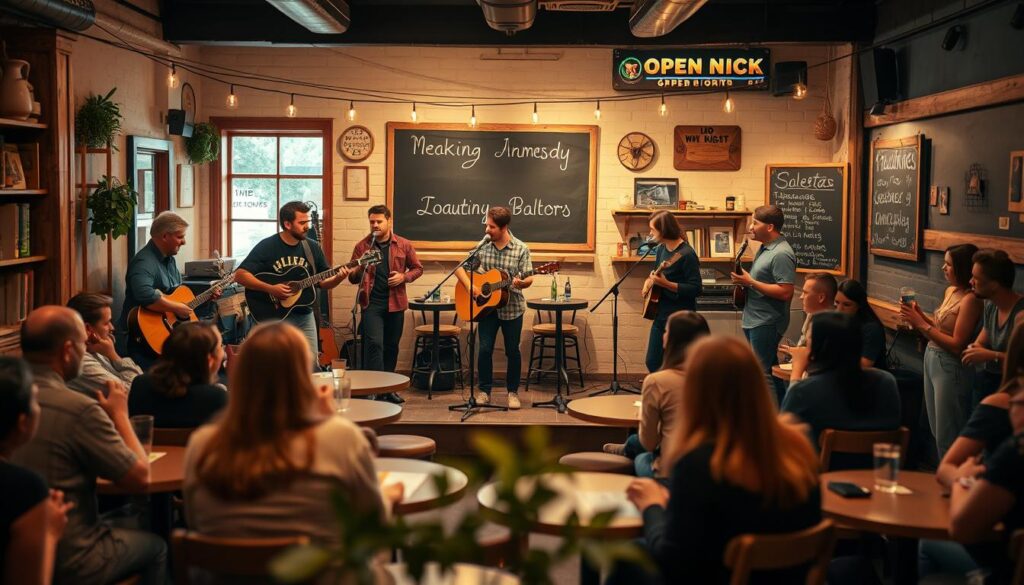
    A cozy open mic night setting in an intimate cafe, with warm, soft lighting that creates a welcoming atmosphere. In the foreground, a diverse group of musicians is performing on a small stage, wearing casual yet stylish clothing. They exude passion and energy, engaging with a captivated audience. In the middle ground, small round tables are occupied by attentive listeners, some holding drinks and others jotting down notes or clapping softly. The background features rustic decor, string lights, and a chalkboard menu, enhancing the artistic vibe of the venue. The scene captures an inspiring moment of creativity and community, showcasing the early stages of indie musicians connecting with their fans in a nurturing environment. The image should be shot with a slightly blurred foreground for depth, and natural, warm tones to evoke a sense of comfort and discovery.

    Josh Barrett’s story shows this path well. Before joining The Wailers, he sang in his church choir and learned from neighbors. These places were his first stage and critics, all in a supportive setting.

    This early foundation was key. It gave him skills and confidence. He formed Judah Tribe, with fans who saw him grow. They supported him, not just because of marketing.

    Many artists follow this path. Open mic nights and local spots are more than gigs. They’re incubators for authenticity. Feedback is quick, relationships are deep, and growth is real.

    We’re thankful for these early chapters in artists’ lives. They show that a musician background built on live experiences is priceless. It’s the heart of finding fans and a lasting music career!

    The Role of Day Jobs in Artistic Development

    Before fame, many musicians worked regular jobs to fund their dreams. We see this as a sign of great dedication. It shows how passion and practicality can build lasting careers in music.

    Take percussionist Bill Summers, for example. Before joining Flo, he worked at a racetrack. He saved every penny, aiming for one goal. His savings helped him move to California and study music at UC Berkeley. This practical step didn’t slow him down; it propelled his career forward.

    Bill’s story teaches us a valuable lesson. Day jobs do more than just pay the bills. They offer life lessons that enrich an artist’s work and character. These lessons are invaluable:

    • Patience: Success in art doesn’t come quickly. Day jobs teach the importance of steady effort.
    • Resourcefulness: Making art on a tight budget sparks creativity. It turns limits into opportunities.
    • Deep Work Ethic: Handling multiple tasks builds stamina and discipline. Passion alone can’t always provide this.
    • Real-World Experience: Interacting with diverse people adds depth to art. It enriches songwriting and performances.

    We’re thankful for these stories of starting small. They show that the journey to success is unique. The day job chapter is a key part of this journey. It’s built on hard work, hope, and a deep love for the craft. Embracing this phase can lay a strong foundation for future success.

    Early Recordings: Demo Quality vs Professional Polish

    Before mixing boards and mastering suites, there’s the simple act of capturing a song. This moment is special! It’s where magic often happens, without the filter of overproduction. The contrast between a demo’s raw charm and a polished track is key for artists.

    Think of Jason Mraz writing “I’m Yours.” He just picked up his guitar and let the melody flow. That raw, spontaneous feeling connected with millions. It shows a demo’s value is in its authentic emotional capture, not just sound quality. These early career struggles are actually periods of pure innovation.

    A dimly lit, cluttered recording studio with vintage recording equipment scattered around. In the foreground, a young musician, dressed in modest casual clothing, appears focused and slightly frustrated as they adjust the dials on an old mixing console. Their body language conveys determination amidst struggle. In the middle ground, various instruments, like an acoustic guitar and a microphone stand, hint at the creative chaos of early demo recordings. The background features shelves filled with vinyl records and soundproofing materials that add to the authentic studio vibe. Soft, warm lighting casts a nostalgic glow, creating an atmosphere that reflects both ambition and the raw essence of the indie music scene.

    Limited equipment and technical know-how can seem like barriers. Yet, they often force incredible creativity. Artists learn to make the most of what they have. This creates a unique sound that polished records can sometimes miss.

    The key is to see the challenge as creative freedom, not a limitation. Learning to navigate these early career struggles builds a resilient, resourceful artistic mind.

    Fans often have a special fondness for these early, unvarnished recordings. They feel like a secret glimpse into the artist’s soul. This connection is priceless. It shows that perfection isn’t the goal—connection is.

    The energy in a rough take can be more compelling than a flawless, but sterile, studio version. For emerging artists, this phase is golden. Embrace the imperfections. Capture ideas freely without the pressure of a “final product.”

    If you’re wondering about process, exploring when to record a demo before finishing your song can offer great guidance. The demos you make today are the treasured artifacts of tomorrow. They document your growth and purest expressions. So, record freely, create boldly, and cherish the journey during these early career struggles.

    Social Media Before the Fame: Authentic vs Calculated Growth

    Before algorithms ruled, artists shared their true selves online. This early digital footprint shows a key choice. It’s between genuine growth and strategic moves. For artists facing early career struggles, this choice shapes their first impression.

    Faceman, Steve Schnepel’s musical alter ego, is a great example. His iconic mask came from his dad’s nickname, “rubber face.” This personal touch built a real community, not a fake image.

    Authentic growth is rooted in personal stories and passion. Calculated growth focuses on numbers and trends. True connections are more powerful than any strategy.

    • Authentic Growth: Based on personal stories or unique views. It feels like talking to a friend. The community is small but loyal. Content is heartfelt, even if it’s not always there.
    • Calculated Growth: Based on data and what others do. It feels like a deal. The goal is to get followers fast. Content is planned out carefully.

    When an artist’s true self becomes their brand, magic happens. This bond helps through tough times. For those in early career struggles, this bond is key. It gives the strength to keep going when progress is slow.

    A dedicated group of fans who connect with your true voice is priceless. This isn’t just advice; it’s a lasting model. It makes building an online presence a journey of discovery.

    So, think about this as you share your work: does it show me? Your answer will guide you through the noise. Building something real takes time, but it’s worth it.

    Breakthrough Moments: The Songs That Changed Everything

    We celebrate those defining tracks that serve as a launchpad, catapulting talented musicians into the public eye. These songs become synonymous with an artist’s name, creating a career launchpad that reshapes their future. For an indie artist, this moment is a whirlwind of excitement and profound change.

    Consider Hanson’s iconic single, “MMMBop.” This track wasn’t just a hit; it was a cultural phenomenon that defined the band’s early career. Taylor Hanson later reflected with immense pride on creating something that connected with millions globally. It was a testament to how a single melody could open doors to a worldwide audience.

    Similar to Hanson, the Flobots experienced a seismic shift with “Handlebars.” While it became known as a national one-hit wonder, its true power was in establishing the band’s enduring platform in their home state of Colorado. The song provided a permanent foothold and recognition that fueled their subsequent creative journey.

    A breakout song is a double-edged sword in the best possible way. The sudden surge of fame can be overwhelming. Yet, this very moment provides an unshakeable foundation. It transforms an artist from a hidden gem into a recognized name, granting them the visibility to build a lasting career.

    The positive impacts of such a breakthrough hit are transformative:

    • Instant Recognition: The artist’s name becomes known to a massive new audience almost overnight.
    • Creative Validation: It confirms that their artistic vision resonates on a large scale, boosting confidence.
    • Industry Opportunities: Doors open for better production deals, festival slots, and collaborations.
    • Fan Community Growth: It catalyzes the formation of a dedicated, supportive fanbase.

    We share these stories with gratitude for the magic of music. A defining track is more than a chart position; it’s a life-altering opportunity that rewards years of patience and craft. For every emerging artist, it represents the beautiful moment when years of work culminate in a song that changes everything.

    Mentor Relationships: Established Artists Helping Newcomers

    Mentorship in music is more than just learning chords. It’s about gaining a philosophy that shapes a career. The most lasting musician backgrounds often come from guidance by those who came before. This cycle of giving back is key to artistic growth.

    We are thankful for the established artists and community leaders who share their wisdom. Their help goes beyond simple advice. It creates a legacy of support that sparks innovation across generations.

    The band Flobots’ story is a powerful example. Their mentor, the late historian Vincent Harding, didn’t teach them guitar. Instead, he challenged their purpose. Harding helped them use their music for social commentary, shaping their identity and mission.

    For jazz legends, their backgrounds are filled with influences. Guitarist Bill Frisell’s sound was shaped in New York, where he learned from Paul Chambers and Charles Mingus. These giants gave him a wealth of ideas, technique, and approach to make his own.

    These mentorships offer more than just technical tips. They provide philosophical grounding. A mentor helps navigate the industry and clarifies artistic values. This support is key for building resilience and authenticity.

    This knowledge and ethos transfer is essential. It prepares new artists to contribute to the cultural conversation. A caring mentor turns raw talent into a sustainable, innovative, and meaningful career.

    Looking at successful musician backgrounds, mentorship is often a key factor. It shows the power of community and the lasting effect of sharing knowledge to guide others.

    Lessons for Current Emerging Artists: Patience and Persistence

    Artist origin stories show us a key truth. A music career is a long journey, not a quick race. Success comes from being patient and persistent.

    Dressy Bessy’s Tammy Ealom kept writing songs for eight years before releasing new music. DeVotchKa worked for seven years to create an album that met their high standards. Taj Mahal has been making music for over 60 years.

    These stories teach us that quiet times are important. They are periods of growth. Your unique path and timing are your strengths.

    We urge every new artist to believe in this journey. Stay connected with your community. Let your true passion guide you. Your story is unfolding with every note and challenge.

    Let these stories of perseverance motivate you. Build your legacy step by step, with patience and persistence.

  • IndieMe Virtual Expo 2026: Buyer Signals

    IndieMe Virtual Expo 2026: Buyer Signals

    The IndieMe Virtual Expo in August 2026 gave handmade wholesale observers a compact case study in how juried creator commerce can work online after the first rush of pandemic-era virtual events. The 14th IndieMe Marketplace Virtual Expo ran from August 12 to August 19, 2026, after being extended by one day from its original August 12–18 schedule at buyers’ request, according to IndieMe’s event press release. Because the event had ended by August 29, 2026, the stronger frame is a measured recap rather than a preview.

    For artists, the most useful signals were not just that orders happened, but that reported ordering stayed active throughout the week. For buyers, the event’s value rested on access: qualified retail buyers could browse and place wholesale orders from juried handcrafted artists based in the United States and Canada. For readers who follow festivals and creator markets as expressions of community taste, the event showed how a screen-based format can still carry the social habits of a buying fair: comparison, discovery, incentives, and relationship-building.

    What The IndieMe Virtual Expo Showed

    IndieMe Virtual Expo Order Pattern

    The most notable reported outcome was the steadiness of order activity. IndieMe said wholesale ordering occurred on every day of the event rather than arriving only at the start. That matters because many virtual events face a common risk: buyers may log in early, scan familiar names, and lose momentum. A weeklong pattern of steady orders suggests that participating buyers kept returning or continued evaluating collections across categories.

    This does not prove that every artist saw equal results. The available information does not provide artist count, buyer count, total sales volume, category breakdown, or median order size. That absence matters. A cautious reading should treat the reported activity as a positive platform-level signal, not as proof that all exhibitors benefited at the same rate. Still, for the IndieMe Virtual Expo, the decision to extend the event through August 19 points to enough buyer demand to justify more ordering time.

    Extension As A Buyer Signal

    The one-day extension is useful evidence because it connected directly to buyer behavior. IndieMe reported larger-than-expected purchases and said buyers asked for more time to complete orders. In trade-event terms, that is more meaningful than a general claim of enthusiasm. It points to a concrete operational change: the event calendar shifted after buyer demand appeared.

    For makers, that type of signal can shape planning. A virtual wholesale event may not require the same booth build-out, travel schedule, or freight decisions as an in-person show, but it still asks artists to prepare product imagery, wholesale terms, inventory expectations, response times, and post-event follow-up. If ordering is distributed across a week, sellers may need sustained attention rather than a single opening-day push.

    Buyer Behavior And Artist Signals

    What Strong Artist Feedback Can And Cannot Prove

    IndieMe reported that some artists described the August event as their strongest event ever, with performance that exceeded certain in-person trade shows in sales or buyer engagement. That is a meaningful claim, but it is still reported feedback rather than independently audited sales data. The distinction is not a dismissal. It simply keeps the analysis fair to artists, buyers, and readers who may use event recaps for business decisions.

    One buyer also described the August Expo as one of the best Expos to date and linked that positive experience to greater interest in The IndieMe Experience in Baltimore. Since the research notes do not provide the buyer’s full purchasing context, store type, or category focus, the comment should be read as one informed perspective rather than a market-wide verdict. Event culture often turns on these individual voices, but evidence-based coverage should avoid turning one comment into a broad claim.

    Why Juried Handmade Context Matters

    The event’s wholesale structure shaped its artistic and commercial meaning. IndieMe described the Expo as a virtual buying event for qualified retail buyers to discover and order from juried North American handcrafted artists. Juried participation is not the same thing as a public open marketplace; it signals that the event was designed around retail buying relationships and handmade product standards rather than casual consumer browsing.

    That format matters for community engagement. Handmade wholesale does not only move goods from studio to shop. It can influence which ceramics, jewelry, textiles, paper goods, décor, and gift objects reach local retailers. When buyers place wholesale orders, they help decide which handmade voices appear on shelves in towns and cities after the event closes.

    Creator Commerce Lessons From The August Event

    Show Specials And Buyer Rhythm

    IndieMe’s artist information page states that the Virtual Expo series had reached its 14th edition and that Expo participation includes features such as artist-provided show specials, including discounts or free shipping, along with buyer giveaways donated by artists, with as many as five giveaways per day during the event artist event details. Those incentives likely helped frame buyer attention during the week, though the available sources do not isolate which feature drove orders.

    Show specials can be read as a familiar trade-show practice translated into an online buying format. At a physical fair, buyers may be influenced by booth conversations, product handling, booth placement, and time pressure. Online, the pressure points are different: visibility, category search, product photography, wholesale terms, shipping offers, and deadline-based incentives. The August event suggests that IndieMe’s model aimed to keep buyers engaged across several days rather than relying on a single opening surge.

    Respecting The Maker-Buyer Relationship

    For artists, the larger lesson is not simply to discount goods or chase every virtual event. Handmade pricing carries labor, materials, skill, overhead, and a maker’s long-term business needs. A show special can support a wholesale decision, but it should not erase the value of the work. Buyers, in turn, benefit when artists provide clear product information, dependable fulfillment expectations, and images that represent objects accurately.

    Because the available research does not list specific artists, categories, or products, this recap avoids naming imagined standouts. That restraint is necessary in creator-commerce coverage. Inventing featured makers or product trends would mislead readers and disrespect the real artists who participated. A trustworthy event review can still be useful by focusing on documented structure, dates, incentives, and reported buyer behavior.

    January 2027 And The IndieMe Calendar

    Calendar page with craft samples and planning notes for future buying dates

    The Next Scheduled Expo

    The next scheduled edition, the 15th event, is set for January 13–19, 2027. IndieMe positioned it as part of a broader buying-season campaign that also includes in-person opportunities such as The IndieMe Experience in Baltimore and Gather: Winter Edition. Because those dates were still in the future on August 29, 2026, they can be discussed as scheduled plans, not outcomes.

    The pairing of virtual and physical events is notable, but it should not be overstated. The research supports the existence of a coordinated buying-season campaign, yet it does not provide attendance projections, exhibitor lists, or sales forecasts for January 2027. The safest interpretation is that IndieMe was using both online and in-person formats to serve wholesale buyers at different points in the buying cycle.

    What Buyers And Artists Could Watch

    For future coverage, the missing data points are clear. Artist count, buyer count, sales volume, category distribution, repeat-buyer share, and order-size ranges would make comparison across editions much stronger. Without them, the August 2026 recap remains useful but partial. It shows positive reported signals, not a complete financial picture.

    Readers interested in cultural events across this publishing network may also find related coverage through a resource connected with industry insights, Kay Granger, particularly where public-facing events intersect with civic calendars and community gatherings. The shared thread is not that all events work alike; it is that dates, participation rules, and documented outcomes matter when assessing any public program.

    IndieMe Virtual Expo 2026 Takeaways

    A Measured Reading Of The August Results

    The August 2026 event should be understood as a successful reported edition within the limits of the available evidence. The IndieMe Virtual Expo ran one day longer than first planned, maintained reported order activity across the week, drew larger-than-expected purchases, and generated positive feedback from at least some artists and buyers. Those are credible event signals when tied to IndieMe’s own release, but they are not a substitute for full comparative data.

    As a festival-style celebration of handmade commerce, the event’s strongest cultural value may sit in the connection between studio practice and retail discovery. A virtual format cannot reproduce touch, scale, or chance hallway conversations in the same way as a physical trade show. It can, however, offer structured access, deadlines, incentives, and a shared buying window. For a juried handmade marketplace, that combination gave the August 2026 Expo enough documented activity to merit attention, while leaving room for more data before broader claims are made.

  • Handmade.com policies and maker trust review

    Handmade.com policies and maker trust review

    Handmade.com policies set a strict standard for creator commerce: a listed item must trace back to a real maker whose hands were meaningfully involved in its creation. For artists, craft sellers, costume makers, and buyers who care about provenance, that claim carries weight. It also raises fair questions about enforcement, buyer confidence, and how a marketplace can protect handmade work without overstating what rules alone can prove.

    The policy direction described in the research is clear. As of June 4, 2026, Handmade.com defined “handmade” as work in which a maker’s hands were “meaningfully and skillfully involved in the creation of every item sold on our platform,” and the item must trace directly to a real individual maker, according to its Policies and Trust page. That definition favors visible authorship over anonymous sourcing, which is a meaningful distinction in a commerce space where shoppers often use “handmade” as a proxy for care, originality, and human labor.

    What Handmade.com policies Require From Sellers

    How Handmade.com policies Define Handmade Work

    The central requirement is direct involvement. The research states that seller eligibility demands participation in design and making, not only packaging, marketing, or fulfillment. It also says items must be made by the seller or by a known maker. That excludes a common gray area in online craft selling: goods sourced from factories, wholesalers, or unknown suppliers and then presented as maker-made.

    For community arts organizers and craft-market curators, this distinction is familiar. A handmade market depends on trust between maker and visitor. The buyer is not only purchasing an object; they are often supporting a person, a studio practice, or a small workshop. A marketplace policy that requires a traceable maker can help preserve that relationship, at least at the level of stated standards.

    Mass Production, Blanks, And Resale Boundaries

    The research notes that since June 2026, Handmade.com has prohibited mass-produced goods and disallowed purchasing goods from factories, wholesalers, or unknown sources for resale. It also describes restrictions on applied graphics, including vinyl decals, sublimation, and print-on-demand on commercial, non-handmade blanks. Personalization such as engraving or embroidery is described as allowed when applied to handmade items.

    That boundary matters because applied decoration can be a serious craft practice in some contexts, while in others it can become a thin layer over industrial goods. The policy, as summarized in the research, appears to draw the line at whether the underlying item and maker involvement support a handmade claim. That is a stricter position than a model that treats any customization as handmade by default.

    AI, Digital Goods, And Material Authorship

    Why The AI Restriction Is Significant

    The research states that Handmade.com’s AI policy, updated by May 2026, bans visual artwork, illustration, or design substantially generated by AI tools such as Midjourney, DALL·E, Stable Diffusion, and Adobe Firefly. It also states that physical prints of AI artwork are not permitted if AI is the primary creative element. This is a notable position because it ties authenticity not only to the physical form of the product, but also to the origin of the image or design.

    For visual artists, the concern is not only whether a print exists on paper, fabric, or wood. The deeper issue is authorship: who made the composition, who made the design decisions, and whether the seller can honestly present the work as their own handmade output. The research does not provide enforcement data, so it would be unwise to claim how consistently Handmade.com identifies AI-generated imagery. What is supported is the policy standard: AI-led visual creation is not treated as acceptable handmade work on the site.

    Physical Products As A Marketplace Requirement

    The research also states that digital-only products and intangible services are not permitted under the latest policy version in June 2026. Every listing must deliver a tangible physical product. This separates Handmade.com from marketplaces where downloadable patterns, digital illustrations, templates, or services can form a large share of seller activity.

    That choice narrows the marketplace’s identity. It favors objects that can be held, worn, displayed, gifted, altered, or collected. For costume culture, textile arts, jewelry, ceramics, printmaking, and home craft, the rule may reinforce the tactile value many buyers seek. Those who are interested in fantasy and artistic expression through clothing may find meaningful connections and ideas at Fairytale Fashion, a related site focused on style and imagination rooted in fashion fairy tales.

    Rights, Imitation, And The Burden On Creators

    IP Claims Need Careful Treatment

    The research states that sellers must represent that they have the necessary intellectual property or usage rights for their listings. It also states that imitations, derivative works without permission, and copying existing pieces are prohibited under the June 2026 policy version. This is a high-level marketplace rule, not a substitute for legal advice. In practice, rights questions can depend on facts outside a product photo or listing title.

    For makers, the safer cultural lesson is to document their own process, avoid passing another artist’s work off as original, and be cautious with protected characters, celebrity likenesses, brand imagery, or close copies of contemporary designs. The policy, as described in the research, places responsibility on the seller to represent rights accurately. That burden is significant for small creators who may not have formal legal support.

    Documentation As A Trust Practice

    Strict rules are easier to evaluate when sellers keep records. Process photos, material notes, sketches, studio images, and descriptions of technique can help buyers understand how an object came into being. The research does not say Handmade.com requires a specific documentation format for every seller, so this should be read as a practical trust practice rather than a stated universal requirement.

    The issue is not unique to one marketplace. Policy shifts around originality and seller evidence have also affected adjacent craft platforms, including the documentation issues discussed in coverage of the Etsy Original Design rule. Across creator commerce, the recurring question is how makers show authorship without turning every listing into a paperwork exercise.

    Reading Handmade.com policies As Trust Signals

    A buyer reviewing a handmade product page while craft tools sit nearby

    Public Reviews Complicate The Picture

    For buyers, Handmade.com policies may signal a serious attempt to protect authentic handmade selling, but policy language should be read alongside public feedback. The research states that, as of August 4, 2026, Handmade.com had a TrustScore of 2.0 out of 5 on Trustpilot based on 15 reviews over the past 12 months. Those reviews included reports of scams, order non-delivery, and impersonation of Handmade.com in job or task offers, as shown on the Trustpilot review page.

    That sample is small, and public review pages can overrepresent negative experiences because satisfied customers may have less reason to post. Still, the reports are relevant to a review of marketplace trust. A strict authenticity policy does not automatically answer questions about fulfillment, customer support, impersonation risk, or dispute handling. These are connected issues, but they are not the same issue.

    What Buyers Can Reasonably Infer

    A buyer can reasonably infer that the platform has published strong standards against resale, mass production, AI-led visual art, digital-only goods, and unauthorized copying. A buyer cannot reasonably infer, from policy language alone, that every listing has been verified in depth or that every transaction will go smoothly. The evidence supplied supports the first point more clearly than the second.

    For a cautious purchase, the practical reading is simple: examine the listing, look for signs of human making, ask respectful questions if the process is unclear, and keep records of orders and communications. That approach protects buyers without treating every seller with suspicion. Many independent artists rely on trust, and trust works best when expectations are clear on both sides.

    Handmade.com policies In Creator Commerce

    Handmade.com policies present a firm definition of handmade commerce: real makers, tangible goods, direct creative involvement, no mass-produced resale, no AI-primary visual art, and seller responsibility for rights. For artists and craft communities, that framework aligns with values often defended at local markets and studio events, where authorship and process are part of the value of the work.

    The caution is enforcement. The research supports the existence of strict standards, but it does not provide enough evidence to measure how consistently listings are reviewed, how many sellers have been removed, or how quickly buyer complaints are resolved. The Trustpilot data cited in the research adds a public-confidence concern, though its small review count limits broad conclusions.

    For creator commerce, the lesson is balanced rather than absolute. Strong rules can set a marketplace culture, but they do not replace transparent enforcement, clear seller documentation, and responsive customer protection. Handmade.com has stated a demanding authenticity standard. Whether that standard earns lasting trust depends on how well the platform, sellers, and buyers can connect policy language to real transactions and real handmade work.

  • AI Music Licensing After The Suno-BMG Deal

    AI Music Licensing After The Suno-BMG Deal

    AI Music Licensing moved into a sharper commercial test on August 12, 2026, when BMG and Suno announced a global strategic alliance covering BMG’s recorded music and music publishing repertoire. The agreement matters beyond the music business because it gives artists, visual creators, event producers, and independent sellers a clearer example of how consent, compensation, and platform controls may be structured when generative systems rely on protected cultural work.

    The deal did not end the broader dispute over generative music tools. It did, however, create a formal path for some BMG artists and songwriters to choose whether their works are included in Suno’s system. For arts communities already weighing soundtrack tools, installation audio, short-form video scores, and creator-commerce promotion, the most useful reading is not that every rights question has been solved. The useful point is narrower: a major rights holder and an AI music platform agreed to a consent-based commercial framework.

    What AI Music Licensing Changed On August 12

    The Announced Scope Of The Alliance

    BMG said on August 12, 2026 that it had entered a global strategic alliance with Suno covering both recorded music and music publishing repertoire, with participation structured around artist and songwriter choice through an opt-in model BMG announcement. That scope is significant because recordings and compositions are distinct rights categories. A creator using music in a film, installation, social video, performance, or branded project often has to think about both sides of the music-rights equation.

    The agreement also sits beside Suno’s broader move toward a licensed model developed with industry partners. According to the research record, Suno associated the rollout with safeguards including watermarking and fingerprinting. Those tools do not answer every artistic or legal concern, but they point to an industry preference for traceability. In practical terms, traceability can affect how a work is identified, how permissions are tracked, and how a platform distinguishes licensed activity from unauthorized imitation or distribution.

    Why The Timing Drew Attention

    The announcement followed a period of pressure on AI music companies. Forbes reported that Universal Music Group and Sony Music remained in active litigation with Suno as of the August 12, 2026 report, while also noting that Suno had raised more than US$400 million, was valued at about US$5.4 billion, and had more than 100 million users Forbes report. Those figures help explain why licensing terms are being watched closely. A platform at that scale can shape habits among amateurs, professionals, advertisers, educators, and small creative businesses.

    For visual arts coverage, the audience is not limited to musicians. Galleries use sound. Fashion films use sound. Cosplay makers, craft sellers, and illustrators often rely on short videos to present process and finished work. Any shift in music licensing practice can affect how these communities choose audio, credit collaborators, document permissions, and assess risk before publishing commercial material.

    AI Music Licensing And Consent

    Opt-In Is The Central Design Choice

    AI Music Licensing often turns on a basic question: who agreed, and to what use? The Suno-BMG structure is notable because BMG artists and songwriters can opt in rather than being described as automatically included. That does not mean every participant will view the terms in the same way. Some may see a new income channel. Others may prefer to keep their work outside AI inputs and outputs. The opt-in design at least makes consent visible as a business feature, not a public-relations afterthought.

    For creators outside BMG, the takeaway should be cautious. One licensed arrangement does not create permission to use another artist’s voice, composition, recording, likeness, or recognizable style. It also does not settle the position of platforms that have no comparable deal. Artists and sellers should treat licensing claims as specific to the platform, territory, work type, account tier, and contract language involved.

    Economic Terms And Attribution Questions

    BMG described the alliance as involving clear economic terms and new creative possibilities. The public description does not provide enough detail to compare artist-by-artist payouts, royalty splits, or downstream reporting. That gap matters. A headline about a licensing deal can sound settled, while the working details determine whether creators can audit use, understand compensation, or withdraw participation under defined conditions.

    Attribution is another open practical issue. In visual culture, crediting an artist, photographer, model, stylist, performer, or musician is part of ethical practice even where a platform interface may simplify production. AI-generated music can blur that habit if users treat outputs as detached from source communities. A rights-aware workflow should still ask whether the audio is licensed for the intended use, whether any human contributors need credit, and whether the platform’s terms allow commercial distribution.

    Why The Deal Matters Beyond Music

    Sound Is Part Of Visual Presentation

    Many emerging visual artists now present work through moving-image formats: studio reels, installation documentation, projection tests, portfolio clips, costume reveals, and shop videos. Music often sets the emotional frame before a viewer reads a caption or sees a wall label. That makes licensed audio more than a back-office issue. It affects the audience’s first reading of the work.

    For small studios and independent sellers, speed can tempt people toward whatever audio tool is easiest. The Suno-BMG agreement shows why that shortcut deserves scrutiny. A tool may generate a track quickly, but a creator still needs to know whether the result can be used in a paid campaign, marketplace listing, festival submission, or client project. That question is not solved by the musical quality of the output.

    Education Needs Clear Examples

    Art schools, community workshops, and online creator courses can use this deal as a case study without treating it as a universal answer. Students can compare the difference between public-domain sound, stock music, commissioned composition, platform-generated music, and licensed AI systems. The strongest lesson is procedural: identify the intended use first, then check the rights pathway before publishing.

    For readers exploring resources that support creator tools and commerce, Shimply is a relevant connection within the same network, offering practical insights into broader seller workflows. The connection here is practical rather than legal: audio choices, product presentation, and rights clearance often meet at the point where a maker turns studio output into public-facing media.

    Rights Questions Around AI Music Licensing

    Creator checking a licensing checklist beside headphones and a tablet

    What Creators Should Ask Before Using AI Audio

    Rights clearance is not a formality for artists who publish work online or sell goods tied to a visual identity. It is part of protecting one’s own practice and respecting other creative workers. The Suno-BMG deal gives one example of a licensed pathway, but each creator still has to ask direct questions before using AI audio in public or commercial settings.

    • Does the platform state whether the output can be used commercially?
    • Does commercial use require a paid account, download, or separate license?
    • Are recordings and compositions both covered, or only one category?
    • Does the output imitate a recognizable living artist, performer, or protected character voice?
    • Can the creator document the license terms that applied on the date of use?

    These questions are not legal advice. They are basic risk-screening steps. If a project has a budget, a client, public distribution, or merchandise attached, a creator may need professional advice before relying on platform-generated audio. The more visible the project, the less sensible it is to depend on assumptions.

    Respecting Style Without Copying Identity

    Visual artists understand the difference between influence and imitation. Music users should apply the same distinction. It is reasonable to describe mood, tempo, instrumentation, or genre in broad terms. It is much riskier, ethically and commercially, to prompt a system to imitate a specific living artist or recognizable performer for the purpose of making substitute work.

    That distinction matters for cosplay, fan art, fantasy fashion films, and handmade product videos. These scenes often draw from shared cultural references, but commercial presentation can raise extra rights concerns. A licensed AI music tool may reduce one set of questions while leaving others in place, including likeness, character, logo, and brand-use issues.

    The Suno-BMG AI Music Licensing Deal

    A Narrow Signal, Not A Universal Settlement

    The Suno-BMG agreement should be read as a narrow signal from a major rights holder and a large AI music platform. It shows that opt-in participation, recorded-and-publishing coverage, economic terms, and technical safeguards can be placed into a formal deal. It does not prove that all AI training disputes are resolved, nor does it establish permission for works outside the agreement.

    For artists and makers, the practical response is to become more specific. Ask which catalog is covered. Ask whether a songwriter opted in. Ask whether a generated track can be used in a client video, runway presentation, exhibition trailer, or product listing. Keep dated records of platform terms. Avoid prompts that trade on a living artist’s identity. Treat music as a collaborative cultural field, not a disposable background layer.

    That standard may sound slower than instant generation, but it is more aligned with how serious creative practice already works. Materials have sources. Images have permissions. Performers deserve credit. Songs carry rights. The Suno-BMG deal did not remove those responsibilities; it made them easier to see.