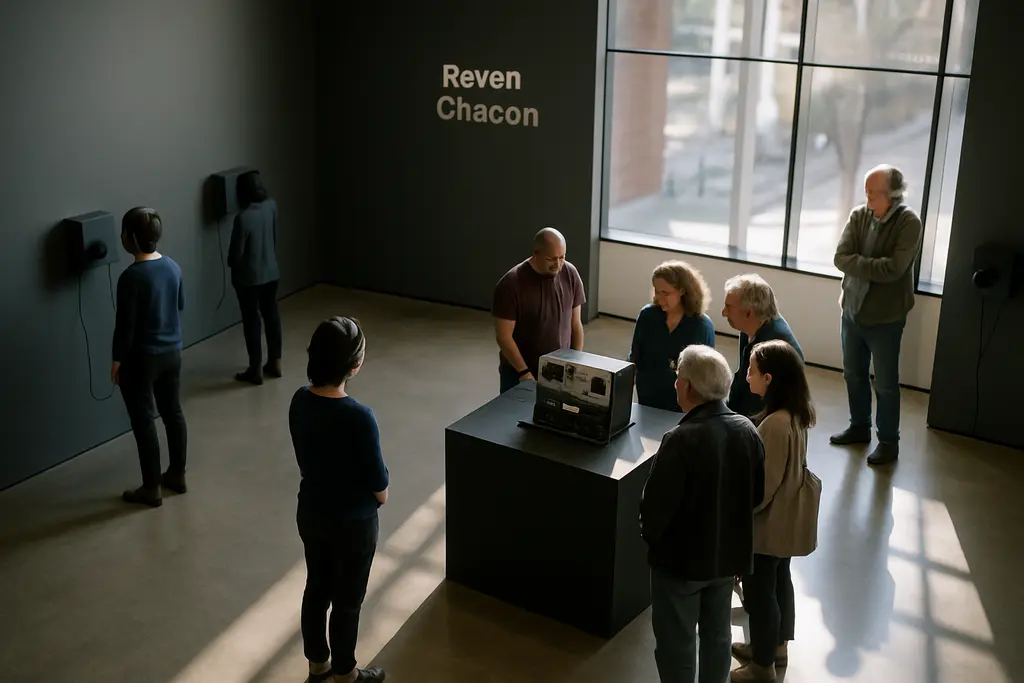
Raven Chacon SFMOMA names an exhibition that had not yet opened as of September 6, 2026, so the most responsible reading is a pre-opening analysis based on museum information rather than a review. Scheduled for October 24, 2026, through November 7, 2027, New Work: Raven Chacon centers a new installation by Diné composer and artist Raven Chacon. The project appears to join moving image, sound, archival film, speculative fiction, and land-based cultural narratives without reducing any of those parts to decoration.
Raven Chacon SFMOMA Exhibition Facts
Dates, Floor, And Admission
According to SFMOMA’s exhibition page, New Work: Raven Chacon is scheduled to run from October 24, 2026, through November 7, 2027, on Floor 6 of the museum. Entry is listed as included with general admission. The museum describes the exhibition as a solo West Coast presentation by Raven Chacon, a Diné composer and artist. These details establish the basic frame, but they do not substitute for direct experience of the installation after opening.
Why Raven Chacon SFMOMA Matters Before Opening
Because Raven Chacon SFMOMA coverage is necessarily anticipatory before October 24, 2026, claims about audience response, critical consensus, or sensory impact should be treated with care. What can be assessed is the project’s stated structure: a five-channel video installation titled The Naming of Names from 2026, accompanied by field recordings and electronic music composed by Chacon. The format suggests an encounter that asks viewers to listen as much as look, a point that matters in museum settings where sound can change the pace of attention.
- Exhibition: New Work: Raven Chacon
- Main installation: The Naming of Names (2026)
- Format: five-channel video installation with sound
- Dates: October 24, 2026, through November 7, 2027
- Location: Floor 6, SFMOMA
Speculative Futures Through Sound And Film
Video, Archives, And The Naming Of Names
The Naming of Names is described by the museum as combining Ray Bradbury’s science fiction with archival film footage from the 1950s and 1960s drawn from the Prelinger Archives. That combination is significant because science fiction often imagines distant futures while archival film can preserve the assumptions, omissions, and visual codes of earlier periods. Placing those materials together can invite viewers to ask who is allowed to name places, who is positioned as discoverer, and whose presence is made to seem distant or strange.
A cautious interpretation would avoid treating the installation as a simple illustration of Bradbury or as a direct historical documentary. Based on the museum’s description, the work seems to operate through friction: speculative fiction against archival footage, earthly terrain against imagined planetary space, and sound against image. Those juxtapositions may make the act of naming feel less neutral. Names can mark memory, control, refusal, survival, or reorientation depending on who uses them and under what conditions.
Listening As Cultural Inquiry
Chacon’s soundtrack of field recordings and electronic music is not a side element in this framework. Sound art can place pressure on the body: breath slows, posture shifts, and attention changes when a room asks for listening rather than quick scanning. As an educator and fitness advocate, I see value in that embodied dimension. Museum stamina is not only about standing longer; it is about noticing when a work asks us to pause, soften the gaze, or become aware of the distance between hearing and understanding.
For readers following sound-based creative practices, robsonic.org offers a nearby point of reference within the same network of related arts coverage. Still, Chacon’s work should be approached on its own terms. The available museum description emphasizes Indigenous land, archival material, and speculative frameworks, not sound as mere atmosphere.
Land, Naming, And Cultural Narratives
Tséyiʼ And Valles Marineris
The exhibition also includes layered topographical drawings that link Tséyiʼ, or Canyon de Chelly, on Earth with Valles Marineris on Mars. The museum’s description says these drawings collapse earthly and Martian canyons. That pairing is charged because it places a culturally specific Indigenous place in relation to a planetary formation often discussed through exploration, mapping, and scientific naming. The connection does not need to erase difference in order to be meaningful; its force may lie in holding two mapped spaces together while asking viewers to notice how naming systems carry power.
Tséyiʼ is not simply a visual form available for abstraction in this discussion. The responsible critical stance is to recognize that the exhibition, as described, engages land as a site of relation and contested representation. Any analysis that turns Indigenous territory into a neutral aesthetic motif would miss the ethical weight suggested by the project’s framing.
The Semiquincentennial Frame
SFMOMA describes the work as intervening in colonial narratives by reimagining Southwestern tribal lands as “otherworldly” and by challenging representations of Indigenous territories during the U.S. Semiquincentennial, the 250th anniversary. That timing matters, but it should not be overstated before the exhibition opens. Anniversaries can invite patriotic commemoration; artists can also use them to test what official memory leaves unresolved.
Here, the phrase “otherworldly” needs careful handling. In a colonial visual tradition, Indigenous lands and peoples have often been framed as remote, exotic, or outside modern time. Based on the museum’s wording, Chacon appears to redirect that language rather than accept it. Speculation becomes a method for questioning the categories through which territory is seen and renamed.
How Artists And Educators Can Approach The Work
Speculation Without Extraction
For artists, educators, and students, Raven Chacon SFMOMA offers a useful case study in speculative practice with ethical stakes. The lesson is not to copy a living artist’s visual or sonic language. A more respectful learning approach is to study the questions the project raises: How do archives shape the future? How does a soundtrack change the authority of an image? How do maps, canyons, and names carry cultural memory?
In classroom settings, those questions can become prompts for slow observation rather than imitation. Students might compare how a place is described in a map, a family story, a museum label, and a science-fiction passage. The point would be to see how each format produces knowledge differently. That method supports creative thinking while avoiding the extractive habit of borrowing Indigenous imagery without context or permission.
Fitness, Attention, And Museum Stamina
Installation art can be physically demanding in subtle ways. A five-channel video work may require viewers to turn, stand, sit, or return to a sequence more than once. Sound can draw the body through a gallery without a clear front-facing viewpoint. Simple wellness habits can improve attention: breathing evenly before entering a sound installation, stepping aside when overstimulated, and allowing time for the body to settle before forming an interpretation.
Those practices are not separate from art education. They help viewers respect works that unfold over time. They also create room for cultural humility, since not every element of an installation is meant to be consumed instantly or translated into quick opinion.
Raven Chacon SFMOMA Cultural Narratives
What Can Be Said Now
Raven Chacon SFMOMA can be discussed now as a scheduled exhibition with clearly stated materials, dates, and themes. It cannot yet be assessed as a completed public encounter. The supported facts point to a new 2026 installation, The Naming of Names, that brings together Bradbury-related science fiction, Prelinger archival footage, field recordings, electronic music, and topographical drawings connecting Tséyiʼ with Valles Marineris.
The strongest pre-opening reading is that Chacon’s project treats speculative futures as a way to question cultural narratives about land, discovery, and naming. For educators, artists, and attentive museum visitors, the value lies in approaching the work slowly: listening to its sound, observing its archival and planetary references, and resisting any claim that turns Indigenous presence into metaphor alone.