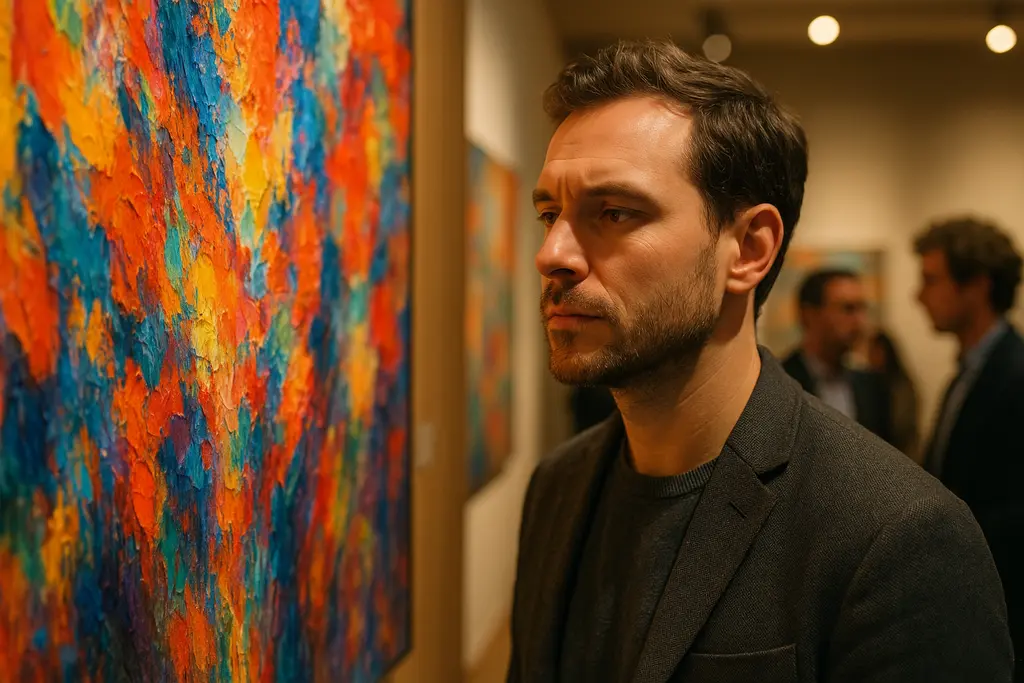
The Stanley Boxer exhibition at Madelyn Jordon Fine Art in White Plains, New York, marked the centennial of the artist’s birth with a focused presentation held from June 17 to August 14, 2026. The gallery’s presentation brought together works spanning four decades, including examples from the Ribbon Painting Series and later material-driven paintings, according to the exhibition information published by Artsy. As a review subject, the show is useful because it does not ask viewers to treat abstraction as a single style. It asks them to study how gesture, surface, and material can change over time while still belonging to one artist’s sustained practice.
Reading The Stanley Boxer Exhibition
What The Stanley Boxer Exhibition Shows
The exhibition’s strongest interpretive value lies in its range. A centennial display can easily become ceremonial, but the available description points toward a more analytical structure: early-1970s ribbon works, 1980s impasto surfaces, and late paintings using unconventional materials. That arc helps viewers see Boxer not only as a painter of abstract marks, but as an artist who tested what a painting’s surface could hold.
For a community arts reader, the Stanley Boxer exhibition also raises a practical question: how do galleries make a past practice legible to present audiences without reducing it to biography? The show’s date range and selected series appear to answer through material evidence. Rather than relying only on reputation, it places bodies of work in contact with one another, allowing changes in surface, scale, and density to become the argument.
Why A Centennial Frame Matters
Boxer was born in New York City in 1926, served in the Navy during World War II, and later studied at the Art Students League. Those facts matter, but they should not be treated as a shortcut to reading the work. Postwar American abstraction included many positions on gesture, objecthood, color, and material presence. Boxer’s case is best approached through what the paintings do: they gather, resist, thicken, suspend, and sometimes appear to push beyond the flat rectangle.
The centennial format gives viewers permission to slow down. In a single-artist exhibition, differences between decades become easier to read because the comparison is internal. The viewer is not simply asking whether Boxer fits a movement label. The more precise question is how his works modify the expectations that viewers bring to postwar abstract painting.
Ribbon Paintings And Suspended Motion
Gesture After Illness
The Ribbon Painting Series, dated 1971 to 1976 in the exhibition notes, forms an especially clear point of study. The research states that the series was developed after a period of illness in late 1970 and that the works are marked by rhythmic, ribbon-like gestures. That context should be handled with care. Illness can be relevant to artistic production, but it should not be used to over-explain the work or turn it into a sentimental key. The paintings still need to be read as formal decisions.
In those works, ribbon-like movement suggests energy held in suspension. The term “ribbon” is helpful because it implies both line and body: something linear, but not weightless; something moving, but not fully free of matter. That double quality makes the series important within the Stanley Boxer exhibition, since it shows an artist thinking about gesture as a physical event rather than a simple trace of the hand.
Movement Without Narrative
The Ribbon Paintings appear to depend on movement, but not on storytelling. This is one reason they can still feel active in a gallery setting. A viewer does not need to identify a figure, scene, or symbol to sense the work’s pressure. Instead, the movement is built through recurrence, direction, and the interval between marks. The “suspended” quality described in the research is not passive; it suggests motion held in a charged state.
That distinction matters for art criticism because abstraction is sometimes discussed as if it were detached from bodily experience. Boxer’s ribbon gestures suggest the opposite. They ask the eye to follow, pause, and return. In community viewing, this can make the work approachable without making it simple. People can disagree about mood or rhythm while still attending to the same visible structures.
Surface, Material, And Community Seeing

Paint Treated As Matter
Boxer has often been described as a “sculptor of paint,” a phrase used in coverage of the centennial show by Art & Object. The phrase is persuasive because it directs attention away from painting as image alone. It suggests that paint in Boxer’s work can behave as substance, relief, weight, and accumulated action.
The 1985 work “Hotjoustatdusk,” named in the research, represents the 1980s phase of heavily manipulated surfaces, with dense impasto and textured brushwork. Such details matter because they help viewers avoid vague praise. “Texture” is not merely an effect; it is a structural condition of the work. Thick paint changes how light falls, how the eye moves, and how a painting occupies physical space.
Why Tactility Reaches Beyond Painting
From the 1990s onward, the research notes that Boxer’s paintings incorporated materials such as pebbles, glitter, and strings. This material shift expands the question of painting’s boundary. A canvas that includes such elements is not only a support for pigment. It becomes a site where matter is arranged, pressed, embedded, and made visible as part of the work’s meaning.
That material attention also connects with wider cultural practices of making. Costume artists, fiber makers, set designers, and community art groups often understand texture as a social form of communication: something that changes how people gather around an object. Readers interested in related conversations about fantasy, dress, and material imagination can explore more at Fairy Tale Fashion. The point is not to collapse painting into fashion or craft, but to recognize that tactile decisions can help many audiences talk about art with precision.
The community value of a show like this rests partly in that shared language. Viewers who may not have a specialist vocabulary for postwar abstraction can still speak carefully about weight, shine, drag, roughness, rhythm, and edge. Those are not lesser observations. They are often the first steps toward a more exact reading of abstract work.
Stanley Boxer Exhibition In Postwar Abstraction
Reputation And Evidence
Boxer’s career included more than 100 solo exhibitions, a Guggenheim Fellowship in 1975, and a National Endowment for the Arts Visual Artists Fellowship Grant in 1989, according to the provided exhibition research. His work is also reported as being held in major museum collections, including the Museum of Modern Art, the Solomon R. Guggenheim Museum, the Whitney Museum of American Art, and Tate Modern. Those markers establish institutional recognition, but they should not replace looking.
The value of the Stanley Boxer exhibition is that it gives reputation a visible test. If the works from different decades can speak to one another across changes in technique, then the exhibition does more than honor an anniversary. It offers evidence of continuity through change. The Ribbon Paintings, the impasto works, and the later material pieces suggest an artist repeatedly asking how far painting can move toward objecthood while remaining painting.
What Viewers Can Carry Forward
The most useful way to leave this show is not with a slogan about Boxer’s place in art history, but with a sharper set of viewing habits. Look at where gesture becomes structure. Notice when surface stops acting like a background and starts behaving like an event. Ask whether added materials clarify the painting’s force or risk overwhelming it. These questions respect the work because they stay close to what can be seen.
The Stanley Boxer exhibition is strongest as a study in sustained material inquiry. Based on the available research, it appears to have presented a rare chance to follow four decades of an artist’s practice through works that test the boundary between painted image and physical object. For postwar American abstraction, that boundary remains one of the most productive places to look.