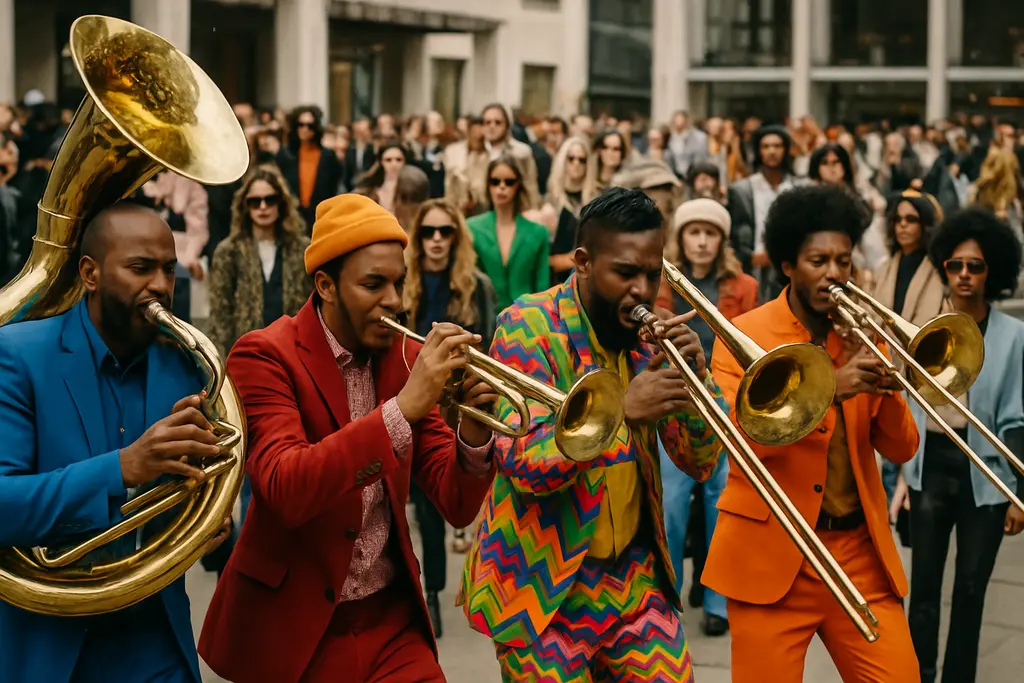
NYFW Brass Bands became one of the more striking cultural signals from September 2026 fashion programming, not because every runway turned into a street parade, but because a few documented live-music choices changed how audiences could read the clothes, the venue, and the social energy in the room. On September 9, 2026, Brass Queens opened Damson Madder’s “Press Play” event with a New Orleans-inspired arrangement, while Ralph Lauren’s Spring/Summer 2027 show on September 10, 2026, ended with student musicians from UpBeat NYC breaking into live music during the finale. Those moments were different in instrumentation and institutional setting, yet both treated sound as part of the show’s authorship rather than background decoration.
The careful reading matters. A brass ensemble at a fashion event is not automatically proof of a broad industry shift, and a single school ensemble appearance should not be folded too casually into the same category as a professional brass act. Still, the September 2026 examples offer useful evidence for how fashion houses and event producers used live musicians to add texture, timing, and community presence to runway presentation. The best interpretation is measured: brass and ensemble performance helped some shows feel more theatrical, but the available reporting does not support sweeping claims about all of New York Fashion Week.
Why Live Music Changed The Runway Read
Sound As More Than Atmosphere
Runway sound is often treated as mood setting, but live musicians can change the pace of attention. Recorded music tends to stabilize the room around a fixed track. A live ensemble introduces breath, volume, risk, and visible labor. The audience sees musicians making choices in real time, and that can make the fashion presentation feel closer to performance art than a timed procession.
At Ralph Lauren’s Spring/Summer 2027 show on September 10, 2026, a string band of student musicians from UpBeat NYC, based in the South Bronx, performed during the finale as models walked the runway, according to a New York Times review. That fact should be stated precisely: the reported ensemble was a string band, not a brass band. Its relevance here is that it sat beside brass-led programming in the same NYFW cycle as evidence of live music being used as a visible fashion-show device.
For a curator or reviewer, that distinction is not pedantic. It protects the musicians from being treated as interchangeable decoration. Brass players, string players, student ensembles, and professional stage acts bring different traditions, rehearsal cultures, and social meanings. The strongest analysis starts by naming those differences before comparing their effect on the room.
How NYFW Brass Bands Shifted The Room
NYFW Brass Bands As Social Staging
NYFW Brass Bands took on a clearer form at Damson Madder’s “Press Play” event on September 9, 2026, where the eight-piece ensemble Brass Queens opened the show with a New Orleans-inspired arrangement. The Washington Post later named Brass Queens and UpBeat NYC among its “Best use of live music” moments from New York Fashion Week, in a review published on September 17, 2026, that also described Brass Queens covering pop songs during the event Washington Post review.
That kind of booking can shift the room in at least three ways. First, brass instruments carry physically. Their presence changes how a venue feels before a garment is assessed in detail. Second, brass performance has a strong association with public gathering, procession, dance, and civic celebration. Those associations can give a fashion show a communal charge without requiring the clothes themselves to mimic parade dress or costume. Third, the performers are visible collaborators, which makes the staging feel less like a sealed brand image and more like an event built from several art forms.
NYFW Brass Bands did not erase the commercial frame of fashion week. These were still branded events serving collection presentation, press attention, and market positioning. Yet the use of Brass Queens made the sonic layer harder to ignore. Rather than simply filling silence, the performance became part of how the audience understood timing, humor, confidence, and audience invitation.
A related NextClues review of NYFW theatrical design considered how local orchestral and brass elements affected runway staging during September 2026. That connection is useful because live music, set design, and venue choice often work together; none of them should be evaluated as isolated decoration when they are programmed as part of the same presentation.
What The Evidence Can And Cannot Claim
Limits Of The September 2026 Record
The strongest evidence from the available reporting is specific, not statistical. It supports the claim that Brass Queens performed at Damson Madder’s event on September 9, 2026, and that UpBeat NYC musicians performed during Ralph Lauren’s September 10, 2026, finale. It supports the claim that at least one major newspaper grouped those performances among notable live-music uses during the week. It does not prove how many NYFW shows used brass, whether brass bookings increased by a measured percentage, or whether live music drove sales.
That boundary is worth holding. Fashion coverage often moves quickly from memorable moments to broad claims about trend direction. A more cautious reading treats these performances as meaningful cases. They show what was possible and visible in September 2026, while leaving open the question of whether they mark a durable programming pattern.
- The confirmed Brass Queens example shows a brass ensemble being used as an opening performance at a fashion event.
- The confirmed UpBeat NYC example shows student musicians being positioned inside a major runway finale.
- The available cited record does not establish a count of all live-music performances across the week.
- The evidence does not show a direct link between these performances and sales, buyer behavior, or long-term brand value.
For NYFW Brass Bands coverage, that distinction protects both readers and artists. It lets critics describe impact without overstating reach. It also avoids turning musicians into proof points for a prewritten industry narrative. The artistic value here lies in the performance itself: rehearsal, arrangement, stagecraft, and how the ensemble shared space with fashion.
NYFW Brass Bands And Fashion Culture
Community Presence Without Overclaiming
NYFW Brass Bands are most persuasive as a cultural signal when understood through presence rather than novelty. Brass Queens brought a collective sound associated with street performance, pop reinterpretation, and public festivity into a fashion-week setting. UpBeat NYC’s student musicians brought youth music education into the frame of a high-profile runway finale. Those choices placed musicians where fashion audiences had to see them, not merely hear them.
There is also a rights and credit dimension, even if this is not a legal analysis. When fashion events use live arrangements of familiar songs or book identifiable ensembles, clear crediting, permissions, and respectful presentation matter. Public reporting can confirm that performances happened, but it should not assume licensing details that are not documented. The more responsible critical stance is to credit the performers by name where verified and avoid guessing about behind-the-scenes rights clearance.
For readers tracking how music events, fashion staging, and community performance cultures overlap, Robsonic offers a related site in the same network with adjacent attention to live-culture contexts. That broader lens helps keep the focus on performers as artists, not accessories.
NYFW Brass Bands, judged from the September 2026 record, did not define all of New York Fashion Week. They did, however, clarify how live sound can alter the social meaning of a show. Brass Queens gave Damson Madder’s event a public-facing pulse, while UpBeat NYC’s appearance at Ralph Lauren showed how young musicians could be folded into a finale with symbolic weight. The lesson is not that every runway needs a horn section. It is that when live music is programmed with care, the runway becomes a shared performance space, and fashion criticism has to listen as closely as it looks.