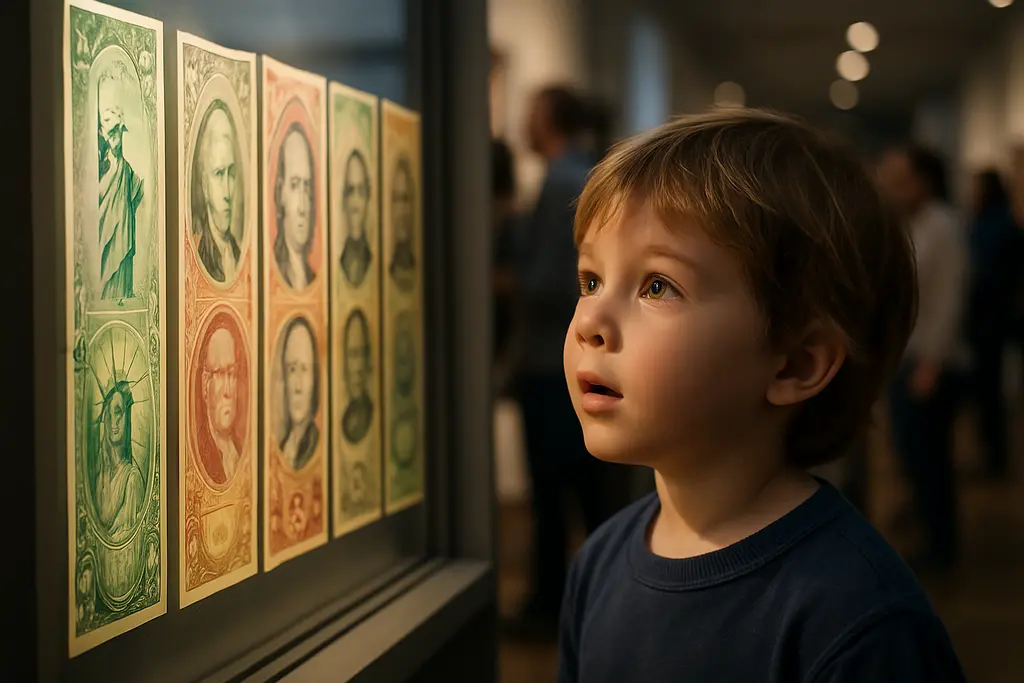
The Treasury exhibition Shaping American Identity: The Art of the U.S. Department of the Treasury asks a direct cultural question: how does a federal department known for currency, public finance, and official design help form the images through which a country recognizes itself? Open from September 19, 2026, through January 18, 2027, at 1503 Pennsylvania Avenue NW in Washington, D.C., the exhibition is presented across more than 70,000 square feet of gallery space, according to the MCAAD exhibition page.
As of October 5, 2026, the show is ongoing, so any assessment has to stay close to the available institutional record rather than overstate reception, visitor response, or scholarly consensus. What can be said with confidence is that the exhibition links art, money, design, and civic symbolism at a moment when the United States is approaching its 250th anniversary. That timing gives the show a wider frame: not only what images the Treasury has preserved, but how those images help define public ideas of work, aspiration, national memory, and belonging.
What The Treasury Exhibition Shows
Treasury Exhibition Dates And Setting
The exhibition occupies a location with symbolic weight: Pennsylvania Avenue NW, a corridor closely associated with federal power and civic ceremony. The site matters because the material on view is not presented as private collecting alone. It is framed through public institutions and national imagery. The collaboration includes the U.S. Department of the Treasury, the Milken Center for Advancing the American Dream, the Bureau of Engraving and Printing, the United States Mint, and Freedom250.
That partnership is useful to read cautiously. It does not, by itself, prove that the exhibition offers a single settled definition of American identity. Rather, it suggests that identity is being approached through several connected systems: fine art, public design, engraving, coinage, and anniversary culture. Each partner brings a different relationship to official imagery, and that breadth helps explain why the show’s subject extends beyond paintings on walls.
Collections, Media, And Public Design
The selected works include paintings, sculptures, posters, and prints drawn from Treasury collections. The available research does not specify the number of objects, the full checklist, or the names of featured artists, so those details should not be inferred. The known range of media still matters. Posters and prints often circulate differently from paintings or sculpture; they can be designed for wider visibility, public instruction, or civic persuasion. Sculpture and painting may carry more ceremonial associations, depending on subject, scale, and display context.
Seen together, these forms point toward a central premise: national identity is not made only through speeches, laws, or monuments. It is also shaped through repeatable images, official emblems, and visual habits. The everyday quality of Treasury-related design is especially significant. Currency, seals, medals, printed documents, and public posters can enter daily life in ways that museum objects often do not.
Art, Money, And National Symbolism
Objects Built For Public Recognition
Because the Treasury exhibition brings together art and design connected to a federal department, it invites a reading of public recognition. A symbol succeeds when people can identify it quickly, but that speed can conceal the decisions behind it. Classical references, allegorical figures, architectural motifs, and images of labor or progress may appear familiar because they have been repeated across civic culture for generations.
The show’s stated emphasis on Americans as they work, play, and pursue their dreams places everyday life at the center of the interpretive frame. That phrase should be handled with care. It gestures toward broad civic aspiration, but exhibitions also depend on selection. Which kinds of labor are pictured? Which communities are present or absent? Which dreams are treated as national, and which remain local, contested, or private? Those questions are not objections to the exhibition. They are the conditions under which identity exhibitions become serious cultural work.
Classical Ideals And National Aspiration
The exhibition’s public description says the Treasury helped craft a “visual identity for our nation—born from classical ideals and reflecting America’s history, accomplishments, and aspirations.” That phrasing identifies a major tension. Classical ideals have long supplied American civic design with figures of liberty, virtue, order, and republic-building. Yet American history is not a single smooth story. It contains achievement and exclusion, confidence and conflict, shared symbolism and disputed meaning.
This is where art history can add pressure without dismissing the exhibition’s aims. National symbols are rarely neutral. They gather authority through repetition, placement, and institutional endorsement. A Treasury seal or allegorical figure may seem stable, but its meaning can shift as viewers bring different experiences to it. The strongest exhibitions on national identity usually allow those shifts to remain visible rather than treating symbols as fixed answers.
Why Scale And Site Matter
Seventy Thousand Square Feet As A Curatorial Claim
More than 70,000 square feet is not a small interpretive gesture. Scale affects how visitors understand importance. A large exhibition can give viewers time to see patterns across media, periods, and institutional uses. It can also risk turning complexity into spectacle if the argument is not organized with care. Based on the available facts, the scale appears designed to present Treasury-related visual culture as a major strand in the formation of American public identity.
For visitors assessing the Treasury exhibition, the key question is not only whether individual works are striking. It is whether the show clarifies the relationship between artistic form and civic function. A poster, a print, or a sculptural emblem may be aesthetically compelling, but its public meaning depends on use: where it appeared, who saw it, what institution endorsed it, and what values it asked viewers to recognize.
Washington, D.C. As Context
Washington, D.C. changes the reading. Art shown near federal institutions often carries a different charge than the same art shown in a commercial gallery. The address places the exhibition in proximity to the symbolic machinery of government. That does not make the show propaganda by default, nor does it make every image official in the same way. It does mean the exhibition’s civic claims deserve close reading.
There is also a useful comparison to broader cultural programming around democracy and memory. NextClues has covered related institutional framing in Smithsonian exhibitions on democracy and identity, where national culture is treated through objects, sound, memory, and public interpretation. The Treasury-centered show belongs to that wider anniversary-season conversation, though its emphasis on fiscal and symbolic design gives it a distinct institutional lens.
Cultural Reading Beyond The Gallery

Fashion, Ceremony, And Symbolic Form
One reason this exhibition crosses beyond narrow art history is that civic symbolism often overlaps with dress, ceremony, pageantry, and public performance. Coins, seals, posters, uniforms, and commemorative imagery all depend on visual codes that audiences learn over time. For readers interested in how fantasy, costume, and designed identity intersect in other cultural spaces, studies of fairytale fashion offer a related way to think about how clothing and symbolic form shape recognition.
That comparison should not blur categories. Federal visual culture and fashion culture operate under different institutions, markets, and rights conditions. Still, both rely on legibility. A viewer recognizes authority, aspiration, celebration, mourning, or belonging through choices of color, silhouette, material, pose, and emblem. The Treasury context shows how such choices can become part of national memory when they are repeated through public systems.
Questions The Exhibition Raises
The Treasury exhibition seems especially useful for asking how official images balance idealism and lived experience. The phrase “American identity” can be expansive, but it can also flatten difference if handled too broadly. An evidence-based response should therefore distinguish between the exhibition’s stated ambition and the questions its subject naturally raises.
- How do Treasury collections represent work, leisure, ambition, and civic belonging?
- How are classical references adapted for American public imagery?
- Which symbols appear stable, and which depend on historical context?
- How does the semiquincentennial frame affect interpretation?
These questions keep the emphasis on analysis rather than celebration alone. They also respect the fact that American identity is not owned by one agency, institution, artist, or anniversary program. It is argued over through images, ceremonies, laws, markets, classrooms, families, and public memory.
Treasury Exhibition And American Identity
A Careful Reading Of A National Show
The final value of the Treasury exhibition may lie in making familiar imagery feel open to examination again. Currency-related design and official symbols can become so common that viewers stop seeing them as artworks or as choices. By gathering paintings, sculptures, posters, and prints in one exhibition, the show appears to slow that recognition process down.
That slowing down is culturally productive. It allows visitors and critics to ask how an image earns authority, how a symbol travels, and how national aspiration is pictured without pretending that aspiration has been experienced equally by all communities. With the United States’ 250th anniversary as the backdrop, the exhibition’s strongest contribution is not likely to be a single definition of national character. Its more durable contribution is the invitation to study how art and design have helped build the visual language through which Americans have imagined public life.