
Forget the old days of campfire songs and generic brochures. Today’s summer sports camps are much more complex. They focus on strategic development, not just fun.
Choosing the right camp is more than just filling summer hours. It’s an investment in your child’s growth and independence. It’s also a logistical challenge that rivals the Pentagon.
This guide is your roadmap to a meaningful experience. We’re moving beyond basic brochures. We’ll analyze options with the detachment of a sociologist studying a unique subculture.
We’ll explore the balance between intense skill development and pure fun. You’ll learn to weigh local convenience against the thrill of travel. Think of this as your essential briefing before the summer campaign starts.
Types of Youth Sports Camps Available
Choosing a camp type is more than picking activities. It’s about finding the right place for your child to spend their summer. Today’s youth athletics camps offer a wide range of options. It’s like choosing a whole ecosystem, not just a simple menu.
The traditional camp offers a mix of everything. You’ll find canoes, archery, and campfire songs. It’s great for kids who can’t decide what they love most.
Specialty camps focus on one thing, like soccer or ballet. These camps are for kids who are totally into one sport or activity. The coaches are top-notch, and the friendships are strong.
But there’s more to it. The “specialty” branch has many different areas:
- Sports & Athletics Camps: All about mastering one sport.
- STEM & Academic Camps: Mixes sports with science and math.
- Arts & Performance Camps: For kids who love to perform.
- Adventure & Outdoor Camps: Builds strength through outdoor activities.
There are also many niche options. Fitness camps focus on overall health. Faith-based camps teach spiritual lessons through sports.
Some camps are made for specific needs. Special needs camps offer a safe place for all kids. Family camps help families bond through activities.
Overnight camps offer a full-time experience. Kids learn to be independent and make lasting friends. You also have to decide between day or overnight camps.
Every youth athletics camp has its own way of teaching. Some focus on many things, while others concentrate on one. You need to find the right fit for your child.
Day Camps vs Overnight Camp Options
Choosing between day and overnight camps is like picking between a daily commute and full immersion in kids sports programs. Day camps keep the family together, while overnight camps send your child into a world of their peers. This choice affects both logistics and psychology.
Day camps offer a balance. For about $100.60 a day, kids get professional coaching, structured play, and social time. They then return home for dinner and their own bed.
This option is great for beginners, younger athletes, or families trying summer camps. It keeps routine and strengthens family bonds. Kids can share their day’s experiences from the comfort of home.
It’s like a controlled experiment in growing up. They enjoy camaraderie without the challenges of living in a cabin.
Overnight camps, on the other hand, offer full immersion. Prices range from $170 to $325 a day, covering lodging, meals, and supervision. It’s more than sports; it’s a complete growth experience.
Here, kids learn to be independent. They manage their belongings, live with others, and face homesickness alone. Research shows overnight camps boost resilience and self-reliance.
The cost difference shows the depth of overnight camps. Day camps focus on skills. Overnight camps build character.
| Feature | Day Camp | Overnight Camp |
|---|---|---|
| Average Daily Cost | $100.60 | $170 – $325 |
| Schedule | Daily return home | Full-week immersion |
| Primary Benefit | Routine & family connection | Independence & resilience |
| Ideal For | First-timers, younger kids | Building self-reliance |
| Experience Depth | Skill-focused sessions | Holistic development |
So, which camp is right for your child? Day camps introduce kids to kids sports programs gently. Overnight camps push personal growth through total immersion.
The question is not which is better. It’s which environment will help your child grow at this time. Some kids need home’s comfort to thrive. Others need to discover they can fly.
Consider your child’s readiness, not just their sports skills. A confident ten-year-old might do well at sleepaway camp. A hesitant twelve-year-old might prefer day camps. The best kids sports programs meet the athlete where they are and challenge them to grow.
Remember, both options develop skills. But only one teaches kids to make their bed after practice. Sometimes, that lesson is worth the extra cost.
Age-Appropriate Camp Selection
The gap between a four-year-old and a fourteen-year-old is huge. It’s not just about years. It’s about their needs in thinking, social skills, and physical abilities. Choosing a summer sports camp based only on location or cost is a big mistake. The key is to find a camp that matches your child’s stage of development.
Choosing the right camp is like casting for a play. You wouldn’t put a toddler in a Shakespeare play. A teen in a camp for younger kids would quickly lose interest.
Let’s look at what each age group needs. This isn’t about holding kids back. It’s about helping them grow at their own pace.
| Age Group | Developmental Focus | Ideal Camp Programming | Parent Pro-Tip |
|---|---|---|---|
| Preschool (3-5) | Social Foundation & Motor Skills | Half-day programs. Emphasis on sharing, taking turns, and following simple instructions. Low-structure play introducing basic movement. | This is a social skills boot camp, not Olympic training. Success is measured in smiles and not eating the craft glue. |
| Elementary (6-10) | Curiosity & Broad Exploration | The peak age for diverse, themed camps. Mix of sports, arts, and games. Structured yet fun, fostering a love for activity and budding independence. | They’re “independence-curious.” Offer a sampler platter of experiences. This is the golden age for discovering a passion. |
| Middle School (11-13) | Skill Mastery & Identity Building | Deeper, sport-specific skill development. Introduction to leadership roles (e.g., team captain, helping younger campers). Focus on strategy and personal growth. | They’re crafting their identity. Camps should offer challenge and a sense of belonging. Look for “CIT-lite” opportunities. |
| Teen (14-18) | Purpose & Real-World Application | Intensive training clinics, official Counselor-in-Training (CIT) programs, or wilderness expeditions. Focus shifts from “fun” to meaningful skill-building, resume padding, and career exploration. | “Just for fun” feels juvenile. They need a program that bridges to adulthood—think pre-college or first-job vibes. |
See the progression? It moves from exposure to exploration to expertise and then to application. A wrong choice can lead to boredom, frustration, or a dislike for activities.
The right summer sports camps are like a developmental catalyst. They provide the right support for a child to grow. Choosing the right camp is not just filling a summer. It’s investing in your child’s growth.
Skill Development vs Recreation Focus
Summer camps offer a choice that’s like a test: do you see a future star or just a kid wanting to have fun? It’s not just about picking a schedule. It’s about understanding your child’s view on competition. Choosing between skill-building and fun activities shapes their whole summer.
The skill-development youth athletics camp is like a mini-combine. It focuses on numbers. Coaches are like talent scouts, giving detailed feedback. The day is filled with drills, video analysis, and feedback.

This camp is all about ambition. Success is measured by how fast you run or how well you hit a ball. It’s for kids who dream of sports all the time. They aim for improvement, not just playing.
The recreation-focused camp is all about fun. It’s not about getting better at sports. It’s about enjoying every moment. Imagine playing kickball one day and ultimate frisbee the next.
Winning isn’t everything here. Coaches focus on making everyone feel included and happy. It’s about making friends and having fun, not just winning.
This choice is important. It’s about understanding your child’s goals in sports.
| Aspect | Skill-Development Camp | Recreation-Focused Camp |
|---|---|---|
| Primary Goal | Measurable athletic improvement | Fun, joy, and social connection |
| Coaching Style | Technical, feedback-oriented, drill-focused | Facilitative, inclusive, game-oriented |
| Daily Structure | Structured drills, skill stations, analysis | Varied games, free play, mixed activities |
| Ideal Athlete | Competitive, self-motivated, goal-oriented | Social, exploratory, values play over winning |
| Pressure Level | Moderate to High (performance-based) | Low (participation-based) |
Choosing the wrong camp can be bad. A competitive kid in a fun camp might get frustrated. A casual player in a serious camp might get burned out.
To decide, listen to what your child really wants. Do they watch game footage on their own? Do they set goals for themselves? Or do they love playing silly games with friends?
The right youth athletics camps know their mission. They either build better athletes or keep play fun. Your job is to find the right camp for your child.
Multi-Sport vs Specialized Camps
Summer camps offer a big choice: multi-sport fun or deep dive into one sport. This choice is not just about the schedule. It’s about how your child grows and learns.
One path is like a summer of discovery. The other is like a focused training camp. Your choice can shape their whole summer and how they learn.
Let’s look at what each offers. Multi-sport camps are like a buffet. Kids try soccer, rock climbing, and more. It’s all about trying new things.
This variety helps kids become generally athletic and flexible. It prevents overuse injuries and keeps childhood exciting. Kids might find a new talent or enjoy teamwork more than competition.
Specialized camps, on the other hand, focus on one thing. They’re for kids who know what they want to be good at. They get expert coaching and feedback.
Here, kids with the same interests motivate each other. But, too much focus can lead to burnout. A setback in their main interest can feel huge.
| Aspect | Multi-Sport Camp | Specialized Camp |
|---|---|---|
| Primary Focus | Broad exposure & discovery | Intensive skill mastery |
| Skill Development | General athleticism, adaptability | Technical proficiency in one discipline |
| Peer Environment | Diverse interests, social mixing | Focused, like-minded passion |
| Best For | Younger children, those exploring interests, or kids in varied kids sports programs | Older children with a clear, self-identified passion |
| Key Consideration | Prevents overuse injuries & burnout from repetition | Potential for high-pressure environment & identity narrowing |
So, how do you choose? Don’t push your own dreams on them. Listen and watch. Ask yourself:
- Is my child trying new things or sticking to one activity?
- Do they talk about their interest with passion over time, or is it short-lived?
- Is their desire for the specialized camp their own, or from others?
The multi-sport path keeps options open. The specialized path boosts mastery for the ready. Research supports a balanced approach for younger kids. The right choice depends on whether your child is curious or focused.
Cost Comparison and Budgeting
Let’s talk about money. Planning for summer sports camps without a budget is tough. It’s like trying to build IKEA furniture without instructions.
Prices vary a lot. Day camps can cost as little as $50 a week. But elite overnight camps can cost over $2,000. Here’s what the national averages say:
- Day Camps: Average around $100.60 per day, with weekly totals ranging from $50 to $500.
- Overnight Camps: Typically $170 to $325 per day, translating to $1,000 to $2,000+ per week.
- Specialty Camps: STEM or high-performance sports programs often start at $1,500 weekly and climb from there.
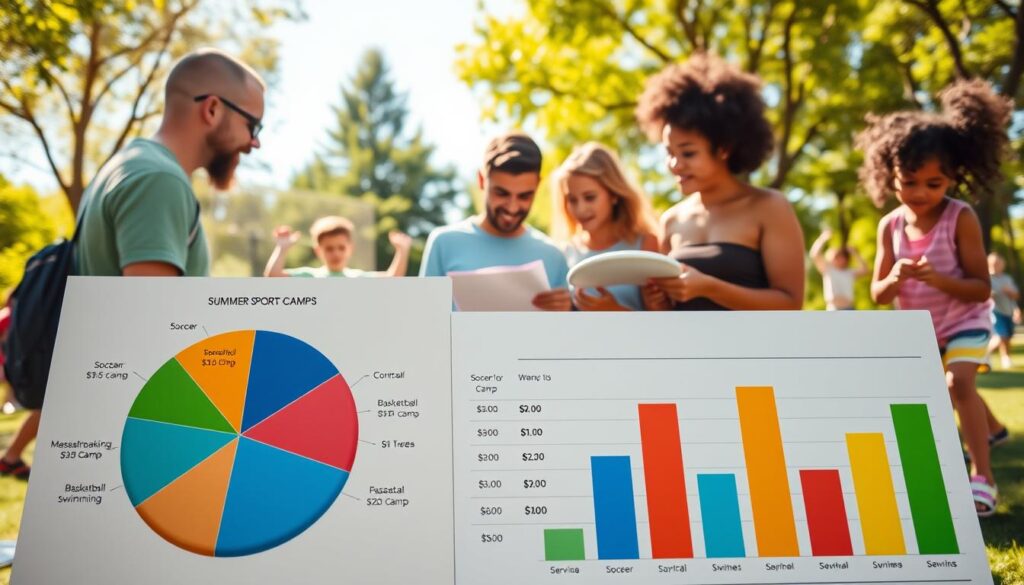
But it’s not just about the cost. You’re paying for quality. This includes the staff-to-camper ratio and the expertise of the coaches. You’re also paying for facilities and care, including meals and lodging.
So, how do you know if you’re getting value? Is the higher price for better staff, smaller groups, and safety? Or is it just marketing?
Think of it as a negotiation. Your budget will guide your choices. But knowing the costs helps avoid overpaying or underinvesting.
This isn’t a one-size-fits-all market. The costs of youth sports vary. A local camp offers one value, while a university camp offers another. It’s not just about the price.
Fortunately, there are ways to make camps more affordable. Scholarships, sibling discounts, and early registration can help. Some camps even offer payment plans.
There are also financial aids like Dependent Care FSAs and tax breaks. It’s worth exploring these options. They can save you money.
Your budgeting should match your camp choice. Are you looking for basic skills or specialized training? Compare costs and outcomes. Sometimes, the less expensive option is just as good.
Remember, the most expensive option isn’t always the best. And the cheapest isn’t always a bargain. Your goal is to find the perfect balance of cost, quality, and your child’s needs. That’s where the real value lies.
Safety Standards and Accreditation
Think of camp safety standards like a restaurant health inspection—you don’t see the process, but you definitely taste the results. When it comes to youth athletics camps, this isn’t about paranoia. It’s about protocol.
The gold standard? ACA accreditation. This isn’t some participation trophy. A camp voluntarily subjects itself to a brutal 300-point inspection covering everything from food service to emergency drills. It’s the closest thing to a safety guarantee you’ll find.
Let’s break down what that actually means. First, the people. Who’s watching your kid?
Staff requirements matter. Reputable camps ensure 80% of staff are over 18, with all staff being at least 16+. Every single one should have annual background checks. Not “most.” Every. Single. One.
Then there’s the supervision ratio. This isn’t a suggestion; it’s math. For tiny campers (ages 4-5), you want a tight 1:5 ratio. For teens, 1:12 is acceptable. Anything looser and you’re not at a camp—you’re at a free-for-all.
Emergency procedures separate the prepared from the panicked. Does the camp have written protocols? Are they practiced? Is there a nurse on site, or just a dusty first-aid kit?
Medical care deserves its own spotlight. How are severe allergies managed? Is there an EpiPen protocol that doesn’t rely on a single locked cabinet? Ask. Then ask again.
Water safety is a universe of its own. At beach camps, how do lifeguards handle ocean currents? Are their certifications current? This isn’t negotiable.
Here’s the reality check: a camp’s willingness to provide detailed, transparent answers tells you more about its culture than any glossy brochure. Don’t settle for vague assurances.
| Safety Aspect | Gold Standard | Minimum Acceptable | Red Flag |
|---|---|---|---|
| Staff-to-Camper Ratio (Ages 4-5) | 1:4 | 1:5 | 1:6 or higher |
| Staff-to-Camper Ratio (Ages 6-8) | 1:6 | 1:8 | 1:10 or higher |
| Staff-to-Camper Ratio (Teens) | 1:10 | 1:12 | 1:15 or higher |
| Background Check Frequency | Annual + random screenings | Annual | Initial hire only |
| Medical Professional On Site | Full-time nurse | Part-time nurse/EMT | First-aid certified staff only |
| Emergency Drill Frequency | Monthly | Quarterly | Once per season |
Asking these questions isn’t being that parent. It’s being a prudent consumer. The best youth athletics camps welcome scrutiny. They have their policies memorized and their certifications framed.
Remember: accreditation is the floor, not the ceiling. A camp can be ACA-accredited and yet have poor practices. Use that 300-point checklist as your starting point, then dig deeper.
Your final test? Ask about their last incident. Every camp has had one. How they handled it reveals everything. Transparent, detailed answers mean they’ve learned. Deflection means they’re hiding.
Safety in these programs isn’t a feature. It’s the foundation. Build everything else on top of that.
Registration Timeline and Deadlines
Think of camp registration like a high-stakes political primary. The early bird gets the worm and a spot in the coveted July session. Kids sports programs follow the school year, not summer.
Your search begins in the fall. Go to expos like the Our Kids Summer Camp Expo. Take virtual tours during visitor days. This is your research phase. By winter, you should have a few top choices.
Spring is for making a decision. Early bird discounts disappear quickly. The best weeks for top kids sports programs get filled fast. Waiting too long means missing out on the best spots.
The timeline is strict. Treating registration as a June task is unrealistic. Your child’s perfect summer depends on your winter planning. Parents who know this secure spots early.
Your last step is to commit before the deadline. This seals your chance for the ideal summer. You’ve looked at types, costs, and safety. Now, act fast to win.