Author: Isla Pennington

  • Best Platforms to Reach Fans in 2026

    Best Platforms to Reach Fans in 2026

    Welcome! We’re glad you’re here to join our conversation. The digital music world is alive and always changing.

    For a long time, a few big names controlled how we listened to music. Now, new, open platforms are emerging. Audius, Opus, and Resonate are leading the way.

    These platforms focus on authentic relationships. They aim to connect artists directly with their fans. It’s a truly inspiring movement!

    We’ve made a detailed guide to help you understand. Our aim is to show where artists and fans can really connect. Choosing the right platform can make a big difference in the music industry.

    Let’s explore this exciting time together. We’ll find out where music and connection are most important.

    Artist Revenue Comparison: Spotify, Apple Music, Bandcamp, and Others

    The digital music world shows big differences in how artists get paid. Some get just a few cents for each stream, while others get direct support from fans. We aim to make these differences clear to you. Our goal is to give you the knowledge to see where your streams can lead to real income.

    We think every musician deserves fair pay. Being open about artist royalties helps everyone in the music world. Let’s look at how big names and new ideas tackle this important issue.

    Big names like Spotify and Apple Music pay artists based on how many times their songs are played. They mix money from subscriptions and ads and split it among artists. This often means artists get very little money for each stream. Spotify pays about $0.003 to $0.005 per stream, while Apple Music pays around $0.01.

    The Bandcamp vs Spotify debate shows a big difference in how artists are treated. Bandcamp lets fans buy music directly from artists, giving them 82-85% of the sale. This way, artists have more control over their earnings.

    New platforms are using tech to fix royalty problems. Audius rewards artists and listeners with its own token, $AUDIO. Opus uses OPT tokens for direct payments. Resonate is a streaming cooperative owned by its artists and listeners.

    Platform Revenue Model Key Feature for Artists Note on Payout
    Spotify Pro-rata Subscription/Ad Pool Massive audience reach ~$0.003 – $0.005 per stream
    Apple Music Subscription Revenue Share Higher per-stream rate ~$0.01 per stream
    Bandcamp Direct Fan Purchase & Tips Keeps ~85% of sales Artist sets prices; Friday waiver days
    Audius Token Rewards ($AUDIO) Blockchain transparency Earn tokens for streams & engagement
    Resonate Listener Cooperative Artist-owned platform “Stream to own” model; democratic control

    Platforms like Audius and Opus use blockchain to keep track of every play. This technology makes sure artists know how their music is valued. We see this as a big step forward for artists.

    Deciding where to share your music is a big choice. Services that pay artists fairly do more than just give money. They show they value your work and support your community. We celebrate every platform that puts its creators first.

    Discovery Features: How Each Platform Helps You Find New Music

    Music discovery has never been more exciting. From algorithms to human-curated lists, there’s a wide range of tools to find new tunes. Discovery is key to a vibrant music scene, turning hidden gems into your new favorite songs. Each platform offers a unique way to find these gems.

    Big names like Spotify and Apple Music use complex algorithms. These systems learn your music tastes to suggest similar artists and songs. This creates a personalized radio that gets better over time. It’s a powerful way to discover new music.

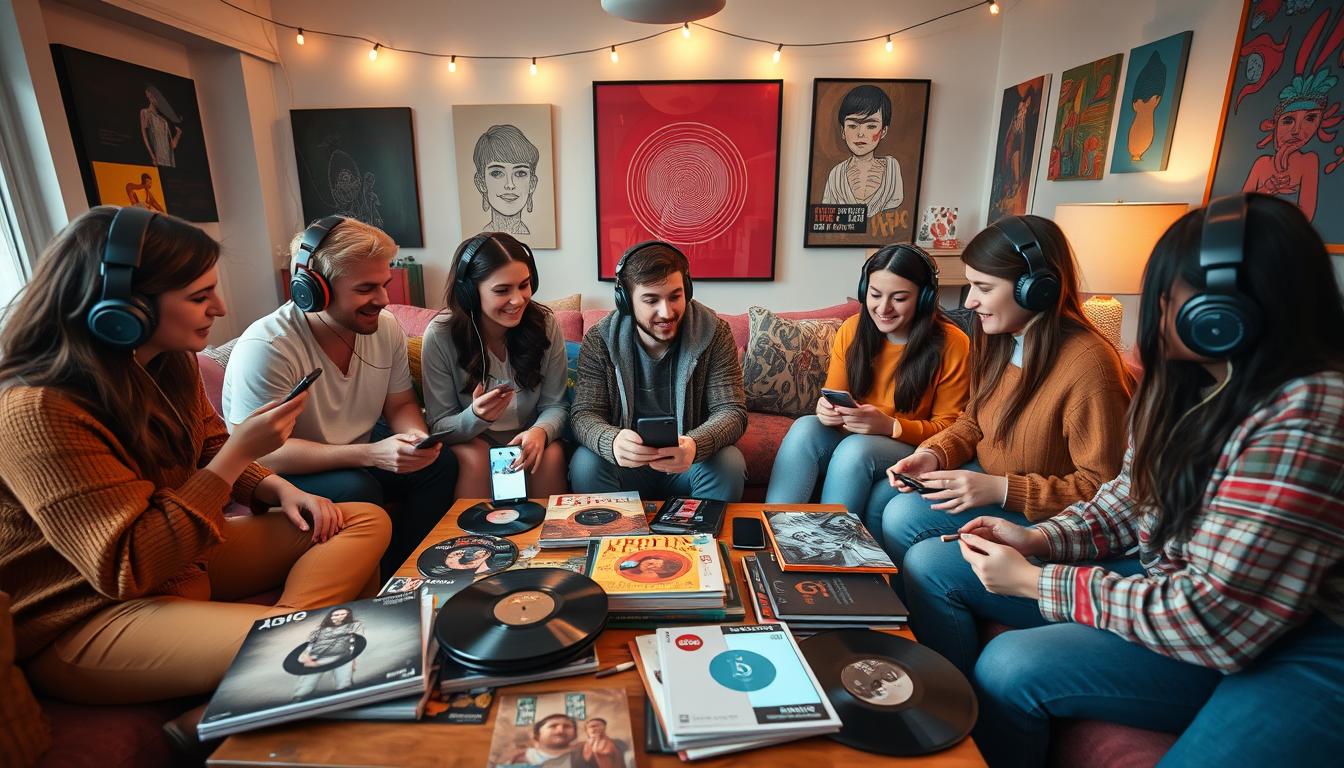
    A cozy, modern living room scene focusing on a diverse group of young adults engaged in discovering indie music together. In the foreground, a person in smart casual attire holds a smartphone, showcasing a colorful music-streaming app interface. The middle ground features a record player and vinyl collection, with several records scattered around, hinting at an eclectic music taste. Friends are seated on a stylish couch, animatedly discussing their latest finds, with headphones around their necks. The background includes warm, ambient lighting with soft golden hues, creating an inviting atmosphere. Large windows reveal a hint of a city skyline, while plants add a touch of nature, enhancing the relaxed vibe. The overall mood is vibrant and connected, reflecting the joy of uncovering new indie music.

    But there’s another side to discovery. It’s about people, not just technology. Indie platforms focus on community and curation. This approach offers a more genuine way to discover new music.

    Take Tamago, for example. It’s a platform where fans create and share playlists. This puts the power of discovery in the hands of passionate music lovers. It’s a democratic way to find new sounds.

    Platforms like Substack also rely on tastemakers. Writers and curators build trusted networks, recommending music. Fans follow these voices, leading to meaningful discoveries. This human touch is a game-changer for indie music streaming.

    So, how do these approaches compare? Let’s look at the key differences.

    Discovery Type How It Works Best For Platform Examples
    Algorithmic Uses your data and listening history to predict preferences. Personalized, hands-free discovery of similar music. Spotify, Apple Music
    Community-Driven Relies on playlists and recommendations from real people and curators. Finding unique, niche artists and trusting human taste. Tamago, Substack networks
    Hybrid Combines algorithmic suggestions with editorial or user playlists. A balanced mix of personalized and curated discovery. Many mainstream platforms are adding this.

    We’re passionate about features that help you connect with music. The community-driven model helps underground artists grow their fanbase. It feels like getting a recommendation from a friend, not a corporate algorithm.

    For fans who want to explore more, checking out best indie music discovery platforms is a great next step. These platforms are designed to help you find new, independent talent.

    The best music platform features for you depend on your preferences. Do you prefer a smart assistant or a community of music lovers? You now have amazing choices for both paths in your indie music streaming journey!

    Audio Quality Considerations: Lossless vs Compressed

    The debate between lossless and compressed audio is more than just tech talk. It’s about keeping the music’s essence alive. The streaming quality we choose shows how much we value the art. It changes how we listen and affects the creators.

    So, what’s the difference? Lossless audio files, like FLAC or ALAC, keep all data from the original recording. Compressed audio, such as MP3 or AAC, makes files smaller by removing data. This can slightly change the sound’s richness and detail.

    Why does this matter so much? For artists, their music is a heartfelt creation. Every detail is intentional. High-fidelity streaming delivers their work as they meant it to be heard.

    For fans, lossless audio offers a full emotional experience. You can hear every sound clearly, from the cymbals to the singer’s breath.

    We’re thankful for platforms like Audius and Opus. They stand for high-quality decentralized streaming. They show that technology can enhance art without losing its essence. This respect is key in our streaming platforms comparison.

    To make the choice clearer, let’s look at the key contrasts:

    Feature Lossless Audio Compressed Audio
    File Size Larger (e.g., 30-50 MB per song) Much Smaller (e.g., 3-10 MB per song)
    Sound Fidelity Identical to studio master Good, but some detail is lost
    Data Usage High Low
    Common Formats FLAC, ALAC, WAV MP3, AAC, Ogg Vorbis

    Choosing a service that values sound quality does more than please us. It sends a message. It shows that artist royalties and creative control matter. Supporting high-definition streaming supports artists’ full vision.

    Our listening habits have power. By understanding the difference between lossless and compressed audio, we make better choices. We can push for a future where great sound and fair artist royalties go together. Let’s celebrate platforms that make this possible!

    Social Features: Connecting with Other Music Fans

    Imagine talking about a new album with the artist themselves. Social tools on modern platforms make this possible. Music is all about connection, and we love the music platform features that create lively communities. These tools turn solo listening into a shared, interactive experience.

    Older services have basic social tools. Spotify and Apple Music let you share playlists and see what friends are listening to. Bandcamp vs Spotify shows a difference in focus. Bandcamp focuses on supporting artists, while Spotify is about sharing and making playlists together.

    New platforms put community at the center. Substack has become a key place for musicians to connect. It has a “Notes” feed, comments, and direct messages for ongoing talks. Artists like Jeff Tweedy and Patti Smith use it to share thoughts and host live streams, building a close fan circle.

    A vibrant music platform social community scene, showcasing diverse indie artists and fans engaging in dynamic conversations and sharing music. In the foreground, a group of four young adults, dressed in stylish casual attire, enthusiastically interact around a mobile device displaying a music app. In the middle ground, a cozy café setting with round tables, colorful posters of indie bands on the walls, and soft lighting creating an inviting atmosphere. In the background, large windows allow warm sunlight to flood in, illuminating the joyful faces of people connecting over their favorite tunes. The overall mood is energetic yet relaxed, capturing the essence of a thriving music community where connections flourish.

    This new model breaks down old barriers. On platforms like Audius and Opus, fans can comment on songs in real-time. Artists can respond right away. It’s a move from broadcasting to having real conversations, creating culture together.

    Let’s look at how big platforms handle social connections:

    Platform Key Social Feature Fan-to-Artist Interaction
    Spotify Collaborative Playlists, Friend Activity Indirect (via playlists)
    Bandcamp Fan Collections, Artist Updates Moderate (via comments/messages)
    Substack Notes Feed, Comments, Live Streams High (integrated dialogue)
    Audius/Opus Timestamped Comments, Token Gating Very High (direct & real-time)

    We think the future of music listening is all about being together. These features do more than just connect us; they show our shared love for music. When you can cheer for a live stream or discuss lyrics with the artist, you’re more than just a fan—you’re part of the story.

    Choosing a platform with strong social music platform features means investing in that joy. It’s about finding your crowd, your voice, and your place in the music you love.

    Offline Listening and Mobile Experience

    True music freedom means having your favorite indie tracks available anywhere. This includes deep underground on a subway or hiking a remote trail. A thorough streaming platforms comparison must look beyond the online catalog. We’re breaking down offline modes and mobile experiences because seamless access is how we stay connected to the music we love, everywhere we go.

    Offline listening is a game-changer. It turns your phone into a personal, signal-free jukebox. This feature is vital for daily commuters, travelers, or anyone wanting to save on data. More importantly, it means your support for artists doesn’t pause when your connection drops.

    Not all download features are created equal. Some platforms are generous, while others have stricter limits. The audio quality of downloads can also vary. We want you to know exactly what you’re getting before you hit that download button.

    The mobile app itself is your primary gateway to indie music streaming. A clunky, slow, or confusing interface can frustrate even the most dedicated fan. We believe the best apps feel intuitive, letting you search, browse, and play without a second thought. Stability is key—no one likes music that stutters or an app that crashes.

    Let’s see how the top contenders stack up on these essential mobile features.

    Platform Offline Download Limits Download Audio Quality Mobile App Highlights
    Spotify Up to 10,000 songs per device on up to 5 devices. Standard quality (equivalent to ~160 kbps). Extremely fast and intuitive. Excellent for playlist management and discovery on the go.
    Apple Music 100,000 songs limit, synced across 10 devices. High-Resolution Lossless available (if downloaded in compatible format). Deep iOS integration. Slightly steeper learning curve but very powerful for library organization.
    Bandcamp Unlimited downloads for purchased music. Streaming offline requires cache, not formal downloads. Purchased files are downloaded in your chosen format (MP3, FLAC, etc.). App focuses on your collection and wishlist. Streamlined for fans to directly support artists from their phones.
    Amazon Music Unlimited Varies by plan, typically up to 1,000 songs per device. Standard or HD/Ultra HD, depending on your subscription tier. Solid and reliable. Offers hands-free listening with Alexa integration as a major perk.

    This table shows a clear range of approaches. Spotify wins for sheer simplicity and high device limits. Apple Music is the champion for audiophiles who want lossless quality offline. Bandcamp’s model is unique, empowering you with permanent file ownership. Amazon provides a balanced, feature-rich experience tied to its ecosystem.

    Your mobile experience should feel effortless. Quick loading times, easy navigation, and reliable playback are the baseline. The best apps add thoughtful touches like clear download progress indicators, smart storage management, and lock screen controls. These small details make a big difference in your daily routine.

    We are grateful for technology that lets us carry entire music libraries in our pockets. A platform that excels in mobile and offline features removes barriers. It ensures you can listen, discover, and support artists during your workout, your commute, or your quiet evening walk. That constant, easy access is what turns casual listening into a lifelong musical journey.

    Artist Support Features: Direct Purchases and Fan Funding

    The dream of a fairer music industry is powered by features that let fans fund the artists they love directly. We are thrilled to highlight the music platform features that make this possible. These tools move beyond streaming pennies to create real, sustainable partnerships.

    This shift is about connection. It turns listeners into patrons and transforms streams into meaningful support. The result is a more resilient and direct creative economy.

    Several innovative models now lead the way. They include direct sales, fan subscriptions, digital collectibles, and smart contracts. Each offers a unique path for fans to show their support.

    Bandcamp is a pioneer in this space. Its model allows artists to sell music and merch directly to fans, keeping a large share of revenue. The famous “Bandcamp Friday” events, where the company waives its revenue share, have funneled millions of dollars straight to creators. This direct sale approach is a cornerstone for improving artist royalties.

    Platforms like Substack have entered the audio world with a fan-funded subscription model. Here, artists can offer exclusive podcasts, music, or community updates to paying subscribers. It builds a dedicated, supportive audience willing to invest in an artist’s ongoing work.

    Blockchain technology introduces even more possibilities. Platforms such as BitSong and Tamago utilize fan tokens and NFTs (Non-Fungible Tokens). These digital assets can represent special access, unique content, or a stake in a song’s success. They allow superfans to engage on a deeper level and share in an artist’s journey.

    These token-based music platform features create new forms of value and ownership. They foster a powerful sense of community and belonging between artists and their supporters.

    Behind the scenes, projects like Mycelia are building the infrastructure for fairness. Using “smart contracts” on blockchains, they aim to automate licensing and payments. This ensures every contributor gets their fair share instantly and transparently. It’s a foundational step toward redefining artist royalties for the digital age.

    We are grateful to see this evolution. Each of these features empowers fans to become true partners. They give artists control and build a more equitable ecosystem for everyone involved.

    Playlist Culture: Curated vs Algorithmic

    Music journeys are exciting when data meets passion. Playlists are more than songs; they’re discovery tools. Knowing the difference between curated and algorithmic playlists helps you find music that speaks to you.

    Algorithms are precise. Spotify uses your listening habits to suggest music. Playlists like “Discover Weekly” offer new music that fits your taste.

    But human touch is special too. Think of a friend’s mixtape or an artist’s influences. Platforms like Bandcamp and Tamago offer a community feel, making discovery a conversation.

    Substack is another place where artists recommend creators they admire. It’s a way of curation based on respect, not just data. For fans, these recommendations offer a deeper connection.

    So, which is better for you? It depends on what you want. Do you want new sounds or a deep dive into a genre? The table below shows the main differences.

    Feature Algorithmic Playlists (e.g., Spotify) Human-Curated Playlists (e.g., Bandcamp, Tamago, Artist Lists)
    Primary Driver User data and machine learning Individual taste, expertise, or community vote
    Discovery Style Personalized, based on listening patterns Thematic, narrative, or scene-based
    Strength Efficiency and volume of new suggestions Context, storytelling, and trusted authority
    Artist Benefit Exposure based on sonic similarity to hits Exposure based on artistic merit or community support
    Fan Experience Passive, seamless background listening Active, engaged, and educational listening

    The debate between Bandcamp vs Spotify shows the divide. One focuses on artist stories and fan discovery, the other on algorithms. For indie music fans, a mix of both is best.

    We thank platforms that let fans and artists curate. Tamago’s community charts show listeners’ great taste. This balance is healthier for music lovers.

    The best playlist culture offers both algorithms and human curation. By understanding these, you control your musical journey. You discover new songs and stories.

    International Availability and Regional Differences

    Decentralized technologies are changing how we share music worldwide. This is great for artists and fans. Music should be free to flow across all borders.

    When we look at streaming platforms comparison, we see big differences. Services like Spotify and Apple Music face many licensing hurdles. This can block songs in some countries, frustrating everyone.

    For indie artists, these barriers can slow growth. Fans in new areas might not get to hear their favorite songs. But, platforms like Audius and Opus are breaking down these walls.

    So, how do these new platforms work? They don’t deal with country-by-country licenses. Instead, they use peer-to-peer networks to share music worldwide. This is a big music platform feature for artists wanting a global audience.

    This leads to a stronger global indie community. Fans can find and support artists from anywhere. The whole world becomes a stage for music, connecting diverse sounds to eager listeners.

    To see these crucial differences, check out the table below:

    Platform Primary Regions Served Licensing Model Key Notes on Availability
    Spotify 180+ countries Regional Licensing Catalog varies significantly by country due to licensing deals.
    Apple Music 167 countries Regional Licensing Similar regional restrictions apply; availability launched in phases.
    Bandcamp Global Direct Artist Upload Artists can sell and stream music globally; fans can purchase from anywhere.
    Audius Global Decentralized Protocol No regional blocking; access is determined by internet access, not licenses.
    Opus Global Decentralized Protocol Designed for borderless streaming from the start, minimizing geographical gaps.

    This streaming platforms comparison shows a clear trend. Mainstream services have wide reach but fragmented catalogs. Indie and decentralized platforms offer a more consistent global experience. This is key for building a global fanbase.

    We’re excited about this shift towards a more open music world. It lets creators share their music freely. And it lets fans explore a vast library of sound from anywhere. Together, we’re bridging gaps one stream at a time!

    Making the Choice: Platform Recommendations for Different Needs

    Exploring the digital music world shows us many options. The right platform for you depends on what matters most. We aim to guide you to a choice that feels right.

    For artists, fair compensation is key. Platforms like Audius and Resonate focus on this. They have new ways to share revenue. On the other hand, Bandcamp is great for artists who want to sell music directly to fans.

    Substack is ideal for singer-songwriters who want to connect with fans. It lets them share music and stories with subscribers. This builds a personal bond beyond just streaming.

    For those who love discovering new music, Spotify or Apple Music are top choices. Their algorithms and playlists are unmatched for finding new favorites. Audiophiles will appreciate services that offer lossless audio for a better listening experience.

    We encourage you to choose a platform that matches your values. Whether you make music or just enjoy listening, your choice impacts the industry. Let’s create a more connected and innovative music world together.

  • Real Artist Development Journeys to the Grammys

    Real Artist Development Journeys to the Grammys

    We love celebrating the incredible journeys that shape musical legends. The road to acclaim often starts in the most unassuming places. Think of a garage band practicing late into the night or a solo performer finding their voice in a local bar.

    Today’s landscape offers more tools than ever for independent musicians. Digital platforms have revolutionized how talent is discovered and shared. Yet for every viral sensation, there are countless creators honing their craft in small venues.

    Consider the paths of Chance the Rapper, Billie Eilish, and Macklemore & Ryan Lewis. Each carved a unique route to the Grammy stage, largely on their own terms. Their successes highlight a powerful shift in the music industry.

    These narratives are about more than fame. They are testaments to raw passion, supportive communities, and sheer perseverance. We are thrilled to explore these heartfelt stories with you. Together, let’s celebrate the indie spirit—a movement built on authenticity and grit.

    The Development Timeline: Years in the Making

    In today’s world, we often focus on quick fame. But the real story of music success is about hard work and patience. We see the big wins, but not the years of effort behind them.

    Building a music career is a long journey. It’s filled with daily practice, small gigs, and growing a fanbase. This journey is not done alone.

    A supportive community is key. Platforms that help artists grow are essential. They provide a space for new talent to shine.

    For example, Spotify’s Fresh Finds playlists have launched over 70,000 emerging independent artists in the last decade. Almost 70% of all Fresh Finds streams in 2024 were from listeners discovering an artist for the first time. This shows a system that works well, slowly introducing new music to fans.

    Artists like Chance the Rapper show the value of patience. His Grammy win was the result of years of free music, fan engagement, and community building. His story teaches us about the journey to success.

    We celebrate every step in an artist’s journey. From the first song to the first show, success comes one day at a time. Understanding this timeline helps us value every artist’s path. It shows that music career growth is a marathon, filled with lessons and victories along the way.

    Early Influences: Childhood Music Experiences That Shaped Artists

    We often look for an artist’s breakthrough moments on stage. But the real breakthroughs start in childhood. Early sounds, family support, and personal discovery build a strong music foundation.

    Think of the first song that moved you or the family member who gave you an instrument. For artists, these moments are more than memories. They are the building blocks of their creativity. Laufey shared her early doubts, saying, “I remember thinking, ‘I don’t fit into a genre—am I even going to be playlisted?’” Her story shows how personal taste is shaped before industry recognition.

    Some artists start alone. Role Model talked about his early days: “I was just making music in my bedroom with no connections.” This image of a creator alone with their ideas is powerful. It shows that the spark often needs no audience. The bedroom becomes the first studio, and experimentation is the first teacher.

    These are the personal, internal breakthrough moments. They are the quiet realizations that music is a calling. An artist might not win a Grammy for decades. But recognizing their unique sound at a young age is often the most authentic breakthrough.

    We are grateful when artists share their vulnerable origin stories. It lets us connect more deeply with the person behind the music. Understanding Laufey’s genre-blending roots or Role Model’s DIY start enriches their art. It turns listeners into a community that shares in the journey.

    Every great career starts with a simple, powerful spark of inspiration. Those childhood experiences—whether filled with doubt, solitude, or unwavering support—are where the magic begins. They are the unsung heroes of every success story we celebrate today.

    First Instruments and Writing: The Creative Spark Ignites

    We think the best indie success comes from making something with what you have. It’s where every great story starts. It’s not about the tools, but the spark in you.

    That first instrument, like a used guitar or borrowed keyboard, opens a door. The first lyrics you write are like blueprints. This moment of creation is key to an artist’s growth.

    Many famous careers started with a DIY spirit. Role Model recorded “girl in new york” for free in a friend’s studio. Remi Wolf made her music in a garage while working as a server. Their indie success came from being thankful and determined, not money.

    A cozy garage studio filled with an array of musical instruments, such as an electric guitar, keyboard, and drums, all artfully scattered around. In the foreground, a young adult wearing casual, modest clothing is intensely focused on writing lyrics in a notebook, inspired by the vibrant energy of their surroundings. The middle ground features a small soundboard and scattered sheet music, hinting at a mix of creativity and organization. The background showcases scattered colorful posters of indie artists and a warm, inviting light emanating from a lamp, creating a relaxed yet passionate atmosphere. A lens effect adds a soft focus to the edges, enhancing the intimate feel of the creative space. The overall mood conveys a sense of determination and excitement about artistic beginnings.

    This DIY way of thinking is more than a method; it’s a way of life. It shows that great art doesn’t need an expensive studio. You just need to imagine and be brave. Garages, bedrooms, and borrowed spaces are where real voices are born.

    We celebrate the journey from the first chord to the first song. It shows that your creative spark is the most important thing. Taking care of that spark is the first step to a real and lasting career.

    High School and College Years: Formal Training vs Self-Teaching

    Aspiring musicians often face a choice between formal training and self-learning during their teenage years. This time is a crossroads filled with discovery and the first career milestones. Whether in a university room or a high school bedroom, these years shape who you are as an artist.

    Getting a degree in music offers a solid technical base. It teaches music theory, composition, and performance skills. This path builds discipline and connects you with mentors who help you grow.

    On the other hand, self-teaching lets you learn by doing. Many famous artists learned through endless practice and online tutorials. Lil Tecca, for example, was just 17 when his song “Molly Girl” hit Spotify’s Fresh Finds playlist. His success came from his own studio work, not school.

    Both formal training and self-teaching are equally valid paths to growth. The key is finding what sparks your creativity. We admire artists who balance school with music. Their dedication is a huge achievement!

    Aspect Formal Training Self-Teaching
    Primary Setting Schools, universities, conservatories Home studios, local venues, online platforms
    Core Strength Technical foundation & structured feedback Creative freedom & real-world experimentation
    Typical Community Peers in academic programs, instructors Friends, online collaborators, local scene members
    Key Milestone Examples First recital, degree completion, ensemble placement First local gig, self-released track, viral moment

    Playing your first gigs and jamming with friends are priceless. These experiences teach you stage presence and how to connect with audiences. They are where theory meets real-world application.

    This phase is about finding your unique voice and setting the stage for your future. We celebrate every learning journey. Your path is unique, and we’re here to support it with enthusiasm and gratitude!

    First Bands and Collaborations: Learning Through Others

    Collaboration is key for new artists. It’s where talent meets reality. In those first bands, musicians learn to create something bigger than themselves.

    Many legends started in garages and basements. This phase is a cherished rite of passage. It’s not just about making noise. It’s about building character and a shared vision.

    In these makeshift studios, you learn more than music. You learn to listen and find your place in a blend. This balance between compromise and passion is powerful.

    A vibrant scene of diverse musicians collaborating in a cozy rehearsal space filled with instruments and sound equipment. In the foreground, a group of three artists—two young men and one woman in modest casual clothing—are animatedly discussing song ideas while surrounded by guitars, a keyboard, and a set of drums. In the middle ground, a fourth musician is adjusting a microphone stand, and sheets of music are scattered on a nearby table. The background features colorful posters of famous albums and awards on the walls, accentuating the creative atmosphere. Soft, warm lighting casts a welcoming glow, highlighting the joy and camaraderie in the air. The camera angle is slightly elevated, giving a clear view of the interaction and collaboration in this energetic, inspiring space.

    These early groups are like creative families. They offer a safe space to experiment and find a unique sound. This confidence is key for the big stage.

    Starting with collaborations has huge benefits. It lays the foundation for a lasting career.

    • Teamwork & Communication: You learn to share ideas and blend voices.
    • Creative Problem-Solving: Working on songs with others boosts your thinking.
    • Emotional Resilience: Handling creative differences prepares you for industry challenges.
    • Defining Your Sound: Playing with others helps you find what makes you unique.

    This process is like building bonds in team sports. In a band, you rely on each other, creating trust that fuels your performance. This dynamic is seen in historic collaborations that changed music, where artists grew by learning from peers.

    Each type of collaboration teaches different skills.

    Type of Collaboration Primary Skills Honed Common Challenge Lasting Impact on Development
    Garage Band Band democracy, songwriting from scratch, live energy cohesion. Aligning diverse musical tastes and commitment levels. Teaches the essence of “band identity” and raw, intuitive creation.
    Creative Duo (Songwriter/Producer) Deep creative trust, refining ideas, studio communication. Maintaining a balanced partnership and shared vision. Builds skills for intimate, focused collaboration essential for solo projects.
    Session & Hired Gun Work Professional adaptability, reading a room, supporting another’s vision. Subduing your own ego to serve the song or leader. Develops versatility and a deep understanding of the music industry.

    These first bands and partnerships make theory practical. They show that music is a conversation. Your artist development journey is faster with others who share your dream. We celebrate this spirit—it’s where great music and artists start.

    Solo Career Decisions: When to Go It Alone

    The digital age has changed how artists start their solo careers. It’s not about leaving something behind but embracing your vision. We celebrate your courage in taking this step for your music career growth.

    Many artists feel a strong urge to express themselves alone. After working with others, they want to share their own sound or message. This isn’t a rejection of past work but a natural step forward.

    Modern icons like Billie Eilish and Chance the Rapper show new paths. Billie Eilish started on SoundCloud with her brother. Chance the Rapper released Grammy-winning music for free online. Their stories show how direct fan connections can boost your music career growth from the start.

    Going solo means you do everything yourself. You become the artist, manager, and promoter. This brings total creative control and a closer bond with your audience. Every success is yours, and every lesson shapes your journey.

    To see different solo paths artists take today, here’s a look:

    Path Key Characteristics Artist Example Core Consideration
    Digital-First Independent Builds audience directly online; retains full ownership and rights. Chance the Rapper Requires mastery of digital marketing and community building for sustained music career growth.
    Strategic Departure from Band Leaves a group to explore a distinct personal sound; may leverage existing fanbase. Beyoncé (Destiny’s Child) Timing is key. Establishing a clear, separate artistic identity is essential.
    Hybrid/Partnership Model Remains a solo artist but partners with a label for specific services like distribution or promotion. Artist like Finneas (collaborator with Billie Eilish) Offers a balance between creative freedom and industry support.
    Label-Supported Launch Signs with a major or indie label early to access resources, studio time, and marketing teams. Olivia Rodrigo Involves sharing control and revenue for faster reach and resources.

    There’s no one right answer, only the right path for you. Whether starting online or moving from a group, the goal is the same: true expression. Trust your instinct, plan your strategy, and don’t be afraid to overcome common hurdles to your breakthrough.

    We believe in the empowerment of owning every step. Your solo journey is a powerful statement of your art. Embrace the freedom, connect deeply, and write your own story of success.

    Industry Connections: Managers, Agents, and Label Relationships

    Platforms like Spotify don’t just play music; they connect emerging talent with industry leaders. For independent artists, finding the right team is a series of breakthrough moments. These connections validate years of hard work and open doors to growth.

    Role Model’s story is inspiring. His song on Spotify’s Fresh Finds playlist filled his inbox with messages from A&Rs and managers. This recognition turned his solo work into a team effort. It showed his music reached beyond his circle.

    Lil Tecca’s manager celebrated his first major playlist add with a screenshot and fire emojis. A good manager is both a cheerleader and a strategist. These industry connections are key for artists to succeed in the business world.

    Behind these stories are dedicated platform editors. Spotify editors use data and intuition to curate playlists. They spot talent and create breakthrough moments that attract managers and agents. We’re thankful for these curators who guide artists.

    So, what do these relationships do for an artist’s career? Let’s look:

    • Managers: They handle daily business, strategy, and are often the artist’s closest advisor.
    • Agents: They book shows and tours, turning online buzz into real-world experiences and income.
    • Label Relationships: Labels offer funding, marketing, and distribution to grow an artist’s global reach.

    Building these partnerships is a big step. It lets artists focus on their music, not everything else. Each connection builds a lasting career.

    We celebrate these breakthrough moments in every artist’s journey. Success in music is rarely solo. It’s about finding your community to share your music with the world.

    Breakthrough Moments: The Songs or Shows That Changed Everything

    A song or show can change an artist’s life. It can go from hopeful to historic. These moments are when hard work meets perfect timing.

    Many artists work hard for years before their big moment. One song or show can make a huge difference. Here are three examples of how a single moment changed everything.

    Laufey found her big break on Spotify’s Fresh Finds. She felt like it was Christmas. It showed her that her unique sound was valued.

    Megan Moroney’s song “Hair Salon” got a lot of attention. It reached people outside of country music. This led to a quick release of her song “Tennessee Orange.”

    Wet Leg’s song “Chaise Longue” was on Fresh Finds early on. Fans knew the words at their first gigs. This created a special energy.

    Each story shows how a big moment can change everything. Here’s a table that breaks down these moments.

    Artist Breakthrough Catalyst Immediate Action Resulting Momentum
    Laufey Spotify’s Fresh Finds playlist add Received critical validation and platform algorithm support Established her as a serious new voice in modern jazz
    Megan Moroney “Hair Salon” added to a key playlist Rush-released “Tennessee Orange” to meet new demand Broke through country boundaries to a wider audience
    Wet Leg “Chaise Longue” on Fresh Finds at debut Went into first live shows with an already-knowing audience Generated immediate buzz and a dedicated early fanbase

    These moments are not just luck. They are when hard work meets the right opportunity. A playlist spot can turn into belief. A fan singing along can turn into confidence.

    We share these stories with excitement and gratitude. They show that the path to indie success is built on patience. But it’s often sparked by a single, unforgettable moment.

    Sustainable Career Building: Beyond the Initial Success & Advice for Aspiring Artists: Patience, Practice, and Persistence

    A major breakthrough is just the start, not the end. The real work of building a lasting music career begins after that first hit. Lil Tecca’s story shows this well. His streams skyrocketed over 18,000% after his first big song, “Ransom,” nearing 2 billion streams.

    Building lasting career milestones requires key principles. Perseverance helps you overcome obstacles. Authenticity makes your music connect with listeners. A loyal fan base is the base of your success.

    Every artist’s journey is unique. Be patient and keep practicing. Show persistence in your work and your relationships. We believe in your voice and support your growth. Your story, from the garage to the Grammy stage, is worth sharing.

  • Rising Stars: 10 Emerging Indie Artists Who Will Define 2025

    Rising Stars: 10 Emerging Indie Artists Who Will Define 2025

    Get ready! 2025 is shaping up to be a landmark year for new music. A fresh wave of talent is crashing onto the scene. They fearlessly break genre boundaries and connect with global audiences in truly authentic ways.

    We are thrilled to turn our emerging indie artists spotlight toward these vibrant creative voices. This guide is a celebration of the pure joy of artist discovery. We invite you to join us in getting to know the inspiring up-and-coming musicians.

    This is more than just a list. It’s a grateful look at the very heartbeat of tomorrow’s music scene. For a deeper dive into the sounds of the future, explore our feature on the top rising artists of 2025.

    Let’s meet the faces and voices ready to make their mark.

    The Art of Spotting Tomorrow’s Headliners Today

    Independent music now makes up nearly half the world’s music market. This is a big change. It shows how music is made, shared, and loved differently today.

    Today, artists need to be real and connect with fans directly. Breakthrough artists often skip traditional paths. They talk to fans, building a loyal group one interaction at a time.

    We look for a mix of talent and a unique view. The best new artists also know how to grow a community. This mix makes them stars.

    It’s important to understand this new world. The table below shows how the old and new paths differ. It highlights what makes today’s breakthrough artists stand out.

    Aspect Traditional Path Modern Independent Path
    Gatekeepers Labels, A&R executives, radio programmers Direct fan engagement, algorithm-friendly content, playlist curators
    Fan Connection Often distant, mediated by marketing campaigns Direct, intimate, and built on social media and live streams
    Primary Distribution Physical media and commercial radio Digital streaming platforms and user-generated content apps
    Creative Control Often ceded to label direction for market appeal Firmly held by the artist, leading to unique and personal sounds
    Revenue Streams Heavily reliant on advances and traditional sales Diversified: streaming, direct merch sales, fan subscriptions, sync licensing

    This new model lets artists stay true to themselves from the start. As listeners and supporters, we get to see raw creativity up close. The excitement of artist discovery is now a journey we’re all part of.

    We’re living in a time of unique voices. The barriers are down, and connections are strong. By valuing authenticity and community, we help choose tomorrow’s stars.

    Artist Profile 1: Genre-Bending Visionary with Unique Sound

    We start with artists who are not just making music but creating new sounds. The most exciting indie music talent today doesn’t fit into one style. They mix different sounds to create something new and captivating.

    Take London’s John Glacier, for example. She combines electronic beats with heartfelt lyrics. Her music moves between rap and melancholy melodies, making it both futuristic and deeply personal. This is what makes up and coming musicians stand out.

    On the other side of the world, Caldwell does something similar. He mixes country’s storytelling with hip-hop’s rhythm. His music jumps from banjo riffs to 808 basslines, telling real stories. This shows how innovation comes from respecting the past while exploring new sounds.

    We admire these visionaries for their bravery. They’re not afraid to mix and experiment, making music something new. They’re the indie music talent and up and coming musicians who will shape 2025’s sound. By breaking the rules, they encourage us to hear music in a new way.

    Artist Profile 2: Bedroom Pop Sensation Taking TikTok by Storm

    Nova Rae started making music in her bedroom and now tops indie playlists. This shows how real connections can spread far in the digital world. It’s a new way to become famous, turning a personal space into a creative hub.

    Her music mixes deep thoughts with catchy synth-pop. Songs like “Midnight Thoughts” feel like a deep chat with a friend. This connection is key on TikTok, where a short clip can start a career.

    A young, emerging indie artist sits on the floor of a cozy, softly lit bedroom, surrounded by vintage musical instruments and colorful fairy lights. The artist, a young person in modest casual clothing, is focused on a laptop, with headphones on, capturing their creative process. In the background, a wall adorned with posters of iconic musicians and an acoustic guitar leaning against the wall adds to the ambiance. The warm, ambient lighting casts a gentle glow, creating an inviting atmosphere that reflects the intimate vibe of bedroom pop music. A sense of aspiration and creativity fills the air, evoking the magical moment of artistic discovery. The angle captures a dynamic perspective, emphasizing the artist's passion and musical journey.

    Nova Rae shows you don’t need big money to win fans. Her journey is a success story in the streaming world. Fans get to see an artist grow from the start.

    It’s not just solo artists. Groups like KATSEYE also excel on social media. They make music for sharing and remixing. Their success shows how looks and sound can work together online.

    Musicians now have full control over their work. They write, produce, and share their music directly. This builds a strong bond with fans, unlike traditional ways.

    As fans, we get to support new talent early. It’s rewarding to be part of their journey from the start. It turns listening into a community effort.

    Every viral hit on TikTok or Instagram Reels is a chance to find new talent. The algorithm can make a hidden star into a famous artist overnight. This makes finding new indie bands thrilling.

    Let’s celebrate the bedroom producers shaping music today. Their rise shows that great music can come from anywhere. Our support through streams and shares helps their journey.

    Artist Profile 3: Folk Revival Pioneer with Authentic Storytelling

    Meet the indie music talent changing Americana and country. Their lyrics feel like talks with a close friend. In a world chasing quick hits, they create deep stories with music.

    Ty Myers is a young voice in Americana, known for his warm sound. His songs tell stories of small towns, love, and hope. His music feels both old and new, drawing us in with its storytelling.

    Byrdie Wilson weaves strong country stories with honest words. Her songs explore personal and common feelings. Her realness connects deeply with her fans.

    Artist Core Sound Key Song Theme Storytelling Approach
    Ty Myers Heartland Americana with pedal steel Small-town life and nostalgic yearning Cinematic, detail-oriented vignettes
    Byrdie Wilson Resilient, narrative-driven country Personal resilience and emotional truth Confessional, first-person diary style

    What sets them apart is their focus on real music. Their songs tell the story first. This approach wins fans who want more than just a sound.

    We thank artists like Myers and Wilson for their work. They show music’s power to share our lives. Their success encourages more indie music talent to focus on quality over fame.

    Supporting these artists means diving into their stories. Listen to their albums from start to end. Go to their small shows where every word matters. This is how we support the next big names in music.

    Artist Profile 4: Electronic Experimentalist Pushing Boundaries

    For those who love new sounds, the best discoveries come from artists who break rules. They see music as a canvas, creating a vital part of the new indie bands scene.

    Artists like Comet, LENAÉ, and Miserableisobel show no fear. They’re not just musicians; they shape moods and textures. Their unique paths are a gift to music lovers.

    A dynamic scene showcasing an electronic experimentalist indie artist in their creative environment. In the foreground, focus on a young adult with an expressive face, wearing stylish, modest casual clothing, immersed in manipulating a series of colorful soundwave visualizers on a sleek tablet. The middle ground features an array of eclectic musical instruments, including synthesizers and drum machines, surrounded by vibrant LED lights casting a mesmerizing glow. In the background, a cozy, artsy studio filled with vinyl records and abstract art on the walls enhances the atmosphere. Soft, ambient lighting creates a moody, inspiring ambiance, evoking a sense of innovation and boundary-pushing creativity. The angle should be slightly overhead, giving a comprehensive view of their artistic workspace, emphasizing the fusion of technology and artistry.

    Comet mixes atmospheric shoegaze with indie vibes, creating deep sounds. LENAÉ turns R&B into something new, playing with vocals and beats. Miserableisobel blends lo-fi with hip-hop, pop, and folk, making something truly hers.

    Her music is a mix of hip-hop beats, catchy melodies, and folk’s closeness. This bold exploration makes her music key. It shows the most exciting sounds are often unexpected.

    These new artists take us on deep journeys. They build worlds with synths, guitars, and intimate voices. Their boundary-pushing music expands our musical world.

    We’re excited to see where they go. Supporting these innovators means embracing the new and finding beauty in it. Their work shows music’s future is full of possibilities.

    Social Media Strategy: How These Artists Built Their Following

    Today, building a loyal fan base is more than just talent. It’s about being smart on social media and really talking to your audience. We love how breakthrough artists see their online space as a place to connect with fans, not just shout out messages. This approach is key to finding new fans.

    The old days of just promoting music are gone. Now, indie musicians know their fans are powerful. They focus on talking back and forth with them. This turns listeners into true fans who feel like they’re part of the artist’s journey.

    Artists are now sharing the behind-the-scenes of their music-making. They post voice memos, song drafts, and stories from the studio. This makes fans feel like they’re part of the process. It builds trust and loyalty.

    Being real with fans is essential. Artists reply to comments, do live Q&As, and make music based on fan ideas. This personal touch makes fans feel special, not just another number.

    Let’s look at the strategy. Each social media platform has its own role in an artist’s growth. The table below shows how musicians use each platform to connect and grow their fan base.

    Platform Core Strategy Key Content Type Community Impact
    TikTok & Instagram Reels Virality & Trend Participation Short-form video, song snippets, behind-the-scenes Drives initial artist discovery and broad reach
    Instagram Stories Daily Engagement & Authenticity Polls, Q&As, casual updates, countdowns Fosters a sense of intimacy and daily connection
    Twitter / X Conversation & Niche Building Threads about influences, real-time thoughts, fan interaction Builds a dedicated core fanbase through dialogue
    Discord or Patreon Superfan Cultivation Exclusive previews, direct messaging, community forums Creates a sustainable, supportive inner circle

    This multi-platform strategy is how breakthrough artists create a strong online presence. Each platform has its own role in the fan’s journey. From finding new fans on TikTok to connecting deeply on Discord, the plan is thoughtful.

    This shift in the music world is beautiful. Artists now have the tools to shape their careers on their own. By talking to their fans and sharing their world, they write their own success stories. Their social media is more than a tool; it’s the heart of their artistic home.

    DIY Ethics: Maintaining Authenticity While Growing

    The journey from a bedroom studio to fame is full of choices. Yet, the DIY ethic is key for today’s indie music talent. Artists who stay true to this spirit are our heroes. They make sure growth doesn’t mean losing their unique voice.

    This DIY way isn’t about avoiding success. It’s about defining success on their own terms. The focus on raw, DIY authenticity is more important than ever. Fans want that real connection that only comes from an artist’s true vision.

    Many artists we admire started with total creative control. They wrote, produced, and released their music on their own. This hands-on approach creates a deep connection with their art. It’s the beginning for up and coming musicians who are starting from scratch.

    The real victory is growing that close connection. The industry is moving towards valuing long-term connections and control. Many artists now start their own micro-labels. This keeps their artistic direction safe and builds a lasting business.

    The smartest indie music talent works with flexible, artist-friendly services. These platforms handle distribution, marketing, and analytics without asking for creative control. This support lets up and coming musicians grow their audience while staying true to their vision.

    Seeing this new generation succeed is truly inspiring. They show that with the right tools and ethics, you can build a lasting career on your own terms. We’re honored to watch and support these up and coming musicians as they shape the future.

    Label Interest vs Independent Path: Critical Decisions Ahead

    Every rising star faces a big choice: to go with a label or stay independent. This choice is not just about business; it’s deeply personal. It shapes an artist’s path.

    Major labels offer big perks. They have lots of money for marketing, global reach, and connections. For a breakthrough artist, it’s like getting a boost to stardom.

    But, there are downsides. You might lose control over your music and face tough contract terms. With fewer big labels, the choice is even more critical.

    Going independent means more freedom. Artists keep their music rights and connect directly with fans. They build their brand their way.

    Groups like Grupo Frontera show success without labels is possible. They control their business and story. This proves new indie bands can thrive on their own.

    The music world needs artists to have real choices. It’s not about one path being better. It’s about finding the right fit for your vision and goals.

    For every breakthrough artist making this choice, look beyond the surface. Think about your future. The best choice supports your art and passion. Artists should have the power to shape their own future.

    Supporting Emerging Artists: Streaming, Merch, and Show Attendance

    This spotlight on emerging indie artists is key. Your support can make a big difference. Together, we can help these talented voices thrive.

    Streaming is a great way to start. Platforms like DistroKid send over $1.5 million daily to indie musicians. By adding songs to your playlists, you help them earn much-needed royalties.

    Buying merchandise is another way to show your support. A vinyl record or tour t-shirt not only looks cool but also helps fund their work. It supports studio time and future projects.

    Attending live shows is the best way to show you care. It creates unforgettable moments and boosts their confidence. It encourages them to keep making music and touring.

    We’re all part of a community that lifts up new talent. Every stream, purchase, and ticket counts. Our support lets these artists keep shaping our music scene.

  • How Music Demos Are Reviewed & What Artists Must Know

    How Music Demos Are Reviewed & What Artists Must Know

    Welcome to our community! We’re thrilled you’re here, eager to share your creativity. This is where your music and artistry get the spotlight they deserve.

    We follow a simple yet powerful philosophy. We believe in fairness, authenticity, and fostering real artistic growth. Every piece of music we receive is treated with the utmost respect and care.

    We offer unbiased, constructive feedback. Songwriter Nathan K. once said, “Letting a song breathe often reveals its true quality.” We take that to heart. Our goal is to support you, not to criticize harshly.

    We see ourselves as both a caregiver and a change-maker in your journey. Our mission is to guide you clearly through the music world. This commitment to integrity is reflected in our purpose and community standards.

    We’re excited to be part of your story. Let’s uncover what makes your work unique and help it shine!

    Our Review Philosophy: Fairness, Authenticity, and Growth

    Welcome to the heart of our operation! Our review philosophy is more than just rules. It’s the base of every demo evaluation we do and our promise to you, the artist. We stand on three strong pillars: fairness, authenticity, and growth.

    First, fairness means we give every submission our full attention. We listen to each track without any bias. Our team treats every song, whether polished or raw, with the same care. This way, your music is judged only on its own worth.

    Second, we love authenticity. In a world of fast trends, we seek your unique sound. We believe the best music comes from true feelings, not just trying to fit in. Songwriter Matreca Berg found success with “Strawberry Wine” by writing what she loved. We’re looking for that real spark in your music.

    Lastly, we focus on your growth. We give you detailed, helpful indie music feedback to improve. Forum member Nathan K. said having a good team is key for artists. We want to be that team for you, giving unbiased advice to sharpen your skills.

    These principles make a constructive review space. Our philosophy supports your artistic path and offers clear guidance. We’re here to listen, understand, and help your music grow.

    Submission Guidelines: Technical Requirements and Expectations

    Your demo is like a musical handshake. We’ve set up these technical requirements to make sure it’s a strong, clear introduction. We’re thankful for every demo submission we get. We want your music to sound its best when we hear it.

    Clear guidelines help us focus on your artistry, not on fixing files. We believe your demo should show the best quality you can do. It doesn’t matter if it’s a simple recording or a full studio production. What we notice first is clarity and intention.

    A detailed technical checklist for demo submissions displayed prominently on a sleek, modern desk. The foreground features a clean, open notebook, filled with neatly organized bullet points and checkboxes, alongside a professional-looking pen. In the middle, a well-structured checklist document is visible, showcasing categories such as "File Formats," "Resolution," "Audio Quality," and "Submission Process," all outlined with clear, concise details. The background includes a blurred laptop screen displaying a coding interface and an ambient workspace with soft, warm lighting, creating an inviting atmosphere. The desk is characterized by minimal clutter, emphasizing professionalism. A shallow depth of field focuses on the checklist while gently blurring other elements, enhancing the main subject's importance and drawing the viewer's attention to the technical aspects of submission requirements.

    To keep our music review process fair and efficient, please follow these technical specs. Following them means your track won’t face any unnecessary delays.

    Requirement Specification Why It Matters
    File Format MP3 or WAV MP3 for quick streaming, WAV for lossless quality. Both are universally compatible.
    Bit Rate / Quality 192 kbps (MP3) minimum, 44.1 kHz / 16-bit (WAV) Ensures the audio integrity of your mix is preserved without excessive file size.
    File Labeling ArtistName_SongTitle.mp3 Prevents your work from getting lost and helps us organize efficiently.
    Metadata Include song title, artist name, and genre in file info Helps our team categorize and reference your work correctly from the start.

    Think of these specs as the foundation for a smooth music review process. A properly formatted file lets our reviewers dive into the emotion and craft of your song. We listen on various equipment, so consistent quality ensures your vision is seen everywhere.

    Here’s a quick checklist for your final submission prep:

    • Export your final mix at the recommended quality.
    • Rename your file clearly using the format above.
    • Double-check that basic metadata is embedded.
    • Listen to the exported file yourself on different speakers!

    Taking these steps shows respect for your work and our music review process. We’re excited to hear what you’ve created and support you at every stage. Thank you for trusting us with your demo submissions!

    The Review Process: From Inbox to Published Feature

    We’re all about being open and clear. So, let’s go through how your submission moves from our inbox to being published. We designed this process to be smooth and artist-friendly, just like modern online systems.

    Your trust is our top priority. We treat every file with care and excitement.

    Step 1: The Welcome Inbox

    Your artist submissions land in our special email. We send a quick confirmation to let you know we’ve got it. This marks the start of our promise to you.

    Step 2: The Curated Queue

    No messy piles here. Every demo goes into a neat queue. Our team listens to each piece carefully, giving it the attention it deserves. No one gets overlooked.

    Step 3: The Heartfelt Evaluation

    This is where the magic happens. Our reviewers dive deep into your demo evaluation. They listen for the story, the skill, and the emotion. They take notes on first impressions and the deeper layers.

    We don’t make decisions alone. Our team gets together to discuss standout tracks. We debate the merits and the impact. This way, we ensure fairness and celebrate different tastes.

    Step 5: The Selection & Notification

    If your work makes the cut, we celebrate! You’ll get a personal email from us. We’ll tell you why we loved it and what’s next. We value clear communication, just like the best must-have peer review system features do.

    Even if your track isn’t featured this time, we aim to give helpful feedback. The shift towards accessible online A&R inspires us. We want you to grow from the experience.

    Modern Review vs. Traditional Methods
    Aspect Traditional Demo Review Our Modern Process
    Submission Channel Physical mail or closed networks Dedicated online portal & email
    Feedback Timeline Weeks or months, often silent Clear timeline with status updates
    Cost to Artist Often high (postage, packaging) Free digital submission
    Artist Communication Minimal to none Proactive and transparent
    Chance of Constructive Feedback Very low High priority for all artist submissions

    This table shows why we’re passionate about our method. It’s cost-effective for you and builds real relationships. The chance you get meaningful insight from your demo evaluation is much higher.

    From inbox to feature, our goal is your success. We’re honored to be part of your creative journey. Let’s create something amazing together!

    What We Listen For: Songcraft, Production, and Originality

    The heart of our evaluation is in three key areas: songcraft, production, and originality. Our music review process celebrates these pillars. We listen as fellow music lovers, eager to find your unique voice.

    We understand what each element means to us:

    • Songcraft: This is the foundation. We look for compelling lyrics and memorable melodies. A solid song structure is essential.
    • Production: Quality production should enhance the song, not overpower it. We seek a clean mix and professional mastering. See how production enhances songcraft in our Feature Spotlight: Audio series.
    • Originality: This is what we seek most. We want to hear the unique idea that is undeniably you. Trying to perfectly tailor music to the market often results in songs that are just “as good as” what’s already out there.

    A tranquil indie music studio setup, featuring a cozy nook with a vintage guitar resting against a soft armchair. In the foreground, a glass of chilled water sits on a wooden table, alongside a notebook filled with handwritten lyrics. The middle layer showcases an artist wearing casual yet professional clothing, deeply focused as they adjust audio mixing equipment, surrounded by soundproofing foam on the walls. In the background, warm fairy lights twinkle softly, casting a gentle glow over shelves filled with vinyl records and music memorabilia. The lighting is soft and natural, creating an inviting atmosphere, while the overall mood is one of creativity and introspection. The lens captures a slightly angled view to give depth, emphasizing the artistic essence of indie music feedback and craftsmanship.

    We agree with that sentiment. We’d always prefer a great song that missed a market than a so-so one that tried to hit one. Authenticity resonates deeper and lasts longer than trend-chasing ever could.

    When we press play, we ask simple questions: Does this move us? Does it feel real? Our goal is to provide indie music feedback that highlights your authenticity. We want to celebrate the craftsmanship and courage in sharing your unique sound.

    This focus guides our music review process. By understanding what we listen for, you can submit your work with confidence. We are tuned to appreciate the artistry behind your demo.

    Constructive Criticism: Helping Artists Improve

    We believe every artist submissions package has hidden talent waiting to be found. Our feedback is a tool to help you on your creative path. We aim to show you new ways to grow, not to judge.

    We see feedback as a precious gift, given with the respect your art deserves. Our comments are always clear, actionable, and uplifting. We focus on what’s good and how to make it better. We’re here to be your biggest cheerleaders and most honest coaches.

    Views on professional critique vary worldwide. Big Jim Merrilee notes that while common in the US, it’s less so elsewhere. Yet, we believe a thoughtful demo evaluation can spark growth anywhere.

    Our feedback is ready for you to use right away. When you get our notes, you’ll find clear steps to take. Here’s what you might see:

    • Lyric Refinement: Tips for more vivid imagery or a tighter phrase to boost emotional impact.
    • Mix Adjustments: Advice on how to place a vocal or instrument for better clarity.
    • Confidence Building: Spotting your unique artistic choices that truly shine, so you can own them.

    This turns our demo evaluation into a powerful growth session. For every artist, we strive to offer insights that empower your next move. We’re excited to see how you use this feedback to improve your sound and connect with more people!

    Success Stories: Demos That Led to Big Breaks

    A well-crafted demo can open doors artists never thought possible. We get to witness these moments up close. It fills our team with joy and motivation.

    Seeing artists grow is our favorite thing. Their stories prove that great music and smart strategy can reach people. It’s a powerful truth.

    An indie folk artist from the Pacific Northwest sent us a haunting demo. Our indie music feedback highlighted its cinematic quality. We suggested she share it on music platforms and post behind-the-scenes content.

    Months later, her song was featured in a popular series. This demo submission wasn’t just a song. It opened a door to income and exposure.

    An electronic hip-hop producer also made a breakthrough. His demos were technically strong but needed focus. He listened to our feedback and improved his track.

    We promoted his work and shared his upcoming shows. A touring manager saw it and contacted him. This led to a national tour and representation. His openness to indie music feedback changed his career.

    These success stories aren’t just luck. They follow a pattern. The music is polished and true to itself. The artist sees indie music feedback as a tool, not criticism. And they use online tools wisely.

    The internet has changed how we share creativity. These artists didn’t just post their music. They used social media to share gigs, studio moments, and tours. This strategic online promotion caught the attention of industry pros.

    We’re proud to be part of these artists’ journeys. Every demo submission shows courage and creativity. With hard work and a willingness to improve, you can achieve your big break. We can’t wait to hear your story.

    Common Mistakes: What Not to Do When Submitting

    Let’s talk about common mistakes that can stop your submission before it starts. We review a lot of music and want every artist to have a fair chance. Often, it’s not the music quality but simple mistakes that get in the way.

    We’re here to help. By pointing out these common mistakes, we want to help you show your best work. Think of this as a friendly guide from our team to yours.

    Technical glitches are the easiest to fix. Sending tracks with poor audio quality or distortion is a big no-no. We’re listening for your song, but a bad mix makes it hard. Always send your clearest, most polished version, even if it’s just a demo.

    Ignoring our specific submission guidelines is another major mistake. Each platform and reviewer has different needs for file type, length, or bio info. Sending the wrong file type or track length shows you didn’t pay attention. This slows down our music review process.

    Choosing the wrong genre is a strategic error. Sending a heavy metal track to a blog that focuses on acoustic folk is a miss. Research where your sound fits. This ensures your demo evaluation is by listeners who get your genre.

    This connects to a point made by musician Big Jim Merrilee. He said, “There is no point in sending in a whole orchestra if they only need guitar and vocals.” Sometimes, a simple, focused demo is what’s needed. Over-producing or sending too much can hide your song’s core.

    Avoid the “kitchen sink” approach. Don’t overwhelm us with your entire catalog, a long life story, and unsolicited photos. We want to connect with your music first. Submit your strongest tracks and a brief, compelling artist statement. This focus helps us give you the attention you deserve.

    Don’t let follow-up anxiety get the best of you. Sending too many “check-in” emails can be seen as pushy. We dedicate serious time to each demo evaluation. Trust the music review process you’ve chosen.

    Remember, we’re on your side. Avoiding these common errors lets your music’s strengths shine. We’re grateful you’re sharing your art with us and are here to help you navigate the journey.

    Building Relationships: From Demo to Regular Coverage

    Every review we publish is an invitation to start a meaningful conversation. We’re all about building lasting connections with the artists we feature. Seeing your demo submissions as the start of a journey, not the end.

    Turning that first feature into regular coverage is a team effort. It needs consistent, high-quality artist submissions and real professional interaction. Just like keeping a social media presence alive, it takes regular effort and true connection.

    We love when artists become part of our creative family. Sharing our features on your channels, tagging us in updates, and telling us about upcoming shows. This shows a real interest in working together. It makes your first review just the beginning of your story with us.

    Following up on feedback or sending new music that shows growth is key. It shows you’re committed. This effort makes us more likely to prioritize your future artist submissions. We’re here to support your long-term journey, starting with building a strong relationship.

    The table below shows the difference between just sending music and building a relationship:

    Aspect One-Off Submission Approach Relationship-Building Approach
    Communication Style Single, outgoing message. Often no follow-up. Ongoing, two-way dialogue. Engages with published content and shares updates.
    Submission Consistency Sends one demo submission and waits. Submits new work periodically, showing artistic evolution and professionalism.
    Engagement Post-Review Minimal interaction after the feature is live. Actively promotes the feature, thanks the team, and participates in community discussions.
    Long-Term Outcome May result in a single feature. Builds familiarity and trust, leading to a higher chance of regular coverage and insider opportunities.

    We aim to be a reliable partner in your career. By focusing on building relationships, you’re not just sending music into space. You’re connecting with a team that is truly invested in your success, one great song at a time.

    FAQ Section: Addressing Artist Concerns and Questions

    We’ve shared our demo evaluation journey with you. Now, let’s tackle your specific questions. This FAQ is your direct line to clarity.

    How long does our music review process take? We aim for a two-week turnaround. High submission volumes can sometimes cause brief delays. We appreciate your patience.

    How should you interpret our indie music feedback? Our notes are meant as constructive guidance. We focus on songcraft and originality to help your art grow. Remember, standards can vary by genre and market, as discussions about UK versus US scenes highlight.

    Can you re-submit a revised demo? Absolutely. We welcome new versions of your work. Show us how you’ve evolved from our initial artist submissions notes.

    What if “life happens” to your online music? We understand. If you need to update links after sending your demo submissions, just reach out. Managing an online presence is part of the creative journey.

    Our goal is to demystify every step. We want you to feel empowered and informed. Use this FAQ as your guide for future artist submissions. We are here as your partners in this exciting process.

  • How to Train Young Athletes: Expert-Approved Age-Specific Workout Plans

    How to Train Young Athletes: Expert-Approved Age-Specific Workout Plans

    Helping a young person grow in sports is more than just drills and practice. It’s about building a strong foundation for health, confidence, and a love for the game. A good development model looks at the whole person, not just the score.

    This guide was made with help from experienced local coaches and sports medicine experts. It offers a clear, structured approach to a youth sports training plan that grows with the child.

    The core idea is the Long-Term Athlete Development (LTAD) framework. It makes sure skill-building fits the child’s physical and mental growth. The aim is for lasting growth that values health and enjoyment over early specialization.

    If you’re a parent, coach, or involved professional, you’ll find useful, age-specific workout advice here. Our goal is to give you the tools to support young athletes so they can truly thrive.

    Safety First: Growth Plates, Form, and Fun Over Load

    Putting fun and right movement before heavy weights is key for growing bodies. A safe training plan respects a young athlete’s unique body. This helps keep them healthy and keeps their love for sports alive.

    At the core of this is knowing about growth plates. These are soft cartilage areas at the ends of growing bones. They drive growth and maturation.

    Because this cartilage is softer, it’s more at risk. Too much stress can hurt it. This might cause pain, change how bones grow, or lead to injuries.

    Teaching the right exercise form is essential. Good technique spreads forces right and builds strong muscles. Coaches must fix form before adding weight or speed.

    The goal is to make a place where learning and fun are the main things. Winning should never hurt a child’s health. This helps them grow healthy and avoid burnout.

    This safety-first approach needs clear rules. The table below shows safe practices and risks to avoid.

    Training Aspect Safe Practice Risk to Avoid
    Load Management Focus on bodyweight mastery; use light medicine balls or bands for resistance. Maximal lifting with heavy barbells or excessive plyometric volume.
    Exercise Selection Multi-joint movements like squats and push-ups with perfect form. Specialized, single-joint exercises that place uneven stress on joints.
    Coaching Focus Constant technique feedback and encouragement of effort. Focusing solely on outcomes like weight lifted or time scored.
    Program Priority Structured play, skill games, and gradual progression. Year-round, sport-specific training with no off-seasons.
    Environment Emphasis on teamwork, trying new skills, and personal improvement. Creating a high-pressure, win-at-all-costs atmosphere.

    This plan turns ideas into real steps. Planning is key, which is why early registration for youth sports programs lets coaches plan right from the start.

    The path of growth and maturation is long. By focusing on safety, form, and fun, we build athletes who are skilled, resilient, and passionate about their sport for life.

    Ages 6–8: Movement Literacy and Play-Based Drills

    For young athletes aged 6 to 8, training isn’t about lifting weights or running laps. It’s about mastering the ABCs of movement through play. This stage sets the foundation for all future sports and physical activity.

    Movement literacy is the essential concept here. Think of it as the physical alphabet. It includes Agility, Balance, Coordination, and Speed (the ABCs). A child with strong movement literacy can confidently run, jump, throw, and change direction.

    They are prepared to learn any sport later on. A Project Play report highlights that early, positive experiences with movement are critical for long-term participation. The goal is to build a wide movement vocabulary in a low-pressure, fun environment.

    Sessions should feel like play, not practice. This approach keeps kids engaged and builds a lifelong love for being active. Forget rigid drills. Instead, use games that naturally develop key skills.

    Here are powerful play-based activities:

    • Tag Variations: Simple tag games improve speed and agility. Try “freeze tag” or “shadow tag” where the chaser must mimic movements.
    • Obstacle Courses: Use cones, hula hoops, and low benches. Crawling under, jumping over, and weaving through builds coordination and balance.
    • Simple Ball Handling: Rolling, catching, and kicking soft balls of different sizes. This develops hand-eye and foot-eye coordination without the stress of strict technique.

    Structure is important. Keep sessions short, around 30-45 minutes. Mix up activities every 5-10 minutes to match short attention spans. Always end on a high note with a favorite game.

    The table below outlines a simple framework for planning these playful sessions:

    Focus Area Key Skill Developed Sample Play-Based Activity Equipment Needed
    Agility & Speed Quick direction changes, fast feet “Zig-Zag Tag” in a marked grid Cones or chalk
    Balance & Body Control Stability on one foot, core engagement “Statue Game” – hold funny poses on different surfaces None or a balance beam (low)
    Coordination & Timing Hand-eye/foot-eye synchronization “Balloon Volleyball” – keep a balloon in the air Balloons
    Overall Movement Literacy Combining multiple ABCs Simple scavenger hunt with movement tasks (hop, skip, crawl) List of tasks

    The joy is in the movement itself. Avoid correcting form too much. Praise effort and creativity. The win at this age is a child asking, “Can we play again tomorrow?”

    By prioritizing play, you build more than athletic skills. You build confidence and a positive relationship with physical activity. This strong base of movement literacy makes the transition to more structured training in later years smoother and more successful.

    Ages 9–12: Coordination, Speed, and Intro to Strength

    The ages of nine to twelve are exciting for young athletes. This “sampling” phase turns natural play into structured skill development. Kids are ready to improve their motor skills, learn new movements, and start building athleticism.

    Many parents and coaches worry about strength for kids. It’s important to understand it’s not about heavy weights. At this age, strength training means mastering body control with one’s own weight, light medicine balls, and resistance bands. The main focus is on perfecting form before adding any extra weight.

    Choosing safe and effective exercises is key. These exercises should help with sports and everyday life. A good starting point might include:

    • Bodyweight Squats: Teaching proper hip hinge and knee alignment.
    • Push-Ups (from knees or incline): Building upper body and core stability.
    • Resistance Band Rows: Strengthening the back muscles to promote good posture.
    • Medicine Ball Chest Passes (lightweight): Developing power and coordination.
    • Planks and Bird-Dogs: Cementing core strength and balance.

    Keep the volume and frequency low. Two to three sessions a week, either as part of practice or dedicated circuits, is enough. Each exercise should be done for 1-2 sets of 8-12 reps. Focus on quality, not quantity. If form breaks down, the set is over. This teaches discipline and prevents injuries.

    Coordination and speed drills are also important. Make them fun and game-like. Use an agility ladder for quick footwork. Set up short sprints with focus on arm drive and knee lift. Practice lateral shuffles to improve side-to-side speed and defensive skills. These activities enhance neuromuscular coordination, making young athletes more agile and responsive.

    The main goal for this age group is to learn new skills and have fun. Celebrate perfect squats or faster shuttle runs. This builds confidence and creates a positive relationship with fitness and strength training.

    The aim for ages 9-12 is to build a strong athletic foundation. Focus on coordination, controlled speed, and smart strength for kids progressions. This prepares them for more advanced training in the teenage years, while keeping it fun and safe.

    Ages 13–15: Technique-Driven Strength and Power

    Young athletes in their early teens see big changes in their bodies. These changes can lead to amazing athletic gains if done right. The focus shifts from lifting heavy to moving perfectly. It’s about turning growth into explosive power.

    Training needs to move from general to skill-focused. Every jump, squat, and lift teaches biomechanics. Coaches and parents must guide and support with patience.

    Plyometrics for youth are key for this explosive power. They’re exercises that teach muscles to burst with force in short times. Think of them as controlled, powerful jumps.

    Safe landing is a top priority. Athletes must land softly, with knees over toes and hips back. This protects joints during growth.

    Start with low box jumps and two-footed hops. Move to single-leg hops or higher boxes when form is perfect.

    A dynamic plyometrics training session for youth aged 13-15, featuring enthusiastic male and female athletes performing exercises like box jumps, squat jumps, and lateral bounds. In the foreground, focus on one athlete, showcasing proper technique with an expressive pose, wearing modest athletic attire. The middle ground captures a group of diverse young athletes engaged in various plyometric drills, emphasizing teamwork and energy. The background displays a well-equipped gym with colorful mats, exercise equipment, and motivational posters. Bright, natural light streams through large windows, creating an energetic atmosphere. The scene is captured from a low angle to emphasize the athletes' movements, inspiring a sense of action and determination.

    Along with plyometrics, introduce basic weightlifting. Focus on technique over load. Use light bars, PVC pipes, or dumbbells.

    The squat and hinge are key. They build strength for all sports. A good coach will break each lift into simple steps.

    Exercise Category Beginner Progression Intermediate Progression Key Technique Focus Red Flag to Monitor
    Plyometrics Two-footed box jumps (12-inch box) Single-leg hops (on soft surface) Quiet, soft landing with bent knees Knees caving inward on landing
    Lower Body Strength Bodyweight squat to a bench Goblet squat with light kettlebell Keeping chest up, weight in heels Lower back rounding excessively
    Hinging Movement PVC pipe Romanian deadlift Dumbbell deadlift with light weight Pushing hips back, keeping back flat Using the back to pull instead of the legs
    Upper Body Push Push-ups from an elevated surface Dumbbell floor press Controlled lowering, full range of motion Shoulder shrugging or flaring elbows

    Watch for consistent form, not just higher numbers. The table shows progressions and red flags. If a red flag appears, simplify or lighten the load right away.

    Listen to the athlete’s body. Pain, not just soreness, means stop and check. Growth plates need careful handling.

    Successful plyometrics for youth and strength training boosts confidence. It teaches that power comes from control. This foundation supports more intense training later.

    Ages 16–18: Performance Training and Recovery Habits

    The high school years are a key time for a youth athlete training plan to grow. Athletes in this age group often focus on one sport. Their training needs to improve their skills and prepare them for top performance.

    They move to structured training blocks. These blocks are like chapters in their yearly plan. Each block focuses on different skills, like strength or power, to get ready for games.

    • Strength & Power: They do exercises like squats and cleans to get stronger. They also do plyometric drills to improve speed and jumping.
    • Sport-Specific Conditioning: They practice movements that are like the game. For example, soccer players do sprint drills, and basketball players work on agility.
    • Movement Integrity: They spend time on exercises that keep them flexible and stable. This helps them avoid injuries and move well.

    But, being an elite athlete isn’t just about training. Recovery is just as important. For high school athletes, recovery habits can give them an edge.

    Good recovery starts with what you eat. Eating the right mix of protein and carbs after training helps your muscles recover. Drinking enough water is also important every day.

    Active recovery is another key part. Doing light activities like swimming or yoga on rest days helps your body recover better than just resting.

    Don’t forget the importance of sleep. Aim for 8-10 hours each night. Sleep helps your body recover and adapt to training.

    Learning to balance training and recovery turns a good youth athlete training plan into a complete system. It prepares young athletes for college or higher levels. They’re not just working harder. They’re working smarter, getting ready for the next level.

    Weekly Practice Planner: Skill, Conditioning, and Games

    This section offers a customizable weekly practice plan template. It helps allocate time across key training areas. A structured schedule prevents overtraining and keeps young athletes motivated.

    You can adapt this framework for any sport or age group. The goal is to create a balanced, progressive week.

    Every effective weekly practice plan template rests on three pillars. These are skill development, conditioning, and game-like scenarios.

    Skill work focuses on technical drills and movement precision. Conditioning builds general athleticism and sport-specific fitness. Games apply skills under pressure and foster a love for play.

    Balancing these domains ensures athletes develop holistically. They build competence, resilience, and joy in their sport.

    Allocating Your Weekly Time

    For most youth programs, a 3-4 day weekly practice schedule works best. Use this simple ratio as a starting point:

    • Skill Development (50% of time): Drills, technique correction, and low-pressure repetition.
    • Conditioning (30% of time): Speed, agility, strength, and endurance work.
    • Games & Scrimmages (20% of time): Controlled competitions and fun challenges.

    This split prioritizes learning while maintaining fitness and engagement. Always adjust based on your team’s needs and the season.

    Day Focus Area Time Allocation Key Activities
    Monday Skill Acquisition 60 minutes Fundamental drills, video review, partner work.
    Tuesday Conditioning & Strength 45 minutes Agility ladder, bodyweight circuits, core stability.
    Wednesday Active Recovery / Off – Light cross-training, mobility, or complete rest.
    Thursday Advanced Skill & Tactics 60 minutes Sport-specific strategies, position-specific drills.
    Friday Game Application 75 minutes Small-sided scrimmages, situational games, cool-down.

    Age-Specific Application

    This weekly practice plan template is a blueprint. You must tailor it to your athletes’ developmental stage.

    For ages 6-8, turn every block into play. Skill time is movement games. Conditioning is tag. Games are simple and rule-light.

    Athletes ages 9-12 need clear structure. Skill drills become more technical. Conditioning introduces basic speed work. Games include more strategic elements.

    With ages 13-15, increase intensity. Skill work focuses on mastering complex techniques under fatigue. Conditioning integrates sport-specific energy systems.

    For ages 16-18, the template becomes a performance plan. Skill sessions are highly specialized. Conditioning is periodized. Games simulate full competitive pressure.

    Use this practice plan template as your foundation. Modify the focus, duration, and activities to match your team’s age and goals. This tool provides immediate structure for productive and enjoyable practices.

    Rest, Sleep, and Off-Days to Avoid Burnout

    For young athletes, progress comes as much from rest as from training. Many plans overlook the importance of downtime. Rest is key to building a strong, performing athlete.

    Understanding recovery is a game-changer. It turns it from an afterthought to a powerful tool. Let’s explore why it’s so important.

    The Science of Sleep and Growth

    Deep sleep releases human growth hormone (HGH). This hormone is vital for muscle repair and growth. For young athletes, missing out on sleep is like missing practice.

    Experts say school-aged athletes need 9-12 hours of sleep each night. Good sleep habits help achieve this. This includes a regular bedtime, a cool, dark room, and no screens before bed.

    Rest days are essential, but they don’t always mean staying in bed. Active recovery is important. It involves light activities that promote blood flow without stressing the body.

    An effective off-day plan might include:

    • Light Activity: A family walk, gentle bike ride, or casual swim.
    • Mobility Work: Dynamic stretching or foam rolling to ease muscle tightness.
    • Mental Break: Encouraging hobbies and social activities unrelated to sports.

    This approach keeps the body active while letting the nervous system and muscles recover. Having one to two full rest days a week is a smart move for long-term growth.

    Recognizing the Warning Signs of Burnout

    Overtraining is a big risk for young athletes. Burnout is physical and emotional exhaustion that makes performance drop and joy in the sport fade. Coaches and parents need to watch for signs.

    The table below shows the difference between healthy training and signs of overtraining and burnout.

    Aspect Healthy Training & Recovery Overtraining & Burnout
    Energy & Mood Generally energized, positive attitude toward practice Chronic fatigue, irritability, apathy, or depression
    Performance Steady or gradual improvements in strength and skill Plateau or decline in performance despite training
    Sleep Patterns Falls asleep easily, sleeps soundly through the night Restless sleep, difficulty falling asleep, or waking up tired
    Interest Level Looks forward to practices and games Makes excuses to skip training, loss of passion for the sport
    Physical Health Normal appetite, minor soreness that fades Frequent illnesses, injuries, or persistent aches and pains

    If you see signs of burnout, it’s time to act. This might mean more rest days, less training, or getting help from a sports medicine expert.

    Adding smart rest days to a young athlete’s schedule is a top performance hack. It prevents injuries, supports growth, and keeps the love for the game alive. Protect recovery time as much as training time.

    Measuring Progress Without Over-Testing

    Coaches and parents face a big challenge: finding ways to measure improvement without making every session a test. The goal is to get insights that help with training, not to cause stress or unhealthy competition. Good measurement should feel like a natural part of growing.

    Too much testing can make athletes lose motivation and waste time. Instead, focus on growth-oriented feedback that celebrates small victories and gently points out areas for improvement. This keeps the focus on long-term growth in age-appropriate workouts.

    A dynamic scene showcasing a youth athlete training environment focused on progress tracking. In the foreground, a diverse group of three young athletes in modest athletic wear, engaged in various age-appropriate exercises, such as agility drills and strength training. A fitness coach, dressed in professional athletic attire, is observing and taking notes on their progress. In the middle ground, a whiteboard filled with colorful charts and graphs illustrates their workout metrics, symbolizing measured improvement without over-testing. The background features a well-lit gym with exercise equipment and motivational posters. Soft, natural light filters through large windows, creating an inviting atmosphere that emphasizes growth and encouragement. The overall mood is energetic and positive, capturing the essence of youth training progression.

    Simple, non-invasive metrics work best. They give a clear starting point and show trends over time without stress. The key is to pick assessments that fit the athlete’s physical and mental stage.

    Here are practical examples for different age groups:

    • Ages 6–8: Technique & Joy Checklists. Use simple “yes/no” lists for basic movement skills. Can they skip with coordination? Do they land balanced? Track their enthusiasm and willingness to try new games as main success metrics.
    • Ages 9–12: Coordinated Time Trials & Skill Circuits. Measure improvement in multi-step agility drills or repeated skill circuits (e.g., dribble-shoot-layup). Record times or successful completions monthly. Introduce basic bodyweight control tests, like a plank hold or vertical jump, focusing on form over numbers.
    • Ages 13–15: Controlled Technique & Strength Benchmarks. With a solid foundation, more structured tests are suitable. Use video analysis for sport-specific technique. Record controlled, sub-maximal strength lifts (e.g., 5-rep max) with perfect form as the non-negotiable standard. Monitor power through medicine ball throws or short sprint times.
    • Ages 16–18: Performance Metrics & Recovery Indicators. Integrate sport-specific performance tests (e.g., beep test, position-specific drills). Track strength progress through safe, progressive overload. Equally important are subjective metrics: sleep quality, muscle soreness, and energy levels, which are key for adjusting age-appropriate workouts.

    This data’s main purpose is to inform and adjust the training plan. If a young athlete struggles with a new skill, the metric tells you to spend more time on foundational drills. If they excel, you can carefully increase the challenge. This responsive approach ensures training remains effective and engaging.

    Creating a positive assessment environment requires clear communication between coaches, parents, and the athlete. Parents play a vital role in reinforcing a growth mindset at home. For more on this partnership, explore our guide on supporting your young athlete.

    Progress measurement is a tool for empowerment. It provides a roadmap, celebrates development, and ensures every age-appropriate workout is moving the athlete confidently toward their personal best.

    Communication Tips for Coaches, Parents, and Athletes

    Coaches, parents, and young athletes need to talk clearly and often. Good communication keeps everyone happy and focused on the athlete’s growth. It stops misunderstandings and builds trust.

    Here are some ways each group can work together better.

    For Coaches:

    • Have a meeting before the season to share plans and rules.
    • Give feedback that is specific and helps the athlete improve.
    • Send out updates regularly to parents through email or a team app.
    • Listen carefully to concerns from athletes and parents without judging.

    For Parents:

    • Support all players, not just your own child.
    • Let the coach teach during games, don’t give instructions from the sidelines.
    • Use car rides home to ask questions, not criticize.
    • Tell the coach about any issues that might affect your child’s game.

    For Athletes:

    • Speak up if you’re confused or feeling pain during drills.
    • Tell coaches about your goals and ask for help to reach them.
    • Listen when coaches or parents are talking to you.

    Managing screen time balance is a big challenge today. Too much screen time can hurt sleep and recovery. Coaches and parents should set rules together. For example, no screens an hour before bed to help sleep.

    Using coach certification is also key. A certified coach knows the right way to teach and keep athletes safe. This builds trust and credibility.

    Parents should ask about a coach’s qualifications. It’s important for coaches to keep learning. Workshops on communication and safety help them lead better.

    When everyone talks with respect and clarity, the focus is on growth, not just winning. This makes the season better for young athletes, who feel supported and enjoy their sport.

    Sample 8-Week Age-Based Plan (Printable)

    This printable 8-week youth athlete training plan is a structured guide for each age group. It turns age-appropriate training into a clear schedule you can follow.

    Think of this plan as your coaching blueprint. It outlines key focuses for four age groups over two months. The aim is to improve skills and fitness while keeping safety and fun first.

    Here’s your quick guide. Use the table to see the weekly focus for each age group. Remember, this is just a sample. Adjust exercises, volume, and intensity based on each athlete’s readiness and your season schedule.

    Week Ages 6-8 Focus Ages 9-12 Focus Ages 13-15 Focus Ages 16-18 Focus Key Notes
    1 Fundamental Movement Skills Coordination & Intro to Bodyweight Strength Technique: Squat & Hinge Patterns Performance Baseline Testing Light intensity. Master form.
    2 Play-Based Agility Games Speed Development & Plyometric Intro Upper Body Push/Pull Technique Strength Accumulation Phase Increase volume slightly.
    3 Object Control Skills Sport-Specific Skill Integration Power Development (Medicine Ball) Max Strength Focus Introduce new movements.
    4 Adventure Circuit Endurance & Recovery Education Deload: Technique Refinement Deload: Active Recovery Reduced volume. Prevent burnout.
    5 Partner Games & Team Challenges Strength Progression (Added Resistance) Complex Lift Integration Power & Speed Emphasis Build upon the foundation.
    6 Creative Movement Exploration Speed & Agility Complexes Metabolic Conditioning Sport-Specific Conditioning Moderate to high intensity.
    7 Skill Showcase & Fun Day Mock Competition Simulation Peak Strength Testing High-Intensity Training Phase Test progress safely.
    8 Review Week & Celebration Review Week & Goal Setting Deload & Transition Planning Deload & Next Cycle Planning Reflect, recover, plan ahead.

    How to Use This Plan Flexibly

    This youth athlete training plan is a template, not a rigid script. For the 6-8 group, replace listed focuses with playful games that develop those skills. If a 9-12 athlete struggles with coordination, repeat Week 1’s focus.

    Always listen to the athlete. Fatigue, soreness, or low motivation mean it’s time to dial back. The “Key Notes” column is key for managing workload.

    Integrating the Plan Into Your Season

    This 8-week block fits well into an off-season or pre-season. For in-season training, cut the volume by 50% and treat sessions as maintenance. Use the deload weeks (4 and 8) to align with lighter game schedules or school breaks.

    Print the plan and post it. Encourage athletes to track their workouts and feelings. This builds ownership and teaches valuable recovery habits. Your printable youth athlete training plan turns expert insight into daily action.

    Budget Gear and Community Facility Options

    You don’t need a gym membership or expensive gear for a top-notch youth athlete training plan. Smart choices and local resources can help you create a great training spot anywhere.

    Smart Gear Choices Make a Big Difference. Choose items that are versatile and durable. They should grow with your athlete. You can build a full toolkit for less than what commercial machines cost.

    Gear Type Budget-Friendly Option Premium Alternative
    Resistance Training Long-loop resistance bands, adjustable water-filled dumbbells Full cable machine, Olympic weight set
    Agility & Speed Homemade ladder (chalk or tape), cone sets, jump rope Commercial agility ladder, electronic timing gates
    Strength & Power Sturdy plyometric box (DIY from wood), sandbags Adjustable plyo boxes, brand-name kettlebells
    Recovery & Mobility Foam roller, lacrosse ball, stretching strap Vibration therapy gun, percussion massager

    Resistance bands are a must-have for any training program. They teach proper movement and tension safely. Jumping rope improves foot speed and cardio better than many machines.

    Your Community is Your Gym. Public spaces are great for training. The trick is to use them creatively and safely.

    • Local Parks: Use benches for step-ups, dips, and incline push-ups. Open grass is perfect for sprint drills, agility work, and bodyweight circuits.
    • School Tracks: Great for paced running, interval training, and walking lunges. They offer a smooth, shock-absorbing surface.
    • Community Recreation Centers: Many offer low-cost passes or memberships. You get access to gymnasiums for court sports, multipurpose rooms, and sometimes basic weight rooms.
    • Empty Tennis/Basketball Courts: The smooth surface is excellent for shuttle runs, lateral drills, and sport-specific skill work.

    Always check public areas for hazards like broken glass or uneven ground. Be respectful of others using the space.

    When buying gear, focus on durability over fancy features. Read reviews from other sports families. Look for sales at sporting goods stores at the end of seasonal sports cycles.

    This practical approach removes financial barriers. It shows that a successful youth athlete training plan is about consistency and smart planning, not a big budget. Your athlete’s development can thrive in any environment with the right tools and a little ingenuity.

    Local Leagues, Camps, and Coach-Education Resources

    A solid training plan is key. Next, find a good team environment. Look for local youth leagues that focus on growth, not just winning.

    Check the coaching philosophy. Top camps and leagues emphasize physical skills and safety. They ensure every child enjoys sports.

    Coach training is vital. Kids with trained coaches are less likely to quit. Yet, most coaches lack the right skills.

    Parents, look for programs backed by organizations like Project Play. They offer a free 30-minute course for coaches on the basics. Use their checklist to find a well-trained coach.

    Your athlete’s journey needs a supportive community. Combine your home plan with a league that educates its coaches. This creates a positive sports experience.

  • The Community Athlete Playbook: Coaching Advice for a Stronger Winning Season

    The Community Athlete Playbook: Coaching Advice for a Stronger Winning Season

    A successful season starts long before the first game. It begins with a solid plan. For those leading community programs, smart planning is key.

    You need to balance school schedules, facility use, and other league events. The aim is to create a schedule that avoids burnout and peaks at the right time. This is critical for youth athlete development, where challenges must match their age.

    A good plan organizes everything. It sets clear goals for all, from young kids to adult players. This structure turns confusion into confidence. It ensures a season where everyone grows, stays involved, and enjoys the game.

    Baseline Fitness and Skill Assessments You Can Do on a Field

    The best training tips from local coaches start with simple field tests. These tests help you understand where your team is at the beginning. Knowing this lets you plan how to improve.

    These tests need little equipment—just a stopwatch, tape, cones, and your eyes. They give you data to track progress. This is great for volunteer coaches who want to see real results.

    Begin with basic fitness tests. These measure how athletic someone is, which is important for most sports.

    • Timed Sprint: Mark out 40 yards. Time each athlete from a standing start. This tests explosive speed and acceleration, key for soccer, flag football, and softball.
    • Beep Test or 12-Minute Run: For endurance. Use a free app for the beep test or measure how far an athlete can run in 12 minutes. It shows cardiovascular fitness for ultimate frisbee or basketball.
    • Standing Broad Jump: Measure the distance jumped from a two-footed takeoff. This assesses lower-body power and coordination, important for volleyball and jumpers.
    • Push-Up Test (to fatigue): Count how many proper-form push-ups an athlete can do without stopping. It shows upper-body strength and endurance.

    Then, do skill assessments. Choose drills that match your sport’s core actions. This lets you see how athletes handle the basics.

    For throwing sports (baseball, softball, football), have athletes throw at a stationary target from 30 feet. Rate their accuracy and form, not just distance.

    For soccer or hockey, set up a dribbling course with cones. Time athletes as they navigate while keeping control of the ball. Note their favored foot and turn tightness.

    For basketball, a spot-shooting drill from five locations around the hoop is helpful. Count successful shots out of ten attempts from each spot.

    Remember, these assessments are not to rank or embarrass. They help establish a fair starting point. Share the results and explain their importance. Seeing improvement later in the season motivates everyone.

    By spending one practice on these evaluations, you improve your coaching. You’ll know exactly where to focus, making drills and training tips more effective.

    Building a Balanced Weekly Training Plan (Practice + Strength + Recovery)

    A balanced training week is like a roadmap for community athletes. It helps them move from basic fitness to top performance. This plan mixes practice, strength training, and rest.

    Think of your plan as having three main parts. The first is skill and tactical practice. The second is foundational strength and conditioning. The third, and just as important, is structured recovery. Without any of these, progress can stall or injuries can happen.

    For community leagues, changing the week’s focus and intensity is key. A tough day of drills should be followed by a lighter day or different work. This method, called daily undulating periodization, keeps athletes sharp and adaptable.

    Here’s a weekly template for a team with two weekly meetups. It balances practice drills with other training.

    Day Primary Focus Session Type Duration (Minutes) Key Objective
    Monday Active Recovery / Mobility Light cross-training, stretching, foam rolling 30-45 Promote circulation, reduce soreness
    Tuesday Sport-Specific Practice Team practice: skill development and game scenarios 90-120 Execute and refine practice drills, build team cohesion
    Wednesday Strength & Conditioning Full-body strength session (bodyweight or light weights) 45-60 Build muscular resilience, prevent injuries
    Thursday Recovery / Light Skill Work Individual or small group technical review, walking, yoga 30-60 Reinforce learning without physical strain
    Friday Speed & Agility Dynamic footwork drills, short sprints, ladder work 40-50 Enhance quickness and change of direction
    Saturday Team Practice / Scrimmage High-intensity practice, conditioned games 90-120 Apply skills under pressure, simulate competition
    Sunday Complete Rest No structured physical activity – Physical and mental restoration

    Adjust your plan based on the season. Early season might focus more on drills, strength, and recovery. As competition approaches, shift to more tactical practice and strength maintenance.

    Key principles for your plan:

    • Contrast Hard and Easy Days: Never schedule two high-intensity days back-to-back.
    • Strength Follows Practice: Schedule strength sessions after practice days, not before. Fatigue from lifting can ruin technique work.
    • Recovery is Active: Light movement on recovery days beats complete inactivity. A walk or gentle yoga speeds healing.
    • Listen to Your Team: If athletes look consistently drained, add a recovery day or reduce volume.

    For youth athletes, focus on skill development and fun. Keep strength sessions bodyweight-based. Adult recreational athletes may need more focus on injury prevention and recovery.

    The ultimate goal is consistent, injury-free improvement. A balanced plan prevents burnout by respecting the body’s need for stress and rest. It turns effort into lasting results.

    Start with the template, then adjust based on your team’s feedback and progress. The best plan is the one your athletes can stick to and enjoy while refining their practice drills.

    Dynamic Warm-Up and Mobility Routines That Prevent Injuries

    The first ten minutes of practice are critical for safety and performance. A dynamic warm-up is essential for any sports team. It involves moving continuously to warm up the muscles and prepare for sports.

    A good dynamic warm-up has three parts: raise the pulse, improve mobility, and activate sport-specific movements. This structure helps prevent injuries by preparing the body.

    Begin with a five-minute Pulse Raiser. This is light exercise to get the heart rate up. Athletes can jog, do side shuffles, or carioca drills. Aim for a light sweat, not exhaustion.

    Then, focus on Dynamic Mobility for five to eight minutes. This phase builds flexibility through motion. Include exercises like walking knee hugs and lunges with twists. Each movement should be controlled to cover the full range of motion.

    The last phase is Sport-Specific Activation. Spend two to three minutes on movements that mimic the upcoming practice. For field sports, try high knees and skipping. This phase gets the body ready for explosive actions.

    Here’s a simple 8-minute routine for any practice:

    • Minute 1-3 (Pulse Raiser): Light jogging, changing direction every 30 seconds.
    • Minute 4-6 (Dynamic Mobility): 10 reps per side of leg swings, walking lunges, and torso twists.
    • Minute 7-8 (Activation): 20-yard sprints at 75% effort, focusing on quick foot turnover.

    Consistency is key. By making these dynamic warm-up routines a staple, you build a culture of injury prevention. Your athletes will perform better and recover faster.

    Foundational Strength Training for Youth and Adult Rec Athletes

    Building a strong foundation is key for all athletes, not just the elite ones. It’s vital for anyone wanting to do better in sports. For community sports, a good strength and conditioning plan helps build strength and resilience.

    Many think strength training means heavy weights and fancy machines. But that’s not true. The real foundation starts with mastering your own body weight. It teaches you control, stability, and how to move right.

    Safety is the most important thing, even more for young athletes. We aim to support their growing bodies, not overwork them. Exercises should get progressively harder and always focus on how you do it, not how much you lift.

    Every athletic move comes down to a few basic patterns. Learning these patterns makes you a complete athlete:

    • Squats: They’re key for jumping, landing, and changing direction. Keep your chest up and knees over toes.
    • Lunges: They help with single-leg stability and hip movement. Step forward or backward with control.
    • Pushes: Think push-ups or band presses. These strengthen your upper body for throwing and blocking.
    • Pulls: Rows or band pull-aparts. They balance out pushing muscles and protect your shoulders.

    You don’t need a fancy gym to start. Bodyweight exercises are perfect for beginners. Adding resistance bands can add variety. They’re portable, safe, and great for learning tension.

    This training helps you perform better on the field. Stronger muscles protect your joints. Better stability means fewer twisted ankles. And explosive power comes from a solid foundation. Studies on strength training for young athletes show it’s good for their long-term health.

    Begin with two short workouts a week. Focus on doing them right. Being consistent with these basics will make your season better and safer.

    Speed, Agility, and Footwork Drills with Minimal Equipment

    Coaches can boost their team’s movement with just cones and open space. It’s key to improve speed, agility, and footwork for any sport. You don’t need fancy gear or a weight room.

    Focus on the quality of each movement, not just how many. Proper form prevents injuries and builds better habits. The right coaching cue can make a drill click for an athlete instantly.

    These exercises help athletes get faster and chase down balls better. Set up two cones 20-40 yards apart.

    • Flying 10s: Jog for 10 yards, then sprint at maximum effort for the next 10 yards. Focus on driving your knees and pumping your arms. The key cue is, “Push the ground away behind you.”
    • Acceleration Sprints: Start from a two-point stance and explode for 20 yards, gradually building to full speed. Coach athletes to “lean forward like you’re climbing a hill” for the first five steps.

    Multi-Directional Agility for Game-Like Movement

    Sports are played in all directions. These drills train the body to stop, start, and change direction efficiently.

    • 5-10-5 Shuttle (Pro Agility): Place three cones in a line, five yards apart. Sprint five yards to one side, touch the ground, sprint ten yards across to the far cone, touch, and sprint back five yards to the start. The vital cue is, “Stay low and push off your outside foot when you change direction.”
    • T-Drill: Set cones in a “T” shape. Sprint forward 10 yards, shuffle 5 yards left, shuffle 10 yards right, shuffle 5 yards back left, then backpedal to the start. Remind athletes to “keep your hips and shoulders square to the direction you’re moving.”

    Quick Footwork for Balance and Control

    Fast feet improve balance, reaction time, and the ability to make micro-adjustments during play.

    • In-Out Ladder Drill: Using a ladder or spaces on the ground, step one foot in a square, then the other foot in, then the first foot out to the side, followed by the second foot out. The rhythm cue is, “In, in, out, out—stay on the balls of your feet.”
    • Cone Taps (Speed Taps): Place a cone in front of you. Rapidly tap the top of the cone with alternating feet as fast as possible for 10-15 seconds. The focus is on “light, quick touches, like you’re dancing on hot coals.”

    Incorporate these speed and agility drills into your practice warm-ups or skill blocks. Consistent work on these fundamentals builds faster, more responsive, and confident athletes. They learn to control their bodies in space, which translates directly to better performance on game day.

    Sport-Specific Skill Blocks and Progressions

    Good coaching breaks down athletic skills into smaller steps. This method, called skill progression, makes complex skills easier to learn. It helps athletes get better and feel more confident step by step.

    The best way to teach is the whole-part-whole method. First, show the whole skill at game speed. Then, focus on its key parts. Lastly, put it all together again in a controlled setting.

    This method works for any sport. Let’s see how it applies to soccer dribbling, basketball shooting, and baseball hitting.

    A dynamic training scene depicting local coaches guiding a diverse group of young athletes engaged in sport-specific skill progression drills. In the foreground, a coach demonstrates a specific technique, wearing modest athletic gear, while attentive athletes practice their skills around him. The middle ground features cones and agility ladders, representing various training tools. In the background, a sunlit outdoor sports field with scattered trees sets an inviting atmosphere, highlighting the teamwork and determination of community athletes. Natural lighting filters through the trees, creating a warm, motivational environment. The composition should be captured from a slightly elevated angle, showcasing the energy and focus of the training session, emphasizing camaraderie and skill building.

    For soccer dribbling, start with the whole. Show a player weaving through cones at pace. Then, break it into parts. Block one is close ball control using the inside and outside of both feet. Block two adds changes of direction and speed. Block three incorporates feints and shielding against a passive defender.

    Basketball shooting follows a similar path. The whole is a game-speed jump shot. The parts begin with proper hand placement and balanced stance. Next, players focus on the shooting motion without the jump. Then, they add the jump and practice under defensive pressure.

    In baseball, hitting a pitched ball is a challenging skill progression. The whole is a full swing at a live pitch. Coaches then break it down. Part one is the stance and load. Part two is the stride and hip rotation. Part three is bat path and contact point. Drills isolate each block before combining them.

    The table below outlines sample progressions for these sports. It provides a clear roadmap from simple foundation to complex game application.

    Sport Target Skill Block 1: Foundation Block 2: Development Block 3: Game Application
    Soccer Dribbling for Possession Inside/Outside Foot Taps in a Square Cone Weaves with Speed Changes 1v1 Keep-Away in a Grid
    Basketball Jump Shot Accuracy Form Shooting (One Hand) Close to Rim Shot Motion with Jump, No Defense Catch-and-Shoot Drills with a Closing Defender
    Baseball/Softball Consistent Hitting Tee Work for Stance and Swing Path Soft Toss for Timing Live Pitching with a Focus on Pitch Selection

    Each block must be mastered before advancing. Rushing the skill progression leads to frustration and bad habits. Coaches should look for consistency and control at each level.

    Confidence grows with each small victory. An athlete who successfully completes a foundational drill is ready for the next challenge. This structured approach ensures no step is missed.

    When designing your own progressions, always start simple. Identify the non-negotiable fundamentals of the skill. Create drills that repeat those fundamentals in isolation. Then, gradually add game-like variables like movement, decision-making, and opponents.

    Remember, a good skill progression is a ladder. Every athlete climbs at their own pace. Your job is to ensure each rung is solid before they reach for the next one.

    Cross-Training Options Using Parks, Trails, and School Facilities

    Don’t just stick to the practice field. Your neighborhood recreation center and public trails offer great opportunities for cross-training. This approach makes your body stronger, reduces injury risks, and keeps workouts interesting. Plus, you can do it all for free by using what’s already around you.

    Local parks are more than just places for picnics. A grassy hill is perfect for sprint intervals that boost power and endurance. Park benches can be used for step-ups, tricep dips, and incline push-ups. Open fields are great for bodyweight circuits, agility ladder drills, and plyometric exercises.

    Trail running or hiking is a top choice for endurance training. The uneven terrain strengthens muscles in your ankles, knees, and hips. This improves your balance and reduces injury risks. Plus, the changing scenery keeps your mind engaged and fresh.

    School facilities are a treasure trove after hours or on weekends. Stadium bleachers are great for conditioning workouts. Running the stairs improves leg strength and lung capacity. The school track is ideal for interval training, while the open field is perfect for sport-specific drills. Many areas also offer access to a community recreation center with extra amenities.

    To help you plan, the table below compares key local venues for effective cross-training. It highlights the unique benefits of each space.

    Location Sample Activity Primary Fitness Benefit Equipment Needed
    Public Park Hill Sprints & Bench Circuits Builds power, speed, and muscular endurance None (bodyweight)
    Local Trail Network 30-Minute Trail Run/Hike Boosts cardiovascular endurance and joint stability Proper footwear
    School Grounds Bleacher Runs & Field Sprints Enhances conditioning and sport-specific agility None
    Community Recreation Center Swim Laps or Court Sports Provides low-impact cardio and full-body engagement Varies (often provided)

    Adding one or two of these sessions to your weekly plan can make a big difference. It breaks the monotony of sport-specific practice. You’ll develop a broader athletic base that benefits your main sport.

    Always check local rules for using public spaces. Prioritize safety, even more so on trails or when training alone. Your local community recreation center can often provide schedules for open swim or gym time. It’s a reliable spot for varied training.

    Coaching Cues and Positive Feedback That Stick

    The words a coach uses can either boost an athlete’s confidence or confuse them. Beyond drills and fitness, good communication is key. It’s a core part of effective local sports training tips. This section explains how to give instructions and feedback that athletes can understand and use to get better.

    Great coaching cues are clear, simple, and easy to follow. Instead of saying “get low,” say “bend your knees until they’re parallel to the ground.” Replace “move faster” with “explode out of the start on the count of three.” Specific language helps athletes know exactly what to do. It makes learning faster.

    It’s important to balance praise and correction. A good rule is to give four compliments for every piece of advice. This doesn’t mean praising poor effort. It means looking for and praising what’s done well. This keeps athletes motivated and open to making changes.

    Generic praise like “good job” is easy to forget. Specific praise is more powerful. For example, “Nice hustle” is better than “I saw how you recovered quickly after that missed pass—that’s great mental toughness.” The second version tells the athlete what to repeat. It turns feedback into a valuable learning tool.

    Creating a positive environment means adjusting your communication for different skill levels. Beginners need simple, success-focused cues. Focus on one key correction at a time. For advanced athletes, use more tactical language. Challenge them with “what if” scenarios. For all levels, frame corrections positively. Say “try keeping your elbow in” instead of “don’t let your elbow flare out.”

    Your communication style sets the tone for every practice. The right words can make a routine session into a powerful learning experience. Mastering this skill is essential for advanced local sports training tips.

    Communication Aspect Effective Coaching Language Ineffective Coaching Language Why It Works
    Giving Instructions “Sprint to the cone, touch it with your left hand, and shuffle back.” “Go over there and come back.” Provides a clear, sequential action plan. Eliminates ambiguity.
    Offering Praise “Your footwork on that cut was precise because you kept your hips low.” “Good move.” Identifies the specific skill executed well. Reinforces correct technique.
    Correcting Form “Let’s work on driving your knee upward for more power.” “Your kick is weak.” Focuses on a solvable action. It is constructive, not critical.
    Motivating During Effort “Last two reps! Push with your legs, you’ve got this!” “Hurry up and finish.” Combines encouragement with a technical reminder. Fosters a team atmosphere.
    Addressing Mistakes “The pass was late. Next time, lead your teammate ahead of their stride.” “You threw it away.” States the fact without blame. Immediately provides a solution for next time.

    Review the table above before your next practice. Choose one or two communication shifts to implement. Notice how athletes respond with better focus and improved effort. Consistent, positive communication is the glue that binds all other local sports training tips together. It turns a group of individuals into a cohesive, improving team.

    Sample 4-Week Practice Plan Templates

    These 4-week plans are a practical guide for coaches. They show how to schedule weekly progressions. A template turns theory into action, saving hours of planning. The plug-and-play resources fit different season phases. You can adjust them for your team’s sport, age, and schedule.

    Pre-Season Foundation Builder Template

    This phase focuses on building fitness and re-introducing skills. It prepares athletes’ bodies for the season. The goal is to gradually increase volume while keeping intensity moderate.

    Weekly Focus:

    • Week 1: Re-acclimation. Low-intensity skill drills, introductory strength circuits, and extended dynamic warm-ups.
    • Week 2: Base building. Increased conditioning, introduction of agility ladders, and more complex skill combinations.
    • Week 3: Integration. Sport-specific scenarios at half-speed, higher-volume strength work, and focused recovery.
    • Week 4: Intensity ramp-up. Introduce controlled scrimmages, speed work, and test baseline fitness metrics.

    Here’s a Week 2 practice example, integrating local sports training tips for a solid foundation:

    Segment Duration Activity Purpose
    Dynamic Warm-Up 15 min Jogging, leg swings, inchworms, lateral shuffles Increase heart rate, improve mobility
    Skill Block 20 min Station-based fundamental drills (e.g., passing, catching, dribbling) Reinforce technique, build muscle memory
    Conditioning 15 min Interval runs (e.g., 30 sec sprint, 90 sec walk) or shuttle runs Develop aerobic and anaerobic base
    Strength Circuit 15 min Bodyweight exercises: squats, push-ups, planks, lunges (3 rounds) Build foundational strength and stability
    Cool-Down 10 min Static stretching for major muscle groups, hydration talk Promote recovery, instill healthy habits

    In the competitive season, the focus shifts to maintaining fitness and sharpening skills. Practices are shorter but more intense, with a direct link to upcoming games.

    Weekly Focus:

    • Week 1 (Post-Game): Active recovery, film review, and light technical work.
    • Week 2 (Mid-Week): High-intensity tactical drills, situational scrimmages, and speed/agility work.
    • Week 3 (Pre-Game): Taper intensity, focus on strategy walkthroughs, and crisp execution drills.
    • Week 4 (Game Week): Final tactical prep, very light conditioning, and mental readiness.

    A sample mid-week (Week 2) practice during the season is highly focused:

    Segment Duration Activity Purpose
    Dynamic Warm-Up 10 min Sport-specific movements at increasing pace Activate nervous system, prevent injury
    Tactical Skill Block 25 min Drills based on last game’s weaknesses (e.g., defensive positioning, set plays) Improve game IQ, correct errors
    High-Intensity Conditioning 10 min Small-sided games (3v3) or sport-specific conditioning circuits Maintain game fitness under fatigue
    Cool-Down & Recovery 15 min Foam rolling, partner stretching, hydration/nutrition reminder Maximize recovery for next game

    These templates are your starting point. The best local sports training tips emphasize adaptability. Swap drills to match your sport, adjust times based on your session length, and always listen to your athletes’ feedback. A great plan is a living document that helps you build a winning season, one well-structured week at a time.

    Safety, Equipment, and Heat/Cold Policies for Outdoor Leagues

    A league’s duty of care means having clear policies for equipment, heat, and cold. These are key to keeping athletes, volunteers, and the league safe. It’s a must for community sports.

    Having written policies helps everyone know what to do. This is a key part of local sports training tips for lasting programs.

    Essential Equipment Checks and Safety Gear

    Do a full equipment check before the first practice. Choose a coach or volunteer to check if all gear is safe. This step helps avoid many injuries.

    Here’s what to check:

    • Protective Gear: Make sure helmets, mouthguards, shin guards, and padding fit right and are in good shape.
    • Footwear: Cleats or athletic shoes should grip well and support the feet, with no worn-out soles.
    • Field and Facility: Check the playing area for debris, holes, and make sure goals, nets, and benches are secure.
    • First-Aid Kit: Keep a full first-aid kit ready at every session. It should have ice packs, bandages, antiseptic wipes, and emergency contact forms.

    A community sports coach conducting a thorough safety equipment check in a well-lit outdoor training area. In the foreground, the coach, dressed in modest athletic wear, inspects a pile of helmets, knee pads, and water bottles. The middle ground features young athletes, dressed in bright, casual sports gear, participating in a warm-up exercise and attentively listening to the coach. In the background, a sunny sky highlights the lush green field and nearby trees, conveying a sense of a vibrant and encouraging training environment. Use vibrant colors and natural lighting to create an energetic atmosphere, capturing the spirit of community engagement in outdoor sports. The scene reflects careful preparation and a focus on safety for all participants.

    Playing in hot and humid weather is risky. Create a heat policy based on the Wet Bulb Globe Temperature (WBGT) or local heat index. Stop or change practice when it’s too hot.

    Make sure athletes drink water every 15-20 minutes. They should bring their own water bottles. Have extra water on hand. Teach coaches to spot early signs of heat illness.

    Watch for these signs:

    • Excessive sweating followed by cool, clammy skin (heat exhaustion).
    • Confusion, dizziness, or headache.
    • Nausea or vomiting.
    • Absence of sweating with red, hot, dry skin (heat stroke – a medical emergency).

    Using these hydration tips is a key local sports training tip for summer leagues. It helps athletes stay safe while playing.

    Cold Weather Policy and Hypothermia Awareness

    Cold weather and wind chill need special care. Set a cold-weather limit, usually below a certain temperature or wind chill. Wearing layers helps keep warm.

    Make sure athletes wear dry clothes. They should change out of wet clothes right after playing. Provide a warm place for breaks. Look out for signs of hypothermia and frostbite.

    Watch for these signs:

    • Uncontrollable shivering.
    • Slurred speech, drowsiness, or confusion.
    • Loss of coordination.
    • Numbness or white/grayish-yellow skin on extremities (frostbite).

    Following these safety, equipment, and weather policies shows true leadership. It makes a place where athletes can grow and have fun. Following these rules makes your program better and more responsible. It turns basic local sports training tips into a culture of care and excellence.

    Tracking Progress: Simple Testing Days and Scorecards

    Setting up regular check-ins can make a seasonal plan very effective. Seeing progress motivates athletes and proves that local sports training tips are effective.

    Plan a “Testing Day” every four to six weeks. Make it a special event, not just another practice. This breaks the routine and builds excitement. Keep the atmosphere positive and encouraging.

    On Testing Day, you’ll compare the same baseline assessments from the start of the season. Did the 40-yard dash time get faster? Did the vertical jump height go up? Can players do the agility ladder drill quicker and with fewer mistakes? This direct comparison shows clear growth.

    To track progress well, you need a system you’ll actually use. Here are three easy methods for community coaches.

    Tracking Method Best For Key Advantage
    Paper Scorecard Smaller teams, coaches who prefer a tactile system. Extremely simple to use during testing; athletes can hold their own card and see their results instantly.
    Digital Spreadsheet (e.g., Google Sheets) Coaches comfortable with tech, teams sharing data with parents. Automatically calculates averages and growth percentages; easy to share via link for transparency.
    Team Management App Programs already using an app for schedules and communication. Centralizes all team info; often includes built-in progress charts that visually display improvement over time.

    Use the data to celebrate progress. Highlight the player who improved the most in agility, not just the fastest. Share team-wide average improvements. This focuses on effort, not just talent, which motivates recreational athletes.

    This process also shows your program’s value to parents. A simple progress report builds trust. It shows you’re paying attention and that their investment is worth it.

    Tracking progress turns guesswork into guidance. It gives you the evidence to refine your approach and celebrate every athlete’s journey. This solidifies your role as an effective leader in community sports.

    Involving Parents and Volunteers for Better Sessions

    Turning willing parents into a strong support team is key for any community coach. Local leagues often rely on volunteers, but without clear direction, this can cause confusion. The right strategy can turn helpers into powerful assets, making practices smoother and more productive for all athletes.

    Start with clear communication. Before the season begins, hold a meeting or send a detailed email explaining how parents can help. Emphasize that their involvement will greatly benefit their child’s experience. This sets a collaborative tone right from the start.

    Effective delegation means defining clear, manageable roles. Assign tasks based on a volunteer’s comfort and skill level. General offers to “help” often result in spectators. Instead, offer specific roles. Some of the best volunteer coach tips include creating a simple sign-up sheet for these roles:

    • Station Manager: Runs a specific drill circuit, ensuring athletes rotate properly and understand the exercise.
    • Hydration & Safety Monitor: Keeps water stations full and alerts the head coach to any signs of fatigue or minor injury.
    • Equipment Coordinator: Handles setup, breakdown, and organization of cones, balls, and other gear.
    • Timekeeper/Scrimmage Facilitator: Manages drill timers and helps organize small-sided games.

    Take ten minutes before practice to train your volunteers for their duties. A quick demonstration or review of protocols ensures everyone is on the same page. This small investment boosts confidence and prevents mistakes.

    Lastly, create a positive, team-oriented culture among adults. Publicly thank volunteers by name. Encourage them to cheer for all athletes, not just their own. When parents and coaches unite, it creates a supportive environment. Mastering these volunteer coach tips improves session flow and strengthens the community around your team.

    Local Resources: Camps, Clinics, and Certified Trainers Directory

    Coaching is more than just practice. It’s about building a network of experts. This gives your athletes access to special training. It helps meet their needs and boost their skills.

    First, find good local sports clinics. Look for ones with experienced coaches and positive feedback. Visit to see a session and learn about their approach. Good clinics share their staff’s credentials and schedules online.

    Summer camps and weekend clinics offer deep training. They’re great for athletes wanting to improve a skill. Look for camps led by former college players or top coaches. They bring new ideas and motivation.

    For personal training, find certified trainers. Check for NASM, ACE, or NSCA certifications. Many focus on youth or adult sport-specific fitness. A good trainer creates safe, effective plans that fit with team practice.

    Make a directory of your trusted resources. Use a spreadsheet for contacts, specialties, and costs. Share it with parents and volunteers. A strong network helps your whole community and leads to success.

  • Creating Family Sports Traditions That Last a Lifetime

    Creating Family Sports Traditions That Last a Lifetime

    Let’s talk about the daily routine of driving kids to sports. It’s a common challenge for parents everywhere. But what if we saw it as more than just getting from point A to point B?

    That daily trip could be the start of something special. It’s about creating a shared identity. Think of it as building your family’s story with every game and practice.

    This isn’t just about making athletes. It’s about crafting your family’s legend. It’s the difference between watching from the sidelines and being part of the story.

    We’re moving from just showing up to games to creating special traditions. From backyard Olympics to family game nights, these moments hold us together.

    This article will show you how to turn sports into the heart of your family’s story. Let’s make memories that last.

    Attending Games as a Family Unit

    Going to your kid’s game is a big deal in today’s parenting world. It shows you care and are involved. But just showing up isn’t enough. You need to be more than just a spectator.

    Being part of the game is where the real magic happens. You become a team, watching your child play. It’s like being part of a special club, observing your child in their element.

    To really connect, start with the little things. Wear the team colors to show your support. Making posters is more than just fun; it’s a way to show you’re all in.

    Games give you a chance to share experiences. But it’s the quiet moments that really bond you. Halftime and the car ride home are times to talk and learn from each other.

    Don’t just ask if they won. Ask about their favorite moments and what they learned. This helps them see the value in their efforts, not just the outcome.

    Feeling the same emotions as your family is special. Groaning together at a bad call or cheering for a goal. These moments make you feel connected, like you’re all on the same team.

    Celebrating Sports Achievements

    Imagine the most valuable trophy isn’t metal or wood, but memories. Our culture sees the scoreboard as the ultimate judge. We focus on the end result, not the journey.

    The real magic is after the game. That post-season BBQ is more than food. It’s a chance to share your family’s history through laughter and stories.

    Think of it as a themed party celebrating “Us.” The decorations show your family’s growth. The playlist is filled with songs that made you laugh.

    A poster of your child in action is more than decoration. It’s a snapshot of a moment. A personalized banquet program is a historical treasure. These items show the true value of the season, not just wins and losses.

    Creating a scrapbook with photos from different ages is powerful. It shows growth and determination. These keepsakes turn brief moments into lasting family memories.

    We’re building meaningful athletic traditions. These traditions are about reflection, not just winning. The season becomes a chapter with a proper ending, not just a series of weekends.

    The Hall of Fame wall of photos is your family’s history. Each photo says, “We were here. We did this together.” The banquet program is the season’s final credits.

    These rituals celebrate effort and growth, not just winning. They create traditions that last, built on stories, not stats. The season’s true achievement is the story you’ll tell for years.

    Creating Pre-Game and Post-Game Rituals

    Game day is like a three-act play. The first and last acts are where sports family culture is made. The middle act, the game, is chaotic and unpredictable. But the rituals around it? Those are the scenes we can perfect over time.

    Pre-game rituals are like a warm-up for your family. They turn regular days into game day. A pancake breakfast shaped like the team mascot is more than breakfast. It’s a sign of loyalty. The loud pump-up song in the car is your battle cry.

    These rituals have a psychological purpose. They create a safe space for emotions. They tell everyone, “We’re ready to enter the arena.” The pre-game pep talk sets your team’s mindset for the game.

    Post-game is about integrating the experience. This is where family sports culture truly shines. The game is over, and now it’s time to process.

    The post-game pizza outing, win or lose, teaches a valuable lesson. It shows that the experience is more important than the result. It’s a safe space to talk about feelings and lessons learned.

    This ritual turns emotions into stories. A tough loss becomes a story of resilience. A big win teaches teamwork. Without this, sports are just events. With it, they’re part of your family’s story.

    The beauty of these rituals grows over time. At first, making mascot pancakes seems silly. But by the third season, it’s a tradition. The post-game analysis starts simple and grows into deep conversations.

    These rituals are your family’s unique language. They’re the inside jokes and knowing glances. They offer comfort and continuity, even when the game doesn’t go well.

    Building these rituals is how you create your sports family culture. You’re not just watching games. You’re building a framework of meaning around them. The pancakes and pizza are just props. The real production is your family’s identity, built one ritual at a time.

    Documenting Athletic Journeys

    Imagine the quiet hours spent organizing game photos as the most meaningful family sports bonding. The actual game is loud and exciting. But the real magic is in the quiet moments of looking back at photos.

    In today’s world, documenting is more than just recording. It’s about telling stories. A blurry photo from years ago can become a beautiful memory with some editing. It’s not just about showing off. It’s about preserving history.

    A vibrant collage capturing a family bonding over various sports, showcasing memorable moments. In the foreground, a diverse family of four—parents and two kids—are joyfully playing soccer together, laughing and cheering. The middle layer features snapshots of different family athletic activities: biking, swimming, and hiking, connected by a flowing ribbon of memories. In the background, a sunny park setting with green grass and trees enhances the vibrant atmosphere, while the soft golden hour lighting casts a warm glow. The family members are dressed in modest casual sportswear, conveying a sense of togetherness and fun. The overall mood is joyful and nostalgic, inviting viewers to reflect on the importance of creating lasting athletic traditions.

    Think about the “now vs. then” layout. It might look simple at first. But it tells a story of growth and time. Seeing a young athlete next to a confident older one is powerful.

    Collages of action shots are more than just fridge decorations. They show the hard work and effort put into sports. Choosing which photos to use is a family activity that creates a story in itself.

    Digital templates are great for organizing your family’s sports history. They help turn a mess of photos into a clear story. Sites like digital storytelling for athletic programs offer tools to make this easier.

    Without photos, memories fade. A photo album is a way to keep those memories alive. A team poster is more than a decoration. It shows that everyone was part of something special.

    Keeping memories alive has real value. For athletes, it proves their hard work. For parents, it shows the value of their time and effort. You’re creating a legend together, one photo at a time.

    Looking back at photos is a way to connect deeper. It starts conversations and reminds everyone of special moments. This quiet work strengthens your family sports bonding in ways games can’t.

    So, become the family archivist. Use digital tools and create collages. You’re not just documenting sports. You’re building a lasting history that will be cherished for years to come. And in doing so, you’re creating a shared story that’s priceless.

    Multi-Generational Sports Participation

    Designing a family sports day to include all ages is more than just being inclusive. It’s a way to learn from history. The strongest athletic traditions last for decades, becoming family treasures passed down through sports—much like the inspiring life stories found in the best baseball biographies, where dedication, resilience, and family influence shape legendary careers.

    Having grandparents or older relatives join in isn’t just a kindness. It’s a way to keep family history alive. When Grandpa teaches a kid how to throw a perfect spiral, he’s sharing a part of his past. This connects past and present in a special way.

    A family game day is a mix of ages and experiences. It shows how everyone can find something they enjoy. Toddlers, teens, parents, and grandparents all play together, creating a unique scene.

    This mix of ages bridges the gap between generations. It turns family sports into a shared story, not just a child’s activity. These are the athletic traditions that truly last.

    To make this work, everyone needs a role. It’s about playing together, not just competing. Here’s how each generation can contribute:

    Generation Role on the Field Contribution to Tradition Key Benefit
    Young Children The Enthuasiatic Novice Pure joy, unfiltered excitement, reminding everyone why we play. Injects energy and a sense of new beginnings.
    Teens & Young Adults The Competitive Engine Skill, intensity, and a drive to improve the game’s level. Provides structure and a focus on growth and technique.
    Parents The Facilitators & Nostalgic Players Logistics, encouragement, and a bridge between youthful vigor and elder wisdom. Creates continuity and emotional context for the activity.
    Grandparents & Older Relatives The Historians & Strategists Stories, patience, fundamental techniques, and long-game wisdom. Adds depth, perspective, and a tangible link to the family’s past.

    See how everyone works together? The teen’s drive is balanced by the elder’s patience. The child’s energy is shaped by the parent’s planning. This teamwork strengthens your athletic traditions.

    The goal is to create a cycle where everyone contributes. Today’s young player becomes tomorrow’s leader, and so on. Your family’s sports legacy grows, one generation at a time.

    Building Team Spirit at Home

    The most important team you’ll ever manage operates out of your kitchen. Its roster is fixed, the contract negotiations are brutal, and the season never ends. This isn’t about fantasy leagues. It’s about engineering a sports family culture where your living room has the same cohesive energy as a winning locker room.

    Think of it as a domestic draft. You’re taking the core principles of athletics—camaraderie, shared objectives, collective resilience—and applying them to daily operations. The goal isn’t to turn your home into a boot camp. It’s to make support and fair play as automatic as passing the salt.

    Start with low-stakes rituals. Designate a weekly “Family MVP” for the kid who unloaded the dishwasher without being asked. That’s an emotional assist. Create a silly, secret chant for when someone conquers their times tables. Celebrate the effort as much as the result.

    A vibrant living room scene filled with a diverse family engaged in various sports activities, illustrating team spirit and togetherness. In the foreground, a father and daughter are setting up a mini basketball hoop, while the mother and son prepare a small tabletop soccer game. The middle ground features colorful team jerseys, some family members exchanging high-fives, and a table adorned with healthy snacks. In the background, a window allows warm afternoon sunlight to filter in, creating a cozy, inviting atmosphere. The image should evoke happiness, laughter, and bonding through sports, with soft lighting enhancing the cheerful vibe. Capture the scene from a slightly elevated angle to showcase the interaction and joy of building family traditions through athletics.

    The “Best Team Spirit” award is your most powerful tool. Give it to the sibling who cheered loudest at a sibling’s recital, not just a game. This reinforces that your family unit is the primary team. Victories—a promotion, a good grade—are shared. Setbacks are collectively shouldered. You’re building a support system that doesn’t clock out after the final whistle.

    How do you translate sideline strategy to the home front? The table below breaks down the playbook.

    Sports Field Concept Home Front Application Core Benefit
    Team Huddle Weekly family meeting to discuss goals & gripes. Ensures everyone is heard and on the same page.
    Most Valuable Player (MVP) “Family MVP of the Week” for unsolicited help. Recognizes contribution beyond formal chores.
    Team Chant / Cheer A silly, unique cheer for non-sport victories. Creates shared identity and celebrates effort.
    Post-Game Analysis Calm discussion after a conflict or tough day. Turns setbacks into learning, not blame.
    Strength & Conditioning Shared activities like walks, puzzles, or cooking. Builds non-verbal teamwork and resilience.

    This isn’t about playing games. It’s about internalizing a game’s best qualities. The real trophy of a strong sports family culture isn’t a shelf. It’s the unspoken knowledge that your home team always has your back. That’s a championship feeling that lasts long after the season ends.

    Supporting Multiple Children’s Sports

    Handling multiple kids’ sports is like playing a game of chess blindfolded. It’s not just parenting; it’s a real-time logistics challenge. The family minivan becomes the control center, and bonding happens through shared survival.

    It’s a continuous strategy game. You manage Google Calendars, game locations, and equipment that grows in the trunk. The art of split-duty, where one parent goes to one game and another to another, is your standard procedure.

    Yet, in this chaos, family sports bonding magic happens. It’s in the small moments, like a five-minute recap while driving to another game. Or laughing together when you wear the wrong sports shirt.

    Each sport brings its own culture to your family. Swimming is quiet and intense, like a library with chlorine. Soccer is loud and chaotic, like a block party. Baseball is slow and strategic. Celebrating these differences is part of your family’s language.

    This experience teaches kids to support their siblings’ passions. Your soccer player asks about her sister’s swim times. Your baseball enthusiast knows his brother’s tennis schedule. They learn to cheer from afar when they can’t be there.

    The logistics become bonding rituals. Familiar routes and parking spots become part of your family’s rhythm. These aren’t just details; they’re the heartbeat of your athletic life.

    Here’s what successful multi-sport management looks like in practice:

    • The Family Command Center: A visible calendar (digital or analog) where everyone can see the week’s battles
    • Equipment Zones: Designated bags and spaces for each sport’s gear to prevent the great shin guard shortage of 2023
    • The Handoff Protocol: Clear communication systems for schedule changes and location updates
    • Split Attendance Strategy: Rotating which parent attends which events to maintain connection with each child

    This level of family sports bonding operates under pressure. It’s forged in the fire of overlapping seasons and conflicting championships. The shorthand you develop—”north field” versus “south pool,” “early game” versus “late practice”—becomes your family’s secret language.

    Remember: the goal isn’t perfect attendance at every event. It’s presence in the moments you can manage. A text during a game you’re missing. A recorded video of a play you couldn’t see live. These small acknowledgments build the connective tissue of your athletic family.

    Ultimately, supporting multiple children’s sports creates a unique form of family sports bonding. It’s the camaraderie of the road, the shared survival of a hectic season, and the deep understanding that comes from navigating this complex landscape together. Your family isn’t just participating in sports—you’re building a team that operates across multiple fields, pools, and courts.

    Creating Sports-Themed Family Events

    Think of the Family Sports Day as the crown jewel in your collection of athletic traditions. It’s not about watching pros on TV. You’re creating the main event in your own backyard. You become the commissioner, the groundskeeper, and the head referee.

    The blueprint is simple but transformative. Pick a Saturday. Claim the local park or your own yard. The activity roster should read like a recess fantasy: three-legged races, water balloon artillery with Nerf Super Soakers, a tug-of-war that settles old sibling rivalries. The equipment is gloriously low-tech—sacks, ropes, chalk lines.

    This day performs a magic trick. It temporarily suspends the pressure of organized leagues and travel teams. Here, the only stat that matters is how much watermelon you can eat. Adults are allowed—encouraged, even—to be terrible at potato sack hopping. Kids get to be champions of something invented five minutes ago.

    The secret sauce, as any good playbook reveals, is in the structure. Clear safety rules prevent tears. Age brackets keep competition fair but fun. The prizes aren’t trophies; they’re silly sunglasses or the right to pick the post-game pizza toppings. This intentional framing elevates chaos into ceremony.

    That post-event barbecue or ice cream run isn’t just a meal. It’s your family’s version of a medal ceremony. You’re not just cleaning up cones and balloons. You’re conducting the closing festivities for an institution you just founded. This day becomes your personal holiday, circled on the calendar years in advance.

    You’ve moved beyond participating in sports. You’re now architecting them. These homemade athletic traditions build a world where your family’s story is written in grass stains and laughter. The field might be small, but the legacy is anything but.

  • How Families Can Get Involved in Local Community Sports

    How Families Can Get Involved in Local Community Sports

    The youth sports world is huge, worth billions. It’s making it hard for regular families to join in. The focus on elite teams is leaving others behind.

    But there’s a better way. It’s about going back to community leagues. Think of it as the “farm-to-table” movement for athletics.

    We need to explore this new world. We’re looking for places where everyone can play, without the high costs.

    This search involves some detective work. A bad website is a warning sign. But it’s even more important to understand a league’s values. Do they welcome everyone, or only the best? This choice shapes the heart of community sports.

    Volunteer Opportunities for Parents

    The secret to affordable community athletics isn’t hidden in grant applications. It’s in the minivan next to you. Your time, not your wallet, is the most powerful tool in youth sports. Every parent who volunteers saves money for everyone else.

    Think beyond the whistle and clipboard. While coaching is key, volunteers bring diversity. You don’t need to diagram plays to make a difference. Find your niche and make an impact.

    Here are some non-coaching roles that keep community athletics running smoothly:

    • Team Manager: The person who handles schedules, communications, and logistics.
    • Snack Coordinator: A role that boosts morale and energy after games.
    • Fundraising Architect: Creates campaigns that fund equipment and more.
    • Social Media Scribe: Shares the season’s story, building community.
    • Equipment Manager: Makes sure every child has what they need to play safely.

    This isn’t just filling slots. It’s a civic duty with better scenery and fewer boring meetings. Programs that use volunteers well thrive, becoming more accessible and sustainable.

    The data shows: volunteer-driven programs cut costs by 30-40%. This is the difference between a child playing or sitting out. Your help makes community athletics a right, not a luxury.

    So ask yourself: where does your skill set meet the league’s needs? The answer might surprise you—and save your community thousands.

    Family-Friendly Sporting Events

    What makes a sporting event welcoming? It’s not just about watching games. It’s about enjoying time together as a family. The goal is to have fun, not just watch sports.

    Too often, youth sports feel like a big test. Parents worry a lot. The prices at the concession stand are too high. It’s not fun for families.

    A vibrant family-friendly sporting event taking place in a sunny local park. In the foreground, a smiling family of four—parents in casual athletic attire and two children in colorful sports gear—are energetically playing a game of frisbee. In the middle ground, other families participate in various activities such as soccer, with children laughing and parents encouraging them. The background shows a clear blue sky dotted with fluffy clouds and a few trees, adding to the cheerful atmosphere. Warm, natural lighting enhances the lively feel of the scene. The camera angle is slightly elevated, capturing the joyful expressions of the families as they engage in sports, creating a sense of togetherness and community spirit.

    A family-friendly event is different. Everyone cheers for good sportsmanship. It’s about having fun, not just winning.

    So, what makes it work? It starts with clear communication. A good website with schedules and maps is key. Families should easily find the field and know when to arrive.

    Next, thoughtful amenities are important. It’s not about fancy stadiums. It’s about shaded seats for grandparents and a place for younger kids to play. And food that’s affordable.

    The culture is the most important thing. A family-friendly event makes sure everyone feels welcome. It’s about recognizing effort, not just winning.

    • Every player’s effort gets recognized, not just the star’s goals.
    • Mistakes are met with encouragement, not criticism.
    • The experience itself is the reward, making family sports participation about connection, not competition.

    This change doesn’t happen by accident. It takes organizers who put enjoyment first. They make sure everyone can join in, no matter their skill level.

    The result? Families want to go. They come for the fun, not just to watch. The game becomes a chance to connect with others. That’s when family sports becomes a special part of your story.

    Supporting Youth Teams as a Family

    Let’s talk about the elephant in the locker room: youth sports have become a luxury good. The average family spends $692 per child annually just to keep them in the game. That’s before the $200 cleats, $500 tournament fees, and the gas money for three-state travel circuits.

    This isn’t just expensive—it’s exclusionary. The pay-to-play model creates a velvet rope around the field. But here’s the analytical truth: when families band together, they can dismantle that rope, thread by thread.

    True family sports participation moves beyond writing a check to the elite travel club. It’s about mobilizing your household unit to bolster the community team. Think of it as micro-economics at the local level. Your family’s effort directly subsidizes access for the family next door.

    The strategy is collective action over individual expenditure. Instead of one family shouldering the burden, multiple families distribute the load. This creates a sustainable ecosystem where everyone contributes, and everyone benefits.

    Support Strategy Family Effort Required Community Impact Average Cost Offset
    Equipment Exchange Program Medium (organizing, sorting) High (reduces waste, increases access) $150-300 per child
    League Scholarship Fund Low (monthly contributions) Very High (enables participation) Full season fees for 2-3 kids
    Grassroots Fundraising High (planning, execution) Medium-High (builds community bonds) $500-1000 per event
    Volunteer Coaching & Officiating High (time commitment) Very High (reduces program costs) $1000+ (replaces paid staff)

    Look at that outgrown mitt in your garage. It has a second life waiting on another child’s hand. Equipment swap programs turn clutter into community assets. They’re the circular economy of youth sports. One family’s discard becomes another’s opportunity.

    Scholarship funds are the great equalizer. A small monthly contribution from twenty families can cover season fees for two economically disadvantaged kids. That’s not charity—it’s investment in a more robust, diverse team. Inclusivity isn’t optional; it’s essential for healthy competition.

    Grassroots fundraising does double duty. It raises necessary funds while building social capital. A car wash, a bake sale, a community raffle—these events create connections beyond the field. They transform anonymous parents into teammates working toward a common goal.

    The most insightful youth sports parents understand this dynamic. They see their role not just as financiers, but as architects of access. Their family’s involvement becomes the scaffolding that supports the entire team structure.

    This is the new math of community sports. It’s less “pay-to-play” and more “we-all-chip-in-so-we-can-all-play.” Your family’s contribution—whether time, used equipment, or fundraising hustle—lowers the barrier for everyone. That’s how you build a team that reflects the actual community, not just its bank accounts.

    Coaching and Officiating Opportunities

    Forget the bake sale—the real engine of affordable community sports is a robust bench of volunteer coaches and officials. It’s not about finding the next Vince Lombardi. For kids under 10, it’s about finding an adult who keeps the snack schedule and doesn’t push too hard.

    Quality, volunteer-led coaching and officiating are key to a sustainable league. It’s the ultimate, high-impact form of local sports volunteering. Professional coaches and referees cost money. This money comes from registration fees, which can price families out.

    The alternative is a volunteer ecosystem. More volunteers mean lower costs. Lower costs mean more kids can play. It’s that simple.

    So, how do you recruit these volunteers? You tap the obvious and the overlooked. The league’s recruitment playbook should look like this:

    • Parent Volunteers: The first line of defense. Most just need a nudge and the assurance they’ll be trained.
    • Former Players & Coaches: A deep reservoir of knowledge exists in every community. That guy who played college ball? He might love teaching fundamentals.
    • Local High School & College Athletes: Perfect for assistant roles. They get community service hours; kids get relatable mentors.

    Officiating is the frontier that’s often most understaffed. It’s a tough job. But creating a culture that respects officials—and trains volunteers thoroughly—is a game-changer. A good referee maintains safety and fairness, which keeps kids engaged and parents from losing their minds on the sidelines.

    The league’s job is to provide the structure, the training, and the support. Your job is to show up with some enthusiasm and a willingness to learn. This model of local sports volunteering doesn’t just save money. It builds consistency and community connection in a way a hired gun never could.

    Think of it as civic infrastructure. You’re not just coaching third-grade soccer. You’re maintaining the pipeline that keeps the sport alive and accessible in your own town. That’s a legacy worth more than any trophy.

    Fundraising and Sponsorship Support

    Fundraising is not just a chore. It’s a chance for families to be creative and help their community. Think of it as a way to finance your local sports team through community efforts.

    Successful programs see fundraising as a year-round effort, not just a seasonal task. This keeps your team in the minds of the community. The goal is to have different ways to make money, so fees aren’t too high.

    The classic car wash is more than just cleaning cars. It’s a chance to show your team to the community. Families work together, and it’s a fun way to raise money.

    Getting support from local businesses is also key. A logo on a jersey helps both your team and the business. It shows your team is part of the community.

    Being creative is important. Don’t stick to one idea. Here are some ways to fundraise:

    • Event-Based Fundraisers: Fun runs, tournaments, or “a-thon” events. They’re fun and raise money.
    • Online Crowdfunding: Use platforms like GoFundMe for specific needs. Share a story about how it will help.
    • Grant Writing: Look for grants from foundations, corporations, or local government. It takes research but can be rewarding.
    • Service/Sale Hybrids: Partner with restaurants for nights where a percentage of sales go to your team. It’s a win-win.

    Combining old and new ideas works well. A bake sale can help fund a big event. An online campaign can improve facilities. For more ideas, check out these sports fundraising ideas.

    Here’s a comparison of different fundraising models. Each has its own level of effort, reward, and community value.

    Fundraising Model Effort Level Potential Revenue Community Engagement Value
    Local Business Sponsorship Medium (Relationship Building) High (Season-long support) High (Creates economic partnerships)
    Community Event (Car Wash, Tournament) High (Logistics, Volunteer Coordination) Medium (Depends on turnout) Very High (Public visibility, team bonding)
    Online Crowdfunding Campaign Medium (Storytelling, Promotion) Variable (Can go viral) Medium (Digital reach, specific goal focus)
    Product Sales (Cookie Dough, Catalog) Low to Medium (Distribution) Low to Medium (Traditional margins) Low (Transactional, less interactive)
    Grant Applications High (Research, Writing) Very High (Large awards possible) Medium (Formal, demonstrates program merit)

    The highest value often comes from activities that bring people together. Fundraising is not just about money. It’s about building relationships in your community.

    Think in quarters, not just in crises. Fall is for sponsorships, winter for indoor events. Spring is for car washes, and summer for back-to-school campaigns.

    This approach makes local sports volunteering more than just filling a budget gap. It’s about building a strong financial base for kids to play, no matter their family’s income. It shows your team’s financial creativity.

    So, when someone complains about fundraising, change their mind. It’s not just a necessary task. It’s about mobilizing community resources. It’s where your family’s efforts directly support your team’s future. That’s very rewarding.

    Building Community Through Sports

    Community athletics is the heart of real social interaction in American suburbs. Forget the fancy travel teams and their cliques. The magic is in local courts and fields.

    What are we building? It’s not just about college scholarships. It’s social capital, the trust and connection that holds a town together. A thriving league becomes a “third place,” where we just are together.

    A vibrant community athletics gathering on a sunny day, showcasing diverse families engaging in various sports activities. In the foreground, children of different ages participate in a friendly soccer match, their faces filled with joy and determination. The middle ground features parents and family members cheering enthusiastically, some holding refreshments while others capture moments on their smartphones. The background reveals a community sports facility with banners representing local teams. Soft, warm lighting enhances a sense of camaraderie, while the scene is captured from a slightly elevated angle to encompass the breadth of the gathering. The atmosphere is lively and upbeat, reflecting the spirit of community and togetherness in sports.

    Source 2 shows a sad trend: local leagues closing as kids join exclusive teams. It’s not just about missing games. It’s about missing out on community and connections.

    Think of a youth soccer game as a town hall meeting. You see the same families every week. You learn about each other’s lives. This is how community athletics builds strong bonds.

    Source 1 highlights the importance of good league management. A well-run league is like community infrastructure. It’s where news spreads and different groups meet. Good management builds pride and connection.

    The travel tournament model is different. Kids play far from home, and parents only meet their team’s families. This model lacks community-building.

    The essence of community athletics is making a place feel like home. It gives kids a sense of belonging and adults shared experiences. When leagues disappear, something important is lost.

    Returning to local sports isn’t just nostalgia. It’s a smart choice. It shows we need real connections, not just online ones. Standing together in the autumn, cheering for kids, is what truly matters.

    So, when you hear about a town’s community athletics program, look beyond the games. See it as the way a neighborhood comes together, one Saturday at a time.

    Multi-Generational Sports Activities

    We’ve made play age-segregated, turning it into a youth-only activity. President Clinton remembered church leagues and company softball teams fondly. These were times when sports brought everyone together.

    Today, kids are on travel teams, and adults watch from the sidelines. Their own rec leagues have faded away.

    The answer isn’t more elite youth programs. It’s breaking down age barriers. True family sports participation means mixing generations on the field. Imagine parents and kids learning together, or a community day where everyone competes.

    This isn’t just a nice idea. Special Olympics has programs for ages 2-7. They show that movement skills have no age limit. Why stop there?

    Intergenerational play shows that sports can be for everyone. It ends the idea of “serious athlete kid” versus “sedentary adult.” When kids see their parents or grandparents trying new skills, sports becomes about shared experiences.

    These activities also help in many ways. They create mentorship and build empathy. They make sports a lifelong part of family and community life.

    So, how do we make this happen in our communities? We need programs that welcome all ages. Here are some models for family sports participation that work:

    Activity Type Age Range Key Benefits Community Impact
    Parent-Child Skills Clinics 5 years to adult Builds bonds through shared learning; reduces performance pressure Creates beginner-friendly entry points for hesitant families
    Community Field Days All ages (2+) Low-stakes, high-fun environment; emphasizes participation over competition Fosters neighborhood connections beyond immediate family units
    Grandparent-Led Fundamentals 4-12 years with 55+ leaders Taps into elder wisdom; provides patient, experienced instruction Values seniors as community assets, combating age isolation
    Mixed-Age Pick-Up Games 8 years to adult Teaches adaptive play; models sportsmanship across generations Reclaims informal play spaces from hyper-structured youth dominance
    Family Fitness Challenges All family members Focuses on collective achievement; customizable to ability levels Promotes health as a family value, not an individual pursuit

    When sports are for all ages, we solve many problems at once. We tackle childhood obesity and adult sedentary lifestyles together. We fight loneliness in both seniors and youth. We build stronger, healthier communities.

    This approach shows that play never ends. It sees a toddler’s first catch and a seventy-year-old’s tennis game as part of the same journey of movement and joy.

    The best family sports participation is when we stop asking “who is this for?” and make activities for everyone. That’s how we rebuild what we lost. We do it through age-blended play that strengthens our communities across every generation.

    Creating Inclusive Sports Environments

    Let’s be honest. The true test of a community’s athletic spirit isn’t the shiny trophy case. It’s the open gate. An inclusive sports environment shows our community’s health, not just wins and losses. This final pillar needs careful planning, not just good wishes.

    Socioeconomic barriers fall with simple acts. Scholarship funds and community equipment banks help every kid. They ensure everyone has what they need to play. This isn’t charity; it’s investing in our community’s talent. Local sports volunteering now focuses on breaking down barriers, not just maintaining fields.

    The Special Olympics Unified Sports model is a great example. It pairs athletes with and without intellectual disabilities. This creates teams where everyone feels they belong. With adaptive equipment and trained volunteers, the game is open to all. This approach values the shared experience over winning.

    Inclusion means cheering for everyone, not just the stars. It’s about welcoming late bloomers and those who may not be as skilled. The message is clear: “This field, this court, this community is for you, too.”

    The goal of local sports volunteering is to create these inclusive spaces. A league’s quality is shown by the diversity of smiles on its field, not just wins. This is how we build a stronger, more equitable sports culture, one league at a time.

  • Why Analysis Helps Players and Fans

    Why Analysis Helps Players and Fans

    Ever watch a great play and wonder how it happened? Or see a team struggle and wish you understood why? Breaking down sports events gives us those answers.

    For athletes, this process turns raw performance into clear lessons. It shows what worked, what didn’t, and where to improve. Players gain sharper skills and smarter strategies by learning from each moment.

    Fans get deeper insights too. Understanding key decisions and plays makes watching more engaging. You appreciate the sport on a whole new level.

    This approach isn’t just about scores—it’s about context. As data-driven methods show across sports, detailed review enhances how everyone experiences the action.

    Whether you’re on the field or in the stands, digging into the details makes the game richer and more rewarding for all.

    Box Score and Stat Glossary by Sport

    Ever wonder how coaches and analysts quickly break down game performance? The answer lies in the trusty box score – your ultimate statistical snapshot of any sporting event.

    Think of a box score as the game’s DNA. It captures everything from final scores and records to individual player contributions. This powerful tool gives players clear insights into their performance while helping fans understand exactly how the game unfolded.

    Different sports have unique statistical languages. Let’s break down the key metrics you’ll encounter across popular American sports:

    Basketball Box Score Essentials

    Basketball box scores tell the story through these key stats:

    • Points: Total score contribution
    • Rebounds: Successful retrievals after missed shots
    • Assists: Passes leading directly to scores
    • Steals: Defensive takeaways from opponents

    Imagine your local high school star recording 25 points, 10 rebounds, and 8 assists. That’s nearly a triple-double – an exceptional all-around performance!

    Football Statistical Breakdown

    Football metrics focus on yardage and scoring plays:

    • Touchdowns: Six-point scoring plays
    • Passing Yards: Air distance gained through completions
    • Rushing Yards: Ground distance gained by ball carriers
    • Tackles: Defensive stops of opposing players

    A quarterback throwing for 300 yards and 3 touchdowns while completing 70% of passes demonstrates exceptional efficiency and playmaking ability.

    Soccer Statistical Language

    Soccer’s box score emphasizes possession and scoring opportunities:

    • Goals: Successful scores
    • Assists: Passes leading directly to goals
    • Shots on GoalAttempts forcing keeper saves
    • Pass Completion %: Accuracy rate of distribution

    When a midfielder records 1 goal, 2 assists, and 90% pass completion, they’ve dominated both offensive creation and possession efficiency.

    Learning to read these statistical stories transforms how you understand games. Players can identify specific areas for improvement, while fans gain deeper appreciation for contributions beyond scoring.

    The best part? You can start applying this knowledge immediately to your next game viewing or performance review. That box score contains more insights than you might imagine!

    Filming and Tagging Plays

    Capturing game footage changes how teams learn and grow. Today, filming is easy for all, from youth to varsity teams. Even a simple smartphone can be a powerful tool for coaches.

    Good film study starts with regular recording. Place your camera at midfield or behind the end zone for the best view. Make sure the whole field is in sight for all player movements. Smooth shots make analysis easier later.

    Tagging plays helps organize your footage for quick access. Use categories that fit your team’s needs. Common tags include offensive formations, defensive sets, and specific play types. This makes finding what you need during review sessions easy.

    Here’s a simple tagging system for most sports:

    Tag Category Example Tags Best For
    Offensive Plays Fast break, Set play, Transition Scoring patterns
    Defensive Sets Man-to-man, Zone, Press Defensive strategies
    Special Situations Timeout plays, Last second shots Clutch moments
    Player Specific John’s assists, Sarah’s rebounds Individual development

    Local teams have seen big improvements with this method. The Jefferson High basketball team cut turnovers by 30% with weekly film study sessions. Players could see their mistakes and understand corrections visually.

    Coaches use tagged footage to teach tactics better. They show exactly what happened instead of describing it. This visual learning helps players understand complex concepts faster. Fans also enjoy seeing how teams prepare.

    Start filming with these simple steps:

    • Use your smartphone on a stable tripod
    • Record entire games or practices
    • Tag key moments right after recording
    • Review footage with your team weekly

    The right filming and tagging does more than prepare for games. Teams build valuable play libraries over time. These help new players learn systems faster and let coaches track progress across seasons.

    Don’t wait for perfect equipment to start. Begin with what you have and focus on being consistent. The most valuable film study comes from regular recording and review, not expensive cameras. Your team’s improvement will show the worth of this investment.

    Key Moments and Momentum Shifts

    The most exciting part of any game often comes down to a few decisive momentum shifts. These moments change everything – the energy, the players’ confidence, and the final score. Understanding these turning points helps us appreciate the game more.

    Key moments are critical instances that significantly impact the game’s direction. They might be a spectacular steal, a clutch three-pointer, or a perfectly timed timeout. These plays are what everyone remembers and talks about long after the game ends.

    Momentum shifts occur when one team takes control of the game’s energy and rhythm. It’s like a wave – once it starts, it can carry a team to victory. The best teams recognize these shifts and ride that wave to success.

    A dynamic basketball court scene capturing key moments and momentum shifts during a local game. In the foreground, a close-up of a basketball player in professional sports attire, mid-action, as they make a crucial shot. Their intense focus and determination are palpable. In the middle ground, teammates and opponents react, showcasing a mix of celebration and tension, embodying the game's energy. The background features an enthusiastic crowd, with vibrant colors representing team spirit, and dramatic lighting highlighting the court. The atmosphere is electric, emphasizing strategic moves and emotional reactions, with the camera angle slightly elevated to create depth and movement. The overall mood is intense, reflective of critical game moments leading to teachable insights.

    So, how do you spot these game-changing moments? Look for sequences where one team scores multiple times without response. Watch for defensive stops that lead to fast breaks. Notice when a player makes an exceptional individual effort that inspires their teammates. These are all signs of momentum shifting.

    Let’s take a local high school game as an example. Our team was down by 12 points with just 4 minutes remaining. Then, a freshman guard stole the ball twice in a row, leading to easy baskets. The crowd went wild, our players started believing, and suddenly we were right back in it.

    That steal created a massive momentum shift. The other team called timeout, but the energy had already changed. Our players were flying around the court with new confidence. We ended up winning that game by 3 points, all because of those two critical steals.

    Recognizing these shifts matters because it helps players adapt in real-time. When you feel momentum building, you can push harder and capitalize on that energy. When momentum swings against you, it’s time to regroup and stop the bleeding.

    Coaches use this awareness to make strategic adjustments. They might call timeout to break the other team’s rhythm or design plays to get the ball to their hottest player. Fans who understand momentum shifts enjoy games more because they can anticipate what might happen next.

    Every game has these critical moments. The more you watch for them, the more you’ll appreciate the beautiful flow of sports. Next time you’re watching a game, try to identify those key moments when everything changes. You might be surprised at how much more engaged you become!

    Tactical Takeaways and Adjustments

    Great teams don’t just play hard – they play smart. Coaches spot patterns and make changes that turn games around.

    Let’s break down how tactical analysis creates winning moments. It’s like a chess match where every move counts.

    Offensive efficiency often comes down to shot selection. Teams that take high-percentage shots near the basket usually score more points. The best squads know when to push the pace and when to slow things down.

    Defensive adjustments can completely change a game’s momentum. Smart coaches notice which opposing players are hot and adjust their defense. Sometimes it’s as simple as switching who guards the top scorer.

    Time management separates good teams from great ones. Knowing when to call timeout or how to manage the clock in final minutes shows true basketball intelligence. These decisions impact game outcomes more than people realize.

    Successful teams make in-game adjustments based on what’s working. If the opponent keeps scoring in the paint, a coach might switch to a zone defense. If three-pointers aren’t falling, they’ll focus on driving to the basket.

    Player positioning creates better efficiency on both ends of the court. Proper spacing opens driving lanes while good defensive positioning limits easy baskets. Small positioning tweaks can make big differences.

    Remember that tactics should always serve the players’ strengths. The best adjustments work with what your team does well.

    Fans who understand these tactical layers enjoy games on a deeper level. You’ll start seeing the chess match behind the athletic display.

    Quotes from Coaches and Captains

    Words from coaches and captains after a game reveal the real story. These quotes add emotional depth and strategic insights that stats can’t show.

    Post-game interviews give a peek into the team’s mindset. Coaches talk about their halftime plans, and captains share the team’s spirit. This info is invaluable for your analysis.

    To get good quotes, you need to be quick and prepared. Talk to coaches and players right after the game. Ask them about specific moments you noticed.

    Use quotes throughout your analysis, not just at the end. Place them near the plays or decisions they talk about. This makes your breakdown more engaging.

    Coach Maria Johnson said after last week’s win: “We noticed their weak-side defense was slow to rotate, so we kept attacking that gap in the third quarter.” Her quote explains her team’s strategy.

    Team captain David Chen shared: “When we were down by twelve, we just focused on one possession at a time. The scoreboard didn’t matter until the final buzzer.” His words show the team’s mental game during tough times.

    Always give credit where it’s due. Include who said it and the context. Well-placed quotes make analysis more engaging and relatable.

    Catch both the highs and lows. Quotes about overcoming challenges are often the most powerful. They show how teams handle pressure.

    These genuine voices add personality and depth to your analysis. They turn stats into stories and strategies into moments we can all understand.

    Visualizations (Shot Charts, Possession, Pace)

    Visual tools turn game data into pictures anyone can get. These charts and maps make analyzing games fun for players and fans.

    Basketball coaches love shot charts to spot scoring patterns. These colorful diagrams show where players shoot and how well they do. A good shot chart shows hot and cold spots on the court.

    Local high school teams use these tools to plan better. Players see where they score best. This helps them make smarter choices during games.

    A detailed basketball shot chart visualization, showcasing a vibrant court layout with marked shooting zones. In the foreground, highlight various colored dots representing shot attempts—red for missed shots and green for successful ones—layered over a digital basketball court. The middle ground features arrows indicating player movements and shot angles, all within a sleek, modern design. In the background, a subtle blurred image of a cheering crowd and basketball hoops create an immersive atmosphere. Use bright, contrasting colors for the shot markings against a soft, muted court color, and employ dynamic lighting to enhance depth. Capture a sense of excitement and analytical insight, suitable for sports analysis. Exclude any text, labels, or watermarks.

    Soccer teams use possession maps to track ball movement. These maps show which areas of the field a team controls. Coaches can find strong passing lanes and weak defensive spots.

    Pace metrics measure game tempo in many sports. Basketball tracks possessions per game. Soccer measures minutes of possession. Hockey looks at offensive zone control.

    Making these visualizations is easier than you think. Many free apps and websites offer simple tools. Just input game data and they create helpful charts.

    Here’s a quick guide to different sports visualizations:

    Visualization Type Best For Sports What It Shows Why It Matters
    Shot Chart Basketball, Hockey Scoring locations & accuracy Improves shooting strategy
    Possession Map Soccer, Football Ball control areas Shows field dominance
    Pace Graph Basketball, Soccer Game tempo changes Reveals fatigue patterns
    Heat Map All Sports Player movement density Shows positioning trends

    These visual tools make game analysis exciting and effective. Players see their performance in colorful, easy-to-understand formats. Fans get deeper insights into game trends.

    Try using these visualizations in your next game review. You’ll see how much clearer the game becomes with these visual patterns and trends.

    Player Grades with an Objective Rubric

    An objective grading system changes how we look at player contributions. It gives clear insights beyond just the score. This method makes evaluations fair and consistent, benefiting players, coaches, and fans.

    Creating a good rubric starts with knowing what matters most. Look at metrics that really show how players impact the game:

    • Accuracy – How well players do their skills
    • Decision-making – The quality of their choices during the game
    • Effort – Their consistent energy and commitment

    These areas help make fair evaluations that value all kinds of contributions. A player might not score but can get high marks for defense or creating chances.

    To make your grading scale, define each level clearly. Use a 1-5 scale with clear criteria:

    Grade Accuracy Decision-making Effort
    5 (Excellent) Always precise Makes the best choices Works at full intensity
    4 (Good) Usually accurate Makes smart decisions most of the time Shows high energy
    3 (Average) Results are mixed Makes some bad choices Shows moderate effort
    2 (Needs work) Makes many mistakes Makes poor choices often Shows inconsistent effort
    1 (Poor) Always inaccurate Makes bad choices regularly Shows little effort

    Using this system in local games helps coaches and players. Coaches can see where players need to improve. This fair approach removes personal bias from evaluations.

    Players get clear, useful feedback. They know exactly where to focus their practice. This structured feedback helps players grow and supports community sports teams building bonds through shared understanding and growth.

    Fans get to appreciate player contributions more than just stats. Knowing why a player got a certain grade helps fans see the game’s nuances. This leads to more informed and engaged fan discussions.

    The grading system works best when everyone knows the criteria. Share the rubric with players and fans to create a common language. This transparency builds trust in the process.

    Remember, grades should be for growth, not criticism. The goal is to help players improve, not to criticize. Frame feedback positively to keep players motivated.

    Regular grading lets players track their progress. They can see how they’ve grown, which boosts confidence. This data is key for both individual and team growth.

    Objective player grading gives a full view of performance. It celebrates different contributions and shows clear paths for improvement. This makes the game more meaningful for everyone.

    Social Cutfowns and Reels Workflow

    Making cool social media content from your games is easy. Just follow a simple plan to make cutdowns and reels that excite your fans.

    First, find the most thrilling parts of your game footage. Look for big plays, emotional moments, and game-changing scenes. These will be the heart of your social media posts.

    Keep your editing simple and quick. Most phones have great editing apps. For extra features, try free apps like CapCut or InShot. They help you trim clips, add music, and text overlays.

    Make your cutdowns short and to the point. The best reels grab your attention right away. Start with the most exciting part. Add captions to explain what’s happening or highlight player achievements.

    Timing is key for social media. Post when your audience is most active. For local sports, this is usually evenings after games or weekends. Engage with comments and shares to spark conversations.

    Tagging players, coaches, and teams helps you reach more people. Use hashtags and location tags to connect with wider sports communities. This boosts your content’s visibility a lot.

    Follow best practices for social media in local sports. This ensures your content connects with fans and promotes good sportsmanship.

    Being consistent is key to growing your social presence. Post regularly so your fans know when to expect new content. Mix up your posts with game highlights, behind-the-scenes, and player features.

    Most importantly, have fun! Social media should show the excitement and teamwork of your team. When you enjoy making content, it shows and attracts more fans.

    Learning Points and Practice Drills

    Game analysis shows important lessons for players and teams. These insights guide in making effective practice drills. For instance, if shots are off, try the Nike Mikan Drill. It boosts close-range shooting with practice.

    Improving defensive stance is common. The Adidas Zigzag Drill helps with agility and footwork. It’s fun and practical, mirroring game situations.

    Coaches like Gregg Popovich stress the importance of drills. He says solving problems in practice is key. Make practice sessions game-like to keep them interesting.

    Fans can also benefit from these drills. Set up a mini-hoop or practice passing in your yard. These drills make sports more enjoyable for everyone.

    Improvement comes from dedicated practice. Use these tips to turn analysis into action. Enjoy the journey of getting better every day.