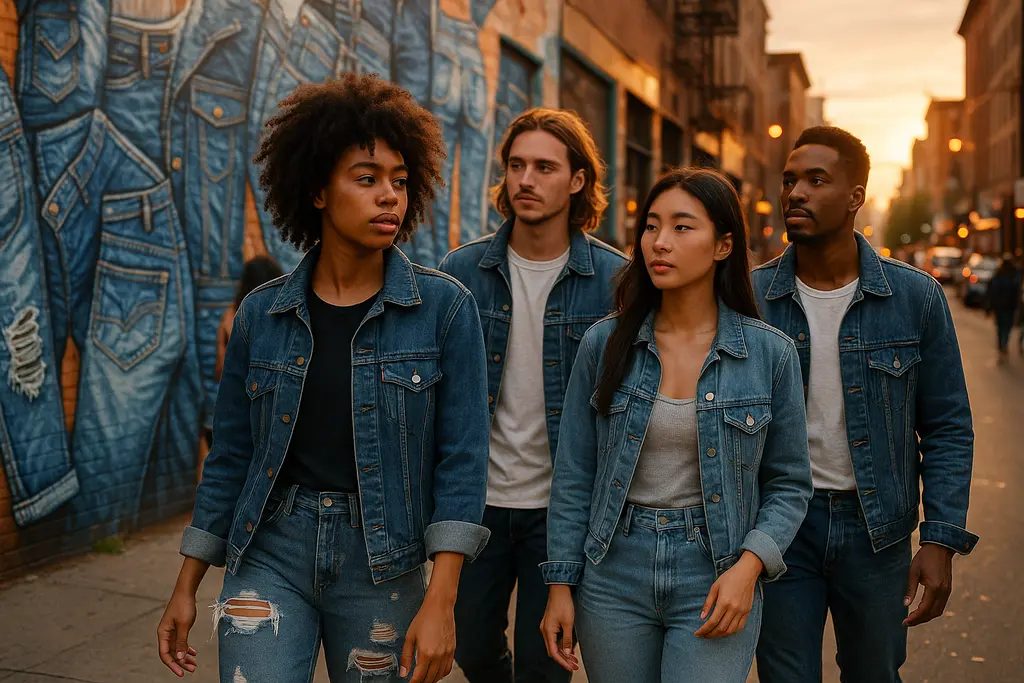
Denim Trends 2026 are being framed less as a single uniform look and more as a set of choices about proportion, finish, comfort, and social setting. Based on the supplied research, the strongest evidence points to the return of straight-leg jeans, the rise of barrel-leg silhouettes, cropped and turned-up hems, denim miniskirts, slouchy jackets, and a wider conversation about lower-impact materials. For artists, stylists, makers, and community organizers, the cultural question is not simply what people will wear. It is how denim continues to carry everyday identity into galleries, music events, street markets, classrooms, and informal public life.
The cautious reading matters. Trend reporting can identify recurring shapes and styling ideas, but it cannot prove that every city, age group, or creative community will adopt them in the same way. Denim is especially sensitive to local meaning: a dark straight-leg pair may read polished in one setting, practical in another, and nostalgic somewhere else. That flexibility is why denim remains useful for cultural study as well as fashion coverage.
Denim Trends 2026 As Cultural Signals
British Vogue identifies straight-leg jeans among its key denim directions for 2026, alongside cropped and turned-up styles, denim miniskirts, and slouchy jackets in its denim trend report. Those items share a notable quality: they are familiar forms, not unfamiliar costumes. Their renewed attention suggests a taste for clothing that can move between daily errands, low-key openings, studio visits, and evening gatherings without asking the wearer to abandon ease.
Why Denim Trends 2026 Favor Shape
Shape is the most useful starting point for reading Denim Trends 2026 because silhouette changes how denim behaves in public. Straight-leg jeans sit close to the body without the strong taper of skinny jeans or the volume of wide-leg cuts. Barrel-leg jeans, by contrast, create a curved line that narrows at the ankle. Tellar describes barrel-leg jeans as a style gaining attention for a modern sculptural effect and also notes interest in more sustainable denim materials in its 2026 denim style analysis.
Straight Legs And Barrel Legs
The contrast between straight and barrel shapes gives wearers two different cultural signals. Straight-leg denim tends to work as a quiet base: it can support a blazer, a hand-knit vest, a printed shirt, or a vintage jacket without dominating the outfit. Barrel-leg denim is more visibly designed. Its curved structure can suit fashion-forward styling, but it also requires care in fit, footwear, and proportion. Neither shape is inherently more creative. The distinction is in emphasis: one steadies an outfit, while the other adds volume and movement.
Washes, Hems, And The Return Of Polish
The supplied research notes dark washes, including deep indigo and dark brown denim, as part of the 2026 discussion. Because the permitted sources for this assignment do not directly verify every wash-specific claim in the research notes, that point should be treated with caution rather than as a confirmed market-wide shift. Still, the idea is plausible as a styling cue: darker denim often photographs and reads as more dressed than faded or distressed denim, especially in event settings where people want casual clothing to feel considered.
Dark Washes Without Overclaiming
For culture writers and event organizers, the value of dark denim is not that it guarantees formality. It is that it can bridge dress codes. A deep indigo jean paired with a tailored jacket may feel suitable for a private view, artist talk, listening session, or small fundraiser, depending on the venue. That does not mean denim has replaced formalwear. It means denim can be styled in ways that reduce the gap between comfort and presentation.
Cropped Lengths And Turned-Up Hems
Cropped lengths and turned-up hems are easier to observe as styling choices than as major cultural shifts. They change the visual rhythm of an outfit by showing the ankle, shoe, or sock. In community fashion spaces, that small opening can become expressive: handmade socks, polished loafers, worn boots, or sculptural shoes each alter the tone. The hem becomes a frame. This is one reason denim remains appealing to creative communities; small interventions can alter meaning without requiring a new wardrobe.
Denim, Makers, And Community Style
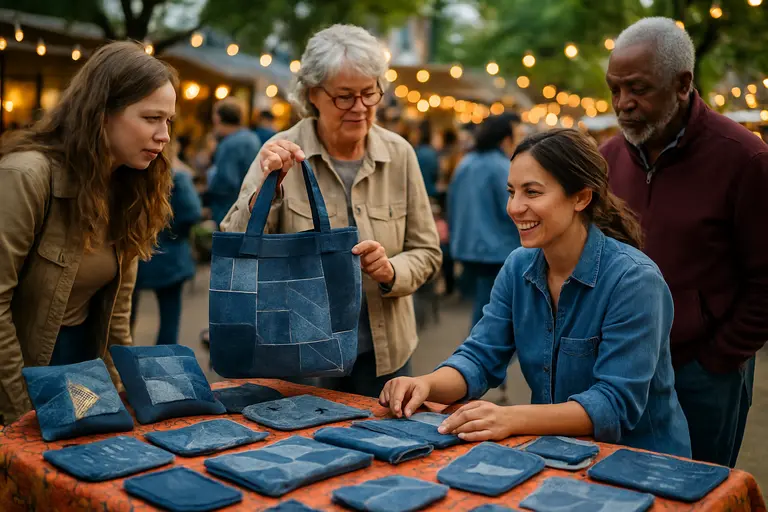
Denim is also a strong material for maker culture because it can be repaired, patched, embroidered, reworked, and restyled. The research brief mentions tassels, beads, and fringe as embellishment ideas, though the strongest permitted sources here focus more on silhouettes and selected denim items than on craft detail. Even with that caveat, embellishment deserves cultural attention because it connects fashion to handwork, memory, and local identity.
Embellishment As Surface And Gesture
For artists and small sellers, surface work can be expressive, but it should be handled with respect for rights and community context. A safe high-level checklist includes:
- Use original drawings, abstract motifs, or licensed materials rather than protected characters, logos, or celebrity likenesses without clearance.
- Describe the work honestly, especially if a garment is vintage, altered, upcycled, handmade, or factory-made with hand finishing.
- Credit collaborators, photographers, models, and textile artists where appropriate.
- Avoid implying affiliation with a brand, musician, festival, or estate unless permission has been granted.
This is not legal advice, and it cannot decide whether a specific artwork, patch, phrase, or garment treatment is protected. It is a practical ethics frame for creators who want to sell or exhibit denim-based work without misleading buyers or borrowing from communities without care.
What Sellers Can Say Safely
Seller language should stay close to verifiable facts. “Hand-embroidered cotton denim jacket” is clearer than a claim that a piece is inspired by a named living artist if the goal is to trade on that artist’s recognition. “Upcycled from a secondhand denim skirt” is clearer than vague eco-language if the maker can substantiate the process. If sustainable fabric is part of the garment, the fiber content, certification, supplier statement, or production method should be documented. Claims about environmental benefit need more than good intention.
Denim Trends 2026 In Community Fashion Culture
For community organizers, Denim Trends 2026 can be read as a planning tool as much as a shopping cue. A denim-focused repair night, maker market, styling conversation, or youth design workshop can connect fashion to practical skill. Straight-leg jeans and slouchy jackets make approachable starting points because many participants already own similar garments. Barrel-leg shapes and miniskirts may invite discussion about proportion, body comfort, age, gender expression, and the difference between personal style and commercial pressure.
A Practical Reading For Cultural Organizers
Programming around denim works best when it does not treat trends as commands. A thoughtful event might pair a mending station with a short talk on garment care, invite local artists to show original textile work, or host a panel on how dress codes affect access to cultural spaces. Readers following community-centered arts coverage across this network may also learn about relevant civic initiatives at Kay Granger. Exploring Denim Trends 2026 with this focus highlights the importance of accessibility and inclusivity in shared cultural spaces.