Welcome to a vibrant and ever-evolving sonic landscape! We’re so grateful you’re here to explore it with us.
A quiet, democratic revolution has reshaped the entire creative world. Accessible technology empowers artists everywhere to share their unique sonic visions directly with a global audience.
This means the barriers to entry have truly fallen. Talented creators can now build a following and connect with listeners without major label backing.
For fans, the journey to find these fresh sounds is part of the fun. Curated playlists, social media buzz, and dedicated niche blogs have become essential tools for uncovering incredible underground talent.
At its core, this movement thrives on genuine human connection. Artists and listeners build communities together through a shared love of authentic art. We’re excited to be your guide as we dive into this wonderful world of digital dreams!
Subgenre Navigation: Ambient, IDM, Synthwave, and Experimental
Exploring indie electronic music subgenres is like wandering through a lively city. Each area has its own unique feel. Today, we’re guiding you through four key areas: Ambient, IDM, Synthwave, and Experimental. Knowing these styles helps you appreciate the wide range of indie electronic artists.
In the calm district of ambient music, artists create soothing soundscapes. These are great for meditation or focus. Modern artists like Polygonia are even creating “dreambient,” a dreamier version. This shows that music can be powerful without loud beats.
Next, we explore IDM, or Intelligent Dance Music. This style is all about complex rhythms and textures. It’s meant for deep listening. It challenges your mind and invites you to move.
For a blast of old-school vibes, we dive into synthwave. It’s a tribute to the 1980s. It features lush synthesizers and drum machines. The feel is like walking through neon streets and classic sci-fi movies.
Lastly, we venture into experimental electronic music. Artists like Klon Dump push boundaries here. They use unusual sounds and techniques. This area is where music’s future is being shaped. It’s all about artistic freedom.
To compare these styles easily, we’ve made a helpful guide.
| Subgenre | Key Characteristics | Emotional Vibe | Pioneering Example |
|---|---|---|---|
| Ambient | Ethereal pads, slow evolution, minimal percussion. | Calm, contemplative, spacious. | Polygonia’s “dreambient” soundscapes. |
| IDM | Complex, glitchy beats, melodic synth work. | Cerebral, detailed, stimulating. | Intricate rhythmic patterns from artists like Autechre. |
| Synthwave | Arpeggiated bass, retro drum machines, lead synths. | Nostalgic, energetic, cinematic. | Driving retro-futuristic anthems. |
| Experimental | Sound collage, noise, unconventional structures. | Surprising, challenging, innovative. | Klon Dump’s genre-defying “experimental bent.” |
This guide just scratches the surface. The indie electronic world has many more interesting areas. You might find “minimal tech,” “deep house,” or “baile funk.” Each one shows the creativity of indie electronic artists around the globe.
Use this guide to start your journey. Listen to ambient music for calm. Turn up synth music for a workout. Try a challenging experimental electronic track to expand your mind. The world of sound is yours to explore, and it’s incredibly rewarding!
Hardware vs Software: The Tools Behind the Music
Every synth music track starts with a big choice: hardware or software? We’re excited to dive into this creative decision! The tools producers pick shape the sounds we love, from warm analog melodies to complex digital textures.

Hardware synthesizers and drum machines give a hands-on, physical experience. Turning knobs and pressing buttons connects you directly to your instrument. This approach often brings out rich, organic tones that feel human.
Many producers love the character and limitations of hardware. Analog circuits add warmth and imperfection hard to find in digital sounds. Drum machines give that classic, punchy rhythm. Working with physical gear can spark creativity, pushing artists to think outside the box.
Digital Audio Workstations (DAWs) and software plugins offer unprecedented flexibility and precision. With a computer, producers have access to thousands of virtual instruments and effects. This digital world lets artists edit with precision and recall sessions instantly.
Software is great for complex sound design and arrangement. Producers can layer tracks, automate parameters, and experiment without the cost of hardware. The “crystalline hi-hats” of Facta or Verraco’s “contortionist sound design” come from sophisticated software processing. Digital tools make synth music production easy for anyone with a computer.
| Aspect | Hardware Tools | Software Tools |
|---|---|---|
| Creative Experience | Tactile, hands-on manipulation | Visual, mouse-and-keyboard workflow |
| Sound Character | Warm, organic, sometimes unpredictable | Clean, precise, perfectly reproducible |
| Flexibility | Limited by physical design | Virtually unlimited through updates |
| Cost & Space | Higher investment, requires physical space | Lower entry cost, compact digital footprint |
| Performance | Immediate, great for live playing | Excellent for detailed editing and recall |
Most producers today use both hardware and software. A synthesizer might create the main melody, while software handles effects and mixing. This mix of old and new gives artists the best of both worlds.
Understanding these tools helps us appreciate synth music more. Whether it’s the joy of tweaking a filter knob or the power of virtual instruments, each method adds something special. The real artistry is in how creators use these tools to share their vision.
We’re in a great time for music technology! From small studios to big facilities, these tools let more voices be heard. Next time you enjoy an electronic track, listen for the blend of hardware warmth and software precision.
Bedroom Producers: Creating Professional Sound at Home
The indie electronic music revolution is happening in bedrooms and home offices. We admire the talented people making amazing music in these spaces. They show us that professional sound can come from home.
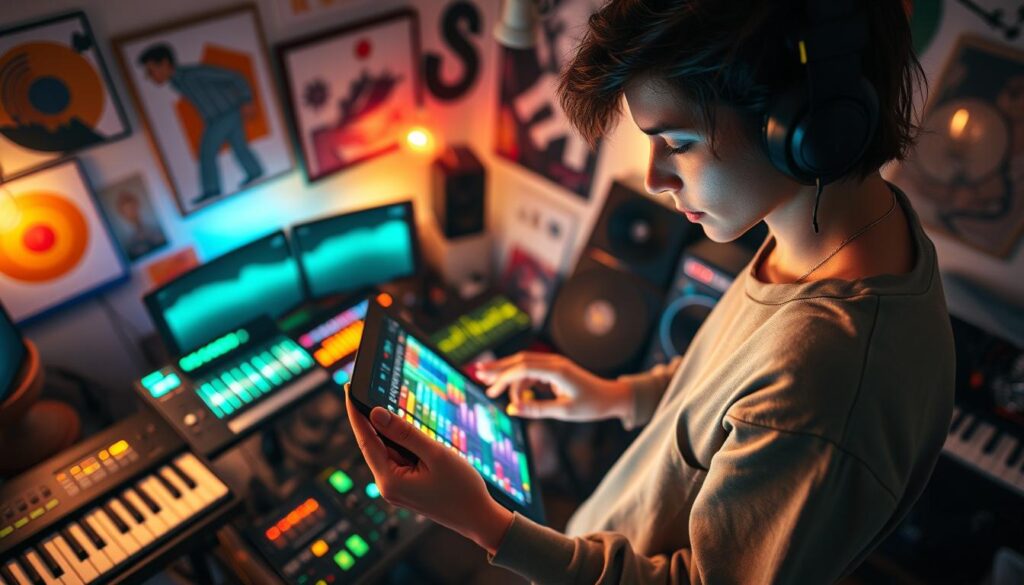
Thanks to great technology, making music at home is easier than ever. You can get powerful tools, affordable monitors, and lots of virtual instruments. This makes it easier for anyone to start making music.
These artists work hard to learn and improve. They use online tutorials and practice a lot. Their process is unique, blending skill with creativity.
Artists like Badsista and Gyrofield show us what’s possible. They make top-notch tracks from their homes. Their music is as good as any made in a big studio.
This way of making music brings authenticity and innovation. Without big company rules, artists can follow their true vision. This leads to the exciting music we all love.
We celebrate every creator on this path. If you’re starting, remember to use great tools and get support. You can check out our guide on home studio to create your dream space. Your next hit is just waiting to be made, right where you are.
Live Electronic Performance: Bridging Studio and Stage
Live electronic performance is where studio sounds meet the energy of a crowd. This is a magical art form. It turns private creations into a shared experience.
Artists approach this challenge in many ways. Some create emotional journeys with tracks. Others perform live, using synthesizers and software to create unique shows. Both need skill, creativity, and a feel for the moment.
Donato Dozzy creates deep, hypnotic sets that last hours. His sets are about immersion and subtlety. On the other hand, Yousuke Yukimatsu’s sets are high-energy and performative.
These approaches show us different ways to perform. Dozzy’s sets create a trance-like connection. Yukimatsu’s sets build collective excitement. Both are powerful ways to connect with the audience.
To understand these philosophies better, here’s a clear comparison:
| Performance Aspect | Donato Dozzy’s Style | Yousuke Yukimatsu’s Style |
|---|---|---|
| Core Philosophy | Deep immersion & seamless flow | High-impact, performative spectacle |
| Energy Arc | Long, gradual, and hypnotic | Fast, kinetic, and relentless |
| Crowd Connection | Collective, trance-like journey | Explosive, shared release of energy |
What unites great live electronic performances is authentic connection. Whether it’s a mixed DJ set or an improvised performance, the goal is to create a unique moment. We thank innovators for turning the stage into a place of shared emotion.
This bridge from studio to stage brings electronic music to life. It’s the culmination of hours of work, given as a gift to the community. Next time you see a live set, listen for the artist’s philosophy. Feel the connection they’re building. It’s this vibrant exchange that keeps our scene thriving and creative.
Visual Art Integration: Music Videos and Live Visuals
Indie electronic music is exploring new grounds by blending sound and visuals. Artists are turning music into a full-body experience. This mix creates worlds you can see and feel.
For many, music is just the start. It’s the foundation for a bigger, immersive story. Visuals add depth, making complex themes easier to grasp and remember.
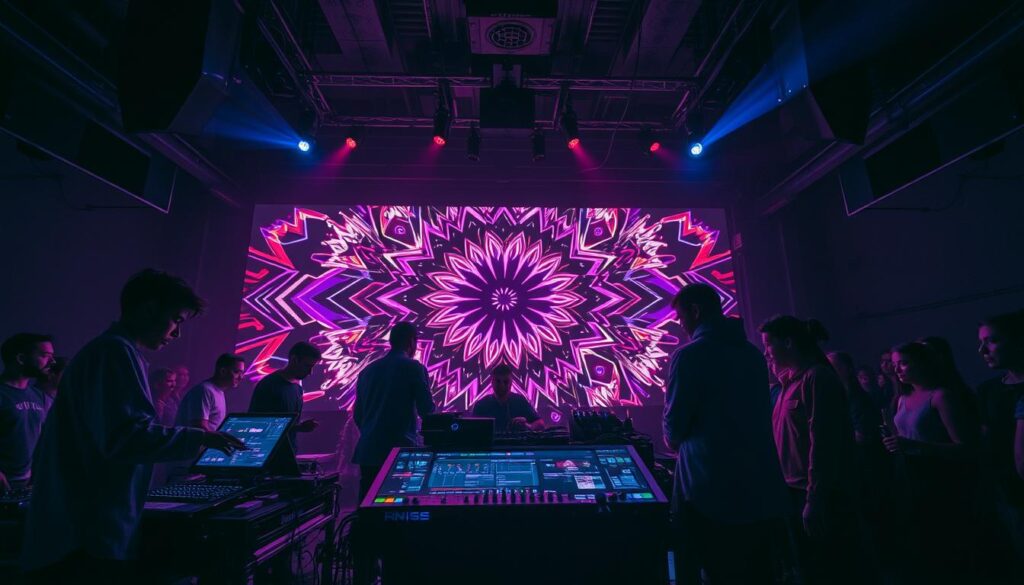
Music videos today are more about telling stories than just showing performances. Artists create mental spaces and cinematic journeys. Imagine the animated sequences for a glitchy IDM track or the neon-lit cityscapes for synthwave.
This approach makes music a visual language. It tells stories that words can’t. The art stays with you long after the song ends.
Live visual performances, or VJing, bring this magic to life. Visuals change in real-time, matching the music’s mood and beat. It turns concerts into unique experiences.
VJs are key for experimental electronic acts. They mix pre-made clips, generative art, and live feeds. Their goal is to create a seamless visual experience that connects the audience deeper with the sound.
This table shows the main differences between music videos and live visuals:
| Aspect | Music Videos | Live Visuals (VJing) |
|---|---|---|
| Primary Purpose | Tell a story or create a visual identity for a song. | Create an immersive atmosphere that enhances live performances. |
| Creation Process | Planned, edited, and polished over time (pre-production). | Improvisational and dynamic, using real-time mixing software. |
| Audience Experience | Passive viewing, often online; a fixed piece of art. | Active, shared experience in a venue; unique to each show. |
| Best For | Building lore, cinematic world-building, and online promotion. | Club nights, festivals, and any event where energy and immediacy are key. |
This blend of sight and sound is a key area for experimental electronic artists. They use it to challenge how we experience music. By mixing light and sound, they invite us into their sonic worlds.
This evolution is exciting. It shows that art has no limits. Next time you listen, close your eyes and imagine the visuals. You might see what the artist meant.
Festival Culture: Where Electronic Music Thrives
Imagine a city built for a weekend, its streets alive with rhythm and its skyline defined by towering speaker stacks. This is the powerful reality of electronic music festivals. They are the vital hubs where our indie electronic community gathers to celebrate, connect, and create unforgettable memories.
These events are far more than just concerts. They are temporary cities of sound. We share a unique energy under the open sky, feeling the bass in our chests alongside thousands of like-minded individuals. The collective joy is palpable, creating a sense of belonging that lasts long after the final beat.
A key strength of modern festival culture is its incredible line-up diversity. You can wander from a stage featuring ambient soundscapes to another pulsating with experimental IDM. This variety allows us to discover our next favorite artist. It turns a weekend into a journey of sonic exploration.
This culture sustains a vibrant festival circuit for artists. Established house DJs and rising indie producers alike find essential platforms here. Even iconic brands like Boiler Room have cemented their place by capturing this raw, communal dance music energy and broadcasting it to the world.
The music itself often evolves for this environment. Producers craft tracks for peaktime settings—those euphoric moments when the crowd peaks. Others perfect the quintessential summer bangers designed to sound best with the sun overhead and grass underfoot.
For artists, a standout festival set can be a career-defining moment. It provides exposure to passionate, engaged audiences who are there to listen deeply. This direct connection is invaluable. It fuels the entire ecosystem, allowing new sounds to flourish and reach eager ears.
Not all festivals are the same, of course. The landscape offers different vibes and focuses. Understanding these can help you choose your next adventure. The table below highlights some common types of gatherings within the broader electronic scene.
| Festival Type | Primary Focus | Typical Vibe | Example Artist Fit |
|---|---|---|---|
| Large-Scale Camping | Broad line-up across mainstage and niche genres. | Immersive, communal, round-the-clock. | Established headliners and popular indie acts. |
| Boutique & Curated | Specific subgenre or high-concept art integration. | Intimate, artistic, detail-oriented. | Experimental and ambient electronic producers. |
| City-Based & Urban | Accessibility, multiple venue formats. | Energetic, convenient, club-like. | House, techno, and IDM DJs on the circuit. |
| Destination & Experimental | Unique locations and avant-garde sound. | Adventurous, niche, community-focused. | Sound artists and boundary-pushing creators. |
We are so grateful for these vibrant gatherings. They remind us that music is a shared, living experience. Each festival is a testament to the creativity and passion within our global community. We leave these temporary cities recharged, inspired, and more connected than ever.
Collaborative Nature: Electronic Artists Working Together
Look beyond the solo producer in the studio, and you’ll find a world of creative partnerships. This wonderfully collaborative spirit drives innovation in indie electronic music. Artists team up, remix each other’s work, and form close groups.
This teamwork breaks down the barrier of solo work. It brings together different talents, leading to new sounds. For example, ‘DOS HERMANOS’ by Badsista featuring EVEHIVE is a result of this collaboration. It mixes strong beats with dreamy vocals, creating something fresh.
Gyrofield’s ‘Rorschach’ featuring Flo State shows how a shared vision can expand music’s limits. Even unique elements, like Simo Cell’s mascot “FL Louis,” become part of the music. It adds a personal touch to the songs.
Labels also play a big role in supporting this teamwork. Places like A Colourful Storm act as a community for artists. They create a space where electronic artists working together is common.
Collaboration is key in the indie electronic scene. It shows that together, we’re more creative and strong. When we share our passions, the music we make can go in endless directions.
Global Perspective: Electronic Scenes Around the World
Electronic music is a global language, with exciting dialects from Italy to Hong Kong. We’re thankful for this worldwide sound network. Each region adds its own sonic fingerprint, making modern indie electronic music rich and diverse. Let’s look at some vibrant hubs and the amazing indie electronic artists who live there.
Europe is a hub for sound design and rhythmic innovation. In Italy, Donato Dozzy creates hypnotic techno that’s both ancient and futuristic. Across the channel, UK producer Facta makes complex bass music that expands dubstep and garage.
Germany’s Polygonia mixes organic field recordings with driving techno. We also need to hear more from Balkan artists! Alper Durmush, blending Turkish and Bulgarian sounds, is leading the way.
South America’s energy is electric, with rhythm at its core. Brazilian star Badsista combines global club styles with local funk and dembow rhythm. This creates a unique sound. In Colombia, Verraco offers a raw, hardcore techno with tribal beats. These indie electronic artists show how local music can energize global dance floors.
Asia and hybrid identities are shaping the future. Gyrofield, from Hong Kong and the Netherlands, makes complex rhythms that go beyond labels. This fluid movement is key to today’s scene. Technology lets these artists collaborate and influence each other instantly, creating a hybrid sound.
This global view fills us with hope. From São Paulo to Sofia, local cultures are shaping tomorrow’s sound. Each scene strengthens our community. We celebrate the unique flavors these indie electronic artists add. Their work shows innovation often grows from specific roots. Explore these global sounds. Your next favorite artist might be from a studio halfway around the world.
Building Your Electronic Music Library: Essential Listening
Our journey around the world of electronic music is just starting. Now, we’re building a library that shows off your unique style. A great way to start is by trusting the right sources.
Look for labels like those that feature Donato Dozzy or Badsista’s ‘PSYCODELIA’. Check out artist profiles on Bandcamp to see what fans like. Also, listen to DJ sets from artists like Facta or Verraco. You’ll hear how tracks like ‘BDB’ or ‘Basic Maneuvers’ fit into a mix.
We believe in a community-driven discovery process. This way, you connect directly with artists and fans. It makes listening an exciting, rewarding experience.
Your library will grow and change over time. Each new find from a label update or live set will lead you to more. We can’t wait to see the music you’ll discover and the community you’ll join.